Visiblie Review 2026
Monitors how brands appear in AI-powered search responses across major LLMs. Offers side-by-side comparisons against competitors for tracking visibility improvements over time.
Key takeaways
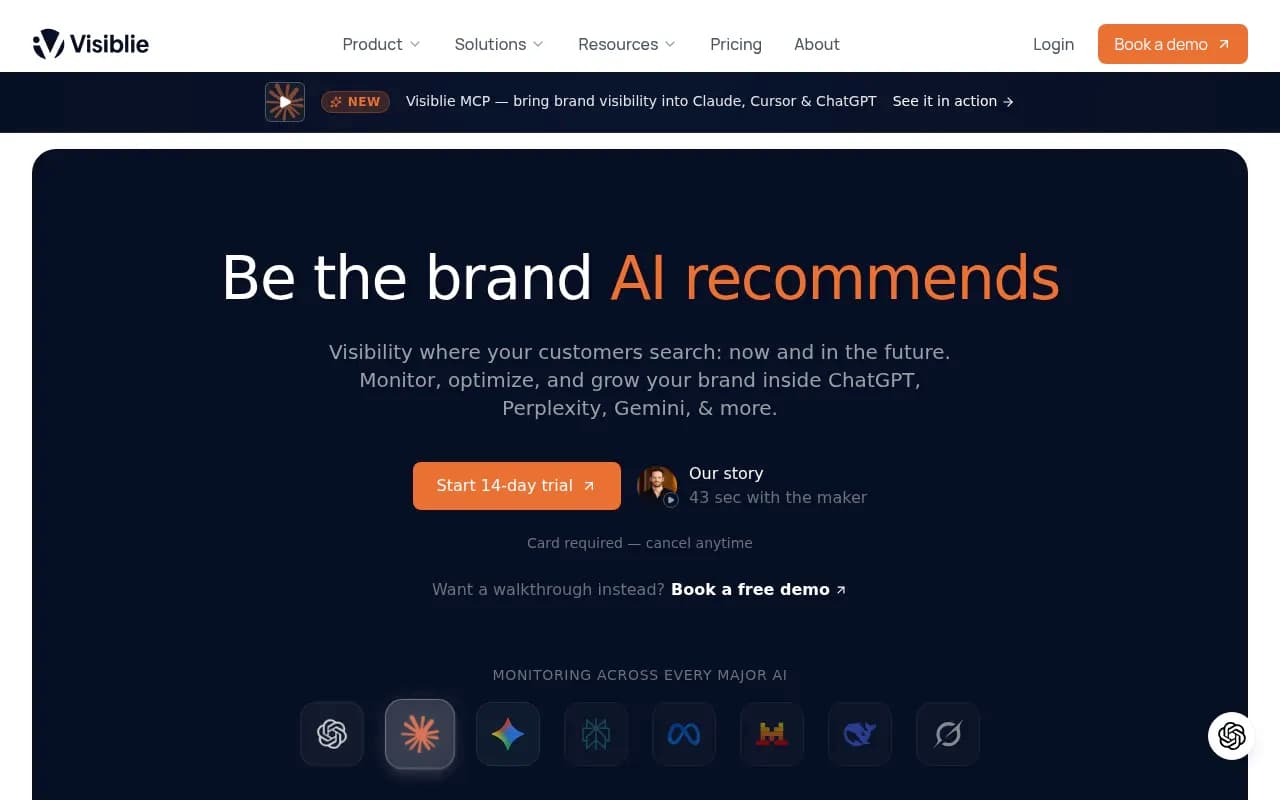
- Visiblie monitors brand mentions across 8 major AI models (ChatGPT, Claude, Gemini, Perplexity, Meta/Llama, Mistral, DeepSeek, Grok) from a single dashboard
- Compared to Promptwatch, Visiblie is primarily a monitoring tool -- it lacks content gap analysis, an AI writing agent, AI crawler logs, traffic attribution, Reddit/YouTube tracking, ChatGPT Shopping tracking, and prompt volume/difficulty scoring
- A standout differentiator is the Visiblie MCP (Model Context Protocol) integration, which brings brand visibility data directly into Claude, Cursor, and ChatGPT workflows
- Pricing starts at €79/month with a 14-day trial; a lifetime deal is also available for early adopters
- Best suited for small-to-mid-size marketing teams and brand managers who want a clean, accessible entry point into AI visibility monitoring
Visiblie is an AI search visibility platform built to help brands understand how they appear in responses from major large language models. The product was created by Gilles (the founder is visible on the homepage with a personal video), and the company positions itself squarely in the growing GEO (Generative Engine Optimization) space. The core pitch is straightforward: as more consumers use ChatGPT, Perplexity, and Gemini to discover products and services, brands need to know whether they're being recommended, how often, and how they compare to competitors.
The platform covers eight AI models at launch: OpenAI/ChatGPT, Claude, Gemini, Perplexity, Meta/Llama, Mistral, DeepSeek, and Grok. That's a solid spread for a relatively young product. The dashboard aggregates mention counts, visibility scores, and model-by-model rankings into one view, which is genuinely useful if you're managing brand presence across multiple AI platforms and don't want to manually query each one.
Notable clients listed on the site include PwC and HAYAH Insurance, which suggests the product has found some traction in enterprise and financial services sectors. The founder-led, bootstrapped feel of the product (personal video on the homepage, direct Calendly booking for demos) gives it a scrappy, early-stage energy that some buyers will find appealing and others may find less reassuring than a larger team.
Key features
Multi-model brand monitoring The core feature is tracking how often and in what context your brand gets mentioned across AI models. Visiblie queries each model with prompts relevant to your industry and brand, then logs whether your brand appears, where it ranks in the response, and how sentiment reads. The dashboard shows weekly mention counts per model (e.g., 42 mentions in ChatGPT, 31 in Perplexity) and a composite visibility score out of 100. You can see trends over time, which is the minimum viable feature for any brand monitoring tool in this space.
Competitor intelligence You can add competitors to track alongside your own brand. The platform shows how competitors rank in AI responses for the same prompts, giving you a side-by-side comparison. This is useful for understanding relative positioning -- if a competitor is consistently appearing in ChatGPT responses where you're absent, that's a signal worth acting on. The depth of this competitor data (how many competitors, how granular the prompt-level breakdown) isn't fully detailed in public-facing materials, which is a minor frustration.
Instant alerts Visiblie sends notifications when your brand gets mentioned in an AI response. The homepage shows a mock alert: "Mentioned in ChatGPT -- Just now." This kind of real-time alerting is genuinely useful for PR teams and brand managers who want to catch both positive and negative AI mentions quickly. The alert system appears to cover the major models, though the exact delivery mechanism (email, Slack, webhook) isn't spelled out in detail on the public site.
Visibility score and reporting The platform generates a visibility score (0-100) with a Poor/Average/Good/Excellent scale, plus automated reports delivered to your inbox. These reports include actionable recommendations like "Add FAQ schema to homepage," "Create comparison pages," and "Update descriptions with AI keywords." The recommendations are practical and SEO-adjacent, which makes sense given how AI models pull from structured web content. Whether these suggestions are dynamically generated based on your specific gaps or drawn from a fixed playbook isn't entirely clear.
AI-powered recommendations Beyond the score, Visiblie surfaces specific optimization suggestions. Examples from the site include adding structured data markup, mentioning competitors in content, and creating comparison pages. These are solid starting points for anyone new to AEO/GEO. The limitation here is that these appear to be general recommendations rather than content Visiblie actually generates for you -- there's no built-in writing agent or content creation tool.
Visiblie MCP (Model Context Protocol) This is the most interesting differentiator. Visiblie has built an MCP integration that brings brand visibility data directly into Claude, Cursor, and ChatGPT. In practice, this means you can query your brand's AI visibility data from within your existing AI workflow tools without switching to a separate dashboard. For developers and power users who live in Cursor or Claude, this is a genuinely clever integration. It's a relatively new feature (announced prominently on the homepage) and positions Visiblie ahead of most competitors in terms of workflow integration.
Unified dashboard All models, all metrics, one view. The dashboard shows model rankings, visibility score trends, weekly mention counts per model, and a recommendations panel. The UI appears clean and focused, which is appropriate for a product at this stage. There's no indication of advanced filtering, custom prompt sets, or granular segmentation -- the dashboard seems designed for clarity over depth.
Who is it for
Visiblie fits best for marketing managers and brand strategists at small-to-mid-size companies who are just starting to think about AI search visibility. If you're a SaaS founder who wants to know whether ChatGPT recommends your product when someone asks for tools in your category, Visiblie gives you that answer without requiring a large budget or technical setup. The 14-day trial and relatively accessible pricing (starting at €79/month) lower the barrier to entry considerably.
The PwC and HAYAH Insurance logos on the site suggest some enterprise adoption, but the product's current feature set feels more aligned with teams of 2-10 people than large enterprise marketing departments with complex reporting needs. An enterprise team managing 20+ brands across multiple regions would likely outgrow the platform quickly, particularly given the absence of features like AI traffic attribution, crawler log analysis, and custom prompt volume data.
Developers and technical users will find the MCP integration particularly compelling. If you're already using Cursor or Claude as part of your workflow, being able to pull brand visibility data directly into those tools is a meaningful time-saver. This persona -- the technical marketer or developer-founder who wants AI visibility data embedded in their existing tools -- is probably Visiblie's strongest fit.
Who should look elsewhere: agencies managing 10+ client brands, enterprise teams needing white-label reporting, or anyone who wants to go beyond monitoring into actual content optimization and gap analysis. The platform doesn't generate content, doesn't analyze which specific pages are being cited, and doesn't show you which prompts competitors rank for that you don't. For those use cases, you need a more complete platform.
Integrations and ecosystem
The headline integration is the Visiblie MCP, which connects the platform to Claude, Cursor, and ChatGPT via the Model Context Protocol. This is a relatively novel approach in the AI visibility space and gives Visiblie a workflow integration story that most competitors lack.
Beyond MCP, the public-facing site doesn't detail specific integrations with tools like Slack, Google Search Console, Zapier, or Looker Studio. The automated email reports suggest some form of scheduled delivery, but there's no mention of webhook support, API access, or third-party data export. This is a notable gap for teams that want to pipe visibility data into their existing analytics stack.
There's no mention of a mobile app. The platform appears to be web-based only. Browser extension support isn't referenced either.
For a product at this stage, the MCP integration is a smart bet -- it puts Visiblie's data where developers and AI-native users already work. But the broader integration ecosystem is thin compared to more established platforms.
Pricing and value
Visiblie's pricing starts at €79/month, with a 14-day trial that requires a card. The pricing page description mentions "Plans from €79/mo" for AI visibility monitoring across ChatGPT, Perplexity, Claude, and Google AI.
A lifetime deal is also available, described as "lock in lifetime access before we switch to subscription-only." This is a common early-stage SaaS strategy to generate upfront revenue and build a user base. The lifetime deal could be good value if the product matures, but carries the usual risk of a young platform.
Specific tier breakdowns (what you get at €79/mo vs higher tiers) aren't fully detailed in the scraped content, which makes direct comparison harder. The pricing is denominated in euros, suggesting a European base of operations.
For context: Promptwatch starts at $99/month for its Essential plan (1 site, 50 prompts, 5 articles) and goes up to $249/month for Professional and $579/month for Business. Otterly.AI and Peec.ai are in similar ranges. Visiblie's €79 entry point is competitive, though the feature set at that price is narrower than what you'd get from more established platforms.
The value proposition is reasonable for a brand manager who wants basic AI visibility monitoring without a large commitment. The lifetime deal is worth considering for early adopters who believe in the product's direction.
Strengths and limitations
What Visiblie does well:
- MCP integration is genuinely differentiated. No other AI visibility tool in this space currently offers native integration with Claude, Cursor, and ChatGPT via MCP. For developer-adjacent users, this is a real advantage.
- Multi-model coverage across 8 platforms (ChatGPT, Claude, Gemini, Perplexity, Meta, Mistral, DeepSeek, Grok) is solid for a product at this price point.
- Clean, accessible UX with a unified dashboard that doesn't overwhelm new users. The visibility score and weekly mention counts are easy to understand and act on.
- Instant alerts for brand mentions provide timely awareness that's useful for PR and brand management teams.
- Accessible entry price at €79/month makes it one of the more affordable options in the GEO monitoring space.
Where it falls short:
- Monitoring-only platform. Visiblie shows you where you stand but doesn't help you close the gap. There's no content gap analysis, no AI writing agent, and no way to generate content engineered to rank in AI responses. Platforms like Promptwatch include an AI writing agent that creates articles grounded in citation data -- Visiblie has nothing equivalent.
- No AI crawler logs. Visiblie doesn't show you which pages AI crawlers are visiting on your site, how often, or what errors they encounter. This is a significant blind spot for anyone trying to understand why certain pages aren't being cited.
- No traffic attribution. There's no way to connect AI visibility to actual website traffic or revenue. No Google Search Console integration, no code snippet for AI traffic tracking, no server log analysis. You can see mention counts but can't tie them to business outcomes.
- No Reddit or YouTube tracking. AI models frequently cite Reddit threads and YouTube content. Visiblie doesn't surface these sources, which means you're missing a key channel for understanding what's influencing AI recommendations.
- No prompt volume or difficulty data. You can't see how many people are asking a given prompt or how competitive it is to rank for. This makes it hard to prioritize which prompts to optimize for.
- No ChatGPT Shopping tracking. As ChatGPT's product recommendation and shopping features grow, this is an increasingly important channel -- and Visiblie doesn't cover it.
- Limited integration ecosystem. No API, no Zapier, no Slack, no Looker Studio. The MCP is clever but narrow.
Bottom line
Visiblie is a clean, accessible AI visibility monitoring tool that covers the basics well and has one genuinely clever differentiator in its MCP integration. For a small brand or solo founder who wants to start tracking AI mentions without a steep learning curve or a large budget, it's a reasonable starting point.
But it's a monitoring tool, not an optimization platform. If you want to understand why competitors are appearing in AI responses where you're not, generate content to close those gaps, track which pages AI crawlers are actually reading, or connect AI visibility to real traffic and revenue, you'll need something more complete. Promptwatch covers all of those use cases and is the stronger choice for any team serious about improving -- not just measuring -- their AI search presence.
Best use case: A brand manager at a mid-size company who wants a simple dashboard to track AI mentions across major LLMs and get basic optimization recommendations, without needing deep analytics or content generation capabilities.
Frequently asked questions
What is Visiblie?
How much does Visiblie cost?
What makes Visiblie different from other AI visibility tools?
Does Visiblie help with content creation or just monitoring?
Which AI models does Visiblie track?
Is Visiblie suitable for agencies managing multiple clients?
Similar and alternative tools to Visiblie