Key takeaways
- Adobe LLM Optimizer has been sold as Adobe Brand Visibility since July 31, 2026. It is sales-led, with no published price and no self-serve checkout.
- Its biggest strengths (CDN-edge deployment, attribution through Adobe Analytics and Customer Journey Analytics) lose value if you don't use Adobe Experience Cloud.
- Alternatives split into three groups: lightweight monitors, enterprise platforms, and platforms that also help you fix visibility problems.
- Most "alternatives" articles online are written by the vendors ranking themselves first. Treat prices and claims as leads to verify, not facts.
- Pick a tool by testing it on your own prompts for two weeks, not by reading a feature grid.
What changed: Adobe LLM Optimizer is now Adobe Brand Visibility
If you searched for "Adobe LLM Optimizer alternatives", you may be reading dated material. Per LLM Pulse's write-up and Dageno's update, Adobe replaced LLM Optimizer with Adobe Brand Visibility for new sales on July 31, 2026. Existing customers continue to get support during the transition. Adobe's Brand Visibility page is the source of truth for naming and availability.
So the real question is: what do you buy if you want what Adobe sells but you aren't an Adobe shop?
What Adobe actually sells
From Adobe's own page, the product covers:
- Tracking across ChatGPT, Claude, Perplexity, Google AI Mode, Microsoft Copilot and more
- Prompt data Adobe says spans nearly 300 million AI search prompts, enriched with clickstream data
- Crawl visibility, showing how AI systems read your site
- Fixes shipped at the CDN edge and content source (blocked crawlers, missing structured data, 404s), with rollback
- Content generation aimed at Wikipedia, YouTube, Reddit and earned media
- Revenue attribution through Adobe Analytics and Customer Journey Analytics
That last item is the catch. Attribution is tied to Adobe's analytics stack. If you run GA4, Mixpanel or something else, you lose the piece that justified the enterprise price in the first place.
What it costs (nobody knows exactly)
Adobe doesn't publish pricing. Third parties disagree wildly. LLM Pulse reports teams being quoted around EUR 60 per tracked prompt per year with a 1,000-prompt minimum, which puts the floor near EUR 60,000 annually. SEORCE cites roughly $115,000 per year. Alice Labs lists USD 1,299 to 2,499 per month, which is its own estimate. None of these are official. Get a quote if you care, but don't anchor on any single number.
Why teams without Adobe Experience Cloud look elsewhere
- Annual contracts and a sales process, with no monthly billing
- Attribution that depends on Adobe Analytics
- A one-click workflow built most directly for Adobe Experience Manager
- A high minimum spend before you've proven GEO works for your business
The fair counterpoint: if you do run AEM and Adobe Analytics, and you have a six-figure budget, Adobe's integration is a real advantage. Nobody else can ship edge-level changes through your Adobe stack. This guide is for everyone else.
One more thing worth flagging. Semrush is described by Adobe as an Adobe company, yet shows up as an "alternative" in some lists. It's a fine product, but it isn't independent of Adobe.
What to look for in an alternative
Two things from Promptwatch Data should shape your shortlist.
You need per-engine tracking. In the Sep 28 to Oct 4, 2026 window, ChatGPT drew only 0.46% of its citations from social platforms, while Google AI Overviews drew 12.2%. Perplexity sat at 2.7%. A tool that blends engines into one score will hide that. If your strategy depends on Reddit or YouTube, the engine you track matters enormously.
You need to see who is cited next to you. In the same period, 47.6% of ChatGPT responses with citations cited 10 or more unique domains, and 52.5% for organic prompts with no brand named. You're rarely alone in an answer. A tool should show co-cited competitors and let you track a broad prompt set, not 20 hand-picked prompts.
Beyond that: whether it shows crawler activity, whether it tells you what to do next, and whether you can try it without talking to sales.
Comparison table
Prices below come from vendor or third-party articles and were not all re-verified. Confirm on each vendor's pricing page.
| Tool | Best for | Approach | Reported starting price | Main trade-off |
|---|---|---|---|---|
| Promptwatch | Teams that want monitoring plus execution | Tracking, crawler logs, content agent, action list | $95/mo (free tier available) | More than a pure monitor if you only want dashboards |
| LLM Pulse | Teams wanting simple tracking, unlimited seats | Monitoring | Check vendor | Vendor-written comparison ranks itself first |
| AthenaHQ | Data-driven teams | Prompt volume estimates, Action Center | About $295/mo (per LLM Pulse) | Verify price directly |
| Dageno AI | Focused GEO workflow | Monitoring to content actions | Free plan | Not an Adobe-style stack |
| Profound | Large brands with dedicated teams | Enterprise analytics | Sales-led | Heavier buying process |
| Otterly.AI | Lean teams starting out | Prompt, mention and citation tracking | Check vendor | Limited workflow and attribution |
| SEORCE | SEO plus AI visibility in one | Unified SEO suite | Free; paid from $79/mo | No CDN-layer delivery |
| Writesonic | Content-led teams | Content plus GEO analysis | Check vendor | Check plan limits |
The alternatives, in more detail
Promptwatch
Promptwatch is the one I'd test first if your problem is "we know we're invisible, now what?" Adobe's pitch is fixing things, not just watching them, and Promptwatch is the closest match to that idea without the Adobe stack. It tracks the real interfaces of ChatGPT, Google AI Overviews, AI Mode, Gemini, Perplexity, Copilot and others, shows IP-verified AI crawler logs (so you see which bots hit your pages and where they hit errors), and has an Action Board plus a Content Agent that plans, writes and publishes to WordPress, Webflow or Framer. Visitor analytics tie AI traffic to your site, which covers part of what Adobe's attribution does without requiring Adobe Analytics.

Plans start with a free Explore tier (10 prompts, ChatGPT only), then Essential at $95/mo, Professional at $245/mo and Business at $579/mo, with a 7-day trial on monthly plans. Confirm at promptwatch.com/pricing. The honest downside: if all you want is a cheap weekly visibility check, it's more tool than you need.
LLM Pulse
LLM Pulse positions itself directly against Adobe: transparent pricing, unlimited seats, no ecosystem lock-in. It's a monitoring-first product. Remember that the comparison article that ranks it first is its own.
AthenaHQ
AthenaHQ covers 8+ AI engines and offers prompt volume estimation and an Action Center with recommendations. The $295/mo figure comes from a competitor's article, so check the vendor page. Note that the catalog has two similarly named entries; the visibility product is Athena HQ at athenahq.ai.
Profound
Profound is the enterprise-tier option for large brands with a dedicated AI visibility team. Expect a sales-led process, which is the thing some people are trying to escape. If you want a like-for-like swap for Adobe's buying experience, this is closest.

Dageno AI
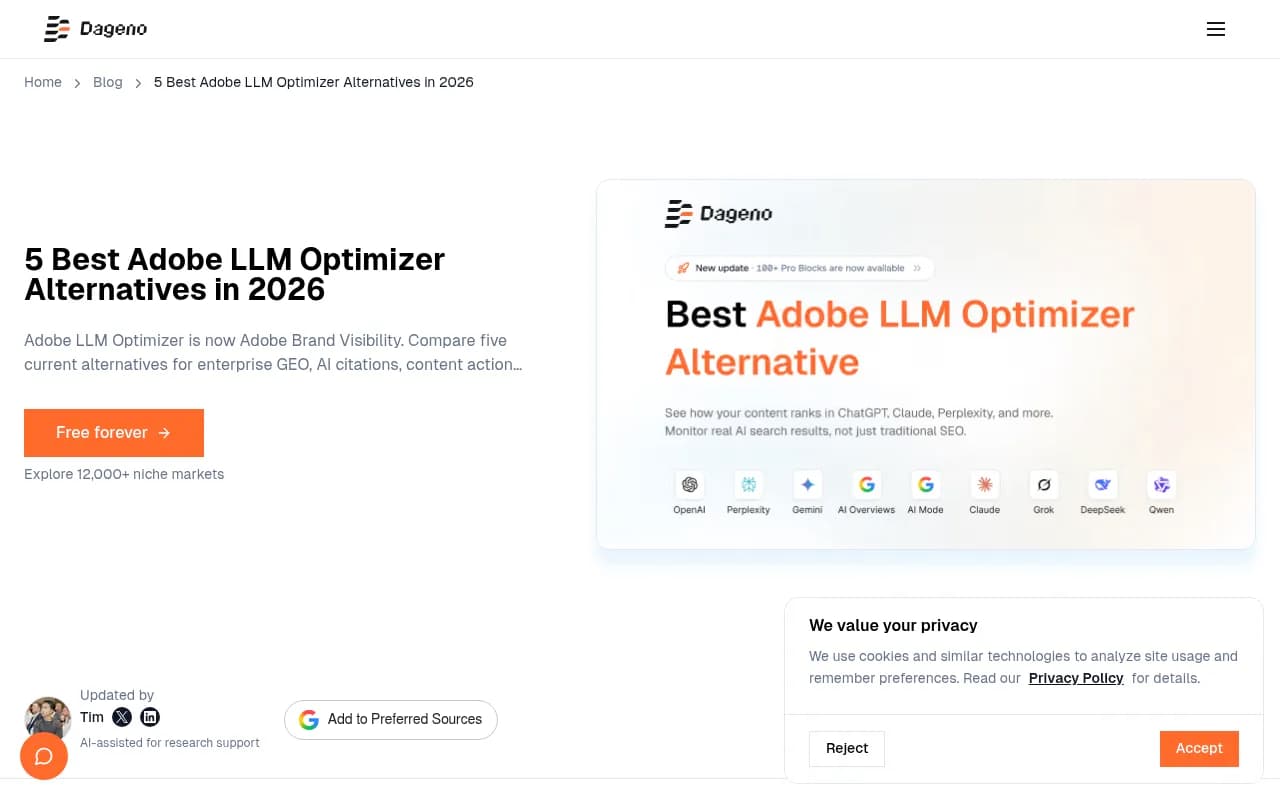
Dageno has a free plan and connects monitoring, gap analysis, content actions and outcome tracking. Good for proving a GEO use case before committing budget. It's also the author of one of the comparison articles, so weigh accordingly.
Otterly.AI
Otterly is the lean option: prompt, mention and citation tracking at an accessible price. Alice Labs calls it a defensible mid-market choice for European teams wanting something lighter than Adobe. You give up enterprise workflow, governance and attribution.

Semrush
If your team already lives in Semrush, adding its AI visibility module consolidates tools. Remember the Adobe ownership point, and that GEO is one module inside a big suite.
Writesonic
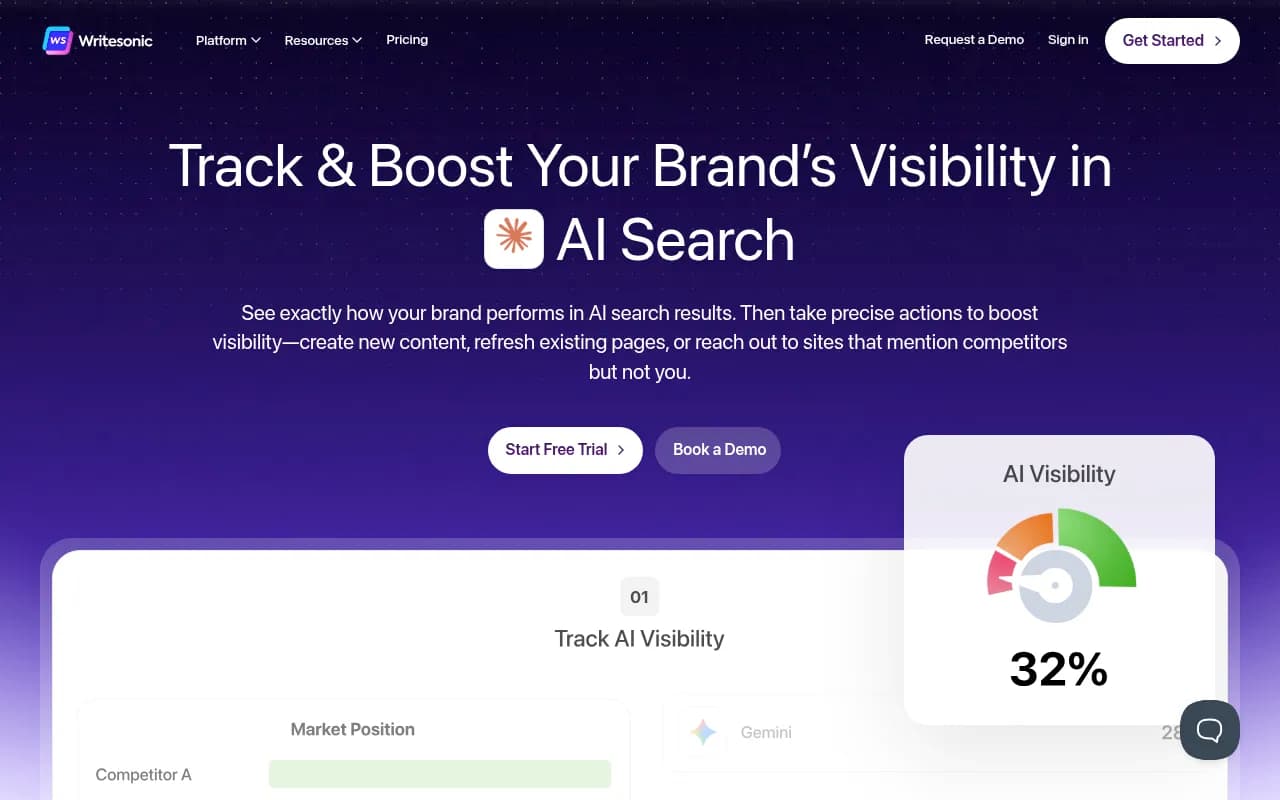
Writesonic suits content-led teams that want content production and GEO analysis in one place. Check plan allowances and analytics depth before you commit.
SEORCE
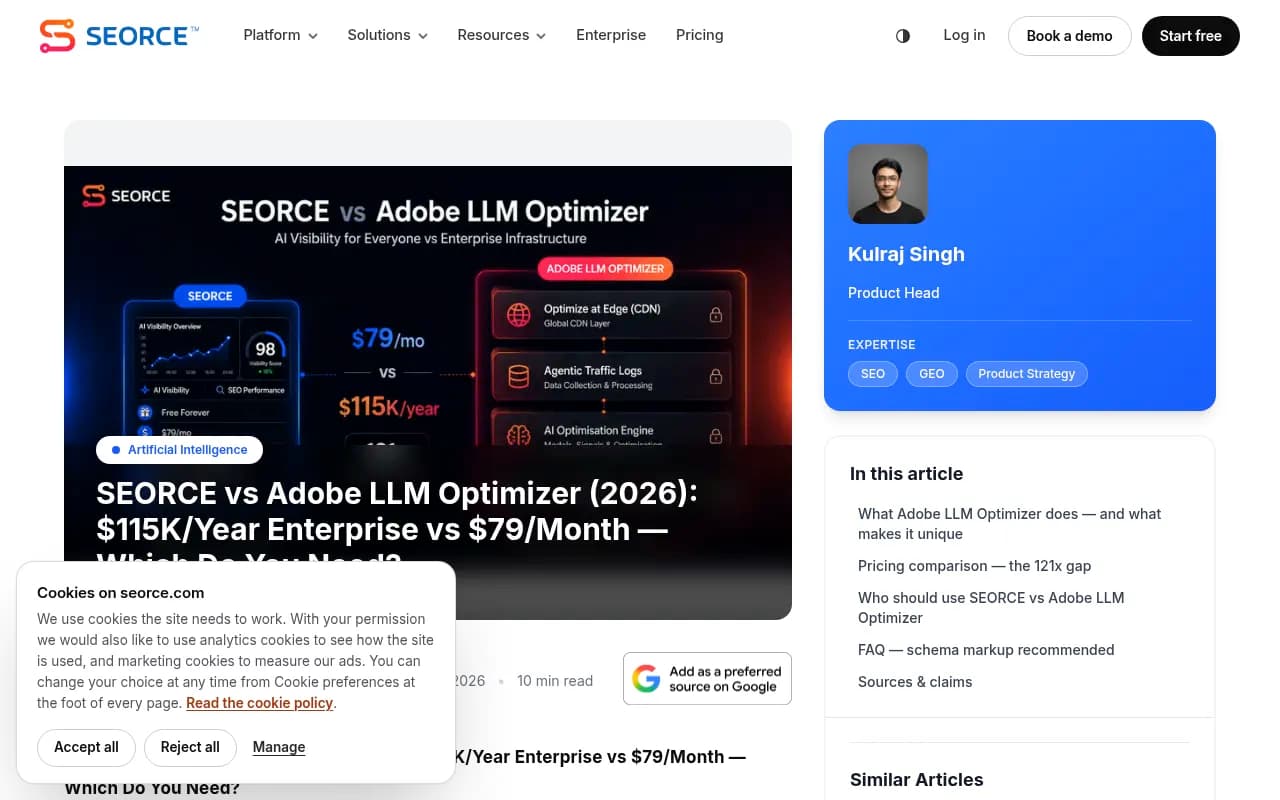
SEORCE says it is free forever with AI monitoring included, paid from $79/month. Its own comparison admits what it lacks: CDN-layer content delivery, one-click optimization and direct CDN log integration for agentic traffic. That candor is useful. Its Adobe price figure of about $115K per year is its own claim.
Which one for which team
| Your situation | Start here |
|---|---|
| Want monitoring plus content and crawler data, no Adobe | Promptwatch |
| Just need basic tracking on a budget | Otterly.AI or LLM Pulse |
| Enterprise buying process, big team | Profound |
| Already deep in an SEO suite | Semrush or SEORCE |
| Content-first team | Writesonic |
| Want to test GEO with no spend | Promptwatch free tier, Dageno free plan, SEORCE free plan |
If you want to browse more options, the GEO software directory at bestgeosoftware.com lists many more tools.
How to run a fair two-week trial
- Pick 50 prompts: a mix of organic category questions, brand-specific ones and competitor comparisons. Brand-specific prompts behave differently; Promptwatch Data shows they cite far fewer domains than organic ones.
- Load the same list into two or three tools.
- Compare the answers each tool reports against what you see by hand in ChatGPT and AI Overviews.
- Check whether it tells you why you're missing: crawler errors, thin pages, no third-party mentions.
- Ask what happens after the report. Does it hand you a to-do list, or just a chart?
- Check export, seats and contract terms before you sign anything annual.
What about the edge-deployment piece?
None of the independent alternatives replicate Adobe's CDN-layer deployment with rollback. If that is the deciding feature, you either buy Adobe or you fix the same problems the slow way: allow AI crawlers in robots.txt, add structured data, repair 404s, publish content that fills gaps. That's less glamorous and it works. Crawler logs tell you which of those is actually blocking you.
The bottom line
If you run Adobe Experience Cloud and have budget, get a Brand Visibility quote. If you don't, you're paying for integrations you can't use. Start with a free tier, test on your own prompts, and choose the tool that tells you what to do next rather than just how you scored.
If you'd rather hand the strategy to people, 1001 SEO Media runs GEO and AI search work for brands as a service and uses Promptwatch for its own tracking.