GetMint Review 2026
GetMint is an end-to-end Generative Engine Optimization (GEO) platform that helps brands track, analyze, and improve their presence in AI-powered search results across ChatGPT, Claude, Gemini, Perplexity, and other major LLMs. Trusted by 200+ brands and agencies, it combines monitoring, content gap
Summary
- GetMint is a monitoring-only GEO platform that tracks brand mentions across AI search engines but lacks the content generation, AI crawler logs, and traffic attribution capabilities that Promptwatch offers
- Strong multi-LLM coverage (ChatGPT, Claude, Gemini, Perplexity, Grok, Google AI Overviews) with persona-based tracking and market segmentation
- Includes a unique media distribution network (150K+ partner outlets) to influence AI training sources, though effectiveness is unproven
- Pricing starts at €99/mo but lacks transparency on prompt limits and feature restrictions per tier
- Best for brands wanting basic AI visibility dashboards; teams needing optimization tools should consider platforms with content generation and gap analysis like Promptwatch

GetMint positions itself as "the first platform for Generative Engine Optimization" -- a bold claim in a market that's rapidly filling with competitors. The French company (they use euro pricing) has attracted 200+ brands including Pretto, Jow, and Bulldozer agency, plus press coverage from TechCrunch and other outlets. Their pitch: AI search is the new gatekeeper of discovery, and if you're invisible in AI answers, competitors are capturing customers you'll never reach. Fair point. But does GetMint actually help you fix that invisibility, or just show you the problem?
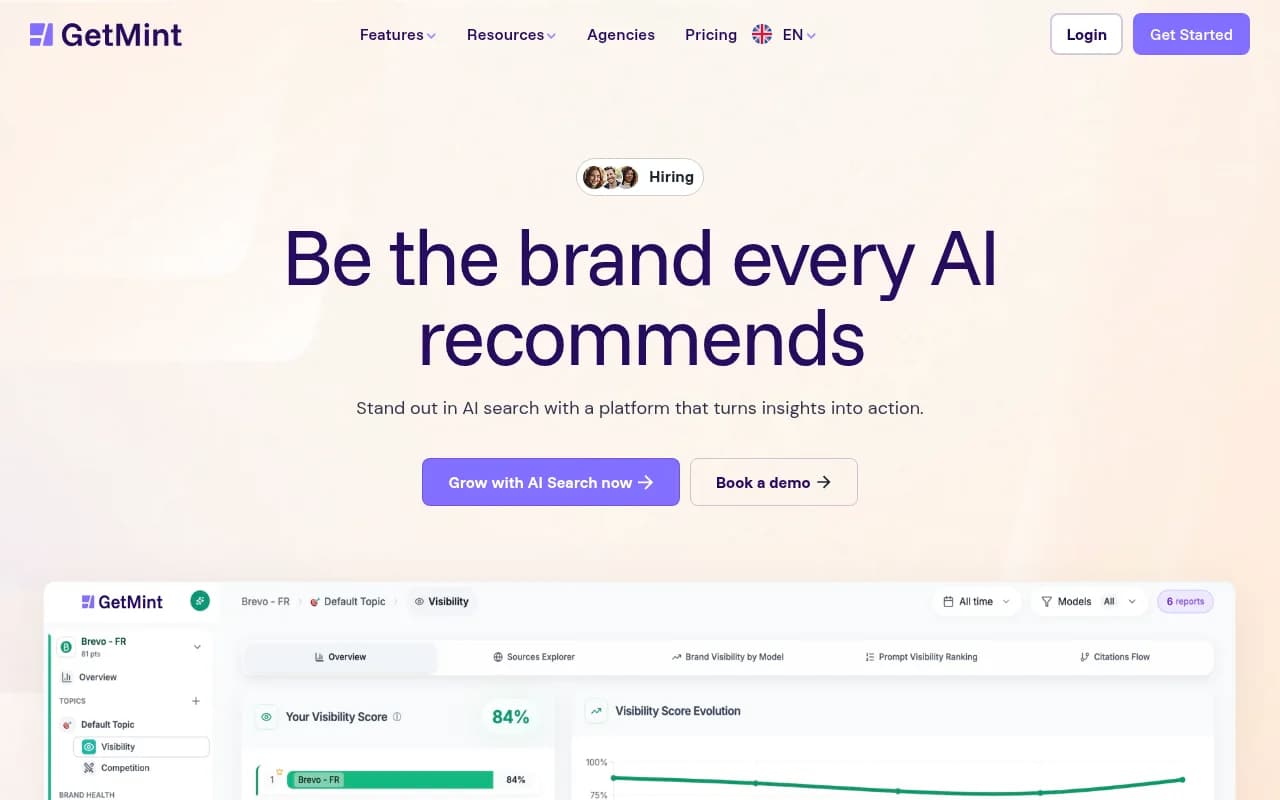
The platform monitors how your brand appears across major AI models -- ChatGPT, Claude, Gemini, Perplexity, Grok, and Google AI Overviews. You define core topics and prompts, GetMint tracks where you show up (or don't), and you get dashboards showing visibility by market, product, and persona. The interface looks clean from the screenshots: heatmaps comparing you to competitors, citation tracking showing which sources AI models reference, and breakdowns by LLM to see if Claude loves you but ChatGPT ignores you.
What GetMint Actually Does
The core workflow is Define → Analyze → Improve. You start by setting up topics and prompts relevant to your business. GetMint then runs those prompts across AI models and tracks whether your brand gets mentioned, how often, and in what context. The dashboards show visibility scores, competitor comparisons, and which sources (your site, third-party articles, Reddit threads) are being cited.
The "Improve" step is where things get interesting but also vague. GetMint claims to help you "act on insights like content gap to boost mentions by refreshing existing content and creating new AI-ready assets." They also offer a media distribution network -- 150K+ partner outlets where you can publish content that might influence what AI models see. This is a unique angle. Most GEO tools stop at monitoring. GetMint is betting that if you can place content in the right external sources, you'll shape how AI models perceive your brand.
But here's what's missing: there's no AI content generation engine. No writing assistant that drafts articles based on citation data. No automated gap analysis that tells you "here are the 47 prompts your competitors rank for but you don't, and here's the content you need to create." GetMint shows you the gaps -- you have to fill them yourself. Compare that to Promptwatch, which not only identifies content gaps through Answer Gap Analysis but also includes an AI writing agent that generates articles, listicles, and comparisons grounded in 880M+ citations. Promptwatch closes the loop: find gaps, create content, track results. GetMint stops after step one.
Multi-LLM Tracking and Persona Targeting
GetMint covers six major AI models, which is solid but not comprehensive. Promptwatch monitors 10+ models including Meta AI, DeepSeek, Mistral, and Copilot. The persona-based tracking is a nice touch -- you can simulate prompts from different user types (B2B buyer, consumer, technical evaluator) to see how AI answers vary by audience. This matters because ChatGPT might recommend your product to developers but ignore you when a marketer asks the same question.
Market segmentation lets you track visibility by geography, though it's unclear how many regions are supported or whether you can drill down to city-level like Promptwatch's state/city tracking. The competitor heatmaps are useful for benchmarking -- you can see at a glance which rivals dominate specific prompts and which LLMs favor them.
The Media Distribution Angle
This is GetMint's differentiator. They've built a network of 150K+ partner media outlets where you can publish content. The theory: AI models train on web content, so if you place articles in high-authority sources that AI crawlers read, you influence what those models "know" about your brand. It's a smart play, but also unproven. How do you know which outlets actually get crawled by ChatGPT or Claude? How long does it take for new content to show up in AI responses? GetMint doesn't provide crawler logs or indexing data to answer these questions.
Promptwatch, by contrast, offers real-time AI crawler logs showing exactly when ChatGPT, Claude, Perplexity, and other bots hit your website, which pages they read, and any errors they encounter. You can see if AI models are even discovering your content in the first place. Without that visibility, you're publishing into a black box and hoping it works.
Content Optimization: Vague Promises
GetMint's site mentions "content optimization credits" in the pricing tiers but doesn't explain what that means. Do you get AI-generated content? Editing suggestions? SEO analysis? The lack of detail is frustrating. The testimonials praise GetMint for "actionable insights" and "clear dashboards," but none mention actually creating content or seeing visibility improvements from specific actions.
This is where the monitoring-only limitation becomes obvious. Knowing you're invisible for 200 prompts is useful. But if the platform doesn't help you write the content to fix that invisibility, you're stuck doing manual research and writing -- the same workflow you'd have without GetMint. Promptwatch's AI writing agent generates full articles based on citation data, prompt volumes, and competitor analysis. It's content engineered to get cited by AI models, not generic SEO filler.
Pricing: Opaque and Potentially Expensive
GetMint lists three tiers on their site: €99/mo (Starter), €299/mo (Growth), €549/mo (Enterprise). But the details are sparse. How many prompts can you track per tier? How many brands or URLs? What are the "content optimization credits" and how many do you get? The site doesn't say. You have to book a demo to find out, which is a red flag for transparency.
For comparison, Promptwatch's pricing is fully public: Essential $99/mo (1 site, 50 prompts, 5 AI-generated articles), Professional $249/mo (2 sites, 150 prompts, 15 articles, crawler logs, state/city tracking), Business $579/mo (5 sites, 350 prompts, 30 articles). You know exactly what you're getting before you talk to sales.
GetMint's €549/mo Enterprise tier likely includes more prompts and seats, but without published limits, it's hard to evaluate value. If you're an agency managing 10 clients, can you track all of them on one plan? Or do you need separate subscriptions per brand? These are basic questions the site should answer.
Who Should Use GetMint
GetMint makes sense for brands that want basic AI visibility dashboards and are willing to handle content creation themselves. If you have a content team that can act on insights quickly, and you're comfortable with a monitoring-only tool, GetMint gives you the data you need. The media distribution network is a bonus if you have budget to publish externally.
It's less suitable for teams that need end-to-end optimization. If you're a lean marketing team at a SaaS company or an agency managing multiple clients, you need tools that not only show you the problem but help you solve it. That means content gap analysis, AI-generated articles, crawler logs to verify indexing, and traffic attribution to prove ROI. GetMint doesn't offer any of that.
Strengths
Multi-LLM coverage: Tracks six major AI models including ChatGPT, Claude, Gemini, Perplexity, Grok, and Google AI Overviews. Persona-based tracking lets you simulate different user types.
Competitor benchmarking: Heatmaps and visibility scores show how you stack up against rivals across prompts and LLMs. Useful for identifying where competitors dominate.
Media distribution network: 150K+ partner outlets for publishing content that might influence AI training data. Unique angle, though effectiveness is unproven without crawler logs.
Clean dashboards: User testimonials consistently praise the interface for being simple and actionable. No learning curve.
Limitations
No content generation: GetMint identifies gaps but doesn't help you create content to fill them. You're on your own for writing articles, optimizing pages, or generating AI-ready assets. Promptwatch includes an AI writing agent that generates full articles based on citation data and prompt analysis.
No AI crawler logs: You can't see when ChatGPT, Claude, or other bots crawl your site, which pages they read, or if they encounter errors. Without this, you don't know if AI models are even discovering your content. Promptwatch provides real-time crawler logs.
No traffic attribution: GetMint doesn't track whether AI visibility translates to actual website visits or conversions. Promptwatch offers traffic attribution via code snippet, Google Search Console integration, or server log analysis.
Opaque pricing: The site lists three tiers but doesn't specify prompt limits, brand limits, or what "content optimization credits" include. You have to book a demo to get details.
Limited model coverage: Six AI models is decent but not comprehensive. Promptwatch monitors 10+ including Meta AI, DeepSeek, Mistral, and Copilot.
No Reddit or YouTube tracking: These platforms heavily influence AI recommendations, but GetMint doesn't surface relevant discussions or videos. Promptwatch includes Reddit and YouTube insights.
No ChatGPT Shopping tracking: If your brand sells products, you can't monitor when you appear in ChatGPT's shopping recommendations. Promptwatch tracks this.
Bottom Line
GetMint is a solid monitoring dashboard for brands that want to track AI visibility across major LLMs. The interface is clean, the competitor benchmarking is useful, and the media distribution network is a creative differentiator. But it's a monitoring-only tool. If you need help actually improving your AI visibility -- content gap analysis, AI-generated articles, crawler logs, traffic attribution -- you'll hit a wall. For teams that want optimization, not just dashboards, Promptwatch is the stronger choice. It shows you the gaps, helps you create content to fill them, and tracks the results end-to-end. GetMint shows you the problem and leaves you to solve it yourself.
Similar and alternative tools to GetMint