Key takeaways
- Beauty buyers now ask ChatGPT, Perplexity, Gemini and Google AI Overviews for "best retinol for beginners" and "best vitamin C serum" before they ever open a retailer site, so being named in those answers is a real revenue question.
- 5WPR's Beauty AI Visibility Index 2026 puts The Ordinary (7.0% estimated citation share) and CeraVe (6.0%) at the top. Ingredient transparency and dermatologist credentials drive citations more than heritage or celebrity marketing.
- Monitoring-only tools tell you whether you were mentioned. Beauty brands also need to know why a competitor wins, which pages get cited, and what to publish next.
- Our shortlist: Promptwatch for the full loop of tracking, content and attribution, Profound and Scrunch for enterprise monitoring, and Otterly.AI, Peec AI and LLM Pulse as lighter trackers.
- Product pages and landing pages together earn about 39% of ChatGPT citations, so your own catalog pages matter more than you might expect.
Why beauty is a special case in AI search
Most AI visibility guides are written for B2B software. Beauty works differently, and that changes which platform you should buy.
Buyers ask concern-led questions: acne, dark spots, sensitive skin, olive-toned foundation. AI engines answer with a short list of brands and often a suggested routine. If you are not on the list, the shopper never sees you. Nobody scrolls to page two of a ChatGPT answer.
The numbers in the 5WPR Beauty AI Visibility Index 2026 show how concentrated this is. 5WPR ran 80+ buyer-intent prompts through ChatGPT, Claude, Perplexity, Gemini and Google AI Overviews in Q1 2026 and ranked brands by citation share. These are estimates from one agency's methodology, so treat them as directional rather than exact.
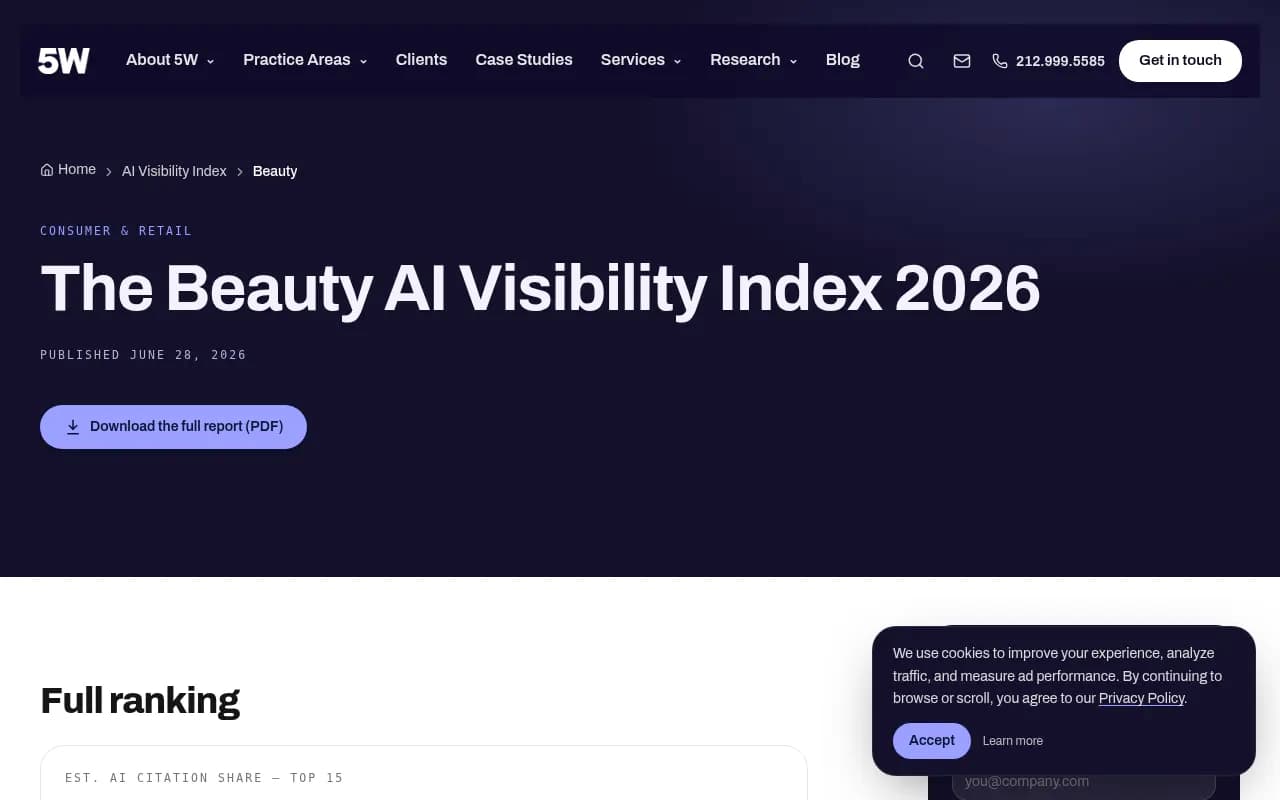
| Brand | Category | Est. AI citation share | Key citation driver (per 5WPR) |
|---|---|---|---|
| The Ordinary | Skincare | 7.0% | Ingredient name as product name |
| CeraVe | Skincare | 6.0% | Dermatologist-developed positioning |
| La Roche-Posay | Skincare | 5.0% | Sensitive-skin authority |
| Charlotte Tilbury | Cross-category | 4.5% | Makeup-artist credibility |
| Drunk Elephant | Skincare | 4.0% | Clean framework and strong ratings |
| SkinCeuticals | Skincare | 3.0% | C E Ferulic vitamin C serum |
| Tatcha | Skincare | 2.8% | Japanese-heritage positioning |
A separate eMarketer leaderboard for Q1 2026 reported that ChatGPT recommended La Roche-Posay in 81% of facial skincare queries. Different methodology, same story: a handful of brands dominate.
The pattern I find most useful is what 5WPR's founder said about it: brands winning publish ingredient transparency, dermatologist credentials and concern-specific content, while brands leaning on heritage and celebrity faces are losing citation surface. That is a content problem, and it is fixable. It also means the platform you choose should help you act, not just watch.
What a beauty brand actually needs from an AI visibility platform
Before comparing tools, decide what you need. I would split requirements into four buckets.
Prompt tracking that mirrors real shopper language
You want to track concern, ingredient, skin-type and comparison prompts, such as "best niacinamide serum for oily skin" or "Sephora vs Ulta." Look for custom prompt sets, persona or country support, and tracking of the real consumer interfaces rather than only API outputs. User-facing answers and citations can differ from API responses.
Source and citation analysis
Beauty answers lean on specialist editorial, dermatologist-bylined articles, retailer pages, and community content. You need to see which domains are cited in your category, and where your pages land in that source list.
Social sources vary by engine. In Promptwatch Data's social media citations report (Sep 28 to Oct 4, 2026), social platforms made up just 0.46% of ChatGPT citations but 12.2% of Google AI Overviews citations. In AI Overviews, YouTube (4.28%) and Instagram (1.61%) were the notable platforms for beauty; TikTok appeared only in AI Overviews, at 0.22%. If you are leaning on Reddit seeding to win ChatGPT, note that reddit.com's share of ChatGPT citations fell from roughly 4% to 0.5% on August 14, 2026.
Content actions
The gap between "we are invisible" and "we are cited" is almost always content. Per Promptwatch Data's content type report (Sep 28 to Oct 4, 2026), product pages earn 22.4% of ChatGPT citations and landing pages 16.8%. For commercial prompts like "best X," product pages hit 26.0%, landing pages 20.6% and listicles 15.0%. For branded prompts such as "Drunk Elephant reviews," product and landing pages take roughly 23% each, with review content at 5.6%. The report's own examples are mostly software, so there is no beauty-specific split, but the direction is clear for any catalog-driven category: complete, factual product pages are your base layer.
Business impact
Mentions are nice. Traffic and conversions from AI platforms are better. Ask whether the tool shows visitors arriving from ChatGPT or Perplexity, and whether it can tell you which pages AI crawlers actually read. Beauty sites are often heavy JavaScript storefronts, and crawler access is a common silent failure.
The shortlist
Promptwatch: best for the full loop from insight to published content
Promptwatch is the one I would put first for beauty brands that want to improve visibility rather than just report on it. It tracks ChatGPT, Google AI Overviews, Google AI Mode, Gemini, Perplexity, Copilot, Claude and others through their real interfaces, by country and language.

The parts that matter for beauty specifically:
- Prompt intelligence with volumes, difficulty and query fan-outs, so you can see the exact web searches AI runs for "best vitamin C serum."
- Citation analytics including Reddit, YouTube and LinkedIn reports, and Offsite Mentions for third-party pages that name your brand without linking.
- IP-verified AI crawler logs, which show whether GPTBot or PerplexityBot can read your PDPs at all.
- Visitor analytics that tie AI traffic to conversions.
- A Content Agent and Action Board that turn content gaps into drafts and publish to Shopify-adjacent CMS setups on Webflow, Framer or WordPress, then track whether each page gets crawled, cited and clicked.
- AI Shopping tracking, which is relevant if you sell products shoppers see in ChatGPT carousels.
Pricing runs from a free Explore tier to Essential at $95/month (50 prompts), Professional at $245/month and Business at $579/month, with agency plans from $199/month. Confirm current numbers at promptwatch.com/pricing. Crisp, one of its customers, reported 2x higher conversion rates from AI traffic than traditional channels. That is a SaaS example rather than beauty, so take it as proof the attribution works, not as a beauty benchmark.
The tradeoff: it is a bigger platform than a simple tracker. If all you want is a weekly mention count, it is more than you need.
Profound: enterprise monitoring for large portfolios
If you are a multi-brand group (think L'Oreal- or Estee Lauder-scale), Profound is a strong monitoring option with enterprise reporting. It generally sits at a higher price point, and it is oriented toward monitoring more than automated content execution.
Scrunch: monitoring and AI-facing site optimization
Scrunch tracks how assistants like ChatGPT and Claude describe your brand and adds some optimization on top. A reasonable fit for mid-market brands with a dedicated team.
Otterly.AI: affordable tracking for small DTC brands
Otterly.AI is a budget-friendly prompt tracker. For an indie skincare label that just wants to know whether it shows up for ten core prompts, it does the job. You will need other tools for crawler data, content and attribution.

Peec AI: clean monitoring with suggestions
Peec AI is monitoring without the optimization layer. Good dashboards, easy onboarding, and a natural pick for a team that already has a content process.

LLM Pulse and AthenaHQ: monitoring-focused alternatives
LLM Pulse and Athena HQ cover multi-engine tracking. Both lean toward monitoring, so budget separately for content production.
Semrush and Ahrefs Brand Radar: if you already live in an SEO suite
If your team already pays for Semrush or Ahrefs, the AI add-ons are convenient. The tradeoff is typically a fixed prompt set and shallower AI-specific data, with no crawler log analysis.
Side-by-side comparison
| Platform | Best for | Tracks real AI UIs | Crawler logs | AI traffic attribution | Content creation |
|---|---|---|---|---|---|
| Promptwatch | Brands that want to act on gaps | Yes | Yes | Yes | Yes, with CMS publishing |
| Profound | Enterprise portfolios | Yes | Limited | Varies by plan | Limited |
| Scrunch | Mid-market monitoring plus site optimization | Yes | Limited | Limited | Limited |
| Otterly.AI | Small DTC budgets | Yes | No | No | No |
| Peec AI | Teams with existing content ops | Yes | No | No | No |
| LLM Pulse / Athena HQ | Multi-engine monitoring | Yes | No | Limited | Limited |
| Semrush / Ahrefs Brand Radar | Existing suite users | Partial | No | No | Partial |
I have not benchmarked each competitor's current feature set line by line, so verify the specifics on each vendor's pricing page before you buy. The pattern holds, though: most tools stop at monitoring.
For wider browsing, the GEO software directory at bestgeosoftware.com lists many more options.
How to pick based on your brand stage
Indie or early-stage brand (under 20 SKUs)
Start with a free or low-cost tier. Track 20 to 50 prompts around your hero ingredient and the concerns it solves. Promptwatch's Essential tier or a budget tracker like Otterly.AI both fit. Spend the savings on better PDPs and an ingredient glossary.
Growth-stage DTC brand
You likely have a content team of one or two people and a Shopify or WordPress storefront. This is where a platform with a content agent and crawler logs pays off, because you cannot staff a full GEO team. Professional-tier Promptwatch is the natural fit.
Multi-brand group or agency
You need multiple projects, white-label reporting and country-level tracking. Promptwatch's agency plans and Profound's enterprise tier are the two I would compare. If you want a human team to run it, an agency such as 1001 SEO Media, which combines technical SEO, content and GEO and uses Promptwatch internally, is another route.
A practical beauty GEO workflow
Tools only matter if you run a routine. This is the loop I would use.
- Build a prompt set of 50 to 100 queries grouped by concern (acne, hyperpigmentation, sensitivity), ingredient (retinol, niacinamide, vitamin C), skin type, and competitor comparison.
- Baseline your Share of Voice and position against the three or four brands you actually lose to. In beauty that is often a pharmacy-heritage brand and an ingredient-led brand.
- Check the cited sources. Note which editorial sites, dermatologist-bylined pages and retailers keep showing up, and which of those you could appear on.
- Audit crawler access. Confirm AI bots can fetch your product pages and that they are not blocked by robots rules or hidden behind client-side rendering.
- Fix the content gaps: complete PDPs with full ingredient lists and concentrations, concern-specific landing pages, a plain-language brand FAQ, and clinician or dermatologist review credits where they are real.
- Get into the roundups. Listicles earn 13.6% of ChatGPT citations overall and 15.0% on "best X" prompts, so earned placement in "best of" articles is worth the PR effort.
- Re-measure weekly, and watch for model changes. Fan-out behavior shifts without warning; Promptwatch Data recorded ChatGPT using the site: operator at scale from August 8, 2026, nearly doubling searches per response.
Keep your claims clean
Beauty has a regulatory edge that software does not. AI engines favor ingredient transparency, but any health or efficacy claim you publish to win citations still needs to be defensible. Do not let an automated content tool invent clinical claims. Whatever platform you choose, keep a Brand Book or equivalent with approved claims and have someone review drafts before publishing.
What I would skip
- Platforms that only report a single vanity "visibility score" with no way to see prompts or sources.
- Tools that track only API outputs. Shoppers use the consumer apps, and those answers can differ.
- Chasing TikTok and Reddit as an AI strategy. They matter for brand building, but Promptwatch Data shows TikTok barely appears in AI citations and Reddit has collapsed in ChatGPT.
Bottom line
If you are a beauty brand that wants to move from "are we mentioned" to "why are we not cited and what do we publish this week," shortlist Promptwatch first, with Profound as the enterprise comparison. If you need only light monitoring on a small budget, Otterly.AI or Peec AI will do. Whatever you pick, start with your product pages and ingredient content, since that is where the citation share in this category is being won.
See Promptwatch Data's full research hub for current citation trends before you set your prompt list.