Key Takeaways
- AthenaHQ is monitoring-focused with deep citation analysis and executive dashboards, but lacks built-in content creation -- you'll need separate tools to act on insights. Orchly.ai bundles visibility tracking with AI content agents that write and publish.
- Orchly.ai costs $49/mo to start (Essential plan) vs AthenaHQ's $295/mo entry point ($95/mo annual). For small teams or solo marketers, that's a 6x price difference.
- AthenaHQ tracks 8+ LLMs including ChatGPT, Perplexity, Claude, Gemini, and Google AI Overviews. Orchly.ai covers the same core models (Google, ChatGPT, Claude, Perplexity, Gemini) but positions itself as a content ops platform first, tracker second.
- Content automation is Orchly.ai's edge -- AI agents handle research, writing, optimization, and publishing with human oversight. AthenaHQ gives you optimization recommendations but you're on your own for execution.
- AthenaHQ's client roster (ZoomInfo, Coinbase, SoFi) signals enterprise credibility. Orchly.ai targets lean marketing teams that need to move fast without hiring writers.
- If you just want visibility data and have a content team, AthenaHQ makes sense. If you need the platform to actually create and publish content, Orchly.ai closes that loop.
Overview
AthenaHQ

AthenaHQ positions itself as an end-to-end GEO (Generative Engine Optimization) platform for brands that want to monitor and improve how they show up in AI search results. It tracks visibility across ChatGPT, Perplexity, Google AI Overviews, Claude, Gemini, and other LLMs. The platform is built around citation source analysis, competitor benchmarking, and executive-level reporting. Used by ZoomInfo, Coinbase, and SoFi, it's clearly aimed at enterprise marketing teams with dedicated AEO/GEO roles. The pitch: unified command center for all AI visibility activities. The gap: it tells you what's wrong but doesn't help you fix it -- no content creation, no publishing workflow, just insights and recommendations.
Orchly.ai
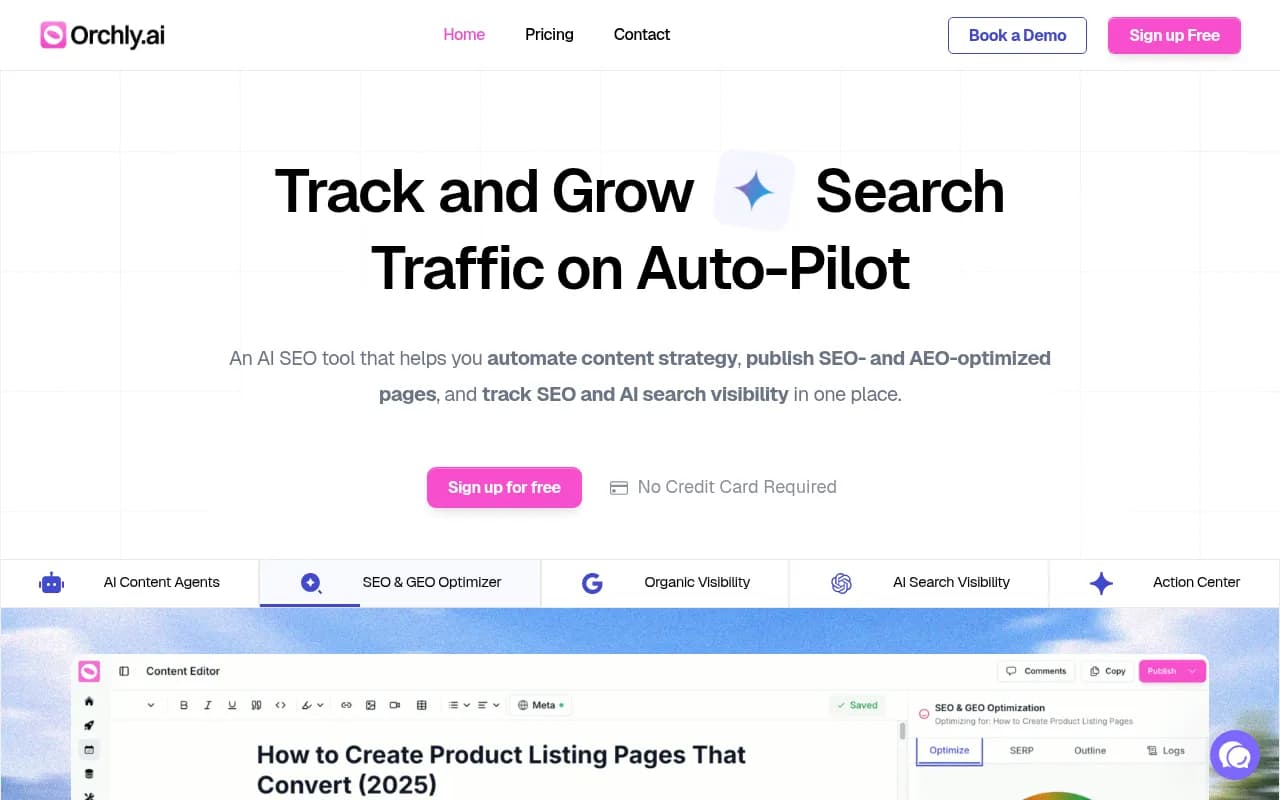
Orchly.ai takes a different angle. It's a content ops platform that happens to include AI visibility tracking. The core value is AI agents that research, write, optimize, and publish SEO- and AEO-ready content with human oversight. Visibility tracking across Google, ChatGPT, Claude, Perplexity, and Gemini is part of the loop -- you see where you're invisible, the platform suggests content to fill gaps, then AI agents draft it and you approve before publishing. It's built for lean marketing teams that don't have the budget or headcount to hire writers and SEO specialists. The trade-off: less depth on citation analysis and executive dashboards compared to AthenaHQ, but way more action on the content side.
Side-by-Side Comparison
| Feature | AthenaHQ | Orchly.ai |
|---|---|---|
| Starting price | $295/mo ($95/mo annual) | $49/mo (Essential) |
| Free trial | No | Yes |
| AI models tracked | 8+ (ChatGPT, Perplexity, Claude, Gemini, Google AI Overviews, etc.) | 5 core (Google, ChatGPT, Claude, Perplexity, Gemini) |
| Citation analysis | Deep source tracking, link building insights | Basic citation tracking |
| Content creation | None -- recommendations only | AI agents write, optimize, publish |
| Publishing workflow | Not included | Built-in with scheduling |
| Competitor benchmarking | Yes, cross-platform visibility heatmaps | Yes, visibility comparison |
| Executive dashboards | Yes, ROI tracking for AI optimization | Basic reporting, white-label audits |
| Technical SEO fixes | Recommendations | Automated fixes (schema, crawl issues, indexing) |
| Integrations | Not specified on site | CMS publishing, structured data automation |
| Target audience | Enterprise teams, dedicated GEO roles | Lean marketing teams, solo marketers |
| Best for | Monitoring + strategy | Monitoring + execution |
Pricing comparison
| Plan | AthenaHQ | Orchly.ai |
|---|---|---|
| Free tier | None | Free trial (no credit card) |
| Entry plan | Self-Serve: $295/mo ($95/mo annual) | Essential: $49/mo (~$37/mo annual with 25% discount) |
| Mid-tier | Not disclosed | Pro: $125/mo (~$94/mo annual) |
| Enterprise | Custom pricing | Custom pricing |
| Annual discount | 68% off (monthly to annual) | 25% off |
AthenaHQ's pricing is a wall for small teams. $295/mo is a serious commitment, and even the annual $95/mo assumes you're confident enough to pay upfront. Orchly.ai's $49/mo entry point is accessible for startups and agencies testing AI visibility tracking. The Pro plan at $125/mo is still cheaper than AthenaHQ's base tier and includes content agents.
AI visibility tracking depth
AthenaHQ wins on tracking sophistication. It monitors 8+ LLMs and gives you citation source analysis -- which pages, Reddit threads, YouTube videos, and domains AI models cite when they mention your brand or competitors. You can see exactly where to build links and which sources to get featured in. The platform also tracks ROI for AI optimization efforts, which matters if you're justifying budget to executives.
Orchly.ai covers the core models (Google, ChatGPT, Claude, Perplexity, Gemini) but doesn't go as deep on citation forensics. You get visibility scores, competitor benchmarks, and sentiment tracking, but the focus is on actionable insights -- "here's what content you should create" -- not exhaustive data exploration. For most teams, that's enough. If you're a data analyst or running a large-scale GEO operation, AthenaHQ's depth is worth paying for.
Content creation and optimization
This is where the platforms diverge completely.
AthenaHQ doesn't create content. It gives you automated recommendations -- "optimize this page", "build links from these sources", "target these keywords" -- but execution is on you. If you have writers, SEO specialists, and a content workflow already in place, that's fine. If you don't, you're stuck with insights you can't act on.
Orchly.ai is built around AI content agents. You tell the platform what topics to cover, and agents research, draft, optimize for SEO and AEO, then queue content for publishing. Human oversight is baked in -- you review and approve before anything goes live. The agents are trained on your data, so output doesn't sound like generic AI slop ("In this fast-paced digital world..."). The platform also auto-schedules publishing to keep you consistent without manual effort.
Orchly.ai also handles technical optimization -- structured data, internal/external links, NLP keywords, schema fixes, crawl issues. AthenaHQ flags these issues but doesn't fix them. If you're a lean team, Orchly.ai's automation saves hours per week.
User interface and workflow
AthenaHQ is designed for GEO specialists and executives. The interface is dashboard-heavy -- visibility heatmaps, citation breakdowns, competitor benchmarks, ROI tracking. It's powerful if you know what you're looking for, but there's a learning curve. The "command center" framing makes sense for teams with dedicated AEO roles who live in the platform daily.
Orchly.ai feels more like a content management system. The Action Center surfaces tasks -- "write this article", "optimize this page", "fix this technical issue" -- and you work through them. It's less about exploring data and more about getting things done. For marketers who don't have time to dig through dashboards, this workflow is faster.
Integrations and publishing
AthenaHQ doesn't mention integrations on its site. It's a monitoring and analysis tool, not a publishing platform. You'll export insights and act on them in your CMS, SEO tools, or content calendar.
Orchly.ai integrates with your CMS for direct publishing. AI agents can draft content, optimize it, then push it live (with your approval). It also automates structured data, internal linking, and external source citations. If your workflow is "research -> write -> optimize -> publish", Orchly.ai handles the entire chain. AthenaHQ only covers the research step.
Target audience fit
Choose AthenaHQ if:
- You're an enterprise with a dedicated GEO or AEO team
- You already have writers and SEO specialists in-house
- You need deep citation analysis and executive-level ROI reporting
- Budget isn't a constraint ($295/mo+ is fine)
- You want the most comprehensive AI visibility data available
Choose Orchly.ai if:
- You're a lean marketing team (1-5 people) or solo marketer
- You need the platform to actually create and publish content, not just recommend it
- You want to automate repetitive content tasks (research, writing, optimization, scheduling)
- You're budget-conscious ($49-125/mo is more realistic than $295/mo)
- You care more about execution speed than exhaustive data analysis
What's missing from each platform
AthenaHQ's biggest gap is content creation. It's a monitoring-only tool in a space where competitors like Promptwatch are bundling visibility tracking with content gap analysis and AI-generated articles. If you're paying $295/mo for insights, you still need to pay writers and SEO tools to act on them. That's a fragmented workflow.

Orchly.ai's gap is tracking depth. It covers the core AI models but doesn't go as deep on citation forensics or competitor analysis as AthenaHQ. If your job is to present detailed AI visibility reports to executives, Orchly.ai's dashboards might feel lightweight. It's built for doers, not analysts.
Pros and cons
AthenaHQ pros
- Deep citation source analysis across 8+ LLMs
- Executive dashboards with ROI tracking
- Strong competitor benchmarking and visibility heatmaps
- Enterprise credibility (ZoomInfo, Coinbase, SoFi)
- Comprehensive GEO workflow management for dedicated teams
AthenaHQ cons
- No content creation or publishing -- insights only
- Expensive entry point ($295/mo or $95/mo annual)
- No free trial to test before committing
- Requires separate tools to act on recommendations
- Overkill for small teams or solo marketers
Orchly.ai pros
- AI agents handle research, writing, optimization, and publishing
- Affordable starting price ($49/mo)
- Free trial with no credit card required
- Built-in technical SEO and AEO fixes (schema, crawl issues, indexing)
- Fast workflow for lean teams -- Action Center surfaces tasks
Orchly.ai cons
- Less depth on citation analysis vs AthenaHQ
- Fewer AI models tracked (5 vs 8+)
- Executive reporting is basic compared to AthenaHQ
- Newer platform with smaller client roster
- Not built for large-scale GEO operations
Who should pick which tool
If you're an enterprise marketing team with dedicated GEO specialists, AthenaHQ is the right call. You need the depth -- citation forensics, 8+ LLM tracking, executive ROI dashboards. You already have writers and SEO tools, so the lack of content creation isn't a blocker. The $295/mo price is justified by the data quality and the credibility that comes with clients like ZoomInfo and Coinbase.
If you're a lean team (startup, agency, solo marketer), Orchly.ai makes more sense. You don't have the budget or headcount to hire writers and pay for multiple tools. You need one platform that tracks visibility, tells you what content to create, then actually creates it. The $49-125/mo price range is realistic, and the AI agents save hours per week on repetitive tasks. You're trading some tracking depth for execution speed, which is the right trade-off when you're resource-constrained.
There's also a middle ground: use Orchly.ai for content ops and supplement with a tool like Promptwatch if you need deeper AI visibility tracking, crawler logs, or Reddit/YouTube citation analysis. Orchly.ai's content agents handle the heavy lifting, and Promptwatch fills the gaps on monitoring depth. That combo costs less than AthenaHQ alone and gives you both insights and action.
Final verdict
AthenaHQ is the better monitoring tool. Orchly.ai is the better content ops platform. Your choice depends on whether you need data or execution.
If your bottleneck is understanding where you're invisible in AI search and you have the team to act on insights, AthenaHQ delivers the most comprehensive tracking available. If your bottleneck is actually creating and publishing content fast enough to stay visible, Orchly.ai's AI agents solve that problem while still giving you enough visibility data to prioritize.
For most teams in 2026, the bigger challenge isn't tracking -- it's execution. Orchly.ai wins on that axis. AthenaHQ is the right tool for a smaller subset of enterprise teams with dedicated GEO roles and existing content workflows.