Key Takeaways
- AthenaHQ costs $295/mo (self-serve) vs Peec AI's €89/mo starter plan -- AthenaHQ is 3.3x more expensive at entry level
- Peec AI offers better multi-language coverage with 10 countries on Professional plan; AthenaHQ focuses on English-first markets
- AthenaHQ has no free trial; Peec AI offers one -- lower barrier to entry for testing
- Both platforms are monitoring-focused with limited content optimization capabilities compared to platforms like Promptwatch that include AI content generation and gap analysis
- AthenaHQ targets enterprise customers (ZoomInfo, Coinbase, SoFi); Peec AI serves 1,500+ marketing teams including agencies
- Neither platform offers crawler log analysis or Reddit/YouTube tracking -- you're getting visibility metrics but not the full picture of how AI models discover your content
Overview
AthenaHQ
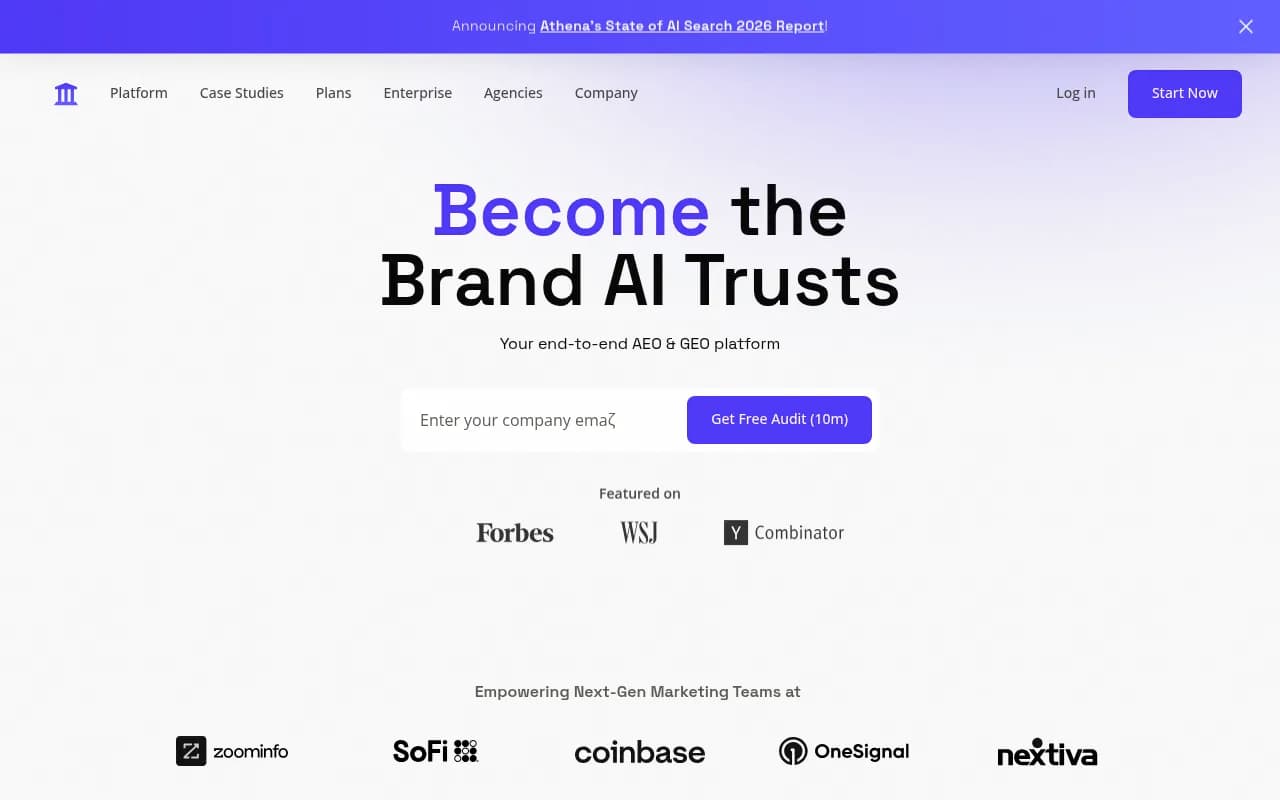
AthenaHQ positions itself as an "end-to-end AEO & GEO platform" for tracking brand visibility across 8+ AI search engines including ChatGPT, Perplexity, Google AI Overviews, Claude, and Gemini. The platform is used by enterprise brands like ZoomInfo, Coinbase, and SoFi. It tracks three core metrics: Visibility (share of chats mentioning your brand), Position (ranking within AI responses), and Sentiment (how AI perceives your brand). The company came out of Y Combinator and has been featured in Forbes and WSJ.
Pricing starts at $295/mo for self-serve plans ($95/mo if paid annually), with enterprise custom pricing available. No free trial is offered.
Peec AI
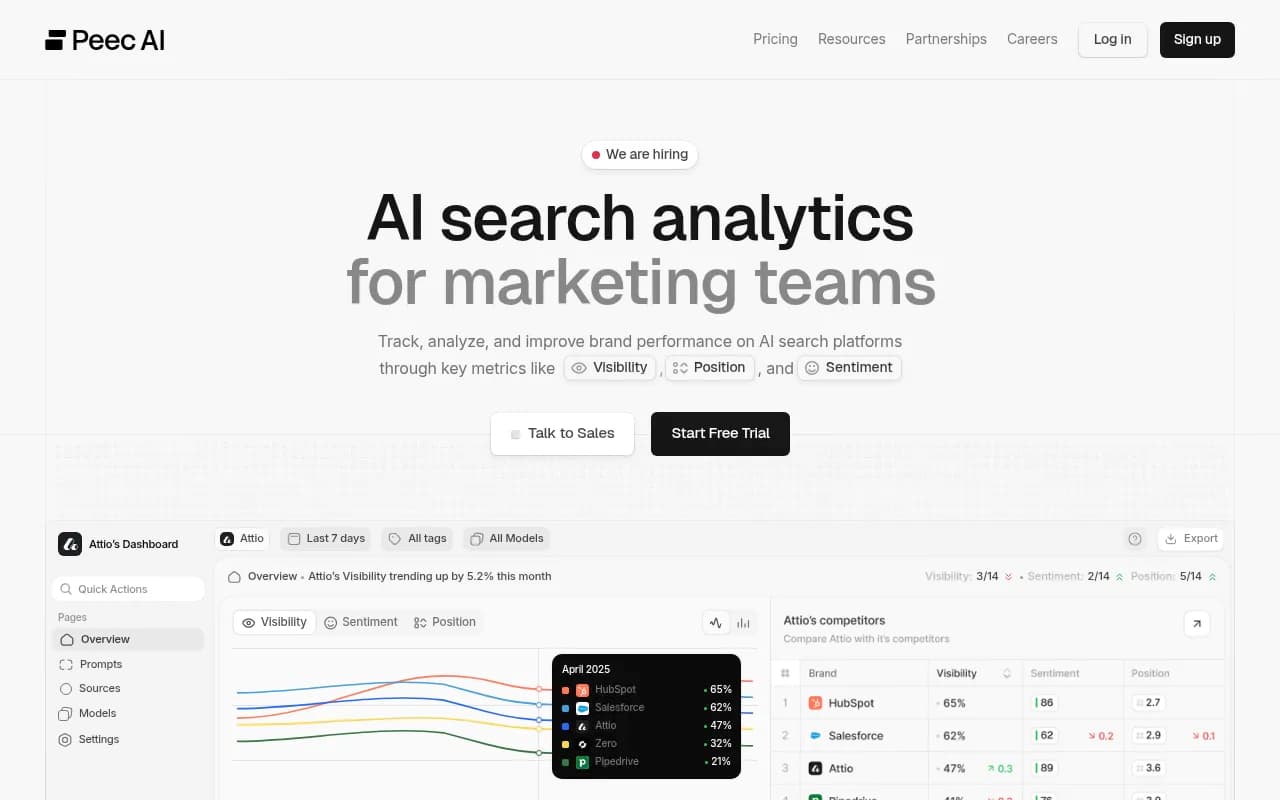
Peec AI is a multi-language AI visibility platform that helps marketing teams track brand performance across ChatGPT, Perplexity, and Gemini. The platform serves 1,500+ marketing teams including both brands and agencies. Like AthenaHQ, it tracks Visibility, Position, and Sentiment metrics. Peec AI differentiates itself with strong multi-language support and a lower price point.
Pricing starts at €89/mo for the Starter plan (25 prompts, 3 countries), with Professional at €199/mo (75 prompts, 10 countries, all models). Business plans are custom priced. A free trial is available.
Side-by-Side Comparison
| Feature | AthenaHQ | Peec AI |
|---|---|---|
| Starting price | $295/mo ($95/mo annual) | €89/mo (~$95/mo) |
| Free trial | No | Yes |
| AI models tracked | 8+ (ChatGPT, Perplexity, Google AI Overviews, Claude, Gemini, others) | 3 main (ChatGPT, Perplexity, Gemini) |
| Multi-language support | Limited (English-first) | Strong (10 countries on Pro) |
| Prompts included (entry tier) | Not specified | 25 prompts |
| Core metrics | Visibility, Position, Sentiment | Visibility, Position, Sentiment |
| Custom prompts | Yes | Yes |
| Content optimization | Automated recommendations | Smart suggestions |
| Target audience | Enterprise brands | Marketing teams, agencies |
| Notable clients | ZoomInfo, Coinbase, SoFi | 1,500+ teams |
| Citation analysis | Yes | Not specified |
| ROI tracking | Yes | Not specified |
| API access | Not specified | Not specified |
Pricing comparison
The pricing gap between these two platforms is significant, especially at entry level.
| Plan | AthenaHQ | Peec AI |
|---|---|---|
| Entry tier | $295/mo self-serve ($95/mo annual) | €89/mo (~$95/mo) |
| Mid tier | Not publicly listed | €199/mo Professional (75 prompts, 10 countries) |
| Enterprise | Custom pricing | Custom pricing (Business plan) |
| Free trial | None | Available |
| Annual discount | 68% off ($95/mo vs $295/mo) | Not specified |
AthenaHQ's annual pricing ($95/mo) is competitive with Peec AI's Starter plan, but you're committing to $1,140 upfront vs Peec AI's month-to-month flexibility. The lack of a free trial on AthenaHQ is a real barrier -- you're buying blind.
Peec AI's Professional plan at €199/mo is likely comparable to AthenaHQ's self-serve tier in terms of features, but Peec AI explicitly tells you what you're getting (75 prompts, 10 countries, all models). AthenaHQ's self-serve tier doesn't publish prompt limits or country coverage, which makes it hard to evaluate value.
Feature deep-dive
AI model coverage
AthenaHQ claims 8+ AI models tracked, including ChatGPT, Perplexity, Google AI Overviews, Claude, Gemini, and unnamed others. Peec AI explicitly lists 3 main models: ChatGPT, Perplexity, and Gemini.
On paper, AthenaHQ has broader coverage. In practice, the models that matter most are ChatGPT, Perplexity, and Google AI Overviews -- the ones with actual user traffic. Claude and Gemini are growing but still niche. If you need comprehensive multi-model tracking, AthenaHQ wins. If you care about the big three, Peec AI covers you.
Neither platform tracks newer models like DeepSeek, Grok, or Meta AI -- gaps that platforms like Promptwatch fill with 10-model coverage including those emerging players.

Multi-language and geo targeting
Peec AI has a clear advantage here. The Professional plan explicitly supports 10 countries, and the platform is built around multi-language tracking. AthenaHQ's website and positioning skew heavily toward English-speaking markets (US enterprise clients like ZoomInfo and Coinbase). There's no mention of multi-country support in their public materials.
If you're a European brand or agency serving international clients, Peec AI is the obvious choice. If you're a US-based B2B SaaS company focused on English-language AI search, AthenaHQ's enterprise focus might fit better.
Core metrics: Visibility, Position, Sentiment
Both platforms track the same three metrics:
- Visibility: Percentage of prompts where your brand appears
- Position: Where you rank in AI responses (1st mention, 2nd, etc.)
- Sentiment: How positively or negatively AI models describe your brand
These are table stakes for any AI visibility platform. The real question is what you can do with that data. AthenaHQ emphasizes "automated content optimization recommendations" and "citation source analysis" -- suggesting they give you actionable next steps. Peec AI mentions "smart suggestions" but doesn't detail what those are.
From the existing comparison research, a 30-day test found that AthenaHQ delivers "real-time GEO automation" while Peec AI provides "limited data analytics." That suggests AthenaHQ's recommendations are more robust, but at 3x the price, they should be.
Content optimization capabilities
This is where both platforms fall short compared to newer competitors. AthenaHQ offers "automated content optimization recommendations" and Peec AI has "smart suggestions," but neither platform includes built-in content generation or gap analysis tools.
You're getting told what's wrong, but you're on your own to fix it. Platforms like Promptwatch close this loop with AI content generation grounded in citation data -- you see the gap, generate the content, track the results. AthenaHQ and Peec AI stop after step one.
If you have a content team ready to act on recommendations, either platform works. If you need help creating the content itself, you'll need a separate tool.
Custom prompts and tracking
Both platforms let you add custom prompts to track specific queries relevant to your brand. Peec AI's Starter plan includes 25 prompts, Professional includes 75. AthenaHQ doesn't publish prompt limits for self-serve plans, which is frustrating -- you don't know if you're getting 50 prompts or 500.
Peec AI also lets you organize prompts with tags and track across all countries, which is useful for agencies managing multiple clients or brands with regional variations.
Citation and source analysis
AthenaHQ explicitly mentions "citation source analysis and link building" as a feature. This means you can see which sources AI models are citing when they mention (or don't mention) your brand. That's valuable for understanding what content to create or which sites to get links from.
Peec AI doesn't mention citation analysis in their public materials. If understanding the source-level data matters to you, AthenaHQ has the edge.
That said, neither platform offers Reddit or YouTube tracking -- two sources that heavily influence AI recommendations. If you want to see which Reddit threads or YouTube videos are shaping AI responses in your category, you'll need a platform with those capabilities.
User interface and experience
Peec AI's website shows clean, modern dashboards with trend lines, competitor benchmarking, and easy-to-scan metrics. The interface looks polished and approachable -- something a marketing manager could jump into without training.
AthenaHQ's website is more enterprise-focused with language like "command center" and "executive dashboard." The positioning suggests a more complex tool with more features, but also a steeper learning curve.
For small teams or agencies, Peec AI's simplicity is a feature. For enterprise teams with dedicated GEO specialists, AthenaHQ's depth might be worth the complexity.
Integrations and API
Neither platform publishes details about integrations or API access. AthenaHQ mentions "AI-native integrations" in comparison research but doesn't specify what those are. Peec AI doesn't mention integrations at all.
This is a gap for both platforms. If you want to pull AI visibility data into Looker Studio, export to your data warehouse, or build custom workflows, you're in the dark until you talk to sales.
Pros and cons
AthenaHQ pros
- Broader AI model coverage (8+ models vs 3)
- Citation source analysis included
- Enterprise-grade features and positioning
- Used by recognizable brands (ZoomInfo, Coinbase, SoFi)
- Automated content optimization recommendations
- ROI tracking for AI optimization efforts
AthenaHQ cons
- 3x more expensive at entry level ($295/mo vs €89/mo)
- No free trial -- you're buying blind
- Prompt limits and country coverage not published for self-serve plans
- Weak multi-language support
- Monitoring-focused with limited content creation capabilities
- No Reddit or YouTube tracking
Peec AI pros
- Much cheaper entry point (€89/mo vs $295/mo)
- Free trial available
- Strong multi-language support (10 countries on Pro)
- Clear, transparent pricing with published limits
- Clean, approachable interface
- Serves 1,500+ teams including agencies
Peec AI cons
- Fewer AI models tracked (3 vs 8+)
- No citation source analysis mentioned
- "Smart suggestions" less detailed than AthenaHQ's recommendations
- Limited data analytics compared to AthenaHQ (per comparison research)
- No content generation or gap analysis tools
- No Reddit or YouTube tracking
Who should pick which tool
Choose AthenaHQ if:
- You're an enterprise B2B brand with budget for a premium tool
- You need comprehensive multi-model tracking including Claude, Gemini, and others
- Citation source analysis is important for your link building strategy
- You have a dedicated GEO specialist who can leverage advanced features
- You're primarily focused on English-language markets (US, UK, Australia)
- You can commit to annual pricing to get the $95/mo rate
Choose Peec AI if:
- You're a marketing team or agency with a tighter budget
- You want to test the platform before committing (free trial available)
- Multi-language and multi-country tracking is essential
- You need transparent pricing with clear limits (prompts, countries)
- You prefer a simpler, more approachable interface
- You're tracking the big three models (ChatGPT, Perplexity, Gemini) and don't need niche coverage
Consider alternatives if:
- You need content generation and gap analysis, not just monitoring -- platforms like Promptwatch offer AI writing agents that create content grounded in citation data
- You want Reddit and YouTube tracking to understand social signals influencing AI
- You need crawler log analysis to see how AI models discover your content
- You want 10+ model coverage including DeepSeek, Grok, and Meta AI
Final verdict
Peec AI wins on value for most teams. At €89/mo with a free trial, transparent limits, and strong multi-language support, it's the smarter choice for marketing teams and agencies who need AI visibility tracking without enterprise complexity or pricing. The interface is cleaner, the pricing is honest, and you can test it before committing.
AthenaHQ makes sense for enterprise brands with bigger budgets who need comprehensive model coverage, citation analysis, and advanced features. But the lack of a free trial and opaque self-serve pricing are real friction points. If you're spending $295/mo (or even $95/mo annual), you should know exactly what you're getting -- prompt limits, country coverage, feature access. AthenaHQ doesn't publish those details, which feels like enterprise sales tactics applied to a self-serve product.
Both platforms share the same fundamental limitation: they're monitoring dashboards, not optimization platforms. You'll see where you're invisible, but you're on your own to create the content that fixes it. For teams who want the full loop -- find gaps, generate content, track results -- neither platform delivers that end-to-end workflow.