Rankshift Review 2026
Measures citation and visibility rates in AI search responses and generates content and citation recommendations for agencies and brands.
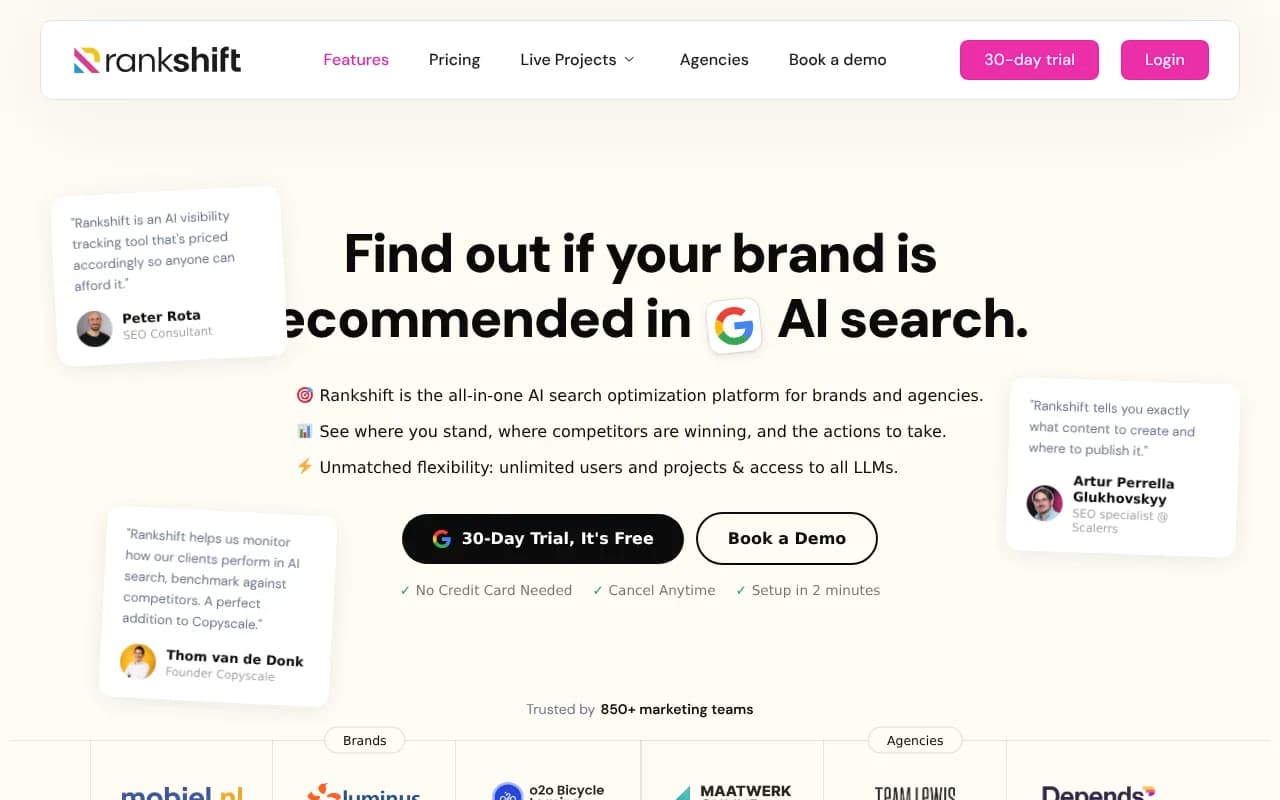
Key takeaways summary (2026 review update below in article body) — see full breakdown underneath this section for details on pricing, features, and who Rankshift fits best in 2026.
Key takeaways
- Rankshift is a genuinely flexible AI visibility tracker: unlimited projects and seats on every plan, nine AI models covered, and prompt tracking that runs on real user interfaces rather than raw API outputs.
- Pricing is credit-based (€69–€359/mo billed annually), which keeps entry costs low but makes costs harder to predict than flat-rate competitors; the credit system takes a while to internalize.
- The content side is the weak spot. The Content Engine (briefs and AI writer) is still in beta, briefs need heavy editing, and there's no CMS publishing workflow — it stops at drafting.
- Compared with Promptwatch, Rankshift lacks AI traffic attribution (it points you at GA4 instead), Reddit and YouTube citation tracking, ChatGPT Shopping insights, prompt volume and difficulty scoring, and automated content publishing to Webflow, Framer, or WordPress.
- Best fit: agencies and B2B SEO teams managing multiple brands who want affordable, flexible monitoring and are willing to act on the data themselves.
What Rankshift does
Rankshift, founded in 2025 by Belgian entrepreneur Pieter Verschueren (co-founder of the SEO agency Depends, which is also a customer), sits in the crowded AI visibility tracking space. Its pitch is straightforward: track where your brand shows up in AI answers, see where competitors are winning, and get told what to do about it.
The tracking layer covers nine platforms: ChatGPT, Gemini, Claude, Perplexity, Copilot, Google AI Overviews, Google AI Mode, Meta AI, and Mistral. One detail I appreciate: responses are pulled from each platform's actual user interface, not just API calls. What an API returns and what a real user sees in ChatGPT can differ, so this matters more than most vendors admit.
You define your own prompts, tag them by campaign or product line, and set check frequency anywhere from hourly to weekly. The homepage shows a credit simulator doing the math for you: pick your models, frequency, and prompt count, and it tells you roughly how many credits you'll burn per month. It's a nice touch, though it also reveals the core tension of the pricing model, which I'll get to.
The features that work well
Visibility and competitor benchmarking
The leaderboard view is the heart of the product. You get visibility scores, citation rates, and sentiment per brand, ranked against competitors, filterable by tag, persona, model, and date range. The demo data on their site (fast food chains, amusingly) shows the format clearly: Taco Bell at 31% visibility, your brand at 24%, sentiment scores alongside.
For agencies running competitive reports for clients, this is the deliverable. It's clean, it's client-presentable, and the ability to track brand name variations and multiple domains under one brand (corporate site plus careers site, for example) solves a real annoyance that simpler tools ignore.
Crawler analytics
Rankshift logs when GPTBot, ClaudeBot, PerplexityBot, and other crawlers hit your pages, including HTTP errors. The demo shows a PerplexityBot hitting a case study URL and getting a 404. That's exactly the kind of thing you want to catch, because a crawler that hits errors stops trusting your site. There's also a robots.txt checker to flag accidental AI crawler blocking. This feature used to be a differentiator; now it's table stakes among serious platforms, but Rankshift implements it properly.
Sentiment and brand perception
Beyond positive/neutral/negative percentages, Rankshift surfaces themes the AI associates with your brand, things like "affordable" or "lacks enterprise features." That's more useful than a bare sentiment score, because it tells you what to fix. The grounded answers metric (what percentage of responses about you are actually based on retrieved sources versus hallucinated) is a smart inclusion too.
Action Center
A prioritized to-do list derived from your tracking data: add FAQ schema to /pricing, build a /vs/competitor landing page, submit a sitemap to Bing. Each action is ranked by expected visibility impact. It's a good idea and reasonably executed, though the actions tend toward generic SEO recommendations rather than deeply AI-specific insight.
Where it falls short
The credit system
A credit is spent each time a prompt is tracked in a specific model and locale. That means a single prompt checked hourly across nine models in three countries burns through your allowance fast. Starter (€69/mo annually) includes 9,500 credits and 150 prompts per day; Professional (€159/mo) has 22,000 credits and 350 prompts; Business (€359/mo) has 53,000 credits and 850 prompts. Enterprise is custom, adding SSO, SLA, a dedicated account manager, and beta access.
The upside is that you're never charged per seat or per project, which is genuinely agency-friendly and unusual in this market. The downside is that budgeting requires simulation. One independent reviewer put it plainly: the credit system can be hard to understand. I agree. Also worth noting: a third-party roundup flagged that Rankshift's own pages disagreed with each other on pricing at one point, so verify numbers on their live pricing page before committing.
Content tools are beta-grade
The Content Brief Generator and AI Content Writer exist, and the briefs have sensible structure (H1 through H3 outlines based on prompts likely to earn citations). But per the most detailed independent review I found, the Content Engine is still in beta and the briefs "need significant editing before they're ready to use." It's a research accelerator, not a production tool. And critically, there's no publishing workflow: no CMS connections, no scheduled publishing, no review inbox. You draft, then you copy-paste somewhere else.
This is the biggest gap versus Promptwatch, whose Content Agents plan, write, and publish GEO-optimized content directly to Webflow, Framer, or WordPress on a schedule you control. Rankshift diagnoses; it doesn't close the loop.
Missing measurement layers
Rankshift tracks mentions and citations well, but it doesn't attribute actual traffic or conversions from AI platforms to your site. It points you at GA4 for that. Promptwatch's visitor analytics track AI-driven traffic and conversions natively, which for teams trying to justify AI search spend to a CFO is the difference between "we're mentioned a lot" and "AI traffic converts at 2x our other channels."
Other gaps: no Reddit or YouTube citation tracking (both are significant citation sources in AI search), no ChatGPT Shopping or ads tracking beyond a basic inclusion, no prompt volume or difficulty scoring, and no query fan-out analysis. Historical trend data is also thin since the product is young.
Who should use it
Good fit: an agency managing 10–30 client brands that wants unlimited seats and projects at a low entry price, already has a content workflow, and needs solid monitoring plus benchmarking. The Maatwerk and SmartSites logos on their site suggest this is exactly who's using it.
Poor fit: early-stage brands with too little online presence for AI models to have formed an opinion about them, teams who want a tool that both diagnoses and produces publish-ready content, and anyone who needs to prove AI-driven revenue rather than just visibility. If you're in that last camp, Promptwatch's end-to-end stack (crawler logs, traffic attribution, content gap analysis, automated publishing, Agent Chat) covers the full journey from "why aren't we visible" to "here's the content that fixed it."
Bottom line
Rankshift is a solid, affordable monitoring platform with unusual flexibility on seats and projects, real-UI tracking, and decent crawler analytics. Its weaknesses are the confusing credit pricing, beta-grade content tooling with no publishing workflow, and the absence of traffic attribution and offsite citation tracking. For pure monitoring on a budget, it's a legitimate choice. For teams that want to move from insight to execution, Promptwatch is the stronger option, and you can compare other options in the GEO software directory or browse AI rank tracking tools for alternatives.

Tags:
Frequently asked questions
How much does Rankshift cost?
Which AI models does Rankshift track?
Does Rankshift include content creation tools?
How does Rankshift compare to Promptwatch?
Is Rankshift good for agencies?
Does Rankshift have a free plan?
Similar and alternative tools to Rankshift