Elmo Review 2026
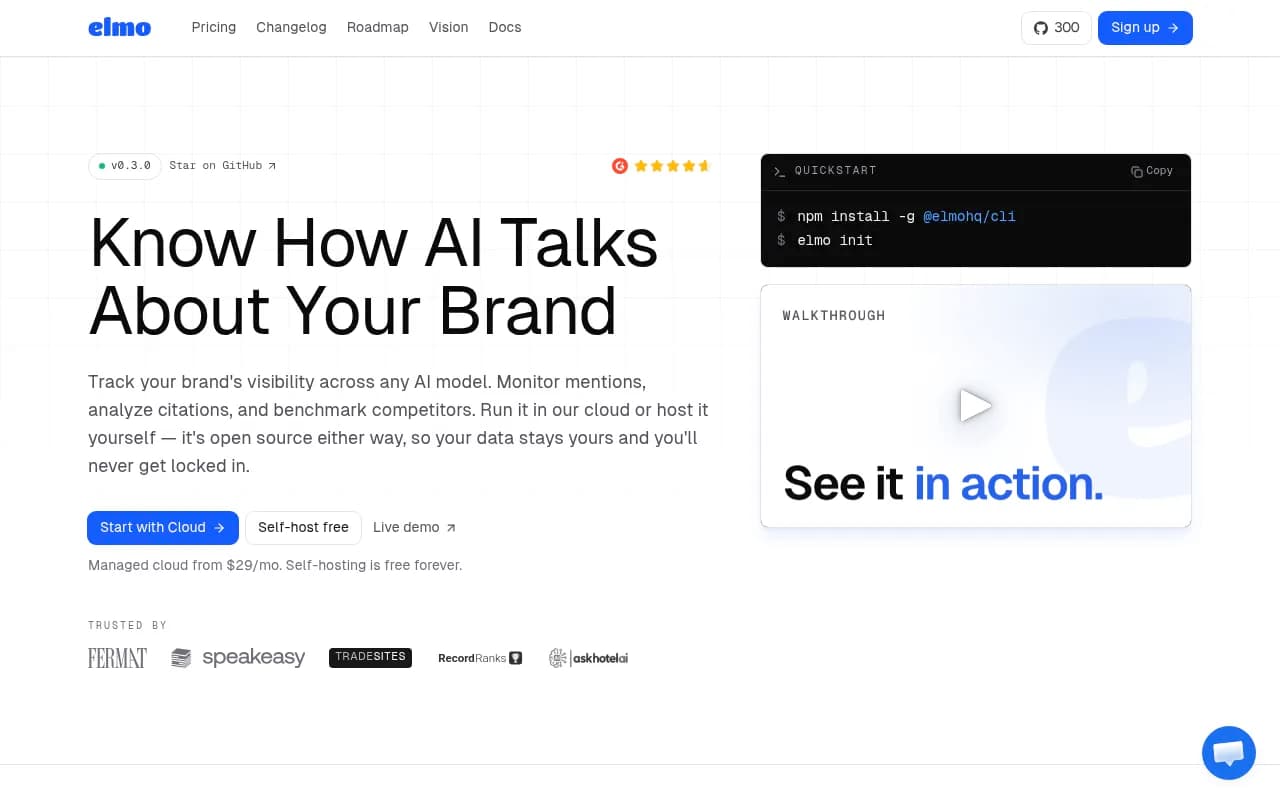
Self-hostable tracker for ChatGPT, Perplexity and Gemini visibility. Free if you run it yourself, or use the hosted cloud version starting at $29/month.
Key takeaways
- Elmo is a genuinely open-source (MIT-licensed) AI visibility tracker you can self-host for free, with a managed cloud starting at $29/mo — a refreshing, anti-lock-in stance in a market full of opaque black-box scoring.
- It covers the monitoring basics well: per-prompt visibility, share of voice leaderboards, citation analysis, query fan-outs, and competitor benchmarking across ChatGPT, Google AI Mode/Overviews, Perplexity, Gemini, Copilot, and more.
- Compared to Promptwatch, Elmo is monitoring-only. It lacks AI crawler logs, visitor analytics (actual AI traffic and conversions), Reddit and YouTube citation tracking, ChatGPT Shopping and Ads Radar, prompt volume and difficulty scoring, and automated content generation with CMS publishing.
- It's a very young project (founder Jared Rhizor started it in July 2025) with visible growing pains: a shipped bug that caused billable API failures, a Grok outage when unauthenticated access was cut off, and a 6-7x cost jump when a scraping provider changed behavior.
- Best fit: developers and cost-conscious teams who want full source-code access and are comfortable running Docker Compose — not enterprises that need mature support, sentiment analysis, or multi-language tracking.

What Elmo is
Elmo calls itself an open-source answer engine optimization (AEO) platform, and for once the label is accurate. The entire product — the dashboard, the scrapers, the scoring logic — lives on GitHub under an MIT license. You can read exactly how each visibility metric is calculated, which matters in a category where most vendors treat their scores as trade secrets.
The pitch is simple: track how AI answer engines mention your brand, which competitors appear alongside you, and which sources each model cites. Run it in their cloud from $29/mo, or self-host it on your own infrastructure for free. The name, incidentally, comes from LLMO (LLM optimization), which is a nicer bit of trivia than most product names can claim.
The founder, Jared Rhizor, is building this bootstrapped and explicitly rejects the VC-funded enterprise pricing model that dominates this category. That's either a strength or a risk depending on how you look at it. One person shipping fast means quick responses to customer requests (a TradeSites testimonial confirms they added a requested integration quickly), but it also means the bus factor is one.
Core features
Visibility tracking and share of voice
The dashboard gives you an at-a-glance view of current visibility, share of voice, and 30-day trends. You can filter by AI model, time range, and tags, and see per-prompt visibility scores with trend lines comparing your brand against competitors. The share of voice view includes a live leaderboard ranking who AI engines name most — useful for spotting which competitor is eating your lunch in ChatGPT's answers.
Query fan-outs
Elmo shows the exact web searches AI engines generate when they fan a single prompt out into dozens of sub-queries, plus how they rewrite your prompts along the way. This is genuinely useful, and it's a feature most cheap trackers skip. If you want to understand how AI expands "best project management tool" into the searches that actually determine who gets cited, this is where you look.
Citation analysis
You can see which domains and URLs AI models cite most, track new and dropped sources over time, and break citations down by category — brand, competitor, social, and more. Given that ChatGPT typically cites only around five sources per web-search-enabled response (Perplexity closer to ten, per Promptwatch's data on average sources per response), those citation slots are scarce enough that tracking who wins them is worth doing.
Opportunities
Elmo generates AI-ranked recommendations: content to create, pages to refresh, and third-party sources to pitch. It's a lighter version of what full optimization platforms offer — there's no content generation, no CMS publishing, no automated workflows. Think of it as a to-do list, not a doer.
Model coverage
Elmo tracks ChatGPT, Claude, Gemini, Grok, Mistral, Perplexity, Copilot, DeepSeek, Google AI Mode, and Google AI Overviews. Scraped surfaces (the real user-facing UIs) are sampled up to 4× daily on paid plans, and you can bring your own API keys or use scraping providers like BrightData, DataForSEO, Oxylabs, or Cloro. The v0.2.18 change to scrape real ChatGPT/Gemini UIs instead of calling model APIs was the right call — API outputs and user-facing answers genuinely differ — even though it raised per-run costs from ~$0.0006 to ~$0.004.
Pricing
Three deployment modes:
- Self-hosted: $0, forever. Unlimited prompts, all models, citation analysis, competitor tracking, full source code. You pay only for your infrastructure and API keys.
- Cloud: Starter at $29/mo (1 brand, 50 prompts, ChatGPT only, scraped 1×/day), Basic at $99/mo (1 brand, 50 prompts, any 4 platforms, 4×/day sampling), Pro at $299/mo (2 brands, 150 prompts, plus premium grounded models like Claude Sonnet 5 web and GPT-5 Search, 20 prompt/model pairings included), Business at $649/mo (5 brands, 350 prompts, 30 pairings). Extra pairings are $5/mo each. Annual billing saves two months. All plans include API access and unlimited seats — the no-per-seat pricing is a real differentiator.
- White label: custom pricing for agencies, with custom branding, domain, SSO, and a shared Slack channel.
The pricing is honest for what it is. A $29 entry point beats most competitors' entry tiers. But note the ceiling: Business at $649/mo covers 5 brands and 350 prompts. Promptwatch's Professional plan at $245/mo includes 150 prompts, 18,000 responses, 25M crawler logs, automated content generation, and shopping insights — more capability per dollar once you compare beyond the entry tier.
Strengths
- True open source. MIT license, 954 commits, active daily development, and you can verify every metric. For teams with data-residency or trust requirements, self-hosting is a legitimate option most competitors don't offer at all.
- No seat pricing. Unlimited seats on every cloud plan is rare and agency-friendly.
- Real UI scraping, not just APIs. Sampling actual ChatGPT and Gemini interfaces reflects what users actually see.
- Query fan-outs included. Many trackers at this price omit them.
- Responsive development. The changelog shows fast fixes and quick feature additions when upstream providers change behavior.
Limitations
Elmo's own comparison page against Profound is refreshingly honest, and it confirms what the feature list implies. Compared to a full platform like Promptwatch, Elmo is missing:
- AI crawler logs — no visibility into when ChatGPTBot, ClaudeBot, or 400+ other crawlers hit your site, what they read, or what errors they hit. This is the "why" behind visibility scores, and Elmo doesn't have it.
- Visitor analytics — no tracking of actual traffic and conversions from AI platforms to your site. You see mentions, not business impact.
- Reddit and YouTube citation tracking — no dedicated reports for the sources AI engines lean on heaviest.
- ChatGPT Shopping and Ads Radar — no tracking of product recommendations or sponsored placements in AI answers, an increasingly important surface.
- Prompt volumes and difficulty scoring — you can't prioritize prompts by search volume because Elmo doesn't estimate it.
- Content generation and CMS publishing — the Opportunities feature tells you what to do, but nothing writes or publishes the content for you.
- Sentiment analysis and multi-language/multi-region tracking — absent, per Elmo's own comparison page.
Reliability is also a fair concern for a young project. The v0.2.15 OpenAI retrieval bug caused billable failures in production before v0.2.16 patched it. Grok tracking broke entirely when unauthenticated access was cut off. The DataForSEO provider change multiplied per-run costs 6-7x overnight. None of these are disqualifying, but they're the reality of a bootstrapped project dependent on upstream vendors who change terms without warning.
There's also no independent review presence yet — no G2, Capterra, or TrustRadius coverage, and the testimonials on the site are the only ones you'll find. At 297 GitHub stars, the community is small but engaged.
Who it's for
Elmo fits a specific profile: a developer or technical marketer at a startup or small company who wants visibility data without a $500/mo contract, values owning their data, and can run a Docker Compose stack (or is happy with the cheap cloud tiers). SEO agencies that want a white-labeled AEO offering for clients without building their own tooling should also look at the white-label option.
It's a weaker fit for enterprises that need sentiment analysis, geographic tracking, crawler analytics, or content production workflows — and for anyone who wants the platform to close the loop from insight to published content rather than just reporting.
Bottom line
Elmo is a credible, honest, genuinely open-source entry in the AI visibility space, and its self-hosting option is unique at this price point. As a tracker, it does the monitoring job well. But it stops at monitoring. If you want to know why you're visible, which AI crawlers are reading your site, what traffic AI answers actually drive, and then have agents write and publish the fixes, Promptwatch covers that full loop — crawler logs, visitor analytics, Reddit and YouTube citation tracking, prompt volumes, and automated content generation — at a comparable price. Elmo tells you where you stand. Promptwatch helps you move the needle.
Frequently asked questions
What is Elmo?
Is Elmo free to use?
How much does Elmo cost?
Who is Elmo for?
Which AI platforms does Elmo track?
Can I self-host Elmo?
What is AEO and why does it matter?
What's the difference between Elmo's free and paid versions?
Does Elmo require technical knowledge to set up?
Is Elmo open-source?
Similar and alternative tools to Elmo