Key takeaways
- Software to track your local AI visibility runs from about $29 to $245 a month for most small businesses. City-level targeting usually pushes you toward higher tiers.
- The bill is driven by prompt count. A matrix of services times cities eats prompts quickly, and tracking one prompt tells you almost nothing.
- Tracking is the cheap part. Local SEO retainers run $500 to $5,000 a month, and GEO agency work can go far higher.
- Vendor pricing changes often and sources disagree. Check live pricing pages before you commit.
- A realistic small-business setup is a $50 to $250 monthly tool, a frozen prompt set, and a baseline recorded before you change anything.
What local GEO tracking actually means
GEO tracking is checking whether your business shows up when people ask ChatGPT, Google AI Overviews, Perplexity or Gemini for a recommendation. For a local business, the questions look like "best emergency plumber in Leeds" or "which dentist near me takes walk-ins."
That is different from classic local rank tracking, where you watch your position in the Google Maps pack. AI answers are generated, vary from run to run, and cite a pile of third-party sources. So tracking means running a fixed set of prompts repeatedly and recording whether you're mentioned, where, and how you're described.
There are three separate buckets of cost, and mixing them up is how people get confused by wildly different quotes:
- Tracking software, the monthly subscription that runs prompts for you.
- Labor, either your own hours or an agency's.
- Fixing what the tracking reveals: listings, reviews, content, citations.
This guide focuses on the first bucket and shows how it sits next to the other two.
What the tracking tools cost in 2026
Prices below come from vendor pricing pages and independent comparisons gathered in September and October 2026. Treat them as a snapshot. Several sources disagreed with each other (Profound's Growth plan shows as both $399 and $499, Semrush tiers vary by source), so verify on the live page.
| Tool | Entry plan | Monthly price | Prompts | Notes |
|---|---|---|---|---|
| Otterly.AI | Lite | $29 | 15 | 4 engines, no API below $189 |
| LLM Pulse | Starter | $60 | 50 | Weekly tracking |
| Promptwatch | Essential | $95 | 50 | 6,000 responses, all models |
| Peec.ai | Starter | $95 | 50 | 3 engines, extras $35 each |
| Rankshift | Starter | $92 | 150 | 8 models |
| Semrush | AI Visibility Toolkit | $99 | 25 | Per domain, extra prompts cost more |
| Searchable | Pro | $125 | 100 | Some engines cost extra |
| Scrunch | Core | $250 | 125 | |
| AthenaHQ | Starter | $295 | n/a | Credit-based |
| Ahrefs Brand Radar | Lite + Brand Radar | $328 | n/a | Base plan plus per-index fees |
An independent comparison by Agenzy (an official Peec AI partner, so keep that in mind) put the cost per prompt per engine per day between roughly $0.01 and $0.07 across self-serve plans. That spread is why cheap plans are not automatically good value: a $29 plan with 15 prompts can cost more per data point than a $95 plan with 50.
The cheapest ways in
Otterly.AI at $29 a month is the lowest credible ongoing entry point in the sources I found. It covers ChatGPT, AI Overviews, Perplexity and Copilot, but not Gemini or AI Mode.

If you only want to know where you stand today, a one-off audit is cheaper than any subscription. Surmado sells a $50 one-time audit, though it is a vendor, so read it as promotional. Free options also exist: Promptwatch has a free Explore plan (1 project, 10 prompts, ChatGPT only) and a no-login Free AI Visibility Report, and Amplitude and HubSpot offer one-time grader-style checks.

The mid-range most small businesses land in
For a single-location business with a handful of services, $95 to $250 a month is where most of the sensible options sit. Promptwatch Essential at $95 covers 50 prompts across all engines with country tracking, a site audit and content gap analysis. Its Professional tier is $245 with 150 prompts. The relevant catch for local businesses is that state and city tracking starts on the Business plan at $579 a month, according to the vendor's own pricing, so confirm what you get at promptwatch.com/pricing before assuming city-level data.

Peec.ai starts at $95 for 50 prompts on three engines, with other engines as paid upgrades. Semrush's toolkit is cheap on paper at $99 for 25 prompts, but it is priced per domain, and a US Tech Automations post lists much higher tiers ($199 to $549), so check which one applies.

Tools built for local
A few catalog tools target local businesses specifically. Tibly positions itself as AI visibility for local businesses, and Birdeye, Synup, Yext, BrightLocal and Moz Local sit closer to listings and reputation management with some AI-search features. Pricing for these varies by location count, so ask for quotes.

Why prompt count decides your bill
This is the part that surprises people. Local tracking is a matrix. Five services across four cities is 20 prompts per engine before you add any phrasing variants. A 15-prompt plan is gone before you start.
Promptwatch Data's report on unique domains per ChatGPT response (Sep 28 to Oct 4, 2026) shows why you can't get away with one or two prompts. Almost half of responses (47.6%) cite 10 or more unique domains, and for generic organic prompts like "best X for small teams" that rises to 52.5%. Your business is sharing each answer with a crowd, and a single run tells you very little. You can read the full unique domains report.
The Agenzy comparison gives a useful floor. With 25 prompts on three engines, one flipped answer moves your visibility score by about 1.3 points. It treats 50 prompts as the sensible minimum. I'd agree, with the caveat that the source doesn't specifically cover local.
A simple way to size your prompt set
- List the services that make you money, not every service you offer. Three to five is typical.
- List the cities or neighborhoods you actually serve. Two to four for most small businesses.
- Multiply them. That is your base set, per engine.
- Add a few "near me" and comparison-style prompts, since competitor comparison prompts behave differently from generic ones.
- Freeze the list.
That last step matters more than it sounds. If you keep adding prompts you already win, your visibility score rises without anything changing in what the engines say. Record a baseline first, then change things.
Query fan-out and why phrasing matters
When ChatGPT answers, it often runs its own web searches behind the scenes. Promptwatch Data's ChatGPT query fanouts report shows averages around 2.15 searches per response in early December 2025, falling to about 1.84 by early March 2026, with average query length dropping to the high 80s characters and then to about 53 characters from April. (The report's intro still mentions "3-8+" searches, which doesn't match its own averages, so I'd ignore that number.) The practical point is that these searches are short and keyword-like, so your location and service pages should state the city and service plainly near the top.
The costs that sit around the tool
A $95 subscription is not your real GEO budget. Here is how the other buckets compare.
| Cost bucket | Typical 2026 range | Source |
|---|---|---|
| AI visibility tracking tool | $29 to $579/mo | Vendor pricing pages |
| Local SEO retainer | $500 to $5,000/mo | Beancount.io |
| Single-location local SEO | $600 to $1,500/mo | Arc4 |
| Minimum for traction | $750 to $1,500/mo | Mack Media Group |
| Competitive industries | $2,500+/mo | Mack Media Group |
| Professional GEO agency | $1,500 to $50,000/mo | WebFX via LinkedIn |
| Local SEO consulting | $75 to $200+/hr | Beancount.io |
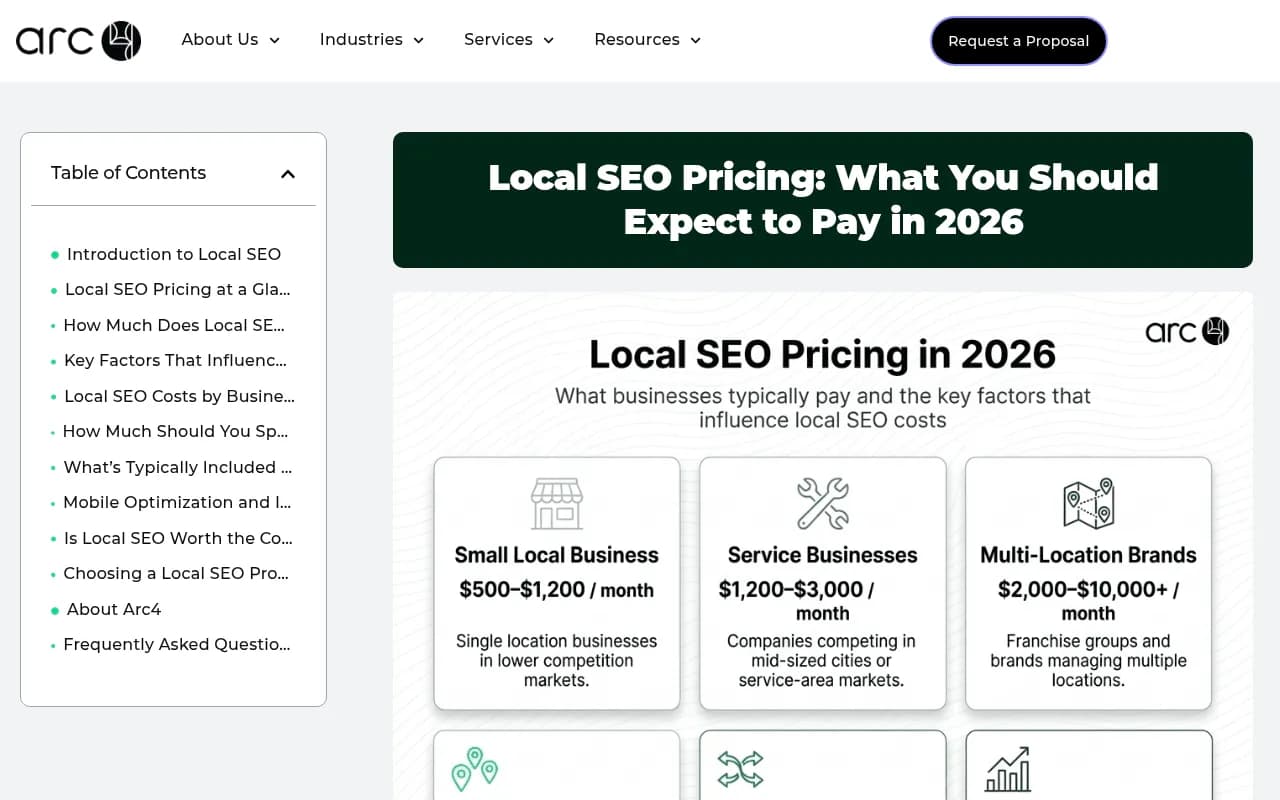
Arc4 says local SEO pricing is up roughly 18% since 2023. Beancount.io makes a point I find useful: a photography studio and a personal injury firm can pay about 8x different for "local SEO," and the gap comes from competition for the same few map-pack spots, not from vendor quality. The same logic applies to GEO. A plumber in a mid-sized town and a lawyer in Los Angeles are not buying the same thing.
The typical retainer bundles Google Business Profile management, review generation, citation cleanup, on-site local pages, and local link building. Those are also the things that tend to move AI answers, because AI systems lean on third-party listings, review sites and directories. Promptwatch Data shows this pattern by sector: for travel prompts, booking and search sites earn more than half of ChatGPT citations (travel report), and for automotive, marketplaces like Autotrader and Cars.com outrank every car brand (automotive report). Local service businesses probably face a similar dynamic, though I found no Promptwatch report specific to local or near-me prompts, so don't treat that as proven.
Your own time
I couldn't find reliable data on how many hours DIY GEO tracking takes, and I won't invent one. My own rough view: if a tool does the prompt running, the time cost is reviewing a monthly report and acting on it. Doing it by hand in a spreadsheet is cheap in cash and expensive in consistency, because answers vary run to run.
Three budget tiers for small businesses
Tier 1: about $0 to $50 a month
Use a free plan or a one-off audit to learn your baseline. Pick 10 to 15 prompts that cover your main service and city. Check manually every month and log the answers in a spreadsheet. This is fine for a one-location business testing whether AI search matters to it at all.
Tier 2: about $95 to $250 a month
This is the sweet spot for most single-location and small multi-service businesses. A tool with 50 to 150 prompts across several engines, plus a site audit. Put the leftover effort into the things that feed AI answers: your Google Business Profile, reviews, consistent name, address and phone data, and clear location pages. Keep LocalBusiness schema on the location URL.
Tier 3: $500 and up
Multi-location businesses, or anyone in a competitive vertical, will want city-level tracking and probably help executing. Promptwatch's Business plan at $579 includes city targeting, the automated Content Agent and Agentic AI Search Optimization, which is where tracking turns into publishing. Agency plans start at $199 a month if you manage several clients. Pair that with an honest local SEO retainer budget on top.
If you'd rather hand the whole thing to a team, an agency like 1001 SEO Media covers local SEO and AI search together, and the monthly cost will sit in the retainer ranges above.
Pitfalls that waste budget
- Treating a lost mention as a GEO problem. It is often a Google Business Profile issue: wrong hours, wrong categories, inconsistent NAP data. Keep a changelog and compare it with your tracking data.
- Buying tracking with no plan to act. A dashboard that says you're invisible is not a fix. Check whether the tool has any action or content layer, or budget separately for one.
- Paying for engines you don't need. Some plans charge extra for Claude, Copilot or Grok. For a local plumber, ChatGPT, AI Overviews and Perplexity probably matter most.
- Ignoring annual discounts, which are around 15 to 17% on several tools, while ignoring that Profound's cheaper plans are billed yearly up front.
- Trusting stale prices. Profound removed its brand plans in September 2026 per the comparison I found, and Scrunch was announced as acquired by Sitecore on June 3, 2026. Pricing and packaging move.
How to decide in 30 minutes
- Run a free baseline scan on two or three tools.
- Count your service-by-city prompt matrix.
- Pick the cheapest plan that covers that matrix at 50+ prompts without paid engine add-ons.
- Freeze the prompts and screenshot the baseline.
- Set a 90-day review. If your mentions haven't moved after real listing, review and content work, change the work, not just the tool.
For more options, the GEO software directory lists tools in this category, and ai-rank-tools.com focuses on AI rank trackers.
Bottom line
A small business can track local AI visibility properly for roughly $95 to $250 a month. Going cheaper is possible but gives you thin data, and going higher mostly makes sense when you need city-level tracking or someone to publish for you. Budget the tool as the smallest line item, and put most of your money into the local fundamentals the AI answers are built from.