Key takeaways
- A team of 5 to 15 people has different needs than a solo marketer or a Fortune 500 brand. You need shared seats, role permissions, reporting that executives will read, and a way to turn findings into work without a dedicated analyst.
- Monitoring-only tools answer "were we mentioned?" Teams of this size usually don't have spare hours to act on dashboards, so tools with content and action workflows tend to pay off faster.
- Track each AI engine separately. Citation counts differ a lot between ChatGPT, Google AI Overviews, Perplexity and Copilot, so one engine's results don't predict another's.
- Most published "best of" lists are written by vendors who rank themselves first. Verify pricing, prompt limits and seat counts on the vendor's own pricing page before you buy.
- Short list for this team size: Promptwatch for the full monitor-to-fix workflow, Semrush if you already live in it, Peec AI or Otterly.AI for a lean budget, Profound for enterprise-style depth.
Why team size changes the buying decision
Most AI visibility roundups ignore who is actually going to use the tool. A solo founder wants cheap and fast. A 500-person enterprise wants SSO, audit logs and a procurement-friendly vendor. Teams of 5 to 15 sit in an awkward middle.
You probably have an SEO lead, a couple of content people, someone on brand or PR, maybe a demand gen manager, and a head of marketing who wants a slide for the board. That is a lot of different people who need different views of the same data. And nobody has "AI search analyst" in their job title.
So the questions that matter are not the ones on a feature checklist:
- How many seats do you get, and do viewers cost extra?
- Can the content person see the gaps without asking the SEO lead to export a CSV?
- Does the tool tell you what to do on Monday morning, or just show a chart?
- Will the numbers hold up when your CMO asks "is this actually driving revenue?"
- Can you track more than one brand, region or product line without paying double?
What an AI visibility tool should actually do
At the basic level, the tool runs a set of prompts against ChatGPT, Google AI Overviews, Perplexity, Gemini and others, then reports whether your brand showed up, where, and which sources were cited. That part is table stakes now.
The differences show up in three places.
Data quality
Some tools query the real consumer interfaces. Others hit APIs. The answers can differ, because what a user sees in ChatGPT's interface is not always what the API returns. If you are making content decisions, you want the former.
Also check how the tool handles engine differences. Promptwatch's average sources per response data shows ChatGPT citing around 5 sources per web-search answer, while Google AI Overviews and Perplexity sit near 10. Copilot swung from under 2 to nearly 17 within a few weeks before settling low. A tool that blends these into one number hides the signal.
Citation intelligence
Knowing you were cited is less useful than knowing why. Look for tools that classify what type of content gets cited. According to Promptwatch's ChatGPT citation share by content type report (Sep 28 to Oct 4, 2026), product pages made up 22.4% of ChatGPT citations, landing pages 16.8% and listicles 13.6%. Product and landing pages together were 39%. If your content plan is all blog posts, that is worth knowing.
Outdated advice is a risk here too. Promptwatch's October 2026 social citations data shows ChatGPT drew only 0.46% of its citations from social platforms, while Google AI Overviews drew 12.2%. A tool or agency still telling you to chase Reddit threads for ChatGPT visibility is working from last year's playbook. The Reddit decline report shows reddit.com's share of ChatGPT citations falling from about 4% to 0.5% on August 14, 2026.
What happens after the dashboard
This is where team-size matters most. With 5 to 15 people you can afford to have one person own AI visibility part-time, not three. If the tool only produces charts, that person spends their week writing briefs and chasing writers. Tools that generate content, flag technical issues and prioritize a to-do list recover a lot of that time.
Quick comparison
Prices and limits change often and several of the figures below come from vendor-authored roundups. Treat them as starting points and confirm on each pricing page.
| Tool | Starting price (approx.) | Best for | Acts on findings? | Seat-friendliness |
|---|---|---|---|---|
| Promptwatch | Free tier; paid from $95/mo | Teams that want monitoring, content and crawler data in one place | Yes (Content Agent, Action Board) | Seats from 1 to 5 by plan, 10 on agency plans |
| Semrush AI Visibility | ~$99/mo | Teams already on Semrush | Limited | Tied to Semrush plan |
| Profound | Enterprise-leaning | Deep prompt-level analytics | Some | Strong for larger orgs |
| Peec AI | Mid-range | Clean tracking and agency-style reporting | No | Good |
| Otterly.AI | From ~$29/mo | Tight budgets | Light recommendations | Basic |
| Ahrefs Brand Radar | $50/mo add-on, higher for standalone index | Backlink-led SEO teams | No | Tied to Ahrefs plan |
| Scrunch | ~$250/mo | GA4-linked traffic attribution | Limited | Multi-user focus |
The tools worth shortlisting
Promptwatch
Promptwatch is the one I would start with for a team in this range, mostly because it covers the full loop. Tracking is the easy part. It also shows IP-verified AI crawler logs (which pages ChatGPT, Claude and Perplexity bots actually read, and where they hit errors), AI-referred traffic and conversions, and a weekly site audit. Then the Action Board gives you a prioritized to-do list and the Content Agent can plan, write and publish to WordPress, Webflow or Framer.
For a small team, that last part is the point. Crisp used it to scale to 5 to 10 articles per day and reported 2x higher conversion rates from AI traffic than from traditional channels.
The pricing maps neatly onto team size. Essential is $95/mo (1 seat, 50 prompts). Professional is $245/mo with 2 seats and 150 prompts. Business is $579/mo with 5 seats, 350 prompts, the automated Content Agent, and state and city tracking. If you are an agency or in-house team running several brands, the agency plans (Kick-off $199, Growth $399, Scale $799) include 10 seats and unlimited projects, though they leave out the Content Agent. Check promptwatch.com/pricing for current numbers; there is a 7-day free trial on monthly plans.
It tracks the real UIs of ChatGPT, Google AI Overviews, AI Mode, Gemini, Perplexity, Copilot, Meta AI and Alexa, plus coding agents like Claude Code. It is also ISO/IEC 27001 certified, which helps if your security team has to sign off.
The honest downside: the Content Agent is gated to Business and above, so a team on Essential is mostly getting monitoring and analysis. And if you only want a simple weekly mention count, it is more than you need.

Semrush
If your team already pays for Semrush, adding its AI Visibility toolkit is the lowest-friction path. Same login, same reports, same billing. Cybernews ranked it first for marketing teams on exactly that basis, though it is worth remembering that review is a ranking of five tools, not a lab test.
The tradeoff is depth. Scaling prompts gets expensive, and it lacks crawler logs and AI traffic attribution of the kind dedicated platforms offer. Fine as an add-on. Less convincing as your only AI visibility source.
Profound
Profound is the heavyweight. Deep prompt-level analytics, agency modes with client workspaces, and a large real-prompt dataset. Its own blog calls itself the best option for agencies, so take that with salt, but the product is serious.
For a 5 to 15 person team it can be overkill. If nobody on the team will live in the platform daily, you will pay for depth you do not use. Teams with a dedicated AEO specialist get the most from it.

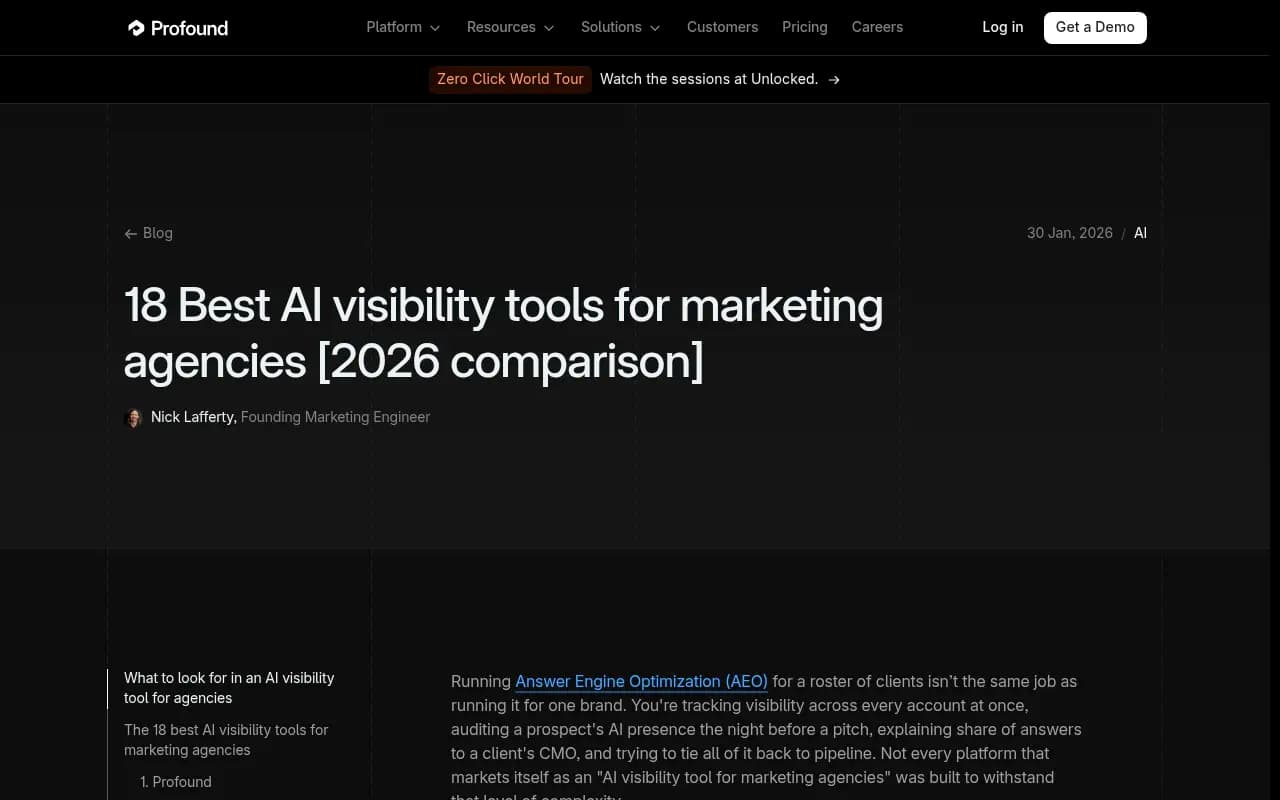
That screenshot is Profound's own agency comparison. Useful for seeing the criteria they evaluate on, including client accounts, pitch environments and reporting, but remember the author ranks itself first.
Peec AI
Peec AI is a clean, readable tracker that gets recommended often for agency reporting and for European teams. It does the monitoring job well and does not pretend to do more. If you already have a content process and just need trustworthy visibility numbers to feed it, that can be enough.
What it lacks is anything downstream: no crawler logs, no visitor analytics, no content generation.

Otterly.AI
Otterly is the budget option, starting around $29/month. It is quick to set up and gives clear recommendations. Several engines, such as Gemini and AI Mode, cost extra on some plans, which can push the real price up. There is also no real prompt-volume data. I would use it for a pilot to get stakeholders comfortable with the idea before committing to something bigger.

Ahrefs Brand Radar
Good for teams whose SEO program is built around Ahrefs and backlinks. You can add custom prompts for about $50/month or buy the standalone index at a higher tier. It is useful context rather than a full workflow.
Other options worth a look
A few others come up repeatedly in 2026 roundups:
- Scrunch is built around GA4-connected traffic attribution and enterprise brand teams, with a higher entry price.
- [tool:scrunch]
- AthenaHQ has an Action Center that turns data into suggested next steps.
- [tool:athena-hq]
- Rankshift combines multi-model monitoring with a built-in content writer and credit-based pricing, which can climb quickly.
- [tool:rankshift]
- ZipTie goes deep on analysis and reporting.
- [tool:ziptie]
- LLMrefs suits keyword-minded SEO teams who think in terms of keywords rather than prompts.
- [tool:llmrefs]
- KIME tracks nine engines and tracks competitor ads in AI answers. Its own blog ranks it first, so weigh that accordingly.
- [tool:kime]
If you want to browse beyond this shortlist, the GEO software directory at bestgeosoftware.com covers many more.
How to choose for a team of 5 to 15
Start with who will touch it
Write down the people who will log in weekly. If it is two people, seat count is not an issue and you can pick on features. If it is six or more, compare seat limits and role types. Viewer access for executives matters because it stops you building a PowerPoint every month.
Decide whether you need to act or just measure
Be honest about your capacity. If you already have writers and a process, a pure tracker is cheaper. If AI visibility is going to be one person's side project, pay for the tool that shortens the path from insight to published page.
Check prompt and response limits against your market
Fifty prompts sounds like plenty until you split them across three product lines, two countries and branded versus non-branded variants. Multiply before you buy. Also check whether limits are on prompts or on responses, since running daily across several models eats responses quickly.
Ask about engine coverage per plan
Some tools advertise nine engines but include two on the entry tier. Ask which models are included at the price you are quoted.
Look for traffic attribution
Visibility without traffic data is a vanity metric. Ask whether the tool connects AI citations to actual visits and conversions, either natively or via GA4 or Search Console. Otherwise you will struggle to justify the budget in six months.
A simple rollout plan
- Run a free baseline first. Several tools, Promptwatch included, offer a free scan of how ChatGPT, Gemini and Perplexity talk about your brand.
- Pick 30 to 50 prompts that reflect how buyers actually ask. Include some branded, some competitor comparison and some category questions.
- Check your AI crawler access. If bots cannot read your pages, nothing else matters.
- Look at which content types get cited in your category and compare with what you publish.
- Assign one owner and one weekly slot. Review movement monthly, not daily, particularly for volatile engines like Copilot.
- Reassess after 90 days. If you have not changed anything because of the data, downgrade or switch to something that makes action easier.
Bringing in outside help
Some teams of this size choose to hire rather than build the skill in-house. 1001 SEO Media is an SEO and GEO agency that works with this kind of team on technical SEO, content and AI search visibility, and uses Promptwatch for tracking. It is an option if you want strategy and execution without a new hire.
My take
For most teams in this range, the deciding factor is not the number of engines tracked. It is whether someone will actually do something with the data on a Tuesday afternoon with four other priorities. Pick a lean tracker if you have a process. Pick Promptwatch if you do not, and want the tool to carry part of the work. Check every price on the vendor's page, because most of the numbers floating around in comparison posts are secondhand.
For more tools in this category, the AI rank tracker directory at ai-rank-tools.com is a good place to keep looking.