Key takeaways
- ChatGPT does not show a ranked list of links, so "rank" is a bundle of metrics: mention rate, position in the answer, share of voice, citation rank and sentiment.
- Answers change from run to run. Report rates over many sampled answers, never one fixed position from a single run.
- Mentions and citations are separate events. ChatGPT can name you without linking to you, or link to you without naming you.
- Read the metrics together. Each one points at a different problem: coverage, prominence, crawlability or reputation.
- Model rollouts move numbers on their own. Check for platform changes before you blame your content.
Why classic rank tracking does not translate
A Google rank tracker records where one URL sits for one keyword. Position 3 is position 3. ChatGPT works differently. It writes a synthesized answer, names a handful of brands inside it, and sometimes attaches sources. Your URL might never show up, and the same prompt can produce a different answer tomorrow.
So a ChatGPT rank tracker runs a fixed set of prompts on a schedule, stores every answer, and computes rates from the pile. The vendors describing this (Ansvisor, Cognizo, TopCited) mostly agree on the core signals: brand mention, position, cited URL, sentiment, and the competitors named next to you.
One more complication. ChatGPT does not search with your prompt. It generates its own web queries, known as fan-outs. Promptwatch's query fan-out data shows the average moving from about 2.15 searches per response in early December 2025 to about 1.84 by early March 2026, and the average query length shrinking too. Your tracked prompts are a proxy for what actually gets searched, which is worth remembering whenever a number looks too precise.
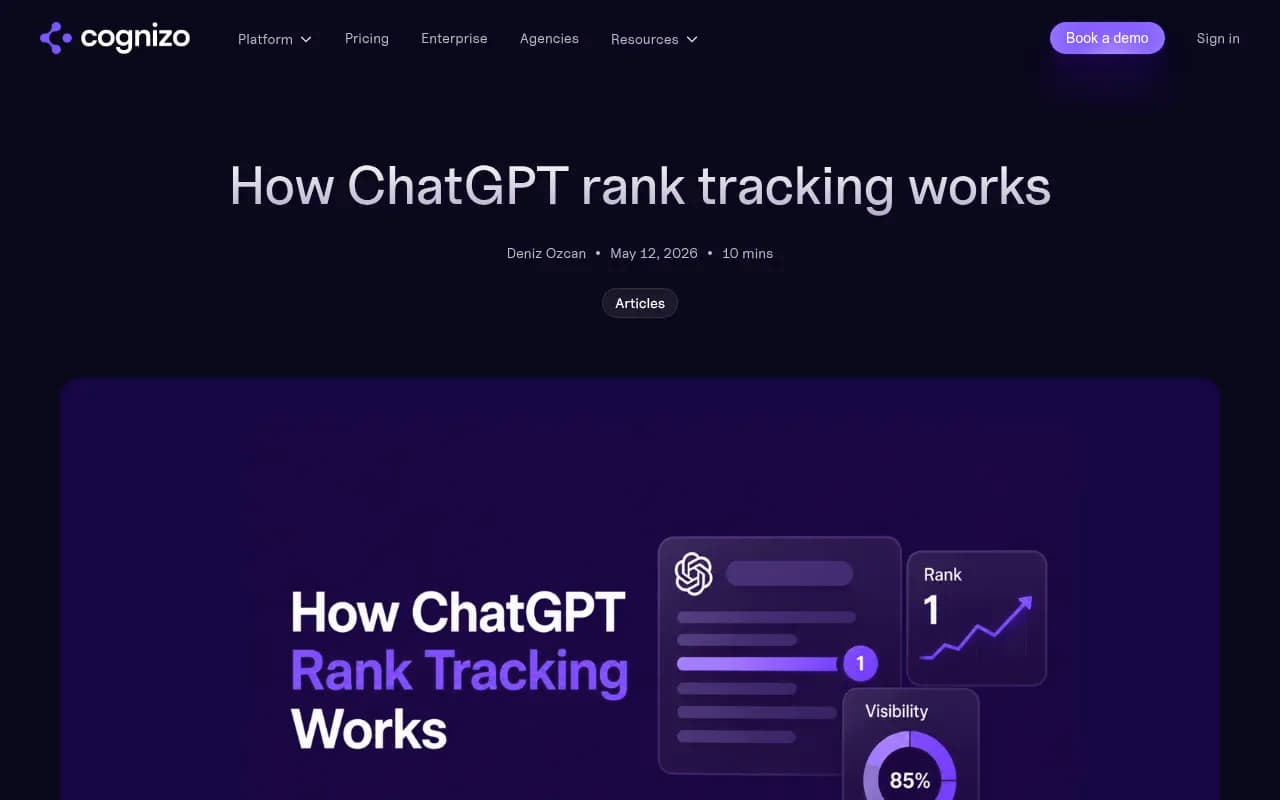
The metrics at a glance
| Metric | What it answers | How it is calculated | What a low number usually means |
|---|---|---|---|
| Mention rate (visibility) | Do I show up at all? | Answers naming your brand / all tracked answers x 100 | Coverage problem |
| Position | How early am I named? | Mean position in answers that list options | Prominence problem |
| Share of voice | How much of the conversation do I own? | Your mentions / all mentions of tracked brands x 100 | Competitors dominate the category |
| Citation rate and citation rank | Does ChatGPT link to my pages, and where in the source list? | Answers linking to your domain / all answers; plus domain placement in the source list | Content or crawlability problem |
| Sentiment | How am I described? | Per-response score, often 0-100 with about 50 neutral | Reputation problem |
The rest of this guide goes through them one at a time.
Mention rate and prompt coverage
Mention rate is the baseline. Count the answers that name your brand, divide by all tracked answers, multiply by 100. If you are named in 38 of 100 sampled answers, your mention rate is 38%. Some tools call this the visibility rate or citation frequency, which is confusing, because it counts brand names in the text and not links.
Prompt coverage is the sibling number: prompts where you appeared at least once in the period, divided by all prompts. Mention rate tells you how often. Coverage tells you how widely. A brand can have a decent mention rate that comes entirely from a handful of branded prompts, and coverage exposes that.
A caution on prompt design. Brand-specific prompts ("is Brand X any good?") will flatter you, because you are named by definition. The honest signal comes from organic prompts where no brand is mentioned: "best CRM for small agencies", "alternatives to X". Separate prompt types in your reporting or you will fool yourself.
Position in the answer
When ChatGPT lists options, where you land matters. Being first of five is a different outcome from being fifth. Position is usually the average slot in answers that list options, and you should leave out answers where you are absent, otherwise absence drags the average in confusing ways.
Some vendors convert placement into points. A common scheme gives 3 points for first, 2 for second and 1 for third, then sums across answers. Others report "first-mention rate" instead, which is the share of answers where you are the default recommendation. Both are fine. Pick one and keep it stable.
The important caveat is that position is directional data. One buyer's guide put it well: citation URLs and stored responses are factual, because ChatGPT either linked a URL or it did not, while position varies across runs because generation is probabilistic. It becomes useful only when sampled five to ten or more times per prompt over weeks. Use it to spot broad gaps ("we are always fourth") and not to celebrate moving from 2.4 to 2.1.
Also watch what else appears in the answer. Shopping units and ads can change the layout, which changes what "position" even means. Promptwatch publishes data on ChatGPT shopping features and ads over time if you want to see how often those appear.
Share of voice
Share of voice (SoV) is your slice of all brand mentions across a fixed prompt set and a fixed list of brands.
The formula: your mentions / total mentions across every tracked brand x 100.
A worked example. You are named in 120 answers. Rival A is named in 200 and Rival B in 80. Total mentions are 400, so your share of voice is 30%.
Four steps keep it clean:
- Fix the prompt set and the brand panel. Prompts are your category's buying questions. The panel is you plus the competitors you count.
- Run the prompts on a schedule and store every answer.
- Count mentions per brand across the same answers.
- Divide yours by the panel total.
What counts as a good share of voice
It depends on how crowded the category is. With four tracked brands an even split is 25%, so 12% is half your fair share. With ten brands, 12% beats an even 10% split. LLM Pulse's glossary makes the same point: in a two-player category 50% suggests parity, while in a fragmented market 15% can already be leadership. Nightwatch suggests 30% in your primary category as a reasonable first target, which I would treat as a rough rule of thumb and not a law.
Two traps are worth naming. First, SoV is a relative number. You can lose share while your mentions rise, simply because a competitor grew faster. Second, it moves with your panel. Add three competitors and your share drops without anything changing in the real world. Document the panel and do not edit it casually.
SoV also varies by platform and prompt type. A brand might hold 40% in ChatGPT and 15% in Perplexity, or lead on educational prompts and trail on "best tools for" prompts. Break it out.
Citation rate and citation rank
This is where people mix things up. A mention is your brand named in the text. A citation is a link to a page. Ansvisor's breakdown is a handy way to think about the four outcomes:
| Outcome | What it tells you |
|---|---|
| Named and cited | ChatGPT recommends you and links to your page. Best case. |
| Named, not cited | ChatGPT knows you but uses other sources. Work on third-party coverage and linkable pages. |
| Cited, not named | Your page supports the answer but you are not recommended. Make the brand name unmissable on that page. |
| Absent | Neither. Look at which competitors and sources win that prompt. |
Citation rate
Answers that link to your domain divided by all tracked answers. Count cited answers, not cited links. One answer linking to three of your pages still counts once.
Citation rank
Citation rank is where your domain lands in the source list inside an answer. Source one is more prominent than source nine. There is no standard formula across vendors, and I could not find an authoritative definition beyond vendor documentation, so check how your tool computes it before comparing numbers across platforms.
How big is the source list? Promptwatch Data found that, for ChatGPT responses with at least one citation from Sep 28 to Oct 4, 2026, 47.6% cited 10 or more different domains and 66.1% cited at least 8. Only 6% cited three or fewer. Brand-specific prompts were different: just 21.3% cited 10 or more domains. A separate average-sources report puts ChatGPT at about five citations per web-search answer. The two reports measure different things and different periods, so do not merge them. The practical lesson is the same: the list is crowded, and a single prompt tells you little.
Which pages get cited
Promptwatch's content type data shows product pages as the most cited type at 22.4% of ChatGPT citations (Sep 28 to Oct 4, 2026), followed by landing pages and listicles. And the content half-life report found that landing pages and docs stayed cited longest among pages cited on July 6, 2026, while news lost half its pages within 36 days. If your citation rate is flat, check which content types you are publishing.
Citation data is also the most defensible number for stakeholders. It is the closest thing to attribution in this whole discipline, because the URL is either there or it is not.
Sentiment
Sentiment scores how ChatGPT describes you. Most tools classify each response, and some report a 0-100 scale where around 50 is neutral. Mention context matters too: recommended outright, compared with others, or mentioned with a caveat.
Sentiment catches a problem the other metrics hide. A brand can have a strong share of voice and still be framed as the budget option, or the one with a known weakness. LLM Pulse puts it bluntly: negative framing undermines effective SoV even when mention counts are high.
Two honest limits. Sentiment classifiers are themselves model outputs, so spot-read the underlying answers before presenting a score. And the score is only meaningful on enough responses. Ten answers will not tell you your reputation.
Reading the metrics together
The real value is in the combinations.
| Pattern | Likely diagnosis | First thing to try |
|---|---|---|
| Low mention rate, low SoV | Coverage gap | Publish for the prompts you are missing; earn third-party listicle and review mentions |
| Mentioned, but late position | Prominence gap | Strengthen comparison and positioning content |
| Mentioned, rarely cited | Content or crawlability issue | Check that AI crawlers can read your pages; add citable data |
| Cited, rarely named | Weak brand association | Put the brand name in headings and key sentences |
| Good numbers, weak sentiment | Reputation problem | Find the sources feeding the negative framing |
Promptwatch's own advice from its domain report is similar: track where you appear and how ChatGPT describes you, measure across many organic prompts, check which competitors share responses with you, and remember that third-party listicles, reviews and forums are often how a brand gets in.
Making the numbers trustworthy
Sample, then sample again
Because responses are probabilistic, run each prompt several times and average. TopCited makes this point for any tool: a tracker has to sample multiple times to produce statistically reliable data. If a tool shows one run per prompt per day, treat position with suspicion.
Watch for platform shifts
Some movements are not about you. Promptwatch Data recorded average citations per response dropping across GPT-5.3, GPT-5.4 and GPT-5-Mini around the March 4, 2026 rollout. On August 8, 2026 ChatGPT began using the site: operator at scale, taking it from about 0.4% to about 17% of fan-out queries overnight. And reddit.com's share of ChatGPT citations fell from roughly 4% to 0.5% on August 14, 2026. If your metrics jump on one of those dates, annotate the chart before you rewrite the content plan.
Track the right surface
Citations appear mainly when ChatGPT searches the web, so the search setting changes what a tracker can see. Tools that scrape the real interface see what users see. API outputs can differ.
Tools that report these metrics
Most tools in this category cover mention rate, share of voice and citations. They differ on depth, sampling, and whether they help you fix anything.
Promptwatch tracks visibility score, share of voice, position, sentiment and citation rank across ChatGPT's real interface and other engines, and adds crawler logs and AI traffic attribution so you can tell a content problem from a crawlability one.

Other options worth a look:



| Tool | Metrics emphasized | Notes |
|---|---|---|
| Promptwatch | Visibility, SoV, position, sentiment, citation rank | Adds crawler logs, traffic attribution and content generation |
| Profound | Sentiment and accuracy analysis | Enterprise-oriented |
| Otterly.AI | Mentions and citations | Entry-level pricing |
| Rankshift | SoV and sentiment | Tracks visibility against competitors over time |
| Ansvisor | Mention rate, citation rate, position | Open-source |
| Rankability | Visibility rate, SoV, position, sentiment | ChatGPT-focused, daily monitoring |
| GenRank | Mentions, position, citations | Strong prompt history and reporting |
I did not verify current pricing or feature differences for these tools, so confirm on each vendor's site. For a wider list, the GEO software directory at bestgeosoftware.com is a good place to compare.
A simple reporting setup
A monthly report that holds up in a stakeholder meeting needs five lines:
- Mention rate on organic prompts, with last month beside it
- Share of voice against a named panel
- Citation rate, plus the top cited URLs
- Average position, labelled as directional
- Sentiment, with two or three quoted answers
Write sentences, not just charts: "We show up in 38% of priority prompts, up from 22%" or "We displaced Competitor B in 12 prompts." Keep the prompt set and panel frozen for the quarter, annotate model changes, and revisit the prompt list only when your category changes.
The short version: mention rate says whether you exist, position says how early, share of voice says how much of the category, citation rank says whether the sources are yours, and sentiment says what the answer says about you. No single one is the rank. Together they are the closest thing ChatGPT has.