beserp Review 2026
Takes keyword data exports from your SEO tools and automatically converts them into campaign strategies, content briefs and prioritized fix lists.
Key takeaways
- beserp solves a real, unglamorous problem: SEO data from Semrush, Ahrefs, and GSC usually dies in a spreadsheet. It turns those exports into clusters, briefs, refresh plans, and a ranked fix queue.
- The credit pricing model is genuinely refreshing. No subscription, no seats, credits never expire, and failed runs are refunded automatically. 1 credit = $0.01, and you start with 500 free.
- The strongest tools are Keyword Clustering and Content Briefs. Competitor Benchmarking depends on SE Ranking data, which is fine but not best-in-class.
- It's a traditional SEO execution tool at heart. Its "AI visibility tracking" is a listed project feature but shallow next to dedicated GEO platforms like Promptwatch, which tracks citations, AI crawler logs, and traffic across 10+ AI models.
- Best fit: in-house SEO teams of 1-5 people and small agencies who already pay for a data tool and need the "so what do I do Monday morning" layer.
What beserp actually does
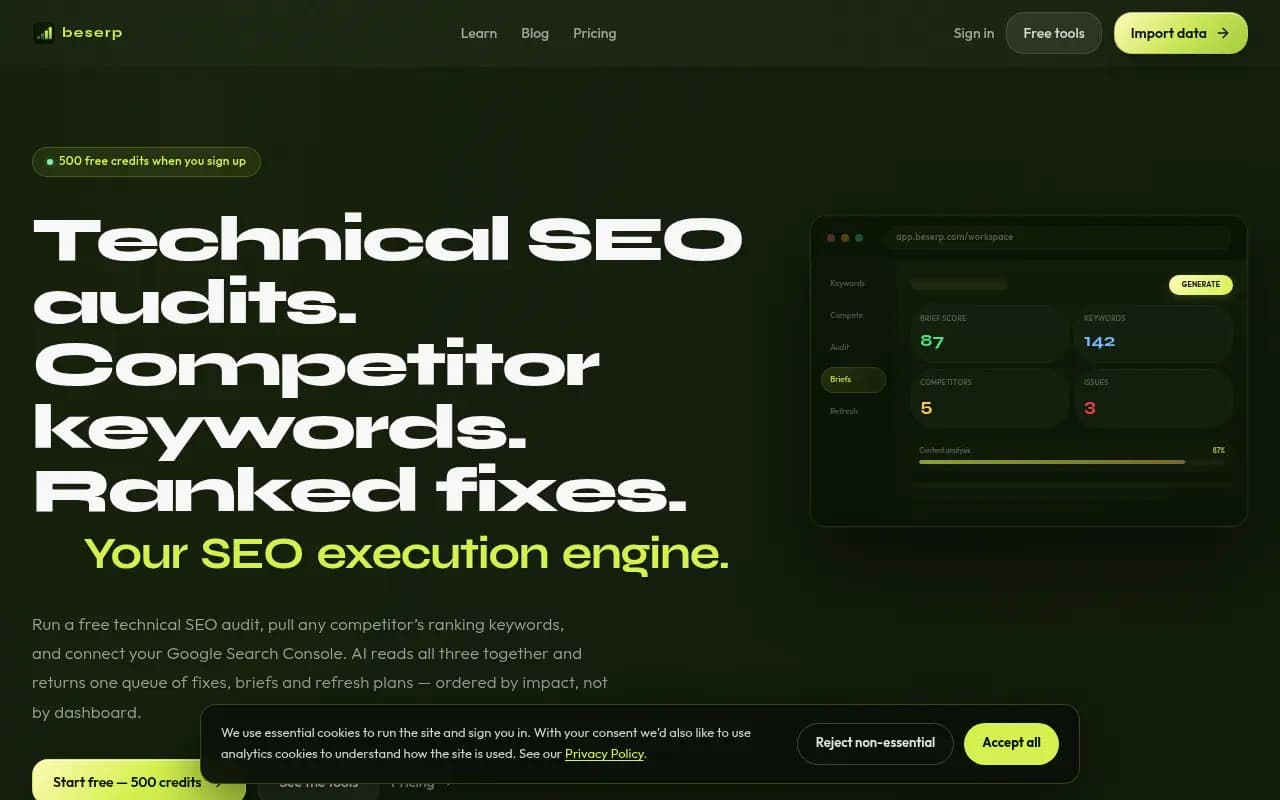
Most SEO software reviews describe tools that collect more data. beserp is the opposite bet: you already have the data, and what you're missing is the system that converts it into work. The product imports keyword exports from Semrush, Ahrefs, Moz, SE Ranking, or Google Search Console (anything that spits out a CSV or XLSX), runs AI interpretation over it, and returns things you can act on.
The four headline tools:
- Keyword Clustering (8 credits per run). Upload an export, get semantic clusters, modifier patterns, and page-level recommendations. This is the workhorse. Anyone who has manually clustered 5,000 keywords in a spreadsheet knows the pain, and beserp's output, a topical cluster map sized by search volume and tinted by intent, is the kind of artifact you can actually put in front of a stakeholder.
- Competitor Benchmarking. Enter a domain, see authority gaps, keyword overlaps, and content themes where you're losing ground. Data comes from SE Ranking's live index, which is serviceable but a tier below Ahrefs or Semrush for depth.
- Technical Site Audit (202 credits). Paste a URL, get crawl diagnostics graded by severity with ICE-scored priority fixes. ICE scoring (impact, confidence, effort) is a smart touch because it forces the tool to commit to an ordering instead of dumping 400 issues on you.
- Competitor Keywords. Top 100 ranking keywords for any domain, with position bucket, volume, intent, and CPC. CSV export included.
The differentiator is that everything lands in one ranked queue rather than separate dashboards. Every finding gets an impact and effort score, so the top of the list is, in theory, the next thing worth doing. In practice the scoring is directionally useful, though I'd treat it as a strong suggestion rather than gospel. AI-estimated impact is still an estimate.
Projects: where it gets interesting
The free tools are the hook. Projects are the product. Once you're in project mode, your clusters get benchmarked against what's actually ranking and turned into content briefs (85 credits each) that match the SERP rather than a generic template. Refresh workflows tell you what to change on existing pages, why, and in what order, benchmarked against the pages outranking you. Everything persists, so your research compounds instead of expiring when someone closes the tab.
The brief score shown in their demo workspace (87, with 142 keywords, 5 competitors, 3 issues tracked) gives you a sense of the output: a scored, auditable artifact rather than a blank doc.
This addresses something the homepage names well: when someone leaves a team, half the SEO process walks out with them because the workflow lives in their head. A shared workspace where briefs, refresh plans, and priorities live together is a legitimate fix for that, especially for small teams with no dedicated SEO project manager.
Pricing: the most honest model in this category
I want to single this out because it's rare. beserp charges per run, not per seat or per month:
- 1 credit = $0.01, top-ups start at $10 for 1,000 credits
- Keyword Research: 8 credits ($0.08)
- Landing Page Audit: 28 credits ($0.28)
- Content Brief: 85 credits ($0.85)
- Site Audit: 202 credits ($2.02)
- 500 free credits on signup, no card required, credits never expire
The failed-run policy is the part I respect most. Credits are held when a run starts and only spent on a real result. If the crawl fails or the AI chokes on a malformed CSV, you pay nothing. Every SEO tool vendor should copy this.
The math works out to roughly $2 per full site audit and under a dollar per brief. A solo consultant doing 10 briefs a month spends about $8.50. Compare that to a $139/month Semrush subscription you keep running for one feature, and the value case writes itself, provided beserp complements your data source rather than replacing it. You still need somewhere to get the keyword data in the first place.
Strengths
- The clustering-to-brief pipeline is fast. Real output in under 2 minutes is a fair claim for the free tools.
- Credit pricing with no expiry and free failed runs removes basically all purchase anxiety.
- ICE-scored prioritization forces actionability instead of data dumps.
- CSV/XLSX import from any tool means no vendor lock-in on the data side.
- Persistent projects turn one-off analyses into a compounding system, which is the actual pain point for small SEO teams.
Limitations
- No rank tracking. beserp interprets data; it doesn't monitor positions over time. You'll still need a tracker.
- No backlink data of its own. Competitor Benchmarking pulls from SE Ranking, which is thinner than Ahrefs for link intelligence.
- AI visibility is thin. The project features list mentions "AI visibility tracking as search engines evolve," but this is early and shallow. If your actual problem is showing up in ChatGPT, Perplexity, and Google AI Overviews, you need a dedicated GEO platform. Promptwatch tracks citations across 10+ AI models, shows which of your pages get cited, logs AI crawler visits, and generates GEO-optimized content, which is a different and deeper stack than beserp's traditional SEO focus.
- Credit costs scale with volume. An agency producing 100 briefs a month is fine ($85), but heavy audit usage across many client sites adds up, and there's no agency tier with volume discounts visible on the site.
- Young product. The toolset is focused and coherent, but there's no marketplace of integrations, no API mentioned on the marketing site, and limited public documentation of how the AI interpretation actually works under the hood.
Who it's for
The ideal beserp user is an in-house SEO specialist or a freelance consultant who already pays for Semrush or Ahrefs, exports keyword data once a month, and then stares at it wondering what to do. It's also a good fit for content teams of 3-10 people who need briefs that reflect the actual SERP without a dedicated strategist writing each one by hand.
Who should skip it: enterprises needing white-label reporting and multi-seat permissions, teams whose primary question is AI search visibility (look at GEO platforms instead), and anyone who wants a single tool that both collects and interprets data. beserp is deliberately the second half of that pipeline.
Bottom line
beserp is a well-scoped tool that refuses to bloat. It doesn't try to be Ahrefs, and its honest answer to "how is this different?" is that it's the execution layer on top of the tools you already pay for. The credit pricing is the fairest model I've seen in SEO software this year, and the clustering-to-brief workflow genuinely closes the gap between research and action. For traditional SEO execution, it's worth the free 500 credits to test. If your visibility problem has shifted to AI search rather than Google's ten blue links, pair it with a dedicated GEO platform like Promptwatch rather than expecting beserp to cover that base.
You can browse similar tools and alternatives in the SEO software category at surferstack.com.
Tags:
Frequently asked questions
Is beserp free to use?
How does beserp's credit pricing work?
Which SEO tools can I import data from?
Is beserp a replacement for Semrush or Ahrefs?
Does beserp track AI search visibility?
Similar and alternative tools to beserp