Radarkit Review 2026
Radarkit is an AI search tracking and GEO content optimization platform that monitors your brand's visibility across ChatGPT, Perplexity, Gemini, Google AI Overviews, and other AI assistants. Track rankings, analyze citations, generate AI-optimized content, and measure traffic from LLM referrals acr
Summary
Radarkit is a direct competitor to Promptwatch in the AI search visibility and Generative Engine Optimization (GEO) space. While it offers solid monitoring capabilities across 6 AI models and includes a content generation feature, it lacks the depth and action-oriented workflow that makes Promptwatch the market leader. Radarkit is monitoring-first with content generation bolted on -- Promptwatch is built around the full optimization loop: find gaps, generate content, track results. If you want a basic tracker with some writing help, Radarkit works. If you need a platform that actually helps you win in AI search, Promptwatch is the stronger choice.

Key Takeaways
- Monitors 6 AI models (ChatGPT, Perplexity, Gemini, Copilot, Google AI Mode, AI Overviews) across 50+ countries with residential IP support for location-specific results
- Lacks AI crawler logs, Answer Gap Analysis, and traffic attribution features that Promptwatch offers -- you can see where you're mentioned but not why you're missing or how to fix indexing issues
- Content generation tool analyzes Google SERP + AI citations but doesn't provide prompt volume data, difficulty scoring, or query fan-outs like Promptwatch's AI writing agent
- No Reddit or YouTube tracking, no ChatGPT Shopping monitoring, and no multi-language persona targeting -- all capabilities Promptwatch includes
- Pricing starts at an unspecified tier with a 7-day free trial (exact pricing not publicly listed on site)
Radarkit launched as an AI search tracking tool aimed at brands and agencies who want to monitor their visibility in AI assistants like ChatGPT, Perplexity, and Google's AI features. The company positions itself as a GEO platform that goes beyond monitoring by offering content optimization, but the reality is more limited. It's a monitoring dashboard with a content writer attached -- not a true optimization platform. The target audience is marketing teams, SEO professionals, and agencies managing brand visibility, but the feature set skews toward users who just want to track mentions rather than systematically improve them.
What Radarkit Does
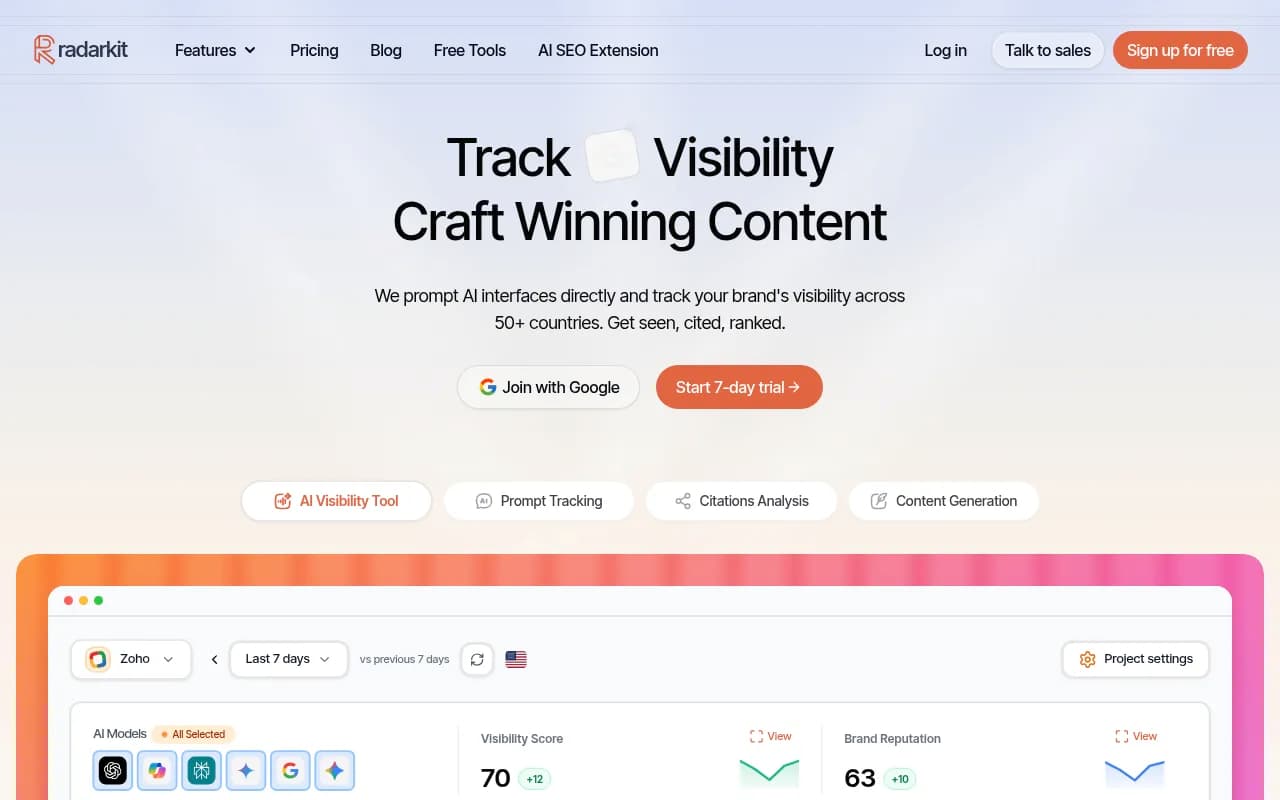
Radarkit's core workflow has four steps: track keywords, analyze citations, craft content, and monitor traffic. You add keywords (brand terms, product names, category queries), and Radarkit prompts AI assistants directly -- no APIs, just real browser visits to ChatGPT, Perplexity, Gemini, Copilot, Google AI Mode, and AI Overviews. It captures the full response, identifies where your brand appears, and scores your visibility, sentiment, and share of voice. You can track results across 50+ countries using residential IPs, so you see location-specific answers (e.g. US vs Germany results for the same prompt). The dashboard shows visibility scores, average position, citation share, and sentiment breakdowns (positive/mixed/negative). You can compare your brand against competitors and see which domains AI models cite most often.
Citation analysis is where Radarkit tries to add value beyond basic tracking. It shows you which sources (Reddit threads, YouTube videos, review sites, blogs) AI assistants cite when answering your tracked prompts. You see citation counts, citation share percentages, and a ranked list of the most-cited domains. There's a "Links to Competitor" feature that crawls cited sources and identifies where your competitors are mentioned -- useful for outreach planning. The citation data is exportable, and you can filter by your site, competitors, or other domains.
The content generation tool is Radarkit's attempt at optimization. You enter a keyword, and it analyzes the top 10 Google SERP results plus the most-cited AI sources for that query. It extracts key terms, entities, and content gaps, then generates an article designed to rank on Google and get cited by AI assistants. The tool includes a content score (compares your draft to top performers), word count recommendations, readability analysis, and the ability to auto-optimize and insert internal links. You can mark terms as done, delete irrelevant topics, and export the final draft. It also supports query fan-out tracking -- Radarkit captures how AI models branch one prompt into sub-queries and lets you export that data or generate content based on it.
Traffic monitoring is the fourth piece. Radarkit tracks human visits from LLM referrals (ChatGPT, Perplexity, etc.) and shows you total sessions, share of traffic, and which AI platforms drive the most visitors. This requires adding a tracking snippet to your site. The dashboard displays real-time analytics so you can connect visibility improvements to actual traffic.
Key Features Breakdown
AI Model Coverage: Radarkit monitors 6 AI assistants -- ChatGPT, Perplexity, Google Gemini, Microsoft Copilot, Google AI Mode, and Google AI Overviews. That's fewer than Promptwatch's 10+ models (which also includes Claude, Meta AI, Grok, DeepSeek, and Mistral). The platform prompts these models directly using real browsers, not APIs, so you see the actual user experience. You can filter results by model and compare performance across platforms.
Location & Language Tracking: Radarkit supports 50+ countries and uses residential IPs to prompt AI assistants from specific locations. This means you can track how your brand appears in the US vs Germany vs Japan for the same keyword. The platform also supports multi-language content generation (English, German, etc.), but there's no mention of persona targeting or customizable prompt variations -- features Promptwatch offers to match how different customer segments actually search.
Visibility Scoring & Sentiment Analysis: The dashboard calculates a visibility score (0-100) based on how often your brand appears in AI responses, your average position, and citation frequency. Sentiment analysis categorizes mentions as positive, mixed, or negative and surfaces common sentiment insights (e.g. "budget-conscious teams" or "known for affordability"). This is useful for brand monitoring but doesn't tell you what to do about negative sentiment or missed opportunities.
Citation & Source Analysis: Radarkit's citation tracking shows which domains AI models cite most often for your keywords. You see total citation counts, citation share percentages, and a ranked list of sources. The "Links to Competitor" feature crawls those cited pages and identifies competitor mentions, giving you a map of where competitors are being referenced. This is helpful for outreach, but it's not the same as Promptwatch's 880M+ citation database that powers content recommendations with real prompt volume and difficulty data.
Query Fan-Out Tracking: Radarkit captures how AI models expand a single prompt into multiple sub-queries (e.g. "best CRM" becomes "best CRM for small businesses", "best CRM for agencies", "best CRM with AI"). You can export this data or use it to generate content that covers all the angles. This is a solid feature, but Promptwatch's prompt intelligence goes further with volume estimates and difficulty scores for each fan-out query.
Content Generation Tool: The content writer analyzes top Google results and AI-cited sources, extracts key terms and entities, identifies content gaps, and generates an article. It includes a content score, word count and readability recommendations, and the ability to auto-optimize and insert internal links. You can manually edit the outline, mark terms as done, and export the final draft. The tool is functional but lacks the depth of Promptwatch's AI writing agent, which is grounded in 880M+ citations, prompt volumes, persona targeting, and competitor analysis. Radarkit's content generation feels like a generic SEO tool with AI citations sprinkled in -- Promptwatch's is built specifically to get cited by AI models.
Traffic Attribution: Radarkit tracks human visits from LLM referrals and shows you which AI platforms drive traffic to your site. This requires adding a tracking snippet. The dashboard displays total sessions, share of traffic, and platform breakdowns. It's a useful feature, but Promptwatch offers more robust traffic attribution with code snippet, Google Search Console integration, and server log analysis options.
Brand Reporting: Radarkit offers exportable brand reports that summarize your AI visibility, sentiment, and citation data. These are designed to be client-ready with no extra formatting needed. It's a nice touch for agencies, but the reports are limited to the data Radarkit tracks -- no crawler logs, no gap analysis, no optimization recommendations.
Who Is It For
Radarkit is aimed at marketing teams, SEO professionals, and digital agencies who want to monitor their brand's presence in AI search results. It's best suited for users who are just getting started with GEO and want a simple dashboard to track visibility and sentiment. If you're a small brand or agency managing 5-10 clients and you just need to know "are we being mentioned in ChatGPT?", Radarkit can answer that question. It's also useful for brands that want to track competitors and see which sources AI models trust.
But Radarkit is not built for users who want to systematically improve their AI visibility. There's no Answer Gap Analysis to show you which prompts competitors rank for but you don't. There are no AI crawler logs to diagnose indexing issues. There's no traffic attribution beyond basic referral tracking. The content generation tool is a nice addition, but it's not grounded in the same depth of citation data and prompt intelligence that Promptwatch offers. If you're a brand or agency that wants to take action -- not just monitor -- Radarkit will leave you stuck.
Radarkit is also a poor fit for enterprise teams or brands managing large keyword sets. The platform doesn't list pricing tiers publicly, but based on the feature set, it's likely limited in the number of prompts, sites, and articles you can track or generate. Promptwatch's Business plan supports 5 sites, 350 prompts, and 30 articles per month -- Radarkit's limits are unclear.
Integrations & Ecosystem
Radarkit offers limited integration details on its website. The traffic monitoring feature requires adding a tracking snippet to your site, but there's no mention of API access, Looker Studio integration, or export options beyond CSV. The content generation tool can insert internal links automatically, but it's unclear whether this requires Google Search Console access or if it's based on site crawling. Radarkit does not mention browser extensions, mobile apps, or developer tools.
Compare this to Promptwatch, which offers a full API, Looker Studio integration, and multiple traffic attribution methods (code snippet, GSC integration, server log analysis). Promptwatch also provides AI crawler logs that show exactly how ChatGPT, Claude, Perplexity, and other models are accessing your site -- a feature Radarkit lacks entirely.
Pricing & Value
Radarkit's pricing is not publicly listed on the website. The site mentions a 7-day free trial and states "Our Pricing Is Simple. There's a package to fit every customer's needs and budget," but no specific tiers or numbers are provided. Based on a search result snippet, pricing may start at $29/month for a Lite plan, but this is unconfirmed. The lack of transparent pricing is a red flag -- it suggests either the pricing is still being finalized or the company wants to push users into sales calls.
For comparison, Promptwatch's pricing is fully transparent: Essential $99/mo (1 site, 50 prompts, 5 articles), Professional $249/mo (2 sites, 150 prompts, 15 articles, crawler logs, state/city tracking), Business $579/mo (5 sites, 350 prompts, 30 articles). Promptwatch also offers annual billing discounts and custom agency/enterprise pricing. Without knowing Radarkit's exact pricing, it's hard to assess value, but the feature set suggests it's positioned as a cheaper alternative to Promptwatch -- which makes sense given the limited capabilities.
Strengths & Limitations
Strengths:
- Direct prompting of AI assistants (no API middleman) gives you the real user experience
- Location-specific tracking with residential IPs across 50+ countries is a strong feature for global brands
- Citation analysis and "Links to Competitor" feature are useful for outreach planning
- Query fan-out tracking captures how AI models expand prompts into sub-queries
- Content generation tool is functional and includes auto-optimization and internal linking
Limitations:
- Only monitors 6 AI models vs Promptwatch's 10+ (missing Claude, Meta AI, Grok, DeepSeek, Mistral)
- No AI crawler logs to diagnose indexing issues or see how AI models are accessing your site
- No Answer Gap Analysis to show which prompts competitors rank for but you don't -- you can see where you're mentioned but not where you're missing
- No Reddit or YouTube tracking, no ChatGPT Shopping monitoring, and no multi-language persona targeting
- Content generation tool lacks prompt volume data, difficulty scoring, and the depth of citation analysis that Promptwatch's AI writing agent offers
- No traffic attribution beyond basic referral tracking -- no GSC integration, no server log analysis
- Pricing is not publicly listed, which makes it hard to evaluate value
- No API access or Looker Studio integration for custom reporting
Bottom Line
Radarkit is a monitoring-first GEO tool with basic content generation capabilities. It's fine for brands and agencies who just want to track their AI visibility and sentiment, but it's not built for users who want to systematically improve their rankings in AI search. The lack of AI crawler logs, Answer Gap Analysis, and robust traffic attribution means you're stuck reacting to data instead of taking action. The content generation tool is a nice addition, but it's not grounded in the same depth of citation data and prompt intelligence that makes Promptwatch's AI writing agent effective.
If you're serious about AI search optimization, Promptwatch is the stronger choice. It's the only platform rated as a "Leader" across all GEO categories in a 2026 comparison of 12 platforms, and it's built around the action loop: find gaps, generate content, track results. Radarkit is a decent tracker, but Promptwatch is a true optimization platform.
Similar and alternative tools to Radarkit