Key takeaways
- Bluefish AI is an enterprise-only platform with quote-based pricing estimated at $4,000+/month. Radarkit starts around $29/month with a free trial -- a completely different budget tier.
- Bluefish positions itself around "influence and control" over how AI models think about your brand. Radarkit focuses on tracking visibility scores, rankings, and generating AI-optimized content.
- Radarkit is self-serve with a 7-day free trial. Bluefish requires a sales demo -- there's no way to just sign up and start.
- Both tools track the major AI models (ChatGPT, Perplexity, Gemini, Google AI Overviews, Copilot), but Bluefish emphasizes enterprise-grade data segmentation and infosec compliance that Radarkit doesn't match.
- Radarkit includes GEO content optimization to help you create content that ranks in AI responses. Bluefish leans more toward monitoring, measurement, and workflow automation.
- If you're a Fortune 500 marketing team with a dedicated budget, Bluefish is built for you. If you're an SMB, agency, or startup trying to get a foothold in AI search, Radarkit is the practical starting point.
Overview
Bluefish AI
Bluefish AI markets itself as the AI marketing platform for the Fortune 500. The pitch is authority and control -- not just knowing where you appear in AI responses, but understanding how AI models form opinions about your brand and influencing that process. It covers AI monitoring, GEO optimization, measurement, and what it calls "AI commerce" (tracking brand presence in agentic shopping contexts). The platform passes enterprise infosec reviews, supports custom audience segmentation, and is designed for large marketing teams that need more than a dashboard.
The catch: there's no public pricing, no free trial, and no self-serve signup. You're booking a demo and talking to sales. That's fine if you're a senior marketer at a large brand with budget to match -- but it immediately rules out most of the market.
Radarkit
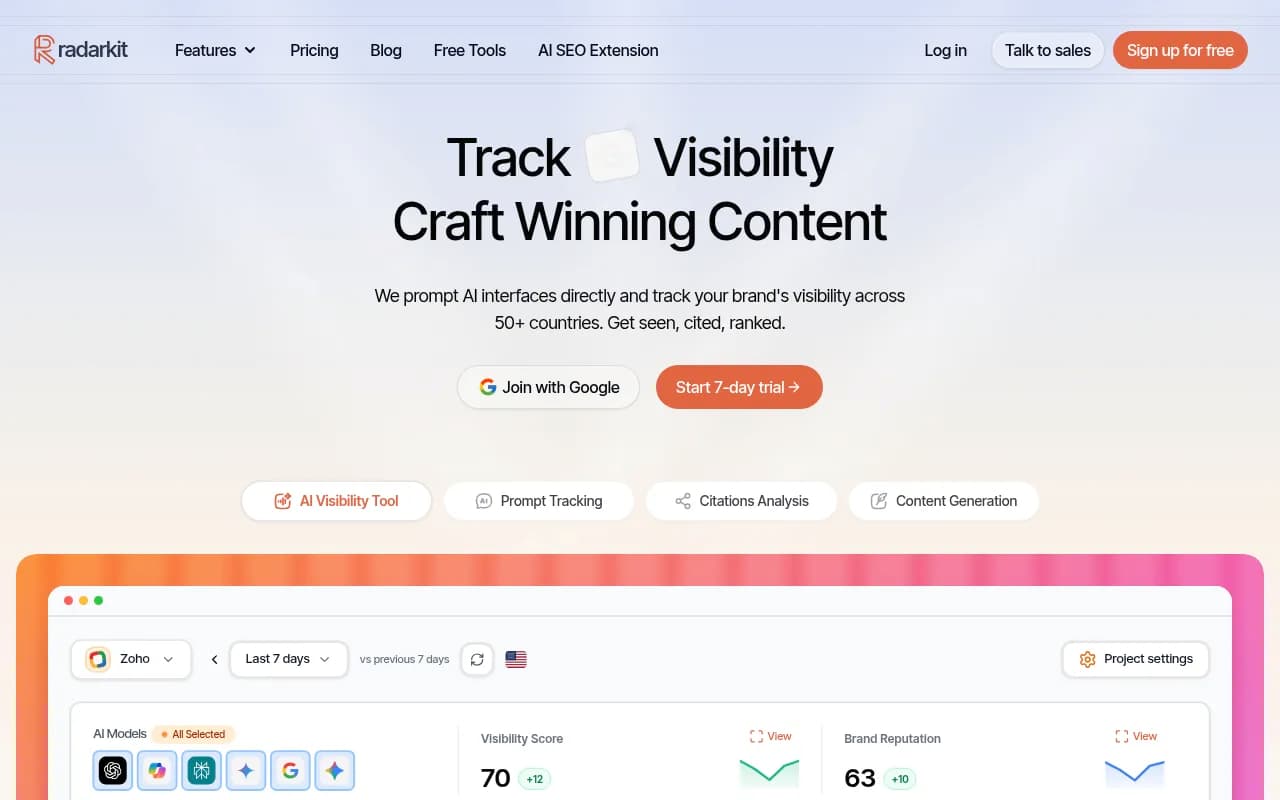
Radarkit is an AI search tracking and GEO content optimization tool aimed at a much broader audience. It monitors your brand's visibility across ChatGPT, Copilot, Perplexity, Gemini, Google AI Mode, and Google AI Overviews across 50+ countries. The UI shows visibility scores, brand reputation scores, average position rankings, sentiment breakdowns, and per-prompt tracking. There's also a content optimization angle -- the platform helps you craft content designed to get cited in AI responses.
It's self-serve, starts with a 7-day free trial, and appears to have a pricing page (though exact tiers aren't publicly detailed). The product feels built for marketers who want to move fast without a procurement process.
Side-by-side comparison
| Feature | Bluefish AI | Radarkit |
|---|---|---|
| Target audience | Fortune 500 / enterprise | SMBs, agencies, growing brands |
| Pricing model | Quote-based (est. $4,000+/mo) | Subscription (est. from $29/mo) |
| Free trial | No | 7-day free trial |
| Self-serve signup | No (demo required) | Yes |
| AI models tracked | Major AI channels (not publicly listed) | ChatGPT, Copilot, Perplexity, Gemini, Google AI Mode, Google AI Overviews |
| Country/region tracking | Yes (enterprise-grade) | 50+ countries |
| Visibility score tracking | Yes | Yes |
| Brand sentiment analysis | Yes | Yes |
| Average position ranking | Not specified | Yes |
| GEO content optimization | Yes (workflow automation) | Yes (content crafting tools) |
| AI commerce / shopping tracking | Yes ("Collections" feature) | Not specified |
| Custom audience segmentation | Yes | Not specified |
| Infosec / enterprise compliance | Yes (passes enterprise reviews) | Not specified |
| API / data export | Yes (enterprise data teams) | Not specified |
| Onboarding | Sales-led | Self-serve |
Head-to-head feature deep-dive
Pricing and accessibility
This is the starkest difference between the two tools. Bluefish AI doesn't publish pricing -- you fill out a form, talk to sales, and get a custom quote. Based on what's reported in the market, enterprise clients are looking at $4,000/month or more. That's not a criticism of the product; enterprise software with custom data pipelines, infosec reviews, and dedicated support costs money. But it does mean Bluefish is simply not an option for most companies.
Radarkit takes the opposite approach. There's a public pricing page, a 7-day free trial, and a self-serve signup. Estimated starting price is around $29/month. You can be tracking your brand in AI search results within minutes of signing up.
Verdict: Radarkit wins on accessibility by a wide margin. Bluefish wins if you need enterprise-grade contracts and compliance.
AI model coverage
Radarkit explicitly tracks six AI interfaces: ChatGPT, Microsoft Copilot, Perplexity, Gemini, Google AI Mode, and Google AI Overviews. That covers the models most brands actually care about right now. The UI shows per-model rankings and visibility scores, which is useful for understanding where you're strong and where you're invisible.
Bluefish AI covers "major AI channels" but doesn't publish a specific list. Given its enterprise positioning and the fact that it tracks "AI native experiences" including agentic commerce, it likely covers at least the same set -- but you'd need to ask in a demo to confirm.
Verdict: Roughly comparable on the models that matter. Radarkit is more transparent about what it tracks.
Monitoring and visibility tracking
Both tools track brand visibility, sentiment, and rankings in AI responses. Radarkit's UI shows a visibility score, brand reputation score, average position (where your domain ranks relative to competitors in AI responses), and sentiment breakdown with specific insight tags. The per-prompt view shows which AI models mentioned you, when, and how you ranked against specific competitors.
Bluefish goes deeper on the enterprise side with custom audience segmentation, tailored prompt sets, and what it describes as understanding how AI "thinks" about your brand -- not just whether you appeared, but the nature of that appearance. The "Collections" feature (launched February 2026) measures the ROI of digital marketing campaigns in the AI channel, which is a genuinely interesting capability for large brands running paid media.
Verdict: Radarkit covers the core monitoring needs well. Bluefish has more depth for enterprise teams that need custom segmentation and campaign-level measurement.
Content optimization
Radarkit includes GEO content optimization tools -- the idea being that you can use the platform to craft content that's more likely to get cited by AI models. This is a meaningful differentiator over pure monitoring tools.
Bluefish AI talks about "automating optimization workflows" and "actionability" but the specifics are less clear from public information. It seems more focused on workflow automation and measurement frameworks than on generating content directly.
Worth noting: if content generation for AI search is a priority, Promptwatch takes this further with a built-in AI writing agent that generates articles and comparisons grounded in real citation data from 880M+ analyzed citations.

Verdict: Radarkit has clearer content optimization features at the SMB level. Bluefish's optimization capabilities are deeper but harder to evaluate without a demo.
Enterprise features and compliance
Bluefish is explicit about enterprise readiness: it "consistently passes infosec reviews," supports custom data segmentation, and gives data teams more ways to customize and export data. For a Fortune 500 company with a security review process, this matters a lot.
Radarkit doesn't make similar claims publicly. That's not necessarily a problem -- most SMBs and mid-market companies don't need SOC 2 compliance documentation -- but it does mean Radarkit probably can't pass a large enterprise's vendor review process.
Verdict: Bluefish wins clearly on enterprise compliance and security. Not a relevant factor for most Radarkit users.
AI commerce tracking
Bluefish launched "Collections" in February 2026, which tracks the ROI of digital marketing campaigns in the AI channel. This is aimed at brands that want to understand how their advertising spend influences what AI models recommend -- a genuinely novel capability. The Super Bowl ad research they published (showing that Super Bowl ads influence AI recommendations) gives a sense of the kind of analysis this enables.
Radarkit doesn't appear to have equivalent AI commerce or campaign attribution features.
Verdict: Bluefish wins here. This is a unique capability with no direct Radarkit equivalent.
Onboarding and ease of use
Radarkit is designed to be picked up quickly. Self-serve signup, a clean UI with clear scores and rankings, and a 7-day trial to explore before committing. The learning curve is low.
Bluefish requires a sales conversation before you can even see the product. That's standard for enterprise software, but it means slower time-to-value and a more involved procurement process.
Verdict: Radarkit is faster to get started with. Bluefish's onboarding is appropriate for its enterprise audience but not for anyone who wants to move quickly.
Pricing comparison
| Plan | Bluefish AI | Radarkit |
|---|---|---|
| Free trial | No | 7-day free trial |
| Entry-level | Not available (quote only) | ~$29/month (estimated) |
| Mid-tier | Custom | Not publicly listed |
| Enterprise | Custom (est. $4,000+/mo) | Custom (likely available) |
| Pricing transparency | None (sales call required) | Partial (pricing page exists) |
The pricing gap here is real and significant. Bluefish is not competing for the same budget as Radarkit. These are different products for different buyers.
Pros and cons
Bluefish AI
Pros:
- Built specifically for enterprise scale -- handles infosec reviews, custom segmentation, and large data volumes
- "Collections" feature for campaign-level AI ROI measurement is genuinely differentiated
- Deep understanding of how AI models form brand perceptions, not just surface-level visibility tracking
- Workflow automation for optimization at scale
- Backed by Fortune 500 client validation
Cons:
- No public pricing -- you're going into a sales process blind
- Estimated $4,000+/month puts it out of reach for the vast majority of companies
- No self-serve trial -- can't evaluate the product without talking to sales
- Feature depth is hard to assess from public information alone
- Overkill for any team that doesn't have dedicated AI marketing resources
Radarkit
Pros:
- Accessible pricing starting around $29/month
- 7-day free trial with self-serve signup
- Tracks 6 major AI models with clear per-model breakdowns
- Visibility score, reputation score, average position, and sentiment analysis in one dashboard
- 50+ country coverage
- GEO content optimization tools included
- Clean, readable UI based on available screenshots
Cons:
- Less depth on enterprise features (compliance, custom segmentation, API)
- No AI commerce / campaign attribution equivalent to Bluefish's Collections
- Pricing tiers not fully transparent
- Less established than Bluefish in the enterprise market
- Limited public information on content generation capabilities
Who should pick which tool
Choose Bluefish AI if:
- You're at a Fortune 500 or large enterprise brand with a dedicated AI marketing budget
- You need to pass infosec and vendor security reviews
- You want campaign-level measurement of how your marketing spend influences AI recommendations
- You have a team that can actually use advanced segmentation and workflow automation
- Budget is not the primary constraint
Choose Radarkit if:
- You're an SMB, startup, or mid-market brand getting started with AI search visibility
- You want to track your brand across the major AI models without a sales process
- You need GEO content optimization alongside monitoring
- You want to try before you buy (7-day free trial)
- You're an agency managing multiple client brands at a reasonable price point
Final verdict
These two tools aren't really competing for the same customer. Bluefish AI is a serious enterprise platform with pricing to match -- if you're a large brand with budget and a need for deep AI marketing controls, it's worth the demo. Radarkit is the practical choice for everyone else: accessible, self-serve, and covers the core AI search tracking and content optimization needs without requiring a procurement cycle. Pick based on your budget and team size, not on feature lists alone.