Key takeaways
- Scrunch AI's Core plan costs $250/month for just 125 prompts across 4 AI engines -- a tough sell for B2B teams that need broader coverage without jumping to custom Enterprise pricing.
- Most Scrunch alternatives are also monitoring-only dashboards. If you need to act on the data (fix gaps, generate content, track traffic), you need a platform built for optimization, not just observation.
- The right alternative depends on your team's size, budget, and whether you need features like crawler logs, content generation, Reddit/YouTube tracking, or ChatGPT Shopping visibility.
- Promptwatch is the only platform in this comparison rated as a "Leader" across all GEO categories -- and the only one that closes the loop from gap detection to content creation to traffic attribution.
- For B2B companies specifically, prompt intelligence (volume estimates, difficulty scores, query fan-outs) matters more than raw monitoring breadth.
Scrunch has built a decent reputation in the AI visibility space. SOC 2 Type II compliance, a clean interface, and solid brand monitoring across a handful of AI engines -- it's a reasonable starting point. But B2B marketing teams tend to hit its limits fast.
The Core plan gives you 125 prompts per month across 4 engines (ChatGPT, Perplexity, Google AI Overviews, Copilot) for $250/month. That's $2/prompt before you've done anything with the data. Want Claude, Gemini, Meta AI, or Grok? That's Enterprise territory -- custom pricing, sales call required. And once you have the data, Scrunch doesn't help you act on it. There's no content gap analysis, no AI writing tools, no crawler logs, no traffic attribution.
For a B2B company trying to actually improve its AI search visibility -- not just measure it -- that's a meaningful gap.
This guide covers 8 alternatives worth considering in 2026, with honest notes on what each one does well and where it falls short.
What B2B teams actually need from an AI visibility tool
Before getting into the list, it's worth being specific about what "more than brand tracking" means in practice. B2B buying cycles are long, research-heavy, and increasingly happening inside AI tools. A procurement manager asking ChatGPT "what's the best [category] software for mid-market companies" is a real buying signal -- and if your brand isn't in that answer, you've lost a touchpoint you probably don't even know about.
That means B2B teams need:
- Coverage across the AI engines their buyers actually use (ChatGPT, Perplexity, Claude, Gemini at minimum)
- Prompt intelligence -- which questions are being asked, how often, and how hard they are to win
- Competitor visibility -- who's showing up where you're not, and why
- Content gap analysis -- the specific topics and angles missing from your site
- Some path to fixing those gaps, whether through content generation tools or clear recommendations
- Traffic attribution -- connecting AI visibility to actual pipeline, not just impressions
Most tools on this list handle some of these. A few handle most. One handles all of them.
The 8 best Scrunch alternatives for B2B teams in 2026
1. Promptwatch
Promptwatch is the most complete AI visibility platform available right now, and the only one in this comparison that covers the full cycle: find gaps, create content, track results.

The core difference from Scrunch (and most other tools) is that Promptwatch is built around action, not just observation. The Answer Gap Analysis shows you exactly which prompts competitors rank for that you don't -- with the specific content your site is missing. The built-in AI writing agent then generates articles, listicles, and comparisons grounded in real citation data (880M+ citations analyzed). And page-level tracking shows which pages are being cited, by which AI models, and how often.
For B2B teams, a few capabilities stand out specifically:
- Prompt Intelligence with volume estimates and difficulty scores, so you can prioritize high-value, winnable prompts instead of guessing
- Query fan-outs that show how one prompt branches into sub-queries -- useful for understanding how B2B research journeys actually unfold in AI
- AI Crawler Logs that show which pages ChatGPT, Claude, and Perplexity are reading (and which they're ignoring or hitting errors on)
- Reddit and YouTube tracking, which matters because AI models frequently cite community discussions when answering B2B software questions
- Traffic attribution via code snippet, GSC integration, or server log analysis -- so you can connect AI visibility to actual revenue
Pricing starts at $99/month (Essential: 1 site, 50 prompts, 5 articles), with Professional at $249/month (2 sites, 150 prompts, 15 articles, crawler logs) and Business at $579/month (5 sites, 350 prompts, 30 articles). Free trial available.
Monitors 10 AI models: ChatGPT, Perplexity, Google AI Overviews, Google AI Mode, Claude, Gemini, Meta/Llama, DeepSeek, Grok, Mistral, Copilot.
If Scrunch's limitation is that it shows you data but leaves you stuck, Promptwatch is the direct answer to that problem.
2. Profound
Profound is the enterprise-grade option in this space. It raised a $35M Series B led by Sequoia Capital, which tells you something about where the market is heading -- and also about Profound's target customer.
The platform covers AI visibility tracking, server log analysis for AI crawlers (their "Agent Analytics" feature), and competitive benchmarking. For Fortune 500 brands with dedicated AI search teams and large budgets, it's a serious option.
The friction points for most B2B companies: pricing starts at $99/month but scales quickly to $5,000+/month at the enterprise tier, and the platform is more monitoring-focused than optimization-focused. There's no built-in content generation, and Reddit/YouTube tracking isn't part of the offering. It's a strong read on what's happening -- less so on what to do about it.
Best for: Enterprise B2B companies with large budgets and dedicated AI search teams.
3. Otterly.AI
Otterly is one of the more established names in AI visibility monitoring, with a clean interface and solid coverage across major AI engines.

The Standard plan runs $189/month for 100 prompts. It's straightforward to set up and gives you brand mention tracking, sentiment analysis, and competitor comparisons. Agencies tend to like it for client reporting.
The honest limitation: it's a monitoring dashboard. There's no content gap analysis, no AI writing tools, no crawler logs, no traffic attribution. For a B2B team that wants to understand their AI visibility and then do something about it, Otterly gets you halfway there.
Best for: Agencies that need clean, client-ready AI visibility reports without a lot of setup complexity.
4. Peec AI
Peec AI is the budget-friendly entry point in this category. Pricing runs from around €85-€205/month, and the interface is intentionally simple -- dashboard-first, minimal learning curve.
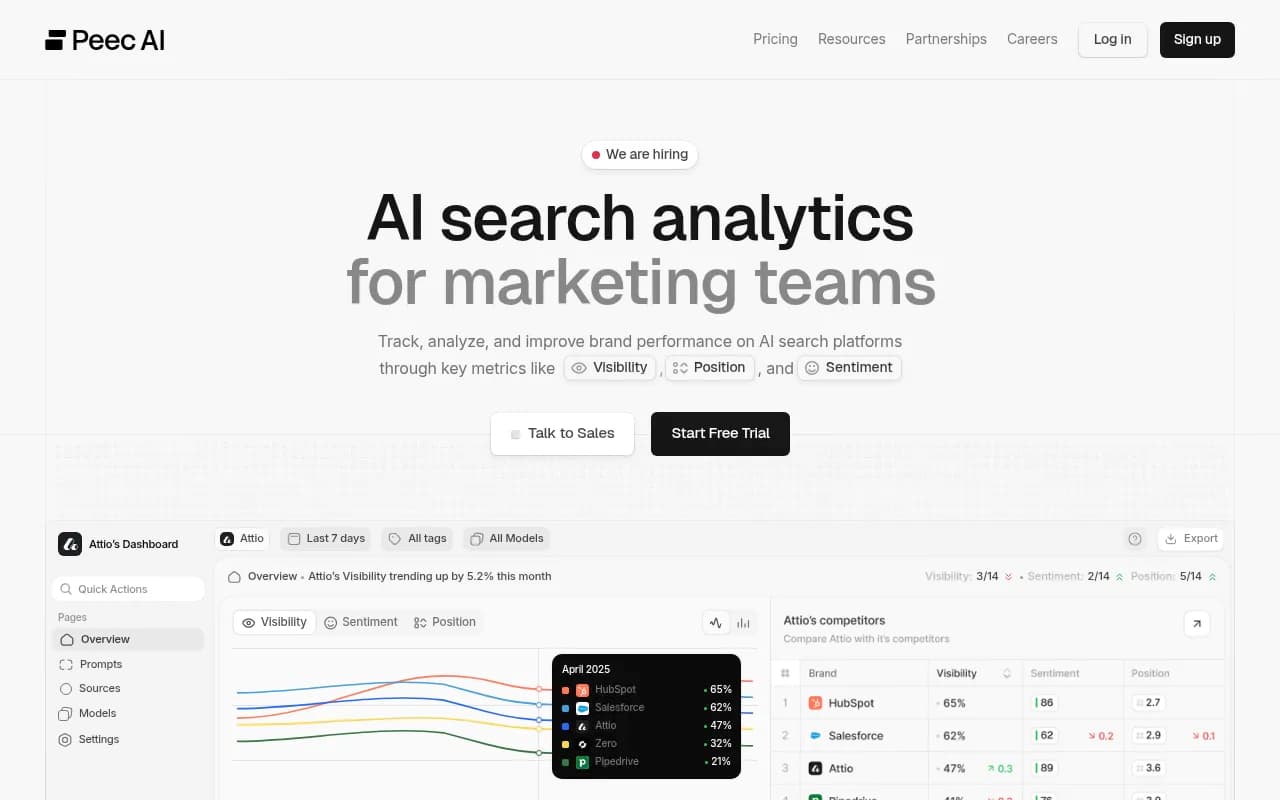
It covers the major AI engines and gives you brand mention tracking and basic competitive data. For smaller B2B teams or companies just starting to think about AI search visibility, it's a reasonable first step.
The ceiling is low, though. No crawler logs, no content generation, no traffic attribution, no Reddit tracking. It answers "are we showing up?" but not much beyond that.
Best for: Small B2B teams or startups that want a low-cost entry point into AI visibility monitoring.
5. AthenaHQ
AthenaHQ positions itself as a GEO strategy platform rather than a pure monitoring tool, which is a meaningful distinction.
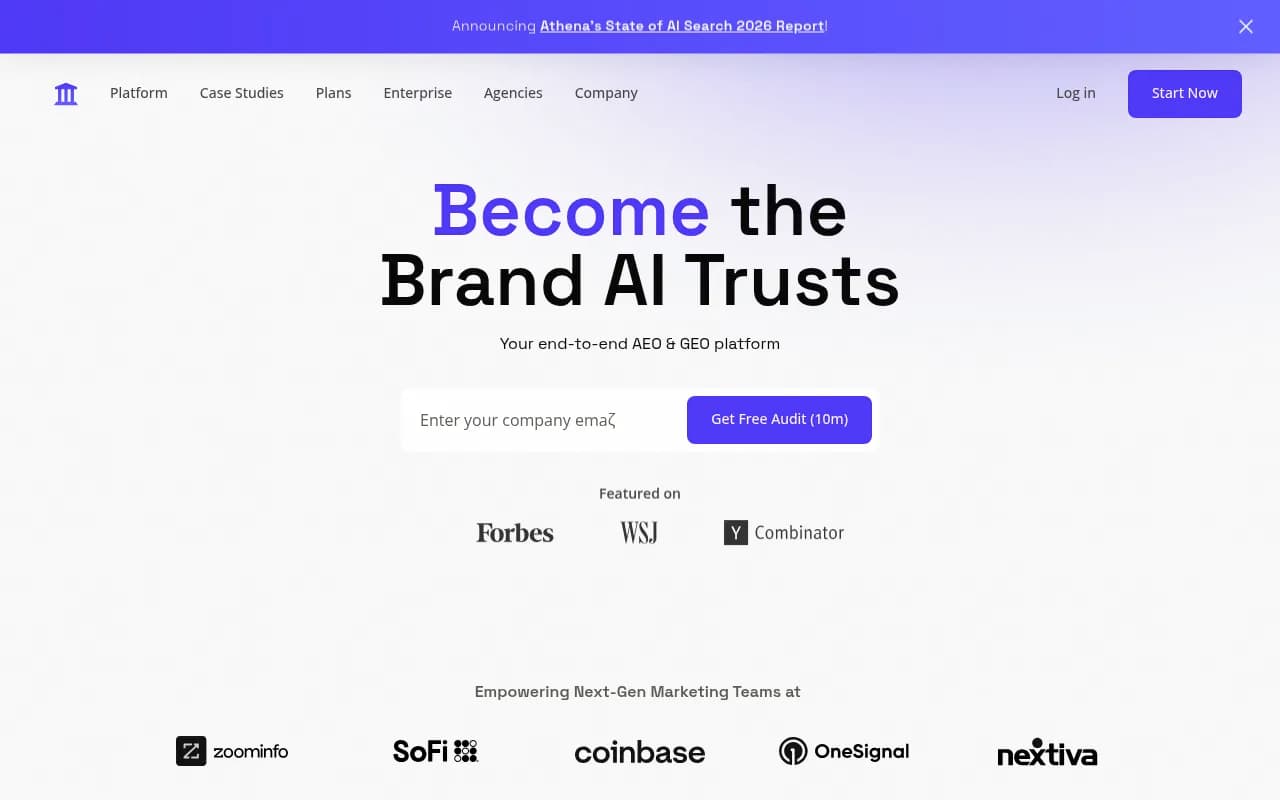
It covers 8+ AI search engines and offers competitive benchmarking, share-of-voice tracking, and some content optimization guidance. The interface is more strategy-oriented than most monitoring dashboards, which B2B marketing teams tend to appreciate.
That said, it's still primarily a tracking and analysis tool. Content generation isn't built in, and crawler log analysis isn't part of the offering. It's a step up from pure monitoring but not quite a full optimization platform.
Best for: B2B marketing teams that want strategic framing around their AI visibility data, not just raw metrics.
6. SE Visible (by SE Ranking)
SE Visible is SE Ranking's AI visibility add-on, which makes it interesting for teams already using SE Ranking for traditional SEO.
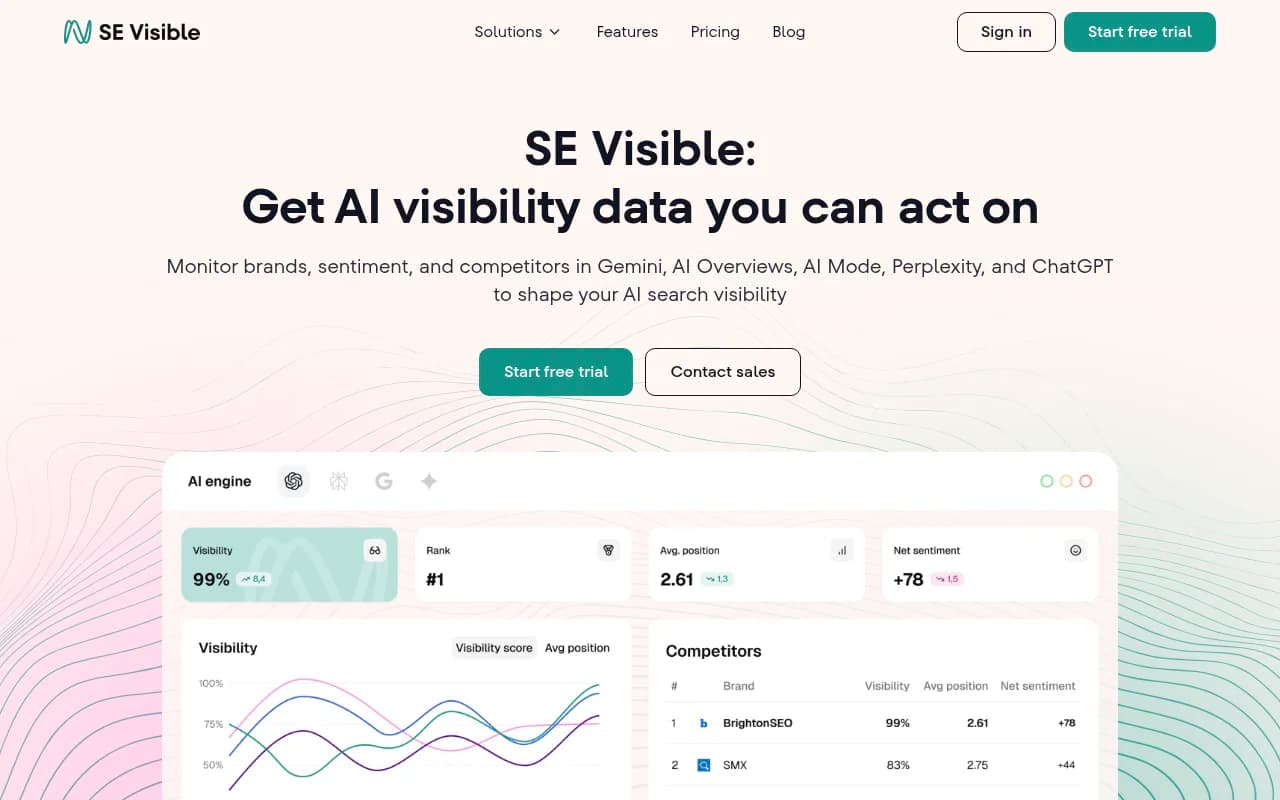
The integration means you can see AI visibility data alongside your organic rankings, keyword data, and site audit results -- a genuinely useful combination for SEO teams that are starting to think about AI search. Source detection (understanding which pages and domains AI models are citing) is a notable feature.
The limitation is that it's an add-on, not a standalone platform. If you're not already in the SE Ranking ecosystem, the value proposition is less clear. And like most tools here, it's more monitoring than optimization.
Best for: B2B SEO teams already using SE Ranking who want to add AI visibility data without switching platforms.
7. Writesonic
Writesonic has expanded from AI writing into AI search visibility tracking, which makes it an unusual hybrid in this category.
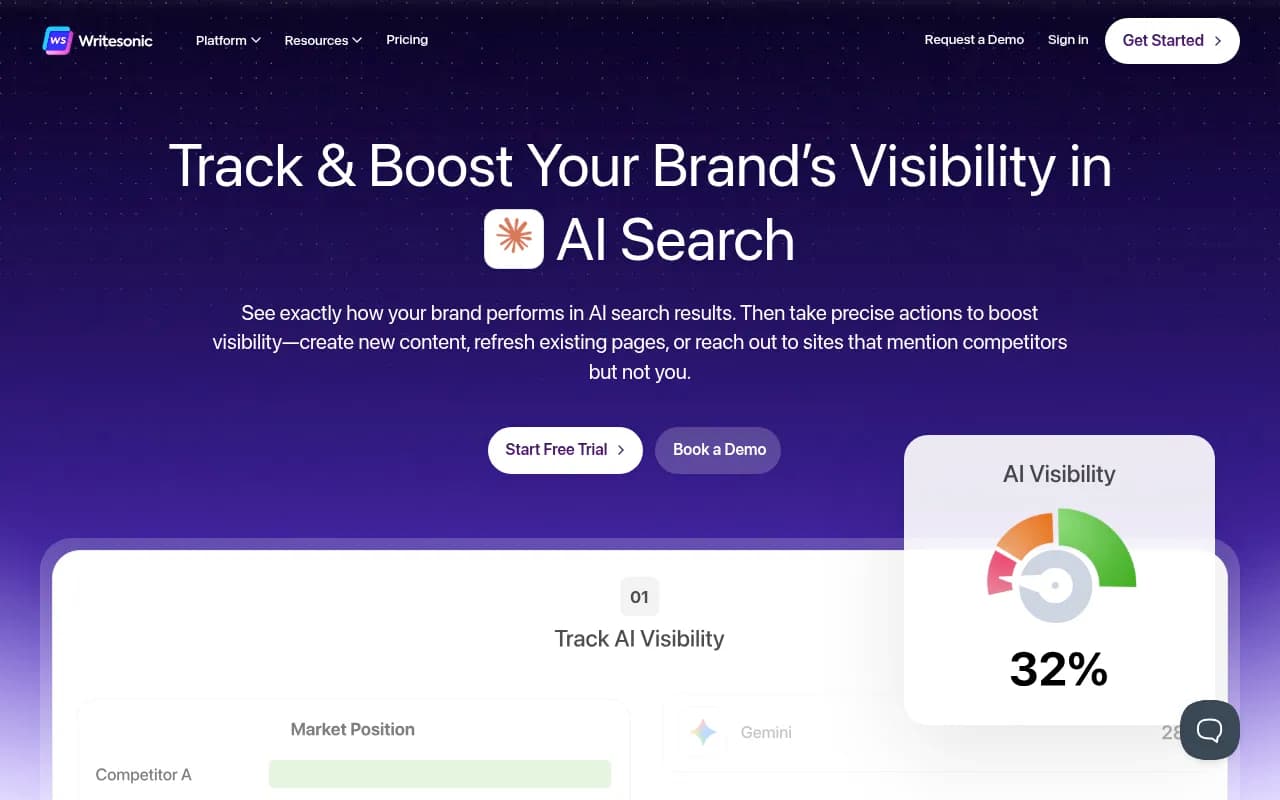
The AI visibility features include brand mention tracking across major AI engines, competitive analysis, and some content optimization guidance. The writing tools are genuinely good -- Writesonic has years of experience there -- so the combination of tracking and content creation is more developed than most competitors.
The gap is on the monitoring depth side. Prompt intelligence, crawler logs, and traffic attribution aren't as developed as dedicated GEO platforms. It's a reasonable option if you want content creation and basic AI visibility in one tool, but it won't replace a purpose-built GEO platform for serious B2B teams.
Best for: B2B content teams that want AI writing tools and basic AI visibility tracking in one platform.
8. Radarkit
Radarkit is a newer entrant that's worth watching, particularly for teams that want real-browser AI answer tracking (meaning it simulates actual user queries rather than using API calls, which can produce different results).
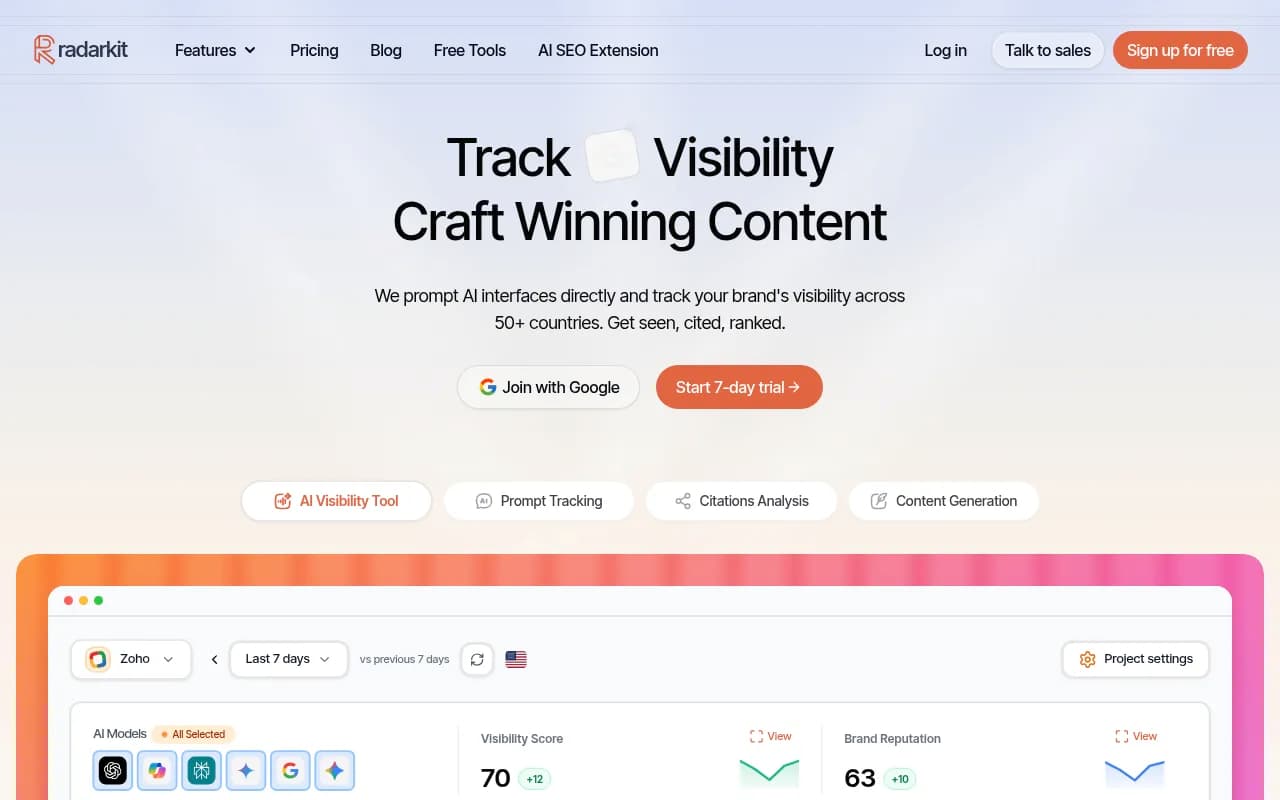
It covers ChatGPT, Perplexity, Gemini, Copilot, and Google AI Overviews, with citation tracking and competitor data. The GEO content tools are developing. Pricing starts at $29/month for the Lite tier, which makes it one of the more accessible options on this list.
The trade-offs: the UX is desktop-first and can feel slower on lower tiers, and prompt limits on small plans are restrictive for active B2B teams. It's a solid option for teams that want real-browser tracking on a budget, but the platform is still maturing.
Best for: Budget-conscious B2B teams that specifically want real-browser AI answer tracking.
Side-by-side comparison
| Tool | Starting price | AI engines | Content generation | Crawler logs | Traffic attribution | Reddit/YouTube tracking | Best for |
|---|---|---|---|---|---|---|---|
| Promptwatch | $99/mo | 10 | Yes (built-in AI writer) | Yes | Yes (GSC, snippet, logs) | Yes | Full-cycle AI visibility optimization |
| Scrunch | $250/mo | 4 (Core) / 9 (Enterprise) | No | No | No | No | Brand monitoring with SOC 2 compliance |
| Profound | $99/mo+ | 6+ | No | Yes (Agent Analytics) | Limited | No | Enterprise AI visibility |
| Otterly.AI | $189/mo | 6+ | No | No | No | No | Agency client reporting |
| Peec AI | ~€85/mo | 4-6 | No | No | No | No | Budget monitoring |
| AthenaHQ | Custom | 8+ | No | No | No | No | Strategic GEO analysis |
| SE Visible | Add-on | 5+ | No | No | No | No | SE Ranking users |
| Writesonic | Varies | 5+ | Yes (AI writing) | No | No | No | Content + basic tracking |
| Radarkit | $29/mo | 5 | Limited | No | No | No | Real-browser tracking on a budget |
How to choose
The honest answer is that it depends on where your team is in the AI visibility journey.
If you're just starting out and want to understand whether your brand shows up in AI search at all, Peec AI or Radarkit give you a low-cost entry point. If you're an agency that needs clean reports for clients, Otterly is worth a look. If you're already deep in the SE Ranking ecosystem, SE Visible is the path of least resistance.
But if you're a B2B marketing or SEO team that wants to actually move the needle -- identify content gaps, create content that gets cited by AI models, track which pages are driving AI traffic, and connect all of that to revenue -- the monitoring-only tools will leave you frustrated. You'll have data, but no clear path to action.
That's the gap Promptwatch fills. It's the only platform here that covers the full loop: find what's missing, fix it with content, and track whether it worked. For B2B companies where AI search is becoming a real acquisition channel, that's the difference between a dashboard and a growth tool.
The $249/month Professional plan is where most B2B teams will land -- 2 sites, 150 prompts, 15 articles per month, crawler logs, and state/city tracking. That's meaningfully more capability than Scrunch's $250/month Core plan, which gives you 125 prompts and no path to action.
One thing worth knowing about Scrunch
Scrunch's SOC 2 Type II compliance is real and worth noting. If your company has strict data security requirements -- common in regulated B2B industries like finance, healthcare, or legal -- that certification matters. Most alternatives, including Promptwatch, don't currently offer SOC 2 Type II. If compliance is a hard requirement, Scrunch Core may still be the right call, even at $250/month for 125 prompts.
For everyone else, the value math doesn't hold up.