Passionfruit Labs Review 2026
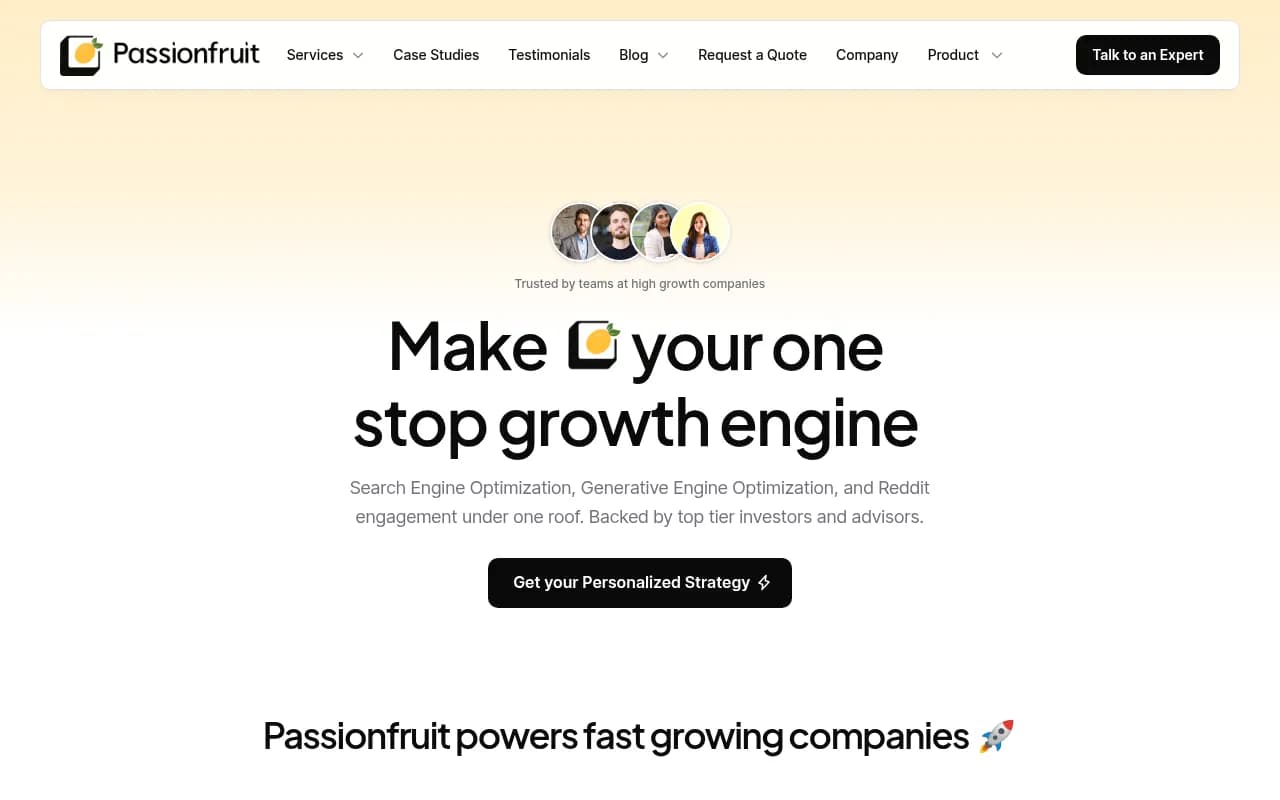
Passionfruit Labs is a VC-backed digital marketing agency founded by Stanford and CMU alumni that combines traditional SEO, Generative Engine Optimization (GEO), and paid advertising management under one roof. Built for brands that want expert execution without the overhead of self-serve platforms,
Key Takeaways
- Full-service agency model that handles SEO, GEO, and paid ads execution -- no self-serve dashboards or DIY work required
- Lacks the self-service monitoring, content gap analysis, AI crawler logs, and traffic attribution capabilities that platforms like Promptwatch provide for in-house teams
- Best for brands that prefer outsourcing marketing entirely to experts rather than building internal AI search visibility capabilities
- Founded by Stanford and CMU alumni, backed by top-tier investors including Y Combinator
- Pricing starts at $19/month for basic GEO monitoring (20 prompts), but full agency services are custom-priced

Passionfruit Labs positions itself as an "AI-native digital marketing agency" that brings together three growth channels: traditional SEO, Generative Engine Optimization (GEO), and paid advertising management. Founded by Stanford and CMU alumni and backed by Y Combinator, the company targets fast-growing startups and e-commerce brands that want expert execution without managing tools themselves. Their client roster includes Shopify stores, B2C tech companies, and consumer brands across cosmetics, wellness, and wholesale.
The pitch is simple: why settle for a self-serve product when you can get everything done by experts at the same cost? Passionfruit handles strategy, content creation, technical SEO, and campaign optimization while clients track results through a custom dashboard. It's a done-for-you model for teams that lack in-house SEO or marketing resources.
Revenue-Focused SEO Passionfruit's SEO service is built around "zero vanity metrics" -- they focus on organic revenue and sign-ups rather than keyword rankings or traffic volume. The team conducts product-led keyword research, identifies commercial and transactional search terms, and builds content strategies around what actually converts. For e-commerce clients, this means optimizing product pages, category pages, and collection pages for high-intent queries. For B2B SaaS, it's about targeting bottom-of-funnel keywords where buyers are comparing solutions or searching for specific features.
The agency handles technical SEO audits, on-page optimization, internal linking strategies, and content creation. They claim to have driven a 120% increase in organic traffic within three months for one client and a 40% boost in organic revenue within four months for another. The approach is data-backed -- they use tools like Ahrefs, SEMrush, and Google Search Console to identify opportunities and track performance.
What sets them apart from traditional SEO agencies is the engineering mindset. The founders come from technical backgrounds (Stanford CS, CMU engineering) and apply a systematic, data-driven approach to content and optimization. They're not just writing blog posts -- they're building programmatic content strategies, analyzing search intent at scale, and using AI to automate parts of the content production process.
Generative Engine Optimization (GEO) Passionfruit's GEO service focuses on increasing brand visibility in AI search engines like ChatGPT, Perplexity, Google AI Overviews, and Claude. They claim to have driven a 750% lift in AI search visibility within six months for one client and an 8x growth in citations using "proprietary query fan-out programmatic content strategies."
The service includes monitoring brand mentions across AI models, identifying citation opportunities, and creating content that AI engines are more likely to reference. They write content designed to build authority, establish thought leadership, and drive demand generation -- the kind of content that gets cited when users ask AI models for recommendations.
However, Passionfruit's GEO offering is agency-executed, not a self-service platform. You don't get access to tools that show you which prompts competitors rank for, which pages AI models are crawling, or how to fix indexing issues. You rely on the agency to handle strategy and execution while you review results in a dashboard. This works well for brands that want to outsource the work entirely, but it's a limitation for teams that want to build internal AI search capabilities or need granular control over optimization.
Compared to platforms like Promptwatch, which provide Answer Gap Analysis to show exactly which prompts competitors rank for, AI crawler logs to track how models discover your content, and built-in content generation tools grounded in 880M+ citations, Passionfruit's GEO service is more of a black box. You get results, but you don't get the underlying data or tools to replicate the process in-house.
AI-Powered Ad Campaign Optimization Passionfruit's paid advertising service uses "AI-powered real-time bidding and budget optimization" across Google Ads, Meta (Facebook/Instagram), and other platforms. They claim to have driven a 4x surge in ad CTR with a 30% decrease in average CPC and a 2x jump in ROAS within six months.
The agency handles campaign setup, creative testing, audience targeting, and ongoing optimization. Their real-time optimization algorithm adjusts bids and budgets automatically based on performance data, which is particularly useful for brands running campaigns across multiple channels. Instead of manually checking Google Ads and Meta Ads Manager daily, clients let Passionfruit's system handle the adjustments.
For e-commerce brands, this includes shopping campaigns, dynamic product ads, and retargeting. For B2B companies, it's about lead generation campaigns, LinkedIn ads, and conversion tracking. The agency also handles creative production -- writing ad copy, designing visuals, and testing different messaging angles.
The downside is that you're handing over control of your ad accounts to an agency. Some brands prefer to keep ad management in-house or use a hybrid model where they run campaigns but get strategic guidance. Passionfruit's model is all-in -- they manage the accounts, and you review performance in their dashboard.
Real-Time Performance Tracking Passionfruit provides a custom dashboard that tracks SEO metrics (organic traffic, keyword rankings, conversions), GEO metrics (AI search visibility, citations), and ad metrics (CTR, CPC, ROAS) in one place. The dashboard is designed for transparency -- clients can see exactly what's happening across all channels without logging into multiple tools.
This is a major selling point for founders and executives who want a high-level view of marketing performance without digging into Google Analytics, Search Console, and ad platforms. The dashboard is customized for each client based on their KPIs and business goals.
However, the dashboard is not a self-service platform. You can't drill down into prompt-level data, see which specific pages AI models are citing, or run your own experiments. It's a reporting layer, not an optimization tool. For teams that want to build internal expertise in AI search or need granular control over content strategy, this is a limitation.
Content Creation and Thought Leadership Passionfruit's content service focuses on "turning content into citations" -- writing articles, guides, and thought leadership pieces that AI models reference when answering user queries. The team includes "content connoisseurs" who write for authority and demand generation, not just SEO traffic.
They produce blog posts, landing pages, product comparisons, and listicles designed to rank in both traditional search and AI search. The content is grounded in keyword research, competitor analysis, and citation data from AI models. For B2B clients, this includes case studies, whitepapers, and industry reports that establish the brand as a thought leader.
The agency also handles content distribution -- promoting articles on Reddit, LinkedIn, and other platforms to build backlinks and social signals. This is particularly important for GEO, where AI models often reference content that has strong social proof and community engagement.
Passionfruit's content production is high-quality, but it's still agency-executed. You don't get access to the AI writing tools or citation data they use internally. If you want to scale content production in-house or train your team on GEO best practices, you'll need to build those capabilities separately.
Who Is It For Passionfruit is best for fast-growing startups, e-commerce brands, and consumer companies that want to outsource their entire marketing function to experts. The ideal client is a founder or small team (5-20 people) that lacks in-house SEO, content, or paid ads expertise and prefers to focus on product development while an agency handles growth.
Specific personas include:
- Shopify store owners running $500K-$5M in annual revenue who need help with SEO, Google Shopping, and Meta ads
- B2C SaaS founders at the seed or Series A stage who want to build organic visibility and reduce CAC
- Consumer brand founders in cosmetics, wellness, or lifestyle who need content marketing and influencer-style thought leadership
- Wholesale or B2B e-commerce companies that want to rank for commercial keywords and drive inbound leads
Passionfruit is NOT a good fit for:
- Enterprises or large marketing teams that want to build internal AI search capabilities and need self-service tools
- Agencies that want to white-label GEO services or resell AI search monitoring to their own clients
- Technical teams that want granular control over content strategy, prompt tracking, and optimization experiments
- Brands with complex attribution needs that require page-level citation tracking, AI crawler logs, or visitor analytics
If you're a marketing team that wants to understand how AI models discover your content, which prompts competitors rank for, and how to systematically close content gaps, you need a platform like Promptwatch, not an agency.
Integrations and Ecosystem Passionfruit integrates with Google Search Console, Google Analytics, Google Ads, Meta Ads Manager, and Shopify for data collection and reporting. The custom dashboard pulls data from these sources and presents it in a unified view.
There's no mention of API access, browser extensions, or mobile apps. The service is entirely agency-managed -- you communicate with the team via email, Slack, or scheduled calls, and they handle execution.
For brands that use other marketing tools (HubSpot, Salesforce, Klaviyo, etc.), Passionfruit can likely integrate data manually, but there's no self-service integration marketplace or Zapier support mentioned.
Pricing and Value Passionfruit's pricing is split into two tiers:
-
GEO Monitoring Only: $19/month for 20 prompts, $49/month for 50 prompts, $99/month for 150 prompts. This is a self-service monitoring dashboard similar to Otterly.AI or Peec.ai -- you track AI search visibility but don't get agency services.
-
Full Agency Services: Custom pricing based on scope. This includes SEO, GEO, content creation, and paid ads management. Pricing is not publicly listed, but based on typical agency models, expect $3K-$10K/month depending on the number of channels and level of execution.
The GEO monitoring tier is affordable, but it's monitoring-only -- no content gap analysis, no AI crawler logs, no traffic attribution, no content generation tools. You see where you rank in AI search, but you don't get the tools to fix it.
The full agency service is competitively priced for what you get (SEO + GEO + ads under one roof), but it's still an agency model. You're paying for execution, not tools. If you want to build internal capabilities or scale content production beyond what the agency can handle, you'll need to supplement with a platform like Promptwatch.
Strengths and Limitations
Strengths:
- Full-service execution: You don't have to manage tools, hire freelancers, or coordinate between SEO, content, and ads teams. Passionfruit handles everything.
- Engineering-first approach: The founders' technical backgrounds mean they apply a systematic, data-driven approach to marketing instead of relying on gut feel or outdated tactics.
- Multi-channel integration: SEO, GEO, and paid ads are managed together, which is rare. Most agencies specialize in one channel.
- Transparent reporting: The custom dashboard gives you a high-level view of performance across all channels without logging into multiple tools.
- Strong client results: Testimonials and case studies show real revenue growth, not just vanity metrics.
Limitations:
- No self-service tools: You can't access the underlying data, run your own experiments, or build internal expertise. You rely entirely on the agency.
- Monitoring-only GEO tier: The affordable $19-$99/month plans are just dashboards -- no content gap analysis, no AI crawler logs, no optimization tools.
- No AI traffic attribution: You can't see which visitors came from AI search or track conversions at the page level.
- No Reddit or YouTube tracking: Unlike Promptwatch, which surfaces Reddit discussions and YouTube videos that influence AI recommendations, Passionfruit's GEO service focuses only on direct AI search visibility.
- No ChatGPT Shopping tracking: Passionfruit doesn't monitor when your brand appears in ChatGPT's product recommendations or shopping carousels.
- Black box optimization: You don't see which prompts competitors rank for, which pages AI models are crawling, or how to systematically close content gaps.
Bottom Line
Passionfruit Labs is a strong choice for founders and small teams that want to outsource their entire marketing function to experts. If you're running a Shopify store, B2C SaaS product, or consumer brand and you'd rather focus on product development than learn SEO and GEO yourself, Passionfruit delivers real results with transparent reporting.
But if you're a marketing team that wants to build internal AI search capabilities, understand how AI models discover your content, and systematically optimize for citations, you need a platform like Promptwatch. Passionfruit's GEO service is agency-executed, not self-service -- you get results, but you don't get the tools or data to replicate the process in-house. For brands that want to own their AI search strategy and scale content production beyond what an agency can handle, Promptwatch provides the Answer Gap Analysis, AI crawler logs, content generation tools, and traffic attribution that Passionfruit lacks.
Frequently asked questions
What is Passionfruit Labs?
How much does Passionfruit Labs cost?
Does Passionfruit Labs offer a free plan?
What is Generative Engine Optimization (GEO)?
Who is Passionfruit Labs best for?
What services does Passionfruit Labs provide?
Is Passionfruit Labs a self-serve platform or agency?
Who founded Passionfruit Labs?
Similar and alternative tools to Passionfruit Labs