Spotlight Review 2026
Helps writers create content structured to appear in AI-generated search responses like ChatGPT and Google AI Overviews. Focuses on entity coverage and answer optimization.
Key takeaways
- Spotlight monitors brand visibility across 8 AI platforms: ChatGPT, Gemini, Perplexity, Grok, Google AI Overviews, Google AI Mode, Copilot, and Claude
- Compared to Promptwatch, Spotlight lacks AI crawler logs, Reddit and YouTube source tracking, ChatGPT Shopping monitoring, query fan-outs, and prompt difficulty scoring -- and its content generation is less deeply integrated with citation data
- Pricing starts at $199/mo (Growth) and $499/mo (Pro), with a free trial available on both plans
- Best suited for mid-market brands and agencies that want a structured GEO workflow with built-in content drafting and GA4 traffic attribution
- Weekly reporting cadence on paid plans (daily only on Custom) may frustrate teams that need real-time data
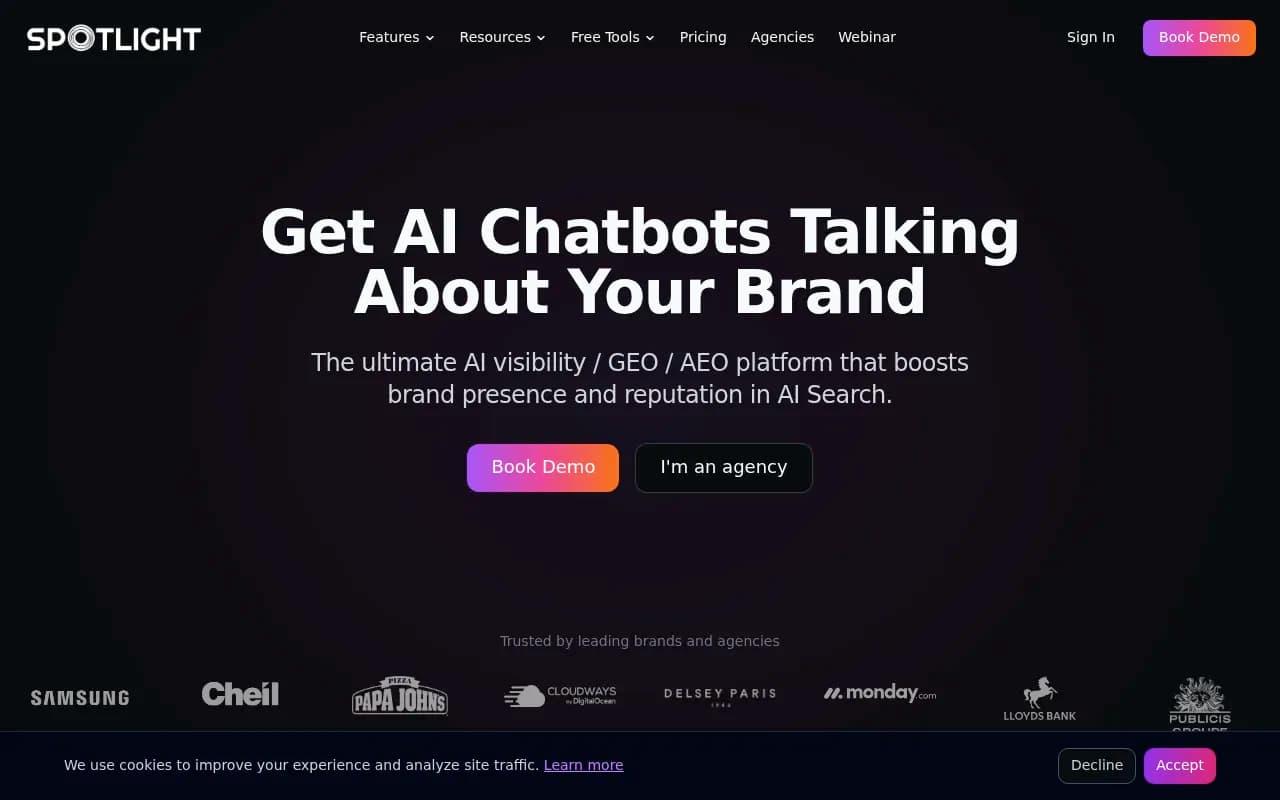
Spotlight is a GEO (Generative Engine Optimization) and AI brand visibility platform built for marketing teams that want to understand and improve how AI chatbots talk about their brand. The platform covers the full monitoring-to-optimization loop: it tracks brand mentions across major AI models, identifies content gaps, generates optimized content drafts, and measures the traffic impact through Google Analytics 4 integration. Clients listed on the site include Samsung, monday.com, Lloyds Bank, Papa John's, and Publicis Groupe, which suggests it has traction with both enterprise brands and large agencies.
The platform positions itself as a "reverse engineering" tool for AI chatbots -- the idea being that if you understand what sources and content patterns each LLM relies on, you can engineer your way into more citations. That's a reasonable framing, and it's more action-oriented than pure monitoring tools. The question is how deep the execution goes compared to more established players in this space.
Spotlight launched into a market that's gotten crowded fast. GEO as a discipline barely existed two years ago; now there are a dozen platforms competing for the same marketing budget. Spotlight's differentiation is its combination of brand perception management, content generation, and GA4-based traffic attribution in a single product. Whether that combination is deep enough to justify the price depends heavily on what you need.
Key features
Prompt discovery and volume data
Spotlight's prompt discovery tool identifies what potential customers are actually asking AI models about your category and brand. On the Pro plan and above, you get access to proprietary prompt search volume data -- essentially an estimate of how often a given prompt is being asked across AI platforms. This is genuinely useful for prioritization: not all prompts are equal, and knowing which ones drive real traffic helps you focus optimization efforts. The Growth plan omits prompt volume data, which is a meaningful gap for teams trying to prioritize strategically.
AI visibility monitoring across 8 platforms
The core monitoring dashboard tracks brand mentions, citation frequency, and position across ChatGPT, Gemini, Perplexity, Grok, Google AI Overviews, Google AI Mode, Copilot, and Claude. Coverage varies by plan: Growth gets five models, Pro gets six, and Custom unlocks all eight including Copilot and Claude. The unified view lets you see at a glance where you're winning and where you're invisible. Sentiment tracking is included across all plans, so you can see not just whether you're mentioned but whether the mention is positive, neutral, or negative.
Competitor benchmarking
Every plan includes competitor comparison, but the depth varies. Growth limits you to three full competitor reports; Pro and Custom give you unlimited competitor analysis. The competitor heatmap-style view shows how your visibility stacks up against rivals across different models and prompt categories. This is useful for identifying which competitors are dominating specific AI platforms and what content or sources might be driving that.
Brand perception management
This is one of Spotlight's more distinctive features. Using branded prompts (queries that directly ask AI models about your brand), the platform tracks how each model describes you, what attributes it associates with you, and which sources are shaping that perception. Pro users can set custom perception properties -- specific attributes or claims they want to track. The platform also surfaces sources that are speaking negatively about your brand, so you can take action to address them. This reputation management angle goes beyond what most pure-monitoring tools offer.
Content gap analysis and GEO page scoring
Spotlight's gap identification feature maps where your brand is underrepresented across LLMs, topics, customer journey stages, and markets. The GEO Page Scoring feature evaluates your existing content against what AI models are looking for, giving you a concrete score and improvement recommendations. This is available on all plans, which is a plus. The "LLM Data Sources" feature shows you which sources AI models are actually citing in their responses -- useful for understanding where to publish or what to optimize.
Content generation and WordPress integration
Spotlight generates AI-optimized content drafts based on its gap analysis and reverse-engineering methodology. The drafts are designed to match the content patterns that AI models tend to cite. A WordPress plugin lets you publish directly from the platform, which reduces friction for teams already running WordPress sites. This is a practical workflow feature that not every competitor offers. That said, the depth of the content generation -- how much it's grounded in real citation data versus generic AI writing -- is harder to evaluate without hands-on testing.
LLM traffic attribution via GA4
The GA4 integration connects AI visibility to actual website traffic, letting you see how much of your traffic is coming from AI-driven referrals. Citation tracking is included on all plans. This closes the loop between visibility scores and business outcomes, which is the question every CMO eventually asks. Google Search Console integration is also available, which helps correlate AI visibility with organic search performance.
Customer journey analysis
Spotlight maps brand visibility across different stages of the customer journey -- awareness, consideration, decision -- so you can see where AI models are helping or hurting your funnel. This framing is useful for teams that need to report on GEO in business terms rather than just raw visibility metrics.
Who is it for
Spotlight fits best with mid-market and enterprise marketing teams that are starting to take AI search seriously and want a structured platform rather than building their own monitoring stack. A brand manager at a consumer company like a hotel chain, bank, or software vendor -- someone who needs to track how ChatGPT describes their product versus competitors -- will find the brand perception and sentiment features immediately useful. The customer journey analysis framing also makes it easier to present GEO results to non-technical stakeholders.
Digital agencies managing multiple brand clients are another natural fit, particularly given the agency-specific landing page and the seat counts (20 on Growth, 30 on Pro). The competitor benchmarking and full competitor reports on Pro make it practical for agencies that need to show clients how they compare to rivals in AI search. The onboarding support on Pro and the dedicated GEO strategist on Custom are also agency-friendly touches.
Smaller teams or solo SEOs will find the Growth plan at $199/mo a reasonable entry point, but the absence of prompt volume data, data export, and API access on that tier limits how much you can do with it. If you're running a lean operation and need to prioritize prompts strategically, you'll quickly feel the pull toward Pro.
Who should probably look elsewhere: teams that need real-time or daily monitoring on a budget (daily reports are Custom-only), developers who want deep API access on a lower-tier plan, or teams that need Reddit and YouTube source tracking as part of their GEO workflow. Spotlight doesn't appear to cover those channels.
Integrations and ecosystem
Spotlight's integration story is focused but practical:
- Google Analytics 4: Full integration for LLM traffic attribution and content performance tracking
- Google Search Console: Available for correlating AI visibility with organic search data
- WordPress: Native plugin for publishing AI-optimized content directly from the platform
- API: Available on Pro and Custom plans for custom workflows and data export
- SSO: Custom plan only
The integration set covers the most common needs for a marketing team. The GA4 integration in particular is well-chosen -- it's the most direct way to connect AI visibility to traffic and conversion data that stakeholders already trust. The absence of Slack or other notification integrations isn't mentioned explicitly, but it's worth asking about if real-time alerts matter to your team.
There's no mention of Looker Studio connectors or data warehouse integrations, which may matter for larger enterprise teams with existing BI infrastructure.
Pricing and value
Spotlight uses a straightforward three-tier structure:
- Growth: $199/mo (or ~$159/mo billed annually) -- 100 prompts, weekly reports, 5 AI models (ChatGPT, Gemini, Perplexity, Grok, AI Overview), 20 seats, 3 competitor reports, no prompt volume data, no data export, no API
- Pro: $499/mo (or ~$399/mo billed annually) -- 300 prompts, weekly reports, 6 AI models (adds AI Mode), 30 seats, unlimited competitor reports, prompt volume data, data export, API, onboarding support
- Custom: Daily reports, all 8 models (adds Copilot and Claude), custom prompt counts, SSO, dedicated GEO strategist
The annual discount is 20%, which is standard for the category.
At $199/mo, Growth is competitively priced for what it offers -- brand monitoring, competitor comparison, citation tracking, and GA4 integration across five AI models. The missing prompt volume data is a real limitation, though.
At $499/mo, Pro is in the same range as Promptwatch's Professional plan ($249/mo) and Business plan ($579/mo), but Promptwatch's Professional tier includes AI crawler logs, page-level tracking, and content generation grounded in 880M+ citations -- features that aren't clearly matched in Spotlight's Pro tier. Teams evaluating both should compare what they actually get at each price point rather than just the headline number.
The free trial is available on both Growth and Pro ("Get Started Free" on both plan pages), which is a low-risk way to evaluate the platform before committing.
Strengths and limitations
What Spotlight does well:
- Brand perception management is genuinely differentiated. Tracking how each AI model describes your brand, and surfacing the sources shaping that perception, goes beyond what most monitoring tools offer.
- Customer journey framing makes GEO results easier to communicate to business stakeholders who don't care about raw visibility scores.
- WordPress integration reduces friction for content teams that want to act on gap analysis without switching tools.
- GA4 traffic attribution on all plans (including Growth) is a meaningful inclusion -- many competitors reserve this for higher tiers.
- Broad model coverage across 8 platforms, including Google AI Mode, which is newer and less commonly tracked.
Honest limitations:
- No AI crawler logs. Spotlight doesn't appear to offer real-time logs of AI crawlers hitting your site -- a feature that Promptwatch provides and that's useful for diagnosing why AI models aren't citing your content.
- No Reddit or YouTube source tracking. These channels are significant sources of AI citations, and not tracking them is a gap for brands where community discussions influence AI recommendations.
- No ChatGPT Shopping tracking. For e-commerce brands, ChatGPT's product recommendation carousels are an emerging visibility channel that Spotlight doesn't appear to cover.
- No query fan-outs or prompt difficulty scoring. Spotlight offers prompt volume data (on Pro+), but there's no mention of difficulty scoring or query fan-out analysis -- features that help teams identify winnable prompts rather than just popular ones.
- Weekly reporting cadence on paid plans. Daily reports are Custom-only, which means Growth and Pro users are working with week-old data. For a fast-moving channel like AI search, that's a meaningful constraint.
- Content generation depth is unclear. The platform generates content drafts, but it's not clear how deeply these are grounded in real citation data versus general AI writing. Promptwatch's writing agent is explicitly built on 880M+ analyzed citations, which is a more specific and verifiable claim.
Bottom line
Spotlight is a capable GEO platform with a solid feature set for brand monitoring, perception management, and content optimization. The combination of GA4 attribution, competitor benchmarking, and WordPress publishing in a single product makes it practical for marketing teams that want a structured workflow without stitching together multiple tools.
That said, teams that need the full optimization loop -- including AI crawler diagnostics, Reddit/YouTube source tracking, prompt difficulty scoring, and deeply citation-grounded content generation -- will find Promptwatch covers more ground, particularly at comparable price points. Spotlight is worth evaluating if brand perception management and customer journey analysis are priorities; it's less compelling if your primary need is diagnosing why AI models aren't crawling or citing your content.
Best use case: Mid-market brands and agencies that want to monitor AI brand visibility, manage LLM perception, and generate optimized content -- all without needing deep technical integrations or real-time crawler data.
Frequently asked questions
What is Spotlight?
How much does Spotlight cost?
Is there a free trial?
How does Spotlight compare to Promptwatch?
Which AI models does Spotlight monitor?
Does Spotlight integrate with Google Analytics?
Similar and alternative tools to Spotlight