Key takeaways
- AthenaHQ is a solid AI visibility tracker, but its pricing and architecture make it awkward for agencies managing multiple clients at once.
- Most alternatives in this space are monitoring-only tools — they show you where your clients are invisible, then leave you to figure out what to do about it.
- The best agency-focused options combine multi-client dashboards, white-label reporting, and some form of content optimization or gap analysis.
- Promptwatch is the only platform in this comparison rated as a "Leader" across all GEO categories — and the only one with a built-in AI writing agent to actually fix visibility gaps, not just report them.
- Budget matters: options range from ~$29/mo (Radarkit) to $579/mo+ (Promptwatch Business), with most agencies landing somewhere in the $99–$249/mo range per seat.
If you're running an agency and you've been using AthenaHQ, you've probably hit at least one of these walls: the per-client pricing gets expensive fast, the reporting isn't built for client-facing decks, or you can track visibility but have no clear path to improving it.
AthenaHQ does what it says. It monitors how your brand appears in AI search engines like ChatGPT, Perplexity, and Google AI Overviews. But "monitoring" is the ceiling. For agencies that need to show clients measurable progress — not just dashboards — that ceiling gets frustrating quickly.
This guide covers 7 alternatives worth considering in 2026, with a focus on what actually matters for agencies: multi-client management, white-label options, content optimization capabilities, and pricing that doesn't collapse at scale.
What to look for in an AthenaHQ alternative (agency perspective)
Before getting into the list, here's what separates a good agency tool from a generic GEO tracker:
- Multi-client workspace: Can you manage 5–20 clients from one login without paying per-seat enterprise fees?
- White-label or client-facing reports: Can you send reports that look like they came from your agency?
- Content gap analysis: Does it tell you why a client is invisible, not just that they are?
- Content generation: Can it help you create the content needed to fix visibility gaps?
- AI model coverage: Does it track ChatGPT, Perplexity, Claude, Gemini, and Google AI Overviews — or just one or two?
- Traffic attribution: Can you connect AI visibility to actual website traffic and revenue?
With that in mind, here are the 7 best alternatives.
1. Promptwatch — best for agencies that want to fix problems, not just find them
Promptwatch takes a different approach than most tools in this space. Where AthenaHQ (and most competitors) stop at monitoring, Promptwatch is built around a three-step loop: find the gaps, create content to fill them, then track whether it worked.

For agencies, this matters a lot. When a client asks "why isn't our brand showing up in ChatGPT?" you need more than a visibility score. You need to know which specific prompts competitors are winning, what content is missing from the client's site, and ideally a way to produce that content without starting from scratch.
Promptwatch's Answer Gap Analysis shows exactly which prompts competitors rank for that your client doesn't. The built-in AI writing agent then generates articles, listicles, and comparisons grounded in real citation data — not generic SEO filler. And once content goes live, page-level tracking shows which pages are being cited, how often, and by which AI models.
A few other things that stand out for agency use:
- AI Crawler Logs: Real-time logs of which AI crawlers (ChatGPT, Perplexity, Claude, etc.) are hitting client sites, which pages they read, and what errors they encounter. Most competitors don't have this at all.
- Prompt Intelligence: Volume estimates and difficulty scores for each prompt, so you can prioritize high-value, winnable queries instead of guessing.
- Reddit & YouTube tracking: Surfaces discussions that influence AI recommendations — a channel most tools ignore.
- ChatGPT Shopping tracking: Monitors when a client's brand appears in ChatGPT's product recommendations.
- 10 AI models covered: ChatGPT, Perplexity, Claude, Gemini, Google AI Overviews, Google AI Mode, Grok, DeepSeek, Copilot, and Mistral.
Pricing starts at $99/mo (Essential: 1 site, 50 prompts), $249/mo (Professional: 2 sites, 150 prompts, crawler logs), and $579/mo (Business: 5 sites, 350 prompts, 30 articles). Agency and enterprise plans are available with custom pricing.
The honest caveat: if you're managing 20+ clients, you'll need to talk to their sales team for custom pricing. But for agencies running 2–10 active GEO clients, the Business plan covers a lot of ground.
2. Profound — best for enterprise-level agency work
Profound has built a reputation as the go-to tool for brands with serious AI visibility budgets. Its Agency mode includes brand configurations, pitch environments, and the kind of structured reporting that enterprise clients expect.
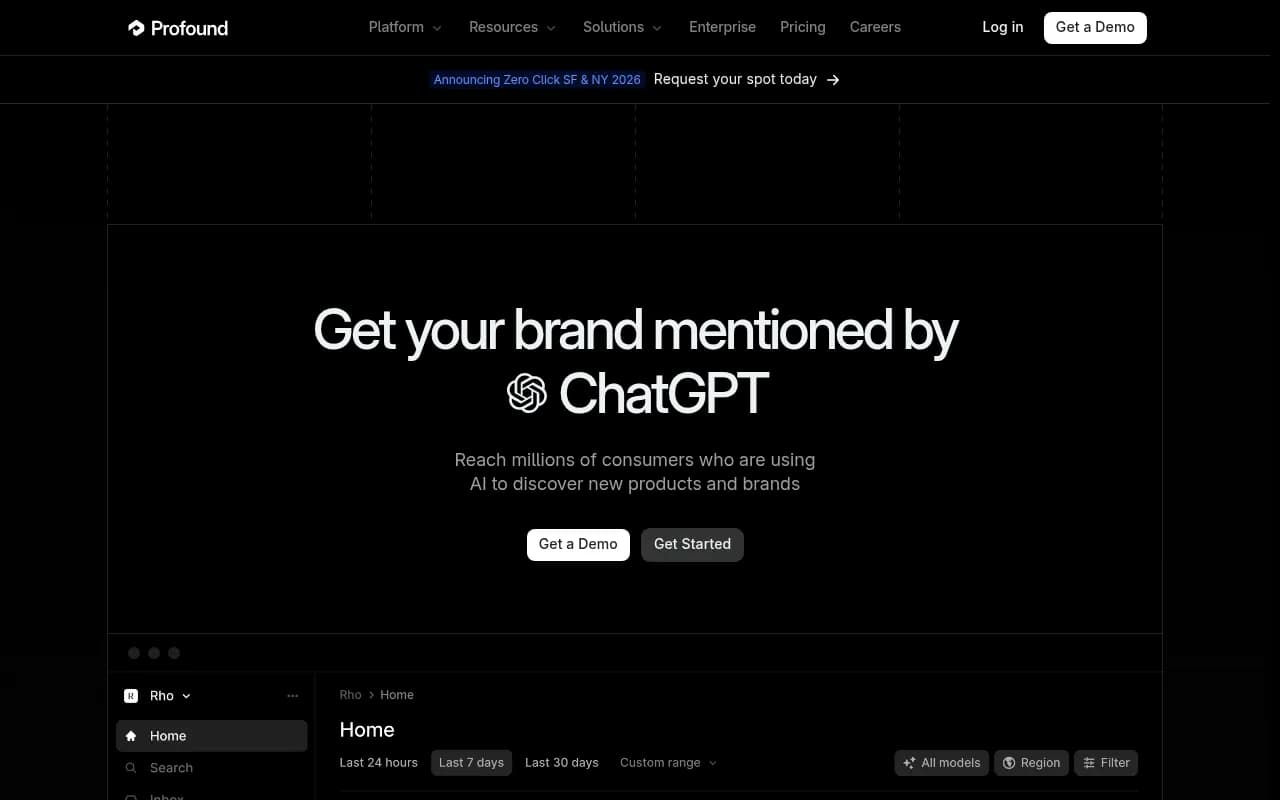
Where Profound shines is depth of data. Prompt analytics, competitive benchmarking, and integrations with existing marketing stacks make it a strong fit for agencies working with large, complex accounts. It also tracks server-side rendering issues that affect how AI crawlers index content — useful for technical SEO teams.
The downside: pricing is on the higher end, and there's no built-in content generation. You get excellent data, but the "what do we do about it" question is still yours to answer.
Best for: agencies with enterprise clients who have budget for premium tooling and separate content teams.
3. Otterly.AI — best for budget-conscious agencies just getting started
Otterly.AI is one of the more affordable options in the GEO space, starting around $29/mo. It covers the basics: AI visibility tracking, keyword research, and link analysis across a handful of AI models.
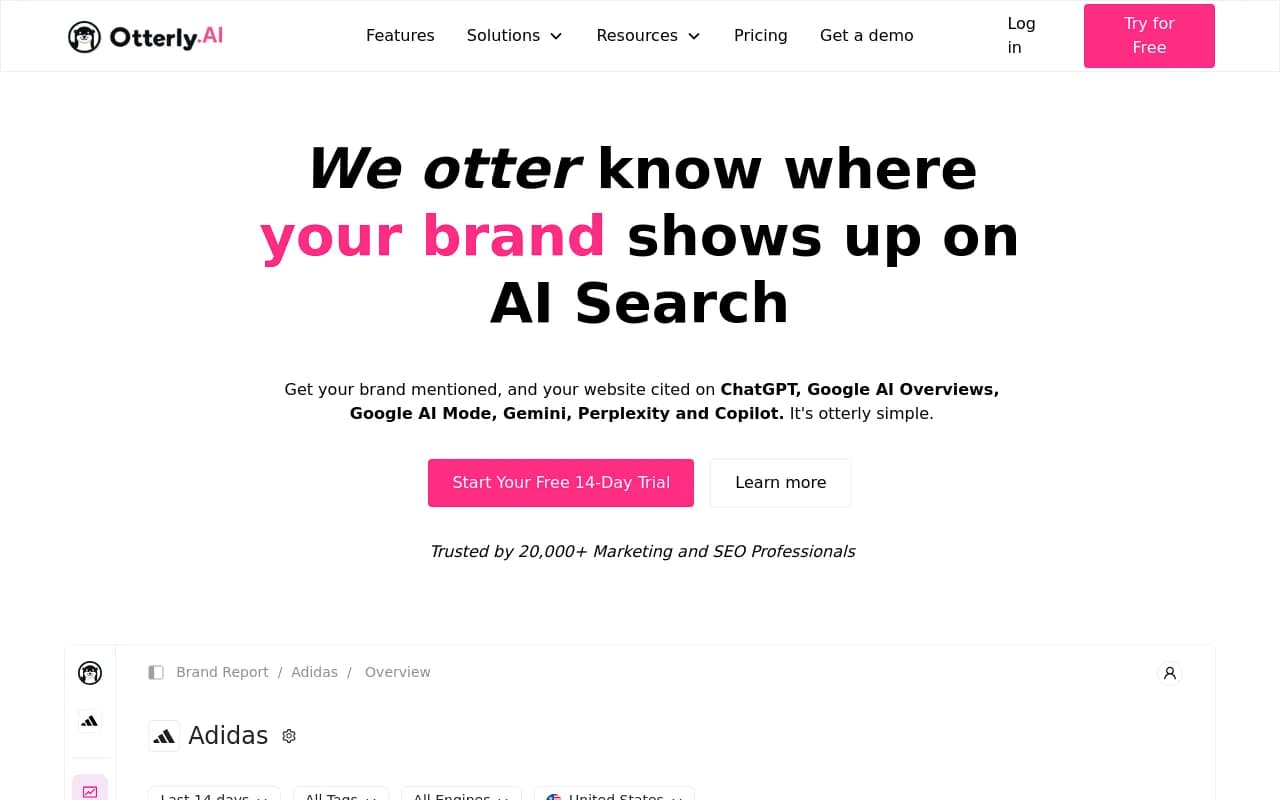
For agencies that are just starting to offer GEO as a service and want to test the waters without a big commitment, Otterly makes sense. The interface is clean, setup is fast, and the unlimited reports feature means you can generate client-facing outputs without worrying about hitting a cap.
The limitations are real, though. There's no content gap analysis, no content generation, no crawler logs, and no traffic attribution. It's a monitoring tool — which is fine if monitoring is all you need right now.
Best for: small agencies or freelancers adding AI visibility as a new service line, with limited initial budget.
4. Scrunch AI — best for content-focused agency teams
Scrunch positions itself around AI traffic analytics and content optimization. It includes site audit functionality and SEO agents that can flag content issues affecting AI visibility.
For agencies where content strategy is the core deliverable, Scrunch's workflow fits naturally. You can audit a client's site, identify content gaps, and get recommendations — all within one platform. The AI traffic analytics give you a sense of how much traffic is actually coming from AI-generated recommendations, which is increasingly important for client reporting.
Starting at $100/mo, it's mid-range in terms of price. It doesn't have the depth of Promptwatch's citation data or the breadth of AI model coverage, but it's a solid option for content-led agencies.
Best for: agencies that lead with content strategy and want a tool that connects content decisions to AI visibility outcomes.
5. Peec AI — best for international and multilingual campaigns
If your agency works with brands across multiple countries and languages, Peec AI is worth a look. It's built with multi-country tracking and sentiment analysis at its core, which is rare in this space.
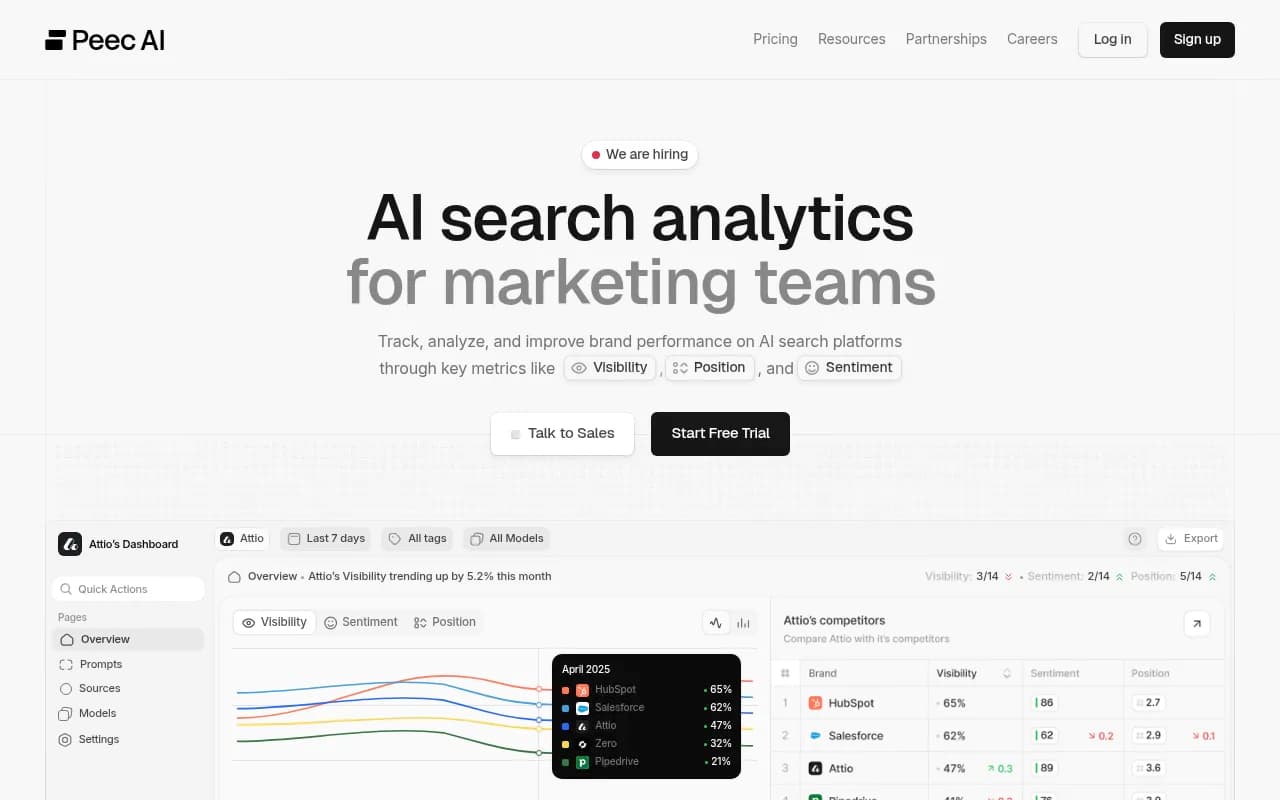
Starting at €89/mo, Peec AI tracks AI visibility across regions and languages, and its sentiment analysis shows not just whether a brand is mentioned but whether those mentions are positive, neutral, or negative. For agencies managing international brands, that's genuinely useful context.
The gap: like most tools in this category, Peec AI is monitoring-focused. There's no content generation or gap analysis built in. You'll need separate tools to act on what you find.
Best for: agencies with international clients who need multi-region, multi-language AI visibility tracking.
6. Radarkit — best for agencies that want real LLM prompting (not API approximations)
Radarkit makes a specific technical claim that's worth paying attention to: it uses real LLM prompting rather than API approximations to track AI visibility. This means the data reflects what users actually see when they query ChatGPT or Perplexity, not a simulated version of it.
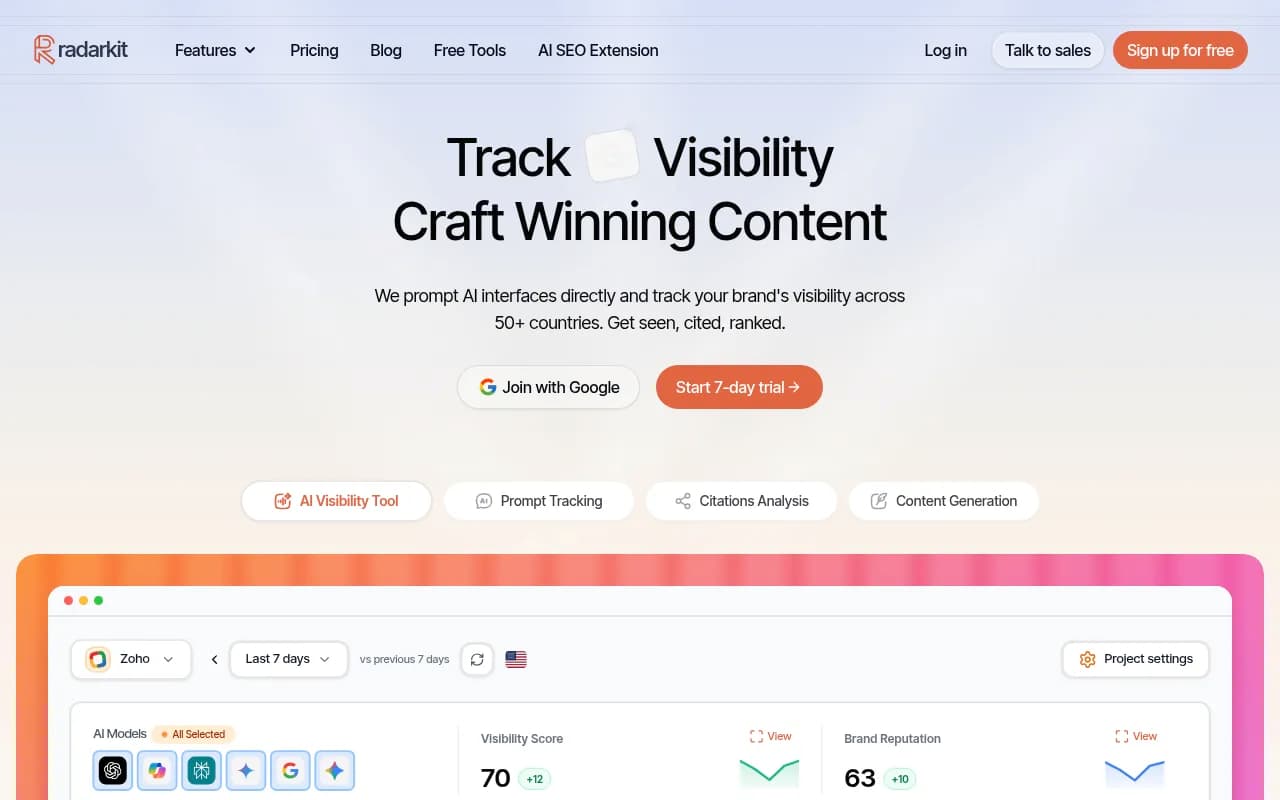
At $29/mo, it's one of the most affordable options on this list. It includes multi-location proxy tracking, competitor share-of-voice, backlink discovery, GA4 integration, and daily refreshes. For agencies managing clients with local or regional presence, the multi-location tracking is particularly useful.
The trade-off is depth. Radarkit doesn't have the content generation capabilities or the citation database that Promptwatch has, and the agency-specific features (white-label reporting, multi-client management) are more limited. But for the price, it punches above its weight.
Best for: agencies that want accurate, real-LLM-based tracking at a low price point, especially for clients with local or multi-location presence.
7. Slate — best for agencies that want a purpose-built agency platform
Slate is built specifically for agencies, which immediately sets it apart from most tools on this list. The platform is designed around client management workflows: separate workspaces per client, agency-branded reporting, and a structure that makes it easy to onboard new clients without starting from scratch each time.
For agencies that are scaling their GEO service offering and need a tool that fits their operational model, Slate's agency-first design is a real advantage. It's not trying to be an enterprise brand monitoring tool that agencies can also use — it's built for the agency workflow from the ground up.
Coverage and depth vary compared to more established platforms, but the operational fit for agencies is strong.
Best for: growing agencies that are making GEO a core service and need a platform that matches how they actually work.
Side-by-side comparison
| Tool | Starting price | AI models covered | Content generation | Multi-client support | Crawler logs | Best for |
|---|---|---|---|---|---|---|
| Promptwatch | $99/mo | 10 | Yes (built-in AI writer) | Yes (agency plans) | Yes | Agencies that want to fix visibility, not just track it |
| Profound | $99/mo | 6+ | No | Yes (Agency mode) | Partial | Enterprise agency accounts |
| Otterly.AI | $29/mo | 4–5 | No | Limited | No | Budget-conscious agencies starting out |
| Scrunch AI | $100/mo | 4–5 | Partial (SEO agents) | Limited | No | Content-led agency teams |
| Peec AI | €89/mo | 5+ | No | Limited | No | International/multilingual campaigns |
| Radarkit | $29/mo | 5+ | No | Limited | No | Accurate tracking at low cost |
| Slate | Custom | 5+ | No | Yes (agency-first) | No | Agencies scaling GEO as a service |
The real problem with most AthenaHQ alternatives
Here's what the comparison table doesn't fully capture: most of these tools, including AthenaHQ itself, are monitoring dashboards. They show you that your client is invisible for certain prompts. They show you that a competitor is winning. They might even show you which content is being cited.
But then what?
The gap between "here's the data" and "here's what to do about it" is where most agencies lose time and client trust. You get a visibility score, you share it with the client, and then you're back to manually figuring out what content to create, how to structure it, and whether it'll actually get cited by AI models.
Promptwatch is the only tool in this list that closes that loop natively. The Answer Gap Analysis tells you exactly which prompts to target. The AI writing agent generates content engineered around real citation data from 880M+ citations analyzed. And the page-level tracking shows you when that content starts getting cited.
That's not a pitch — it's just the honest difference between a tracker and an optimization platform. For agencies that need to show clients measurable progress month over month, that difference matters.
How to choose
If you're an agency deciding between these options, a few practical questions help narrow it down:
- How many clients are you managing? If it's 2–5, most tools work. If it's 10+, you need something with real multi-client architecture (Promptwatch Business, Profound Agency, or Slate).
- Do you need to generate content, or just track? If you have a content team already, a monitoring tool might be enough. If you're expected to deliver content improvements as part of the service, you need Promptwatch or a tool with content generation built in.
- What's your budget per client? At $29/mo, Radarkit or Otterly.AI can work for lower-budget clients. At $99–$249/mo, Promptwatch or Profound give you significantly more depth.
- Do you have international clients? Peec AI is the strongest option for multi-region, multi-language tracking.
- How technical is your team? Crawler logs and traffic attribution (available in Promptwatch) require some technical setup but give you a much clearer picture of what's actually driving results.
The GEO space is moving fast. Tools that were "good enough" in 2024 are already showing their limits in 2026 as AI search becomes a primary channel for many industries. Agencies that build a proper AI visibility practice now — with tools that go beyond monitoring — will be in a much stronger position than those still treating GEO as a reporting exercise.