Key takeaways
- Peec AI is a solid AI visibility monitoring tool, starting around $95/month, that tracks brand citations across ChatGPT, Perplexity, Google AI Overviews, and other LLMs.
- It measures share of voice, citation frequency, sentiment, and competitor benchmarking -- all in a clean, information-dense dashboard.
- The main limitation: it's a monitoring-only platform. It shows you where you're invisible but doesn't help you fix it through content creation, gap analysis, or optimization workflows.
- Enterprise teams will hit walls around missing API access, SSO, and SOC-2 compliance on base plans.
- If you need to go beyond tracking and actually improve your AI visibility, you'll need to pair Peec AI with other tools or switch to a platform that covers the full optimization loop.
Peec AI has had a genuinely impressive first year. Founded in Berlin in early 2025, the company raised $29 million in total funding (a €5.2M seed round followed by a $21M Series A led by Singular) and crossed $4M+ ARR within months. Customers include Chanel, Axel Springer, ElevenLabs, and TUI. That's not a bad start.
But fast growth and strong funding don't automatically mean it's the right tool for your team. This review is based on what Peec AI actually does, where it genuinely delivers value, and where it leaves you on your own.
What Peec AI actually does
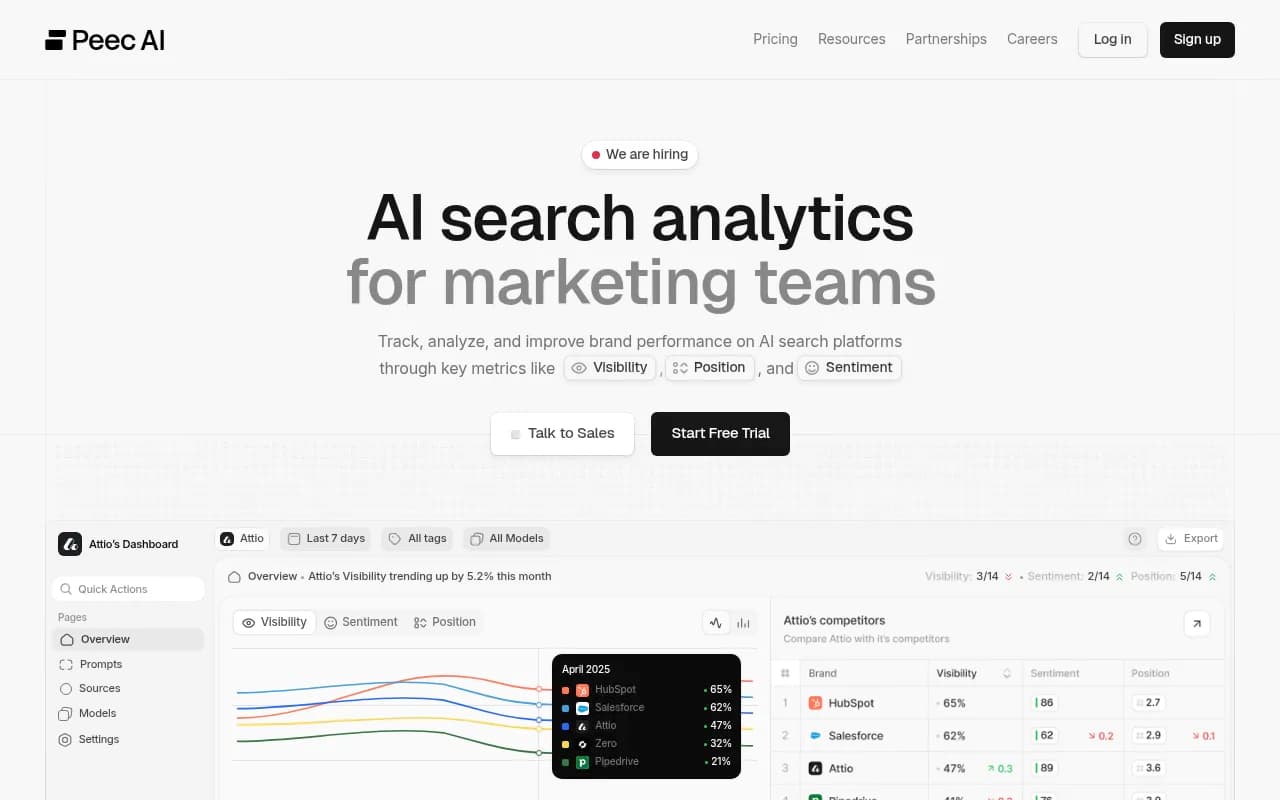
Peec AI is an AI search analytics platform. The core job: track how often your brand gets mentioned when AI systems answer questions in your category.
It does this using UI scraping technology to simulate real user queries across multiple LLMs, then records whether your brand appears, where it appears, and how it's framed. The output is a dashboard showing:
- Citation rate (how often you appear across tracked prompts)
- Share of voice vs. competitors
- Sentiment analysis (positive, neutral, or negative framing)
- Source URLs that AI models are citing
- Position tracking (where in a response your brand shows up)
The platform covers ChatGPT, Perplexity, Google AI Overviews, and several other models. You set up a prompt library around your category, competitors, and buyer questions, then Peec runs those prompts on a schedule and logs the results.
For a B2B marketing team asking "are we even showing up when buyers ask AI for vendor recommendations?" -- Peec AI answers that question clearly.
What the dashboard looks like in practice
The interface is clean. Reviewers consistently note that it's more information-dense than flashy, which is probably the right call for a data-heavy tool. You get prompt-level breakdowns, competitor heatmaps, and trend lines showing how your visibility changes over time.
Setup isn't instant -- you need to think carefully about which prompts to track, and beginners can find the configuration process a bit opaque. But once you're past that initial setup, the data flows reliably.
One thing worth noting: Peec AI uses a credit-based pricing model, which is standard for AI SaaS tools. As you scale your prompt library, you'll burn through credits faster, and that can push you toward higher plan tiers sooner than expected.
Pricing
Peec AI's Starter plan begins at approximately $95/month, which puts it in a genuinely accessible tier for a dedicated AI visibility tool. That's a fraction of what some VC-backed competitors charge.
The credit model means your effective cost scales with how many prompts you're tracking and how frequently. Teams with large prompt libraries or multiple brands will need to budget accordingly.
There's no publicly detailed breakdown of every plan tier, but the consensus from independent reviews is that Peec AI is one of the more affordable options in this space for the data quality it delivers.
Where Peec AI genuinely delivers
Price-to-data ratio. For what you pay, the data quality is solid. You get prompt-level citation tracking, competitor benchmarking, and sentiment analysis at a price point that doesn't require enterprise budget sign-off.
Clean competitor benchmarking. The share-of-voice view across competitors is one of the stronger implementations in this category. You can see, prompt by prompt, who's winning and by how much.
Honest reporting. The platform doesn't pad the numbers or make your visibility look better than it is. That sounds like a low bar, but it matters when you're using this data to make decisions.
Accessible for mid-market teams. Agencies and in-house SEO teams that already have organic search programs and want a dedicated AI visibility layer will find Peec AI fits naturally into their workflow.
The honest limitations
This is where most reviews soften the edges. I won't.
It stops at diagnosis
Peec AI tells you what's happening. It doesn't tell you what to do about it in any meaningful depth, and it certainly doesn't help you do it.
You'll see that a competitor is getting cited for "best project management software for remote teams" and you're not. What you won't get is: which specific content gap is causing that, what you should write to close it, or any tooling to actually create that content.
That's not a knock on Peec AI specifically -- most monitoring-only platforms have this problem. But it's worth being clear about. The dashboard shows you the problem; the solution is still entirely on you.
No content generation or gap analysis
There's no built-in answer gap analysis that shows you which prompts competitors rank for that you don't. There's no AI writing agent to generate content engineered for LLM citation. You're getting a monitoring layer, not an optimization platform.
If you want to close the loop from "we're invisible" to "we're getting cited," you'll need to bring in additional tools or workflows.
Enterprise readiness gaps
On base plans, Peec AI lacks a public API, SSO authentication, and SOC-2 compliance. For enterprise security and IT teams, those are real blockers. Larger organizations that need to integrate AI visibility data into existing BI stacks or require compliance documentation will find the base plans insufficient.
Credit limits can bite you
The credit-based model works fine at small scale. As your prompt library grows -- especially if you're tracking multiple brands, regions, or languages -- costs can climb faster than the headline price suggests. Plan carefully before assuming the entry price is your actual cost.
Beginner learning curve
Radarkit's review gave Peec AI a 6/10 for beginner-friendliness, and that feels accurate. The platform assumes you know what prompts to track and why. If you're new to AI visibility monitoring, you'll spend real time figuring out prompt strategy before you get useful data.
Peec AI vs. the alternatives
Here's how Peec AI stacks up against the main options in this space:
| Tool | Starting price | Content generation | Crawler logs | API access | Best for |
|---|---|---|---|---|---|
| Peec AI | ~$95/mo | No | No | Limited | Mid-market monitoring |
| Promptwatch | $99/mo | Yes (built-in) | Yes | Yes | Full optimization loop |
| Profound | Higher | Partial | No | Yes | Enterprise monitoring |
| Otterly.AI | Lower | No | No | No | Basic tracking |
| Airefs | Lower | No | No | No | Budget monitoring |
| Scrunch AI | Mid-range | No | No | Limited | Agency reporting |
The pattern is clear: most tools in this category are monitoring dashboards. Peec AI is a good one. But if you need to go from "we see the gap" to "we've closed the gap," the monitoring-only tools all have the same ceiling.

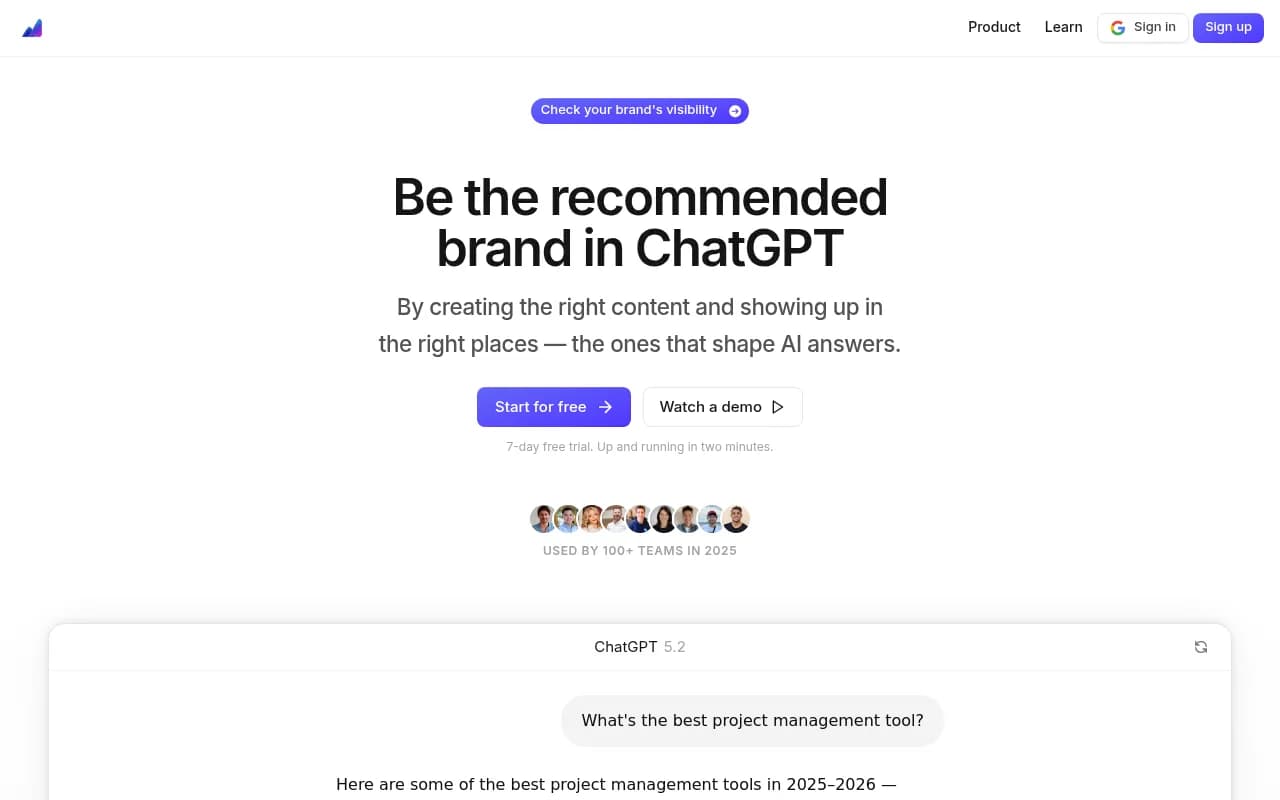
Promptwatch is worth mentioning here because it's one of the few platforms that actually covers the full cycle -- finding gaps, generating content to close them, and tracking the results. The built-in answer gap analysis shows you exactly which prompts competitors rank for that you don't, and the AI writing agent generates content grounded in citation data rather than generic SEO filler. For teams that want more than a dashboard, that distinction matters.

Who should use Peec AI
Peec AI makes most sense for:
- In-house SEO or marketing teams that already have content production workflows and just need the visibility data layer
- Agencies managing AI visibility reporting for clients who want clean, shareable dashboards
- Mid-market brands that want enterprise-grade citation data without enterprise pricing
- Teams doing competitive research on AI share of voice as part of a broader strategy
It's less suited for:
- Teams that need the monitoring to connect directly to content creation and optimization
- Enterprise organizations with SSO, API, or compliance requirements on base plans
- Beginners without a clear prompt strategy already in mind
- Anyone expecting the tool to tell them what to do next, not just what's happening
The bottom line
Peec AI is a genuinely good monitoring tool for the price. The data quality is solid, the competitor benchmarking is useful, and the pricing is more accessible than most VC-backed alternatives in this space. The team behind it is clearly customer-focused, and the product has improved quickly.
But it's a monitoring tool. If your goal is to understand your current AI visibility, Peec AI delivers. If your goal is to improve it -- to actually get cited more often by ChatGPT, Perplexity, and Google AI Overviews -- you'll need more than what Peec AI provides on its own.
That's not a fatal flaw. It's just an honest description of what the product is. Know what you're buying.