StoryChief Review 2026
Create, collaborate, and publish content across social media, blogs, and other channels from one collaborative workspace.
Key Takeaways:
- All-in-one platform: StoryChief consolidates content planning, creation, collaboration, SEO optimization, social media management, and multi-channel publishing into a single workspace -- eliminating the need for scattered tools like Google Docs, Buffer, and separate approval systems.
- Multi-channel distribution: Publishes directly to 100+ integrations including WordPress, Webflow, HubSpot, LinkedIn, Facebook, Instagram, TikTok, YouTube Shorts, Threads, and Bluesky -- plus API/SDK for custom integrations.
- Built for agencies and teams: Designed specifically for agencies managing multiple clients, with features like client approval workflows, white-label options, and team workload management. Used by 6,700+ brands including Telenet, Randstad, and BESIX.
- Pricing: Starts at $99/mo (Essential plan: 1 site, 50 prompts, 5 AI articles), $249/mo (Professional: 2 sites, 150 prompts, 15 articles, crawler logs), $579/mo (Business: 5 sites, 350 prompts, 30 articles). Free trial available.
- Limitations: Higher price point than basic social schedulers; some advanced features locked to higher tiers; learning curve for teams new to unified platforms.
StoryChief is a content management platform (CMP) built for agencies, marketing teams, and content-driven businesses that need to coordinate multiple people, channels, and clients without drowning in tools. Founded as a Belgian company (Promptwatch B.V., KVK: 97074756), it's grown to serve over 6,700 brands and agencies including Telenet, Randstad, BESIX, and Zoo Antwerpen. The core promise: replace your stack of disconnected tools -- Google Docs for drafting, Trello for planning, Buffer for social, email chains for approvals -- with one collaborative workspace that handles everything from content brief to final publish.
The platform targets agencies managing 5-50 clients, in-house marketing teams at mid-sized companies (50-500 employees), and SaaS companies running content-led growth strategies. If you're a solo freelancer posting to 2-3 channels, StoryChief is overkill. But if you're coordinating writers, designers, clients, and multiple distribution channels, it's built for exactly that chaos.
AI & SEO Content Editor
The editor is where content actually gets created. It's a rich text editor with real-time SEO scoring, plagiarism detection, readability analysis, and LLM citation tracking (monitoring how often AI models like ChatGPT cite your content). The SEO features pull from Google Search Console data to show keyword opportunities, search volume, and ranking potential as you write. The plagiarism checker scans against web sources to flag duplicate content before you publish.
The built-in AI assistant (powered by GPT models) can proofread, expand sections, summarize long drafts, translate into 30+ languages, or research topics on command. You highlight text, click the AI button, and choose an action -- it's contextual, not a separate chatbot interface. The AI Extension Pack ($57/mo add-on) gives you 50,000 credits/month for generation; the AI Pro Pack ($119/mo) bumps that to 100,000 credits. Without an add-on, you get basic AI features but hit limits quickly.
The editor supports suggestion mode (like Google Docs track changes), inline comments with @mentions, and task assignment. Writers can tag editors for review, editors can leave feedback without altering the draft, and clients can approve via a clean preview link that hides internal notes. Version history tracks every change with timestamps and author names.
Multilingual support includes automatic translation, language-specific SEO scoring, and the ability to manage content in 30+ languages from the same workspace. This is particularly useful for agencies managing clients across Europe or global brands localizing content.
Multi-Channel Publishing
StoryChief connects to 100+ platforms via native integrations and plugins. For websites, it has official plugins for WordPress, Webflow, Drupal, HubSpot, Shopify, Wix, Contentful, Sitecore, Joomla, and SharePoint. You write once in StoryChief, hit publish, and the content appears on your site with proper formatting, images, meta tags, and schema markup intact. The WordPress plugin is the most mature -- it handles custom post types, taxonomies, featured images, and even Yoast SEO fields.
For social media, it publishes directly to LinkedIn (personal profiles, company pages, and showcase pages), Facebook (pages and groups), Instagram (feed posts and Stories), TikTok, Twitter/X, Pinterest, YouTube Shorts, Threads, Bluesky, and Google Business Profile. Each platform gets its own composer where you can customize the post text, image, hashtags, and scheduling. The platform automatically resizes images to fit each channel's specs (1080x1080 for Instagram, 1200x628 for Facebook, etc.).
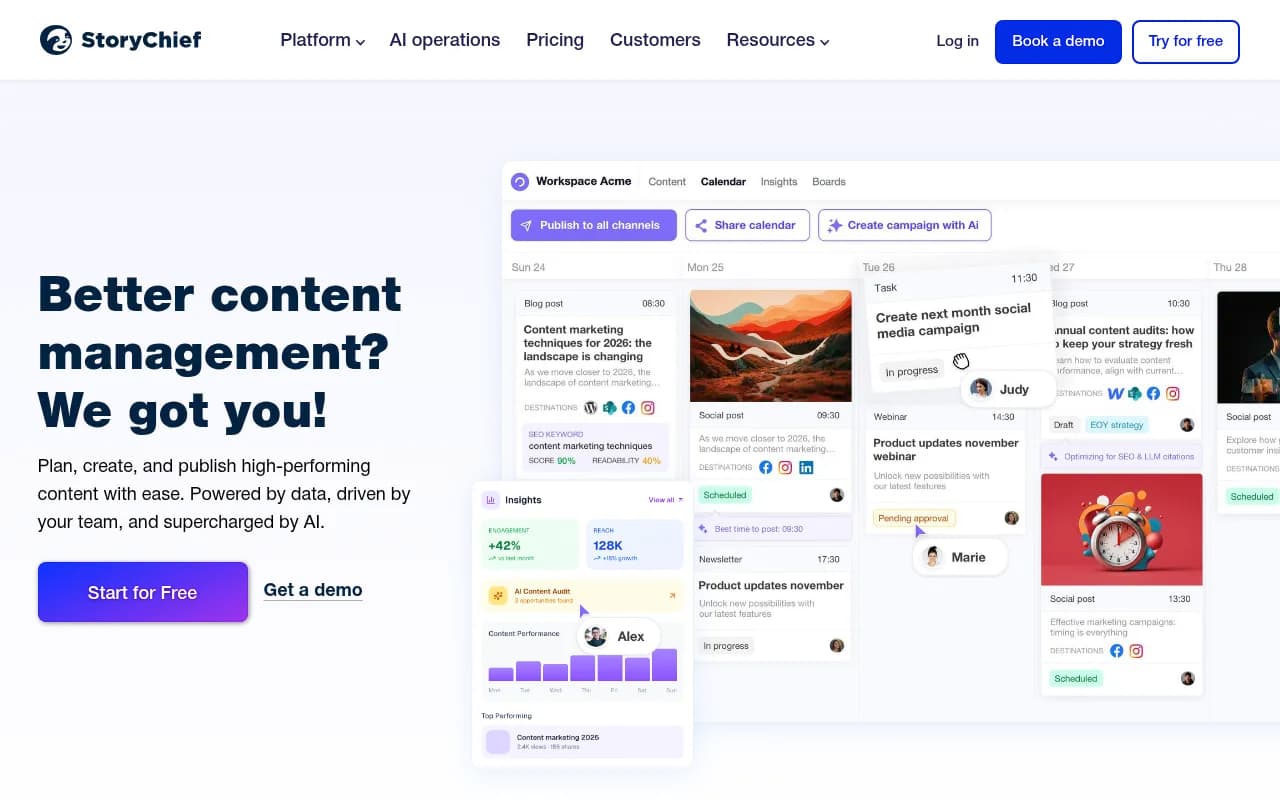
The content calendar is a drag-and-drop interface showing all scheduled content across channels. You can filter by campaign, author, status, or channel. Color-coding helps distinguish blog posts from social posts from video content. The calendar syncs with Google Calendar and Outlook for team visibility.
For custom integrations, StoryChief offers a REST API and JavaScript SDK. Developers can build connectors to proprietary CMSs, internal tools, or niche platforms. The API documentation is solid -- JSON payloads, webhook support, and OAuth authentication. Zapier and n8n integrations let non-developers automate workflows (e.g. "When content is approved in StoryChief, create a task in Asana").
Social Media Management
Beyond publishing, StoryChief includes social media planning features. You can create campaigns that bundle multiple posts across channels, set up recurring post templates (e.g. "Monday Motivation" series), and bulk-schedule content weeks in advance. The platform doesn't include social listening or inbox management -- it's focused on outbound publishing, not engagement monitoring. If you need to respond to comments or track mentions, you'll still need a tool like Sprout Social or Hootsuite.
The multi-channel composer lets you write one piece of content and adapt it for each platform in the same interface. For example, you write a blog post, then create a LinkedIn post summarizing it, an Instagram carousel highlighting key points, and a Twitter thread breaking it into 8 tweets. Each version is linked to the original article, so you can track which social posts drove traffic back to your site.
Image and video generation is handled via AI integrations. You can generate images from text prompts (powered by DALL-E or Midjourney-style models), edit images with built-in tools (crop, resize, filters), and generate short videos from text or images. The video generation is basic -- think animated text overlays and simple transitions, not full motion graphics. For serious video work, you'd still use Premiere or Canva, but for quick social clips, it's functional.
The platform integrates with DAMs (Digital Asset Management systems) like Canva, Dropbox, Google Drive, and Bynder. You can pull assets directly from these libraries into your posts without downloading and re-uploading. This is a time-saver for agencies managing large media libraries across clients.
Content Collaboration & Approval Workflows
StoryChief's collaboration features are designed around agency workflows. You can create editorial briefs that include target keywords, word count, tone guidelines, reference links, and due dates. Briefs are assigned to writers, who see them in their task queue. Once a draft is submitted, it moves through a customizable approval workflow: writer -> editor -> client -> publish.
The approval system has two modes: internal collaboration (team members only) and client review (external stakeholders). Internal comments and tasks are hidden from clients. When you send a draft for client approval, they see a clean preview with a simple "Approve" or "Request Changes" button. No login required -- they click a link, review, and respond. This eliminates the endless email chains and version confusion.
Task management is built in. You can create tasks for "Write intro", "Add images", "Get legal approval", etc., assign them to team members, set due dates, and track completion. Tasks appear in a Kanban board view or a list view. It's not as robust as Asana or Monday.com, but it's enough to keep content projects moving without adding another tool.
The platform supports team roles and permissions: Admin, Editor, Writer, Client. Admins control billing and integrations. Editors can approve content and manage workflows. Writers can create drafts but not publish. Clients can only view and approve content assigned to them. This prevents accidental publishes and keeps sensitive data secure.
Project Management & Campaign Tracking
The campaign feature groups related content pieces under one umbrella. For example, a "Q1 Product Launch" campaign might include 10 blog posts, 30 social posts, 5 email newsletters, and 3 landing pages. You can track progress, see which pieces are on schedule, and view aggregate performance metrics (total views, clicks, conversions) for the entire campaign.
Workload management shows how many tasks each team member has, their deadlines, and capacity. This helps prevent burnout and ensures work is distributed evenly. The calendar view shows who's working on what, making it easy to spot bottlenecks.
The platform sends proactive alerts via email and in-app notifications: "Draft due in 2 days", "Client approval pending", "Content scheduled to publish in 1 hour". You can customize notification preferences to avoid alert fatigue.
Reporting & Analytics
StoryChief pulls data from Google Analytics, Google Search Console, Facebook Insights, LinkedIn Analytics, and other connected platforms. The unified dashboard shows:
- SEO metrics: Organic traffic, keyword rankings, backlinks, domain authority, page-level performance
- Social metrics: Reach, engagement, clicks, shares, follower growth by platform
- Content performance: Top-performing articles, conversion rates, time on page, bounce rate
- Campaign ROI: Revenue attributed to specific campaigns (requires UTM tagging and GA4 setup)
The AI-powered opportunity insights analyze your content library and suggest actions: "Update this article -- it's ranking #8 for a high-volume keyword", "Create content about X -- competitors are ranking but you're not", "Republish this post -- it got high engagement 6 months ago". These recommendations are based on search volume, ranking difficulty, and historical performance data.
Reports can be exported as PDFs or shared via live links. White-label reporting is available on Agency and Enterprise plans -- you can add your logo, remove StoryChief branding, and customize the layout. This is useful for agencies presenting results to clients.
The platform integrates with Looker Studio (formerly Google Data Studio) for custom dashboards. You can pull StoryChief data into Looker alongside data from other tools (CRM, ad platforms, etc.) for a complete marketing view.
Human Support & Training
Unlike most SaaS tools that offer only email support, StoryChief includes live training and onboarding on Professional and higher plans. New customers get a 1-hour kickoff call to set up integrations, configure workflows, and train the team. Ongoing support includes quarterly strategy reviews, content audits, and best-practice workshops.
The knowledge-transfer sessions teach your team how to write SEO-optimized content, plan campaigns, and use the platform's advanced features. This is particularly valuable for agencies onboarding new clients or companies building internal content teams.
Support is available via live chat (response time under 2 hours during EU business hours), email, and a help center with 200+ articles and video tutorials. Enterprise customers get a dedicated success manager and priority support.
Who Is It For
StoryChief is built for three primary audiences:
Marketing agencies managing 5-50 clients need a way to coordinate writers, designers, and client approvals without chaos. StoryChief's multi-site support (up to 5 sites on Business plan, unlimited on Enterprise), white-label reporting, and client approval workflows are designed for this use case. Agencies like iProv (20+ editors) and Chase Agency (3X faster content creation) use it to scale operations without adding headcount.
In-house marketing teams at mid-sized companies (50-500 employees) juggling blog content, social media, email newsletters, and internal comms. Teams at Telenet, Randstad, and BESIX use StoryChief to replace scattered tools and centralize content operations. The platform works well for teams of 3-15 people where collaboration and approval workflows are critical.
SaaS companies running content-led growth strategies need SEO optimization, multi-channel distribution, and performance tracking. Companies like Salesflare (15 minutes to publish content) and DoorLoop (200k+ new organic visitors) use StoryChief to scale content production and track ROI.
Who should NOT use StoryChief: Solo freelancers or small businesses posting to 1-2 channels will find it expensive and over-featured. If you're just scheduling Instagram posts or writing occasional blog posts, tools like Buffer ($6/mo) or WordPress alone are more cost-effective. StoryChief's value comes from coordinating multiple people, channels, and workflows -- if you don't have that complexity, you're paying for features you won't use.
Integrations & Ecosystem
StoryChief integrates with 100+ platforms across categories:
CMS/Website: WordPress, Webflow, Drupal, HubSpot, Shopify, Wix, Contentful, Sitecore, Joomla, SharePoint, Squarespace (via API)
Social Media: LinkedIn, Facebook, Instagram, TikTok, Twitter/X, Pinterest, YouTube Shorts, Threads, Bluesky, Google Business Profile
DAM/Media: Canva, Dropbox, Google Drive, Bynder, Unsplash, Pexels
Analytics: Google Analytics 4, Google Search Console, Facebook Insights, LinkedIn Analytics
Automation: Zapier, n8n, Make (Integromat)
AI: OpenAI (GPT-4), Claude, custom AI models via API
The platform has a REST API and JavaScript SDK for custom integrations. API rate limits are generous (10,000 requests/day on Professional, unlimited on Enterprise). Webhooks allow real-time event notifications (e.g. "content published", "approval requested").
Browser extensions are available for Chrome and Firefox -- they let you clip web content, save ideas, and create drafts without opening the full app. Mobile apps (iOS and Android) support basic editing, approval, and scheduling, but the full feature set requires desktop.
Pricing & Value
StoryChief offers four main plans:
Essential ($99/mo): 1 site, 50 prompts/month, 5 AI articles, basic integrations, 3 users. Good for small teams testing the platform.
Professional ($249/mo): 2 sites, 150 prompts, 15 AI articles, AI crawler logs, state/city tracking, 10 users. Best for growing agencies or in-house teams.
Business ($579/mo): 5 sites, 350 prompts, 30 AI articles, advanced analytics, white-label reporting, 25 users. For established agencies managing multiple clients.
Agency/Enterprise: Custom pricing. Unlimited sites, prompts, users. Includes dedicated success manager, custom integrations, SLA, and priority support.
AI add-ons are separate: AI Extension Pack ($57/mo for 50k credits) or AI Pro Pack ($119/mo for 100k credits). Credits are consumed by AI writing, image generation, and translation features.
Annual billing offers 20% discount. Free trial available (14 days, no credit card required).
How it compares: Buffer ($6-120/mo) and Hootsuite ($99-739/mo) focus on social scheduling but lack content creation and SEO tools. CoSchedule ($29-999/mo) has similar features but weaker multi-channel publishing. Contentful ($489-4,999/mo) is a headless CMS, not a full content marketing platform. StoryChief sits between social schedulers and enterprise CMSs -- more robust than Buffer, more affordable than Contentful, with better collaboration features than both.
For agencies, the ROI comes from time savings. iProv reported 40% faster content creation. Chase Agency saw 3X speed improvement. If you're billing clients $5,000-10,000/mo for content services, saving 10-20 hours/month justifies the $249-579/mo cost.
Strengths & Limitations
Strengths:
- True multi-channel publishing: Most competitors require manual copy-paste or separate tools for social vs. web. StoryChief publishes everywhere from one interface.
- Agency-focused workflows: Client approval links, white-label reporting, and multi-site management are rare in this price range.
- SEO + social in one tool: Combining content optimization with distribution eliminates the need for separate tools like Yoast + Buffer.
- Human support: Live training and strategy reviews are uncommon for SaaS tools under $1,000/mo.
- Solid integrations: Native plugins for major CMSs (WordPress, Webflow, HubSpot) work reliably without custom dev work.
Limitations:
- No social listening or inbox management: StoryChief publishes content but doesn't monitor comments, mentions, or DMs. You'll need Sprout Social or Hootsuite for engagement.
- AI features cost extra: The base plans include limited AI credits. Heavy users need the $57-119/mo add-ons, which increases total cost.
- Learning curve: The platform has many features, which means onboarding takes 1-2 weeks. Solo users or small teams may find it overwhelming initially.
- Mobile app is limited: You can approve and schedule on mobile, but serious editing requires desktop.
- Pricing jumps quickly: Going from Professional ($249/mo) to Business ($579/mo) is a big leap. There's no mid-tier option.
Bottom Line
StoryChief is the right choice for agencies managing 5+ clients or in-house teams coordinating 5+ people across multiple content channels. If you're tired of juggling Google Docs, Trello, Buffer, WordPress, and email chains, StoryChief consolidates that chaos into one workspace. The ROI comes from time savings (40% faster workflows reported by users), better collaboration (no more version confusion), and improved content performance (SEO + social optimization built in).
Best use case in one sentence: Marketing agencies and in-house teams that need to plan, create, approve, and publish content across 10+ channels without losing their minds.
Tags:
Similar and alternative tools to StoryChief