Moz Review 2026
Track rankings, research keywords, and audit technical SEO issues. Offers beginner-friendly tools and educational resources for content marketers.
Key Takeaways
- Comprehensive toolkit: Moz Pro covers keyword research, rank tracking, site audits, competitive analysis, and link building in one platform -- solid for small to mid-sized teams running end-to-end SEO campaigns
- Industry-standard metrics: Domain Authority and Page Authority are widely used benchmarks in SEO, making Moz data valuable for link prospecting and competitive analysis
- Strong educational resources: The Beginner's Guide to SEO has been read 10+ million times, and Moz Academy offers certification courses -- excellent for teams building SEO skills
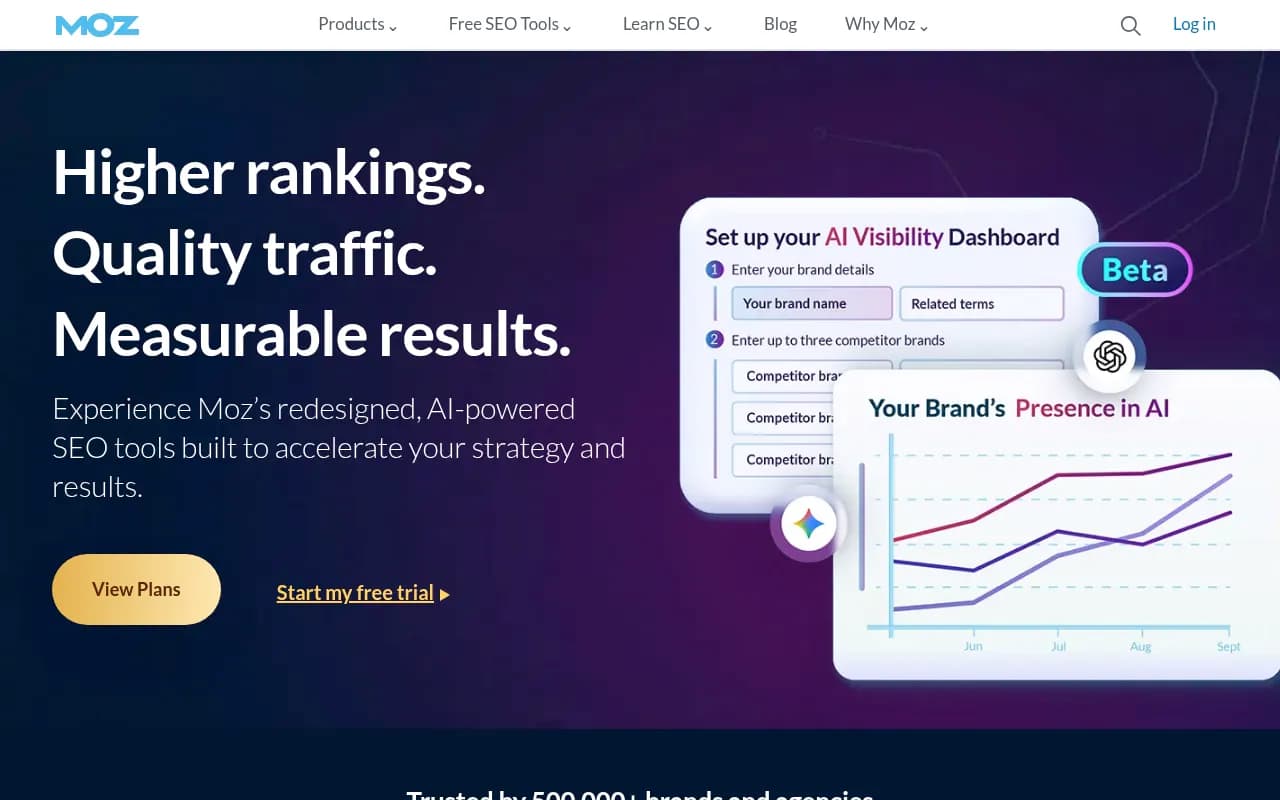
- Limited AI search visibility: Moz doesn't track or optimize for AI search engines like ChatGPT, Perplexity, Claude, or Gemini -- a significant gap as AI search grows. Tools like Promptwatch fill this void with AI citation tracking, content gap analysis, and optimization for LLM visibility.
- Pricing can add up: Plans start at $49/mo but scale quickly for agencies or teams needing more keywords, sites, or advanced features

Moz has been a fixture in the SEO world since 2004, back when "search engine optimization" was still a mysterious dark art. Founded by Rand Fishkin and Gillian Muessig, the company built its reputation on transparency, education, and proprietary metrics that became industry standards. Today, Moz serves 500,000+ brands and agencies with a suite of tools spanning traditional SEO, local search, and enterprise rank tracking.
The platform is built around Moz Pro, an all-in-one SEO toolkit that handles the core workflows most SEO teams run daily: finding keywords, tracking rankings, auditing technical issues, analyzing backlinks, and researching competitors. It's positioned as the accessible, beginner-friendly option in a market dominated by data-heavy platforms like Ahrefs and Semrush. The company also offers STAT (enterprise rank tracking), Moz Local (multi-location SEO and reputation management), and the Moz API for custom integrations.
Moz's target audience is broad: in-house marketing teams at mid-sized companies, digital agencies managing client portfolios, freelance SEO consultants, and anyone learning SEO for the first time. The platform's educational bent -- from the legendary Beginner's Guide to SEO to Moz Academy certifications and the annual MozCon conference -- makes it particularly appealing to teams building internal SEO capabilities.
Keyword Research
Moz's Keyword Explorer offers access to 1.25 billion keyword suggestions, which sounds impressive but trails behind Ahrefs (10+ billion) and Semrush (20+ billion). The tool provides Keyword Difficulty scores (0-100 scale), monthly search volume estimates, organic CTR predictions, and priority scores that combine volume, difficulty, and CTR into a single metric.
The interface is clean and approachable. You can filter by question keywords, see SERP analysis for the top 10 results, and export keyword lists for campaign planning. The "Keyword Suggestions" feature pulls related terms, questions, and search variations -- useful for content ideation.
Where it falls short: the keyword database is smaller than competitors, and the Keyword Difficulty metric can be overly optimistic for competitive niches. Ahrefs and Semrush tend to provide more granular difficulty breakdowns and better parent topic clustering. Moz also lacks AI search visibility data -- you can't see which keywords trigger AI Overviews, ChatGPT citations, or Perplexity answers, which is increasingly important as AI search grows.
Competitive Research
Moz's competitive research suite lets you identify competitors, compare keyword rankings, and find content gaps. The "True Competitor" feature automatically surfaces sites competing for the same keywords, which is handy for discovery. You can see which keywords competitors rank for that you don't, and vice versa.
The link gap analysis shows which domains link to competitors but not to you, helping prioritize outreach targets. The interface presents this data in sortable tables with filters for Domain Authority, linking domains, and keyword overlap.
Limitations: the competitive data isn't as deep as Ahrefs' Site Explorer or Semrush's Organic Research tool. You get high-level insights but less granular analysis of competitor content strategies, traffic estimates, or historical ranking trends. The tool also doesn't track competitor visibility in AI search engines -- a blind spot as brands increasingly compete for citations in ChatGPT, Perplexity, and Google AI Overviews.
Link Research
This is where Moz's legacy shines. The platform indexes 44.8 trillion links, and its Domain Authority (DA) metric is the most widely recognized authority score in SEO. DA predicts a site's ranking potential on a 1-100 scale based on linking root domains, total links, and other factors. Page Authority (PA) does the same for individual pages.
Link Explorer shows linking domains, top pages by authority, anchor text distribution, and spam score (a metric estimating the likelihood of a domain being penalized). You can filter by follow/nofollow, link type, and Domain Authority ranges to find high-quality link prospects.
The Spam Score feature is particularly useful for link audits -- it flags potentially toxic backlinks that could harm your rankings. Moz also offers a "Link Intersect" tool to find sites linking to multiple competitors but not to you.
Downsides: Moz's link index is smaller than Ahrefs (which claims 35+ trillion links) and Majestic (which specializes in link data). The crawl frequency is slower, so new backlinks take longer to appear. Domain Authority, while useful as a benchmark, is a third-party metric -- Google doesn't use it, and it can be gamed through link schemes.
Rank Tracking
Moz Pro's rank tracker monitors keyword positions across 170+ search engines, including Google, Bing, Yahoo, and regional engines. You can track desktop and mobile rankings separately, set up local tracking for specific cities or zip codes, and segment keywords by tags or campaigns.
The interface shows ranking changes over time, search visibility scores, and SERP feature tracking (featured snippets, local packs, knowledge panels). You can set up automated reports to email clients or stakeholders weekly or monthly.
The rank tracker is solid for small to mid-sized campaigns (hundreds to low thousands of keywords). For agencies managing tens of thousands of keywords across dozens of clients, STAT (Moz's enterprise product) is the better fit -- it offers daily updates, full SERP HTML capture, and share-of-voice metrics.
What's missing: AI search rank tracking. Moz doesn't monitor whether your brand appears in ChatGPT answers, Perplexity citations, Claude responses, or Google AI Overviews. As AI search adoption grows, this is a significant blind spot. Platforms like Promptwatch specialize in tracking AI visibility across 10+ LLMs, showing exactly which prompts trigger citations and how your brand compares to competitors.
Domain Overview
The Domain Overview dashboard provides a quick SEO snapshot of any website: Domain Authority, Page Authority, linking domains, ranking keywords, and top pages. It's useful for vetting link prospects, analyzing competitors, or auditing client sites.
Moz recently added Brand Authority, a metric measuring brand strength on a 1-100 scale based on search volume for branded terms, social signals, and link patterns. It's an interesting addition but still unproven compared to established metrics like DA.
The dashboard is clean and easy to interpret, making it accessible for non-technical users. However, it lacks the depth of Ahrefs' Site Explorer or Semrush's Domain Overview, which provide traffic estimates, top organic keywords, and content gap analysis in one view.
Site Crawl
Moz's site crawler audits technical SEO issues: broken links, duplicate content, missing meta tags, slow page speed, crawl errors, and mobile usability problems. The crawler can handle up to 3 million pages on the highest-tier plans.
The interface groups issues by severity (critical, high, medium, low) and provides actionable recommendations for each. You can schedule recurring crawls to monitor progress over time and export reports for developers.
The crawler is competent but not as feature-rich as Screaming Frog (the industry standard for technical audits) or Semrush's Site Audit tool. It lacks advanced features like JavaScript rendering, log file analysis, or custom extraction rules. For most small to mid-sized sites, it's sufficient. For large, complex sites with heavy JavaScript or dynamic content, you'll need a more robust crawler.
STAT: Enterprise Rank Tracking
STAT is Moz's enterprise-grade rank tracking platform, designed for agencies and brands managing thousands to millions of keywords. It provides daily SERP data for 100-result pages, full SERP HTML capture, and share-of-voice metrics across competitors.
Key features include:
- Market visibility: Track your brand's share of voice vs competitors across keyword segments
- SERP feature tracking: Monitor which SERP features (featured snippets, local packs, shopping carousels) appear for your keywords and who owns them
- Custom segments: Group keywords by product line, geography, or campaign to surface granular insights
- API and Looker Studio connectors: Export data for custom dashboards and deep analysis
STAT is overkill for small teams but essential for agencies managing large client portfolios or enterprise brands tracking competitive landscapes. Pricing is custom and starts in the thousands per month.
What it doesn't do: track AI search visibility. STAT monitors traditional search engines but not ChatGPT, Perplexity, Claude, Gemini, or other AI platforms. As AI search grows, this is a notable gap.
Moz Local: Multi-Location SEO
Moz Local helps businesses with physical locations manage listings, reviews, and social posts across Google Business Profile, Facebook, Yelp, and 50+ other directories. It's designed for multi-location brands (retail chains, healthcare systems, franchises) and agencies managing local SEO for clients.
Features include:
- Listing management: Create and sync business information (name, address, phone, hours) across directories from one dashboard
- Review monitoring: Track and respond to reviews on Google, Facebook, and other platforms
- Social posting: Publish updates, promotions, and news to Google Business Profile and social channels
- Visibility Index: A proprietary score measuring how well your listings appear in local search results
- Reporting: White-label reports for agencies showing listing accuracy, review sentiment, and performance trends
Moz Local is a solid mid-tier local SEO platform. It's more affordable than enterprise tools like Yext or SOCi but less feature-rich. It lacks advanced capabilities like location-based landing pages, local inventory ads, or deep integration with CRM systems.
One customer (Chesapeake Regional Healthcare) reported Google Business Profile traffic increasing from 30,000 to 200,000+ monthly views after using Moz Local -- a strong endorsement for the platform's effectiveness.
Moz API
The Moz API provides programmatic access to Domain Authority, Page Authority, Brand Authority, Spam Score, and link data. It's used by developers building custom SEO tools, agencies creating white-label dashboards, and SaaS platforms integrating SEO metrics into their products.
Pricing ranges from $20/mo (Starter) to $500/mo (Growth), with custom enterprise plans available. The API is well-documented and reliable, though the rate limits on lower tiers can be restrictive for high-volume use cases.
Integrations & Ecosystem
Moz integrates with Google Search Console (for importing ranking and traffic data), Google Analytics (for traffic attribution), and Looker Studio (for custom reporting). The platform also offers a Chrome extension for quick DA/PA lookups while browsing.
Notably absent: integrations with content management systems (WordPress, HubSpot), project management tools (Asana, Trello), or AI writing assistants. The ecosystem feels dated compared to newer platforms that embed SEO workflows directly into content creation and publishing pipelines.
Pricing & Value
Moz Pro pricing (as of 2026):
- Starter: $49/mo ($39/mo annual) -- 1 campaign, 50 keywords, 10,000 page crawls
- Standard: $99/mo ($79/mo annual) -- 3 campaigns, 300 keywords, 100,000 page crawls
- Medium: $179/mo ($143/mo annual) -- 10 campaigns, 1,500 keywords, 500,000 page crawls
- Large: $299/mo ($239/mo annual) -- 25 campaigns, 3,000 keywords, 1.25 million page crawls
All plans include a 30-day free trial. Annual billing saves 20%.
Moz Local pricing is separate and starts at $129/mo for 1-5 locations.
STAT pricing is custom and starts in the thousands per month.
Value assessment: Moz Pro is competitively priced for small to mid-sized teams. The Starter plan is affordable for freelancers or single-site businesses. The Standard and Medium plans work well for agencies managing a handful of clients. However, the keyword and campaign limits scale quickly -- agencies with 10+ clients will hit the ceiling fast and need to upgrade or supplement with other tools.
Compared to competitors:
- Ahrefs: $129/mo entry point, larger keyword database, stronger backlink index
- Semrush: $139.95/mo entry point, more features (content marketing, social media, PPC), deeper competitive analysis
- Moz: $49/mo entry point, more beginner-friendly, strong educational resources
Moz is the most affordable option for beginners but offers less data and fewer features than Ahrefs or Semrush at comparable price points.
Strengths
- Industry-standard metrics: Domain Authority and Page Authority are universally recognized benchmarks, making Moz data valuable for link prospecting and competitive analysis
- Beginner-friendly interface: Clean, intuitive design with less overwhelming data than Ahrefs or Semrush
- Educational resources: The Beginner's Guide to SEO, Moz Academy certifications, and MozCon conference provide exceptional learning opportunities
- Affordable entry point: $49/mo Starter plan is accessible for freelancers and small businesses
- Reliable rank tracking: Solid keyword tracking across 170+ search engines with local and mobile support
Limitations
- Smaller keyword database: 1.25 billion keywords vs 10+ billion (Ahrefs) or 20+ billion (Semrush)
- Slower link index updates: Backlink data lags behind Ahrefs and Majestic
- No AI search visibility tracking: Moz doesn't monitor ChatGPT, Perplexity, Claude, Gemini, or Google AI Overviews -- a critical gap as AI search adoption grows. Platforms like Promptwatch specialize in this space, offering AI citation tracking, content gap analysis, and optimization tools for LLM visibility.
- Limited integrations: Lacks connections to CMS platforms, project management tools, or AI writing assistants
- Keyword and campaign limits: Plans scale quickly for agencies managing multiple clients
Who Is It For
Moz Pro is best suited for:
- Small to mid-sized in-house marketing teams running SEO for 1-3 websites with a few hundred to a few thousand keywords
- Freelance SEO consultants who need an affordable, all-in-one toolkit and value Moz's educational resources
- Agencies managing 5-10 clients on the Medium or Large plans, though you'll hit limits quickly beyond that
- Beginners learning SEO who want a less intimidating platform with strong educational support
- Teams prioritizing link building who rely on Domain Authority as a prospecting filter
Moz is NOT ideal for:
- Enterprise brands or large agencies managing dozens of clients or tens of thousands of keywords -- STAT is the better fit, but it's a separate product with custom pricing
- Teams focused on AI search visibility -- Moz doesn't track or optimize for ChatGPT, Perplexity, Claude, or other AI platforms. Promptwatch is purpose-built for this use case.
- Data-heavy power users who need the largest keyword databases, fastest backlink index updates, or most granular competitive analysis -- Ahrefs or Semrush are stronger choices
Bottom Line
Moz Pro is a solid, beginner-friendly SEO platform with strong educational resources and industry-standard metrics. It covers the core workflows most SEO teams need -- keyword research, rank tracking, site audits, link analysis -- in a clean, accessible interface. The $49/mo entry point makes it affordable for freelancers and small businesses, and the Beginner's Guide to SEO remains one of the best free resources in the industry.
However, Moz's keyword database is smaller than competitors, its backlink index updates slower, and it lacks AI search visibility tracking -- a significant gap as ChatGPT, Perplexity, and Google AI Overviews reshape how people find information. For teams serious about AI search optimization, Promptwatch offers the monitoring, content gap analysis, and optimization tools Moz doesn't provide.
Best use case in one sentence: Moz Pro is the right choice for small to mid-sized teams learning SEO or running traditional search campaigns on a budget, but it's not built for AI search visibility or large-scale agency work.
Tags:
Similar and alternative tools to Moz