Key takeaways
- Google AI Overviews now appear in 30–40% of search queries, and traditional rank trackers don't capture whether your brand is cited inside them.
- Dedicated AI visibility tools vary enormously: some only monitor, while others help you identify content gaps and generate content to fix them.
- Promptwatch is the only platform in this comparison rated as a "Leader" across all evaluation categories, combining tracking, gap analysis, and AI content generation in one workflow.
- Semrush and BrightEdge are solid options if you're already invested in those ecosystems, but both have meaningful gaps in AI-specific functionality.
- For smaller teams or agencies, tools like Otterly.AI, LLM Pulse, and SE Ranking offer lighter-weight entry points at lower price points.
Why Google AI Overviews tracking is now non-negotiable
If you've been watching your organic traffic numbers lately, you may have noticed something strange: rankings look stable, but clicks are down. That's not a coincidence. Google AI Overviews (the AI-generated summaries that appear at the top of search results, formerly called SGE) now trigger on roughly 30–40% of queries across desktop and mobile. Users get a synthesized answer before they ever see a blue link.
The implications are real. Being cited inside an AI Overview can drive impressions even when your organic position is lower on the page. Not being cited means you're invisible to a growing share of searchers, even if you rank #1 below the fold.
The problem: your existing rank tracker almost certainly doesn't capture this. Tools like Ahrefs, Moz, and classic Semrush rank tracking show you position 1–10. They don't show you whether your brand appears in the AI-generated block at the top, which sources Google cited, or how that changes week to week.
That's the gap this guide addresses.
What to look for in an AI Overviews tracking tool
Before diving into specific tools, it helps to know what separates a genuinely useful platform from one that just adds a new dashboard to your existing confusion.
The core capabilities worth evaluating:
- AI Overview detection: Does the tool actually identify when an AI Overview appears for a given query, or does it just track traditional SERP positions?
- Citation extraction: Can it tell you which URLs Google cited inside the AI Overview text, not just whether an overview appeared?
- Refresh cadence: How often does it re-query? Daily? Weekly? Near-real-time? For fast-moving queries, this matters.
- Historical data: Can you see how your citation rate has changed over time, or only a current snapshot?
- Multi-model coverage: Google AI Overviews is one surface. ChatGPT, Perplexity, Gemini, and others are separate. Does the tool cover all of them, or just Google?
- Content gap analysis: Does it show you which prompts competitors are visible for that you're not? This is where monitoring tools diverge from optimization platforms.
- Content generation: Can it help you create content engineered to get cited, or does it just show you data and leave you to figure out the rest?
With that framework in mind, here's how the main players stack up.
The tools compared
Promptwatch
Promptwatch is the most complete platform in this space, and the one most directly built around the full optimization loop rather than just monitoring.

It tracks AI Overview citations alongside nine other AI models (ChatGPT, Perplexity, Gemini, Claude, Grok, DeepSeek, Copilot, Meta AI, and Mistral) from a single dashboard. But what sets it apart from most competitors is what happens after you see the data.
The Answer Gap Analysis feature shows you exactly which prompts your competitors are being cited for that you're not. You see the specific content your site is missing, not just a vague "you have low visibility" score. From there, the built-in AI writing agent generates articles, listicles, and comparison pages grounded in real citation data (over 880 million citations analyzed). The content is engineered to get cited by AI models, not just to rank in traditional search.
The tracking side is equally thorough. Page-level citation tracking shows which specific URLs are being cited, how often, and by which models. AI Crawler Logs give you real-time visibility into when ChatGPT, Claude, and Perplexity bots are crawling your site, which pages they're reading, and any errors they encounter. Traffic attribution connects AI visibility to actual revenue through a code snippet, GSC integration, or server log analysis.
Pricing starts at $99/month for the Essential plan (1 site, 50 prompts, 5 articles), with Professional at $249/month (2 sites, 150 prompts, 15 articles, crawler logs) and Business at $579/month (5 sites, 350 prompts, 30 articles). A free trial is available.
The honest limitation: if you only want to monitor one or two keywords and have no interest in content optimization, it's more platform than you need. But for any team serious about AI search visibility, the action loop (find gaps, generate content, track results) is genuinely differentiated.
Semrush
Semrush has added AI visibility features to its existing SEO suite, which makes it attractive if you're already paying for the platform. The AI Visibility Toolkit tracks brand mentions in AI-generated results and integrates with Semrush's existing keyword and competitive data.
The integration is the main selling point. If your team already lives in Semrush for keyword research, site audits, and backlink analysis, having AI Overview data in the same interface reduces context-switching. The platform also has a large user base and strong documentation.
The limitations are worth knowing. Semrush uses fixed prompt sets rather than letting you define custom prompts, which means you're tracking the queries Semrush decides matter rather than the ones that actually drive your business. There's no AI traffic attribution, no crawler logs, and no content generation built in. It's a monitoring add-on, not an optimization platform.
For teams already on Semrush who want a lightweight view of AI visibility without adding another tool, it's a reasonable starting point. For teams where AI search is a strategic priority, it'll hit a ceiling quickly.
BrightEdge
BrightEdge is an enterprise SEO platform that has been adding AI search features, including tracking for Google AI Overviews. It's positioned at large organizations with dedicated SEO teams and enterprise budgets.
The platform's strength is breadth. BrightEdge covers traditional rank tracking, content performance, competitive intelligence, and AI Overview monitoring in a single enterprise suite. For organizations that need everything under one contract and have the budget to match, it's a credible option.
The practical limitations are significant for most teams. BrightEdge doesn't publish pricing publicly (it's enterprise-negotiated, which typically means expensive). The platform is complex, with a steep learning curve. And like Semrush, its AI features are monitoring-focused rather than optimization-focused. You'll see where you're visible or not, but the platform won't help you generate content to close the gap.
It's a good fit for large enterprise SEO teams with existing BrightEdge contracts. It's probably overkill for mid-market brands or agencies.
LLM Pulse
LLM Pulse is a purpose-built AI visibility tracker that covers Google AI Overviews alongside ChatGPT, Perplexity, Gemini, and AI Mode. It's positioned as a lightweight, affordable option with unlimited seats, starting at €49/month with a 14-day free trial.
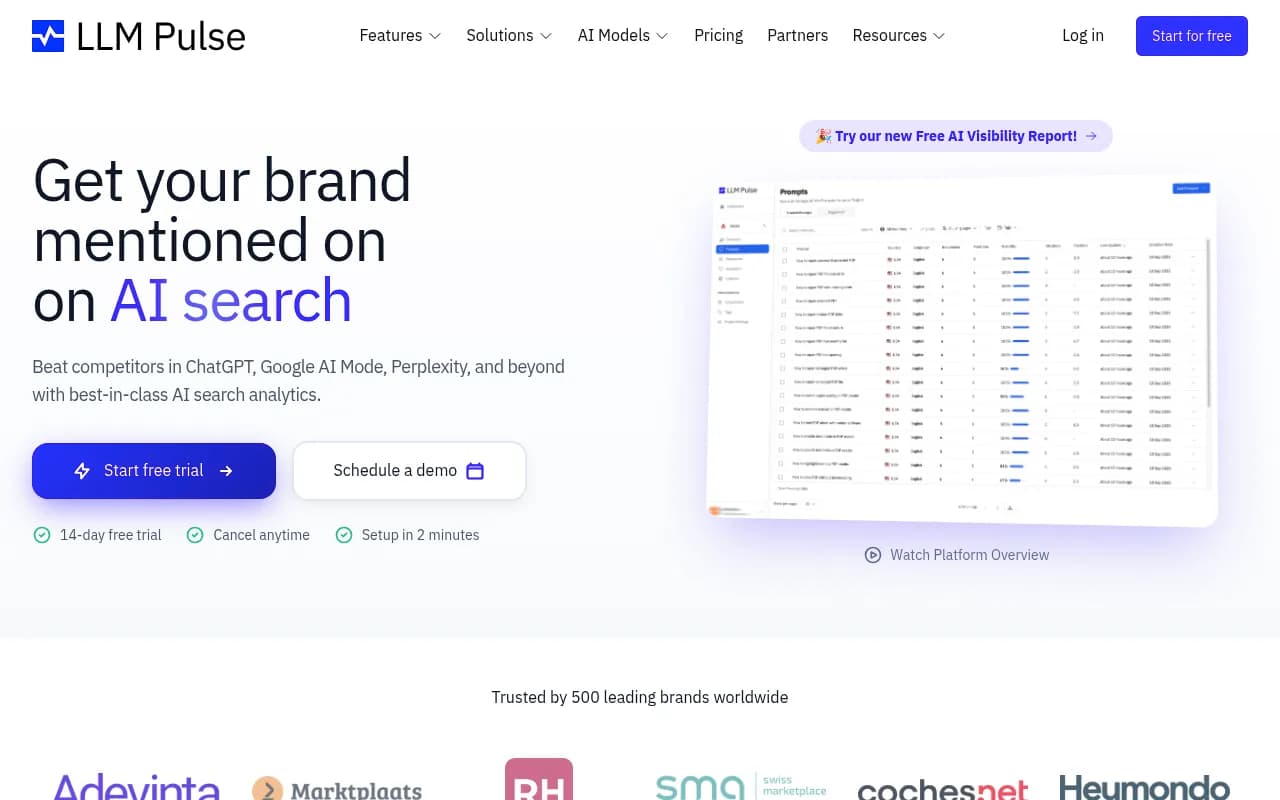
The tool handles the core monitoring workflow well: SERP monitoring, citation extraction, presence/absence detection, and historical tracking. The unlimited seats model makes it particularly attractive for agencies or teams where multiple people need access without per-seat costs adding up.
What it doesn't do is help you act on the data. There's no content gap analysis, no AI writing agent, and no crawler logs. It's a monitoring dashboard, and a good one, but the optimization work still falls entirely on your team.
For smaller teams or those just getting started with AI visibility tracking, LLM Pulse is a solid, affordable entry point.
Otterly.AI
Otterly.AI focuses on AI mention tracking across multiple platforms including Google AI Overviews. It's one of the more established tools in the space and has a reasonably clean interface.

The core use case is straightforward: set up your brand and keywords, and Otterly shows you when and where you appear in AI-generated results. It's accessible for non-technical users and doesn't require a lot of setup.
The ceiling is low. Otterly is monitoring-only. No visitor analytics, no content generation, no crawler logs, no gap analysis. If you want to understand your AI visibility and then do something about it, you'll need additional tools. But as a standalone monitor for teams that just want awareness, it works.
SE Ranking
SE Ranking has built AI visibility features into its broader SEO platform, including Google AI Overview tracking. It's positioned as a mid-market option with a more accessible price point than BrightEdge or enterprise Semrush.
The platform covers traditional rank tracking, site audits, and backlink analysis alongside AI visibility monitoring. For teams that want a single platform covering both traditional SEO and AI search without enterprise pricing, SE Ranking is worth evaluating.
Like most platforms in this space, the AI features are primarily monitoring-focused. The strategic view is useful for understanding where you stand, but content optimization is still a manual process.
Ahrefs Brand Radar
Ahrefs added Brand Radar to track brand mentions in AI search results. If you're an Ahrefs user, it's a natural extension of your existing workflow.
The honest assessment: Brand Radar uses fixed prompts (similar to Semrush), which limits how precisely you can track the queries that actually matter to your business. There's no AI traffic attribution and no content gap analysis. It's a useful signal, but not a complete solution.
Profound
Profound is an enterprise AI visibility platform with a strong feature set, particularly for large brands with complex competitive landscapes.
It covers monitoring across multiple AI models, competitive benchmarking, and some optimization guidance. The pricing is higher than most alternatives, and it lacks Reddit tracking and ChatGPT Shopping monitoring. For enterprise teams with the budget, it's a credible option. For mid-market teams, the cost-to-value ratio is harder to justify when platforms like Promptwatch cover more ground at lower price points.
Peec AI
Peec AI is a multi-language AI visibility platform, which makes it particularly relevant for brands operating across multiple markets.
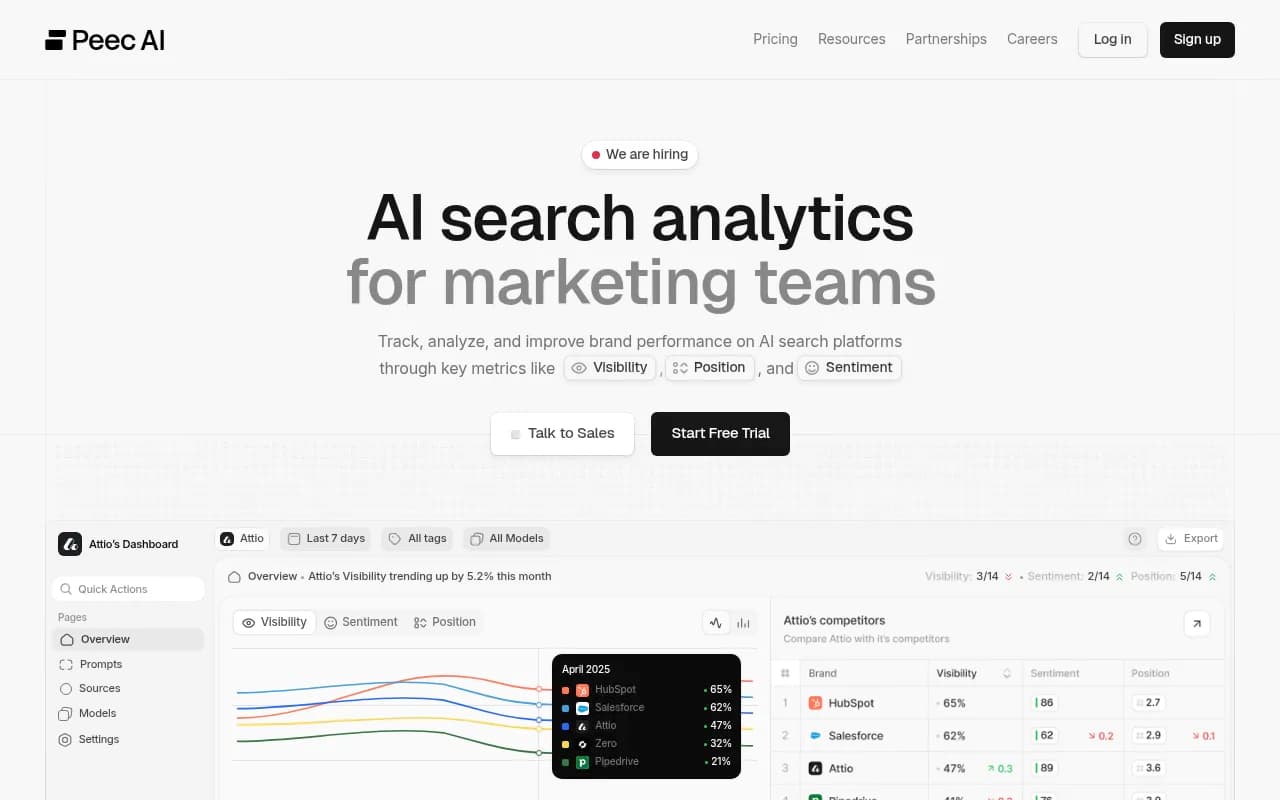
The multi-language support is genuinely useful and not something every platform handles well. The core monitoring capabilities are solid. Like most tools in this tier, it's primarily a monitoring platform without content generation or deep gap analysis.
Head-to-head comparison
| Tool | AI Overview tracking | Multi-model | Content gap analysis | AI content generation | Crawler logs | Traffic attribution | Pricing (starting) |
|---|---|---|---|---|---|---|---|
| Promptwatch | Yes | 10 models | Yes | Yes | Yes | Yes | $99/mo |
| Semrush | Yes (add-on) | Limited | No | No | No | No | ~$139/mo + add-on |
| BrightEdge | Yes | Partial | No | No | No | No | Enterprise (custom) |
| LLM Pulse | Yes | 5 models | No | No | No | No | €49/mo |
| Otterly.AI | Yes | Partial | No | No | No | No | ~$49/mo |
| SE Ranking | Yes | Partial | No | No | No | No | ~$65/mo |
| Ahrefs Brand Radar | Yes | Limited | No | No | No | No | Included w/ Ahrefs |
| Profound | Yes | Multiple | Limited | No | No | No | Enterprise (custom) |
| Peec AI | Yes | Multiple | No | No | No | No | Custom |
How to choose the right tool for your situation
The right tool depends on what you actually need to do with the data.
If you're just getting started and want to understand whether your brand appears in AI Overviews at all, LLM Pulse or Otterly.AI give you that awareness at a low cost. You'll quickly hit their limits, but they're fine for initial orientation.
If you're already on Semrush or Ahrefs and want to add AI visibility without switching platforms, the native add-ons are a reasonable starting point. Just go in knowing they use fixed prompts and won't help you optimize.
If AI search is a strategic priority and you want to actually improve your visibility rather than just watch it, Promptwatch is the clearest choice. The combination of gap analysis, AI content generation, and crawler logs means you can run a complete optimization cycle rather than just generating reports. The $249/month Professional plan covers most mid-market use cases.
If you're an enterprise with an existing BrightEdge or Profound contract, those platforms are worth using for AI Overview monitoring. But consider supplementing with a dedicated optimization tool if you need to actually move the needle.
The workflow that actually works
Tracking Google AI Overviews is only useful if it connects to action. The teams seeing real results from AI search optimization in 2026 are running a consistent loop:
- Identify which prompts and queries trigger AI Overviews in your category
- Check which of those prompts your competitors are cited for that you're not
- Create content specifically designed to answer those prompts with the depth and structure AI models want
- Track whether your citation rate improves over the following weeks
- Repeat
Most monitoring-only tools cover step 4 and nothing else. Tools like Promptwatch cover all five steps in a single platform, which is why the gap between "monitoring" and "optimization" tools is increasingly the meaningful distinction in this space.
The category is moving fast. New tools are launching regularly, and existing platforms are adding AI features at varying levels of depth. The comparison table above reflects the state of the market in mid-2026, but it's worth re-evaluating your stack every six months as the platforms evolve.
What won't change: Google AI Overviews are here, they're covering a growing share of queries, and brands that aren't tracking and optimizing for them are leaving visibility on the table.