Key takeaways
- Most AI visibility platforms offer API access, but the depth varies dramatically -- some give you full programmatic control, others restrict it to enterprise tiers or specific data exports only.
- Promptwatch is the only platform in this comparison that combines API-accessible monitoring data with built-in content generation and optimization -- meaning you can close the loop programmatically, not just pull reports.
- Profound and Scrunch AI have strong API offerings but are priced for enterprise budgets; Otterly.AI and Peec AI are more accessible but have thinner API functionality.
- If you're building internal dashboards, automating reporting, or integrating AI visibility data into your existing stack, the API tier and data model matter as much as the features themselves.
- Free trials exist across most platforms, but API access often requires a paid plan -- check before you commit.
The question used to be simple: does this tool have an API? Now it's more complicated. AI visibility platforms have proliferated fast, and "API access" can mean anything from a full REST API with webhook support to a single export endpoint that spits out a CSV. If you're a developer, a data team, or an agency building client workflows, that distinction matters a lot.
This guide focuses specifically on the API and programmatic access story for five platforms: Promptwatch, Profound, Scrunch AI, Otterly.AI, and Peec AI. We'll look at what data you can actually pull, what you can automate, how pricing works at the API tier, and where each platform has gaps.
Why API access matters for AI visibility
Traditional SEO tools have had mature APIs for years. Ahrefs, Semrush, Moz -- you can pull keyword rankings, backlink data, and site audits into any BI tool or custom dashboard you want. AI visibility is catching up, but slowly.
The reason API access is particularly important here: AI visibility data is inherently time-sensitive and multi-dimensional. You're tracking brand mentions across 10+ AI models, across dozens or hundreds of prompts, across different regions and personas. Doing that manually inside a dashboard is fine for weekly check-ins. But if you want to:
- Feed AI visibility scores into a broader marketing analytics stack
- Trigger alerts when your brand drops below a threshold in a specific model
- Automate competitive benchmarking reports for clients
- Build a custom visualization that combines AI visibility with revenue data
...you need a real API. Let's look at what each platform actually offers.
Platform-by-platform API breakdown
Promptwatch
Promptwatch sits in an interesting position in this comparison. It's the only platform here that's genuinely built around the full optimization loop -- find gaps, generate content, track results -- and its API reflects that.

The Promptwatch API gives you programmatic access to visibility scores, citation data, prompt-level performance, and competitor benchmarks. You can pull page-level citation data (which specific pages are being cited by which models, and how often), prompt volume estimates, and answer gap analysis results. That last one is significant: most platforms let you pull monitoring data via API, but Promptwatch exposes the gap analysis data too, so you can build automated workflows that surface content opportunities without anyone logging into the dashboard.
The Looker Studio integration is a native connector, which means you can build live dashboards without writing any custom code. For teams that live in Looker Studio for reporting, this is a real time-saver.
A few things worth noting: the API is available on Professional ($249/mo) and Business ($579/mo) plans. The Essential plan ($99/mo) doesn't include API access. If you're evaluating Promptwatch purely for API use, budget accordingly. The platform also covers 10+ AI models (ChatGPT, Claude, Gemini, Perplexity, Grok, DeepSeek, Copilot, Mistral, Meta AI, Google AI Overviews), so the data breadth you're pulling via API is genuinely wide.
One thing that sets Promptwatch apart from a developer perspective: the AI crawler log data is also accessible. You can see exactly which AI crawlers hit which pages, when, and what errors they encountered. That's the kind of technical signal that's hard to get anywhere else and very useful for debugging why certain pages aren't getting cited.
Profound
Profound is the enterprise-grade option in this comparison. It's used by large brands and agencies that need deep analytics and are willing to pay for them.
Profound's API is API-first in a meaningful way -- the platform was built with programmatic access as a core use case, not an afterthought. You can pull brand mention data, sentiment analysis, share-of-voice metrics, and competitive intelligence. The data model is fairly sophisticated, with support for unlinked and implied brand mentions (not just direct citations), which matters if you want a complete picture of how AI models talk about your brand.
The catch is pricing. Profound is squarely in the enterprise tier, and API access isn't available on entry-level plans. For smaller teams or agencies managing multiple clients on tight budgets, the cost-to-value calculation gets harder. The platform also doesn't have built-in content generation -- it's a monitoring and analytics tool, so the API gives you data to act on, but the acting happens elsewhere.
From a coverage standpoint, Profound tracks most major LLMs but doesn't match Promptwatch's breadth on models like DeepSeek or Mistral. For global brands tracking AI visibility across less mainstream models, that's a gap worth noting.
Scrunch AI
Scrunch AI has positioned itself as a content-focused AI visibility tool, and its API reflects that orientation.
The Scrunch API gives you access to content gap analysis data, citation tracking, and competitive benchmarks. Where it's strong: the content intelligence layer. If you want to pull data about which topics and angles are getting cited by AI models in your category, Scrunch surfaces that reasonably well. The API documentation is solid, and the data model is clean enough to work with.
Where it's weaker: model coverage. Scrunch covers the major platforms (ChatGPT, Claude, Perplexity, Gemini) but Google AI Mode is enterprise-only, and some of the newer models aren't tracked at all. If your audience is using Grok or DeepSeek in meaningful numbers, you'll have blind spots.
Like Profound, Scrunch is priced toward the higher end. API access is available but gated behind upper-tier plans. The platform doesn't have traffic attribution built in, so connecting API-pulled visibility data to actual revenue requires external tooling.
Otterly.AI
Otterly.AI is the most accessible option in this comparison from a pricing standpoint, and it's popular with smaller teams and solo practitioners who want basic AI visibility monitoring without a large budget commitment.

The API story here is more limited. Otterly.AI's API access exists but is relatively thin -- you can pull brand mention data and basic visibility scores, but the data model doesn't go as deep as Profound or Promptwatch. There's no crawler log access, no content gap analysis via API, and the model coverage is narrower (ChatGPT and Perplexity are core; Gemini and Google AI Overviews are add-ons).
For teams that just need to automate basic reporting -- "how many times was our brand mentioned this week across these prompts" -- Otterly's API is probably sufficient. For anything more sophisticated, you'll hit the ceiling quickly.
One thing Otterly does well: it's genuinely easy to set up and the API is straightforward to work with. If you're a developer who wants to get something running fast without reading 40 pages of documentation, that counts for something.
Peec AI
Peec AI is a multi-language AI visibility platform, which is its main differentiator. If you're tracking AI visibility across multiple markets and languages, Peec is worth a serious look.
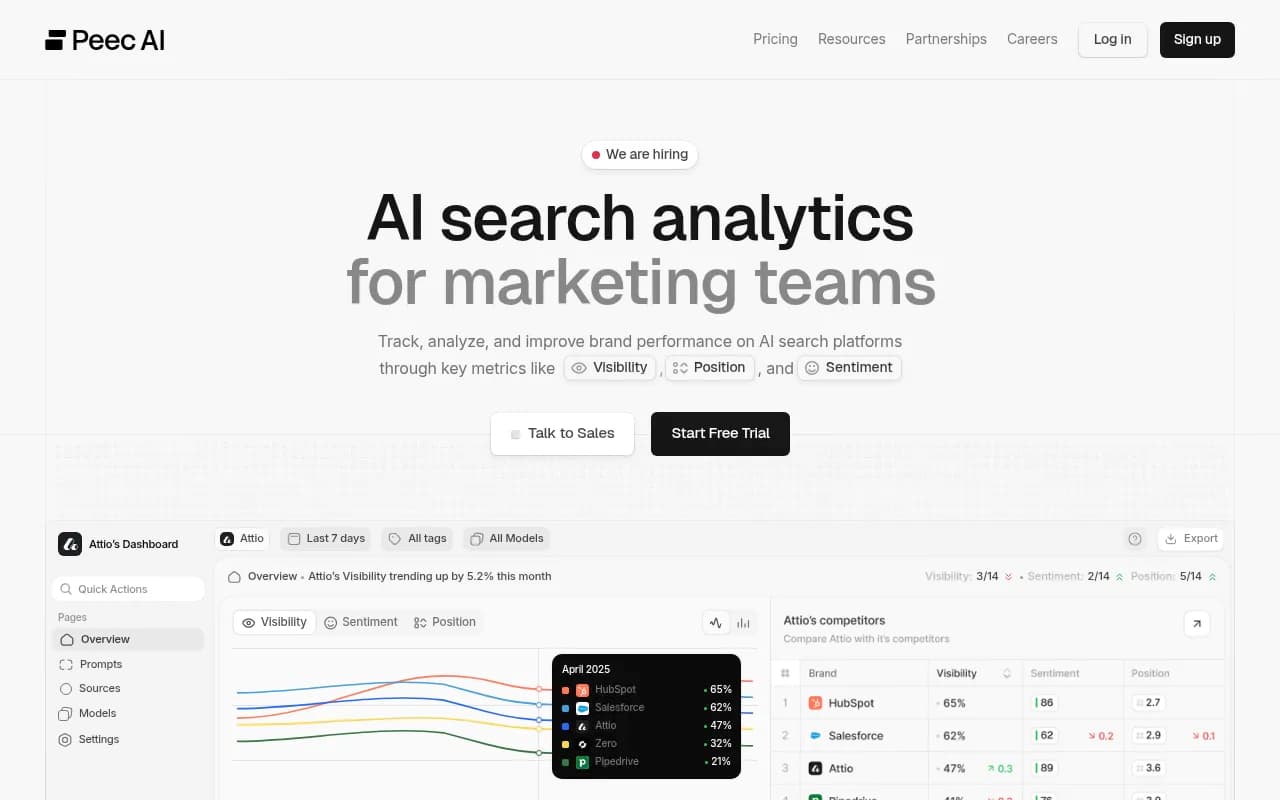
The Peec API gives you access to visibility scores, prompt tracking data, and competitive benchmarks. The multi-language support extends to the API, so you can pull localized data programmatically -- useful for international brands or agencies managing clients in multiple regions.
The limitations are similar to Otterly in some respects: the API is functional but not deep. Content generation isn't part of the platform, so you're pulling monitoring data and doing something with it elsewhere. Model coverage is decent for core platforms but thinner on newer or less mainstream models.
Peec's pricing is mid-range, and API access is available on paid plans. The platform has been growing its feature set, so the API capabilities may expand -- but as of now, it's a solid monitoring API rather than a full optimization data layer.
Side-by-side comparison
| Feature | Promptwatch | Profound | Scrunch AI | Otterly.AI | Peec AI |
|---|---|---|---|---|---|
| API availability | Professional + Business plans | Enterprise plans | Upper-tier plans | Paid plans | Paid plans |
| AI models covered via API | 10+ (ChatGPT, Claude, Gemini, Perplexity, Grok, DeepSeek, Copilot, Mistral, Meta AI, Google AIO) | Most major LLMs | ChatGPT, Claude, Gemini, Perplexity (Google AI Mode: Enterprise) | ChatGPT, Perplexity (Gemini, Google AIO: add-on) | Core LLMs + multi-language |
| Citation data via API | Yes, page-level | Yes, with implied mentions | Yes | Basic | Basic |
| Content gap analysis via API | Yes | No | Partial | No | No |
| Crawler log data via API | Yes | No | No | No | No |
| Traffic attribution | Yes (GSC, snippet, server logs) | No | No | No | No |
| Content generation | Yes (built-in AI writing agent) | No | No | No | No |
| Looker Studio integration | Yes (native) | No | No | No | No |
| Multi-language support | Yes | Limited | Limited | No | Yes |
| Pricing entry point | $249/mo (Professional) | Enterprise | Enterprise | Low-cost | Mid-range |
| Free trial | Yes | Yes | Yes | Yes | Yes |
What you can actually build with each API
This is the question that matters most for developers and data teams. Here's a realistic picture of what's achievable with each platform's API:
With Promptwatch's API
The combination of citation data, gap analysis, crawler logs, and prompt-level metrics means you can build fairly sophisticated workflows. Some realistic examples:
- A Slack bot that alerts your team when a competitor gains visibility for a high-value prompt
- A Looker Studio dashboard that shows AI visibility trends alongside organic traffic and revenue
- An automated weekly report that surfaces new content gaps and pipes them into a content calendar tool
- A crawler health monitor that flags when AI bots encounter errors on key pages
The content generation API is also worth mentioning -- you can trigger article generation based on gap analysis data, which means you could build a nearly automated pipeline from "identify gap" to "draft content" to "track results."
With Profound's API
Profound's strength is depth of brand intelligence. You can build:
- Executive-level brand health dashboards that track AI sentiment over time
- Competitive share-of-voice reports that run automatically on a schedule
- Alerts for unusual changes in how AI models describe your brand or products
It's a strong data layer for analytics-heavy teams. The gap is on the action side -- Profound tells you what's happening but doesn't help you change it.
With Scrunch AI's API
Scrunch is best for content teams that want to automate content intelligence. You can pull topic and citation gap data to feed into editorial planning, or build dashboards that show which content types are getting cited most in your category.
With Otterly.AI's API
Straightforward monitoring automation. Good for basic "are we being mentioned" tracking at scale, especially for agencies managing many clients who just need a simple visibility score in their reporting.
With Peec AI's API
The multi-language angle is the real value here. If you're building a reporting system for an international brand and need localized AI visibility data, Peec is the most practical option for that specific use case.
Choosing the right platform for your API use case
The honest answer is that the right choice depends on what you're trying to build.
If you want the most complete data layer -- one that covers monitoring, gap analysis, crawler intelligence, and content generation -- Promptwatch is the only platform in this group that offers all of that via API. The price point reflects that ($249/mo minimum for API access), but for teams building serious workflows, the data breadth justifies it.
If you're a large enterprise that needs deep brand intelligence and sentiment analysis, Profound's API is worth the premium. Just accept that you'll need other tools to act on the data.
If you're an agency that needs to automate basic visibility reporting across many clients at low cost, Otterly.AI's API is probably sufficient. You won't get deep data, but you'll get something functional fast.
If multi-language coverage is your primary requirement, Peec AI is the most practical choice.
Scrunch sits in an interesting middle ground -- better than Otterly for content intelligence, not as comprehensive as Promptwatch, and priced closer to the enterprise end without quite the enterprise feature set.
A note on API stability and documentation quality
One thing that's easy to overlook when evaluating APIs: documentation quality and stability matter as much as features. AI visibility is a fast-moving space, and several platforms have changed their API schemas significantly over the past year as they've added new models and features.
Promptwatch and Profound both have reasonably mature API documentation. Scrunch's docs are solid. Otterly.AI and Peec AI are functional but less comprehensive -- expect to do some trial and error.
If you're building something that needs to be reliable over time (a client-facing dashboard, an internal analytics system), factor in the maintenance burden of working with a less stable API. The cheaper option can end up costing more in developer time.
Bottom line
The API landscape for AI visibility platforms in 2026 is maturing but still uneven. Most platforms have some form of API access, but the depth, reliability, and data model vary significantly.
For teams that want to build real workflows -- not just pull data into a spreadsheet -- Promptwatch is the most complete option. It's the only platform here where the API gives you access to the full optimization loop: monitoring data, gap analysis, crawler logs, content generation triggers, and traffic attribution. That's a meaningful difference from platforms that are monitoring-only.
For pure enterprise brand intelligence, Profound is the strongest data layer. For budget-conscious basic monitoring automation, Otterly.AI works. For international brands, Peec AI's multi-language API is hard to beat.
Whatever you choose, test the API before committing. Most platforms offer free trials, and a few hours of hands-on testing will tell you more about real-world usability than any comparison guide.