Key takeaways
- Slate's own pricing works out to roughly $0.050 per tracked AI answer on Growth and Scale, and $0.040 on Agency, at monthly billing. Annual billing drops those to about $0.040, $0.040 and $0.032.
- Most Slate alternatives do not publish their answer quotas the same way, so a clean ranking by cost per response needs you to normalise platforms, regions and run frequency first.
- Promptwatch is the one alternative in this list where the numbers are published in a form you can divide: $95 for 6,000 responses, which is about $0.016 per response, and it adds crawler logs and content tools on top.
- Cost per response and cost per citation are different things. One ChatGPT answer holds about 5 citations, while AI Overviews and Perplexity hold about 10.
- Cheaper is not always better. If you need content workflows, a $99 all-in-one tool can beat a $499 tracker. If you only need monitoring, you are overpaying for Slate's content engine.
Why cost per tracked response is the right yardstick
Pricing pages for AI visibility tools are a mess. One vendor sells prompts, another sells credits, a third sells projects and hides the response cap in a footnote. Comparing sticker prices tells you almost nothing.
The unit that actually matters is the tracked response: one answer captured from one AI platform, for one prompt, in one location. That is how Slate defines an AI answer, and it is the closest thing this market has to a common currency. Divide the monthly price by the responses included and you get a number you can compare.
I will be upfront about one limit. Not every vendor publishes its quota, and I did not verify every competitor's current plan in this pass. Where a number is a third-party estimate, I say so. Check each vendor's pricing page before you buy.
What Slate actually costs per answer
Slate is an AI content operations and visibility platform aimed at agencies and mid-market B2B teams. Its pricing is published clearly, which is more than you can say for many rivals.
| Plan | Monthly price | AI answers per month | Cost per answer (monthly billing) | Cost per answer (annual, 20% off) |
|---|---|---|---|---|
| Growth | $499 | 10,000 | about $0.050 | about $0.040 |
| Scale | $999 | 20,000 | about $0.050 | about $0.040 |
| Agency | $2,000 | 50,000 | $0.040 | about $0.032 |
| Enterprise | Custom | Custom | Custom | Custom |
The arithmetic is mine, based on Slate's listed prices. A few details change the real number:
- Every plan tracks ChatGPT, Perplexity, Google AI Overviews and Google AI Mode. Claude and Gemini sit in a separate answer pool sold as an add-on in packs of 1,000 answers, and the pricing page does not state what those packs cost.
- Credits for the content workflows are a separate allowance, so they do not eat into tracking.
- Growth covers one region. Scale is multi-region.
- Slate lists bring-your-own API key on all plans.
Here is the pitfall that catches people. 333 prompts tracked daily on one platform burn about 10,000 answers a month, the entire Growth allowance. Run the same prompts weekly and you use about 1,450. So the real cost per prompt depends on platforms times regions times run frequency. A tool that looks cheap per answer can still be expensive if you need daily runs across five countries.
How to normalise any tool to cost per response
Before you rank anything, put every candidate through the same four questions.
- How many responses (not prompts) are included per month?
- How many AI platforms does that quota cover, and are some paid add-ons?
- How many regions or languages are included?
- How often do prompts run, and can you change that?
Then calculate monthly price divided by responses. If a vendor only sells prompts, multiply prompts by platforms, regions and runs per month to estimate responses. If it sells credits, find out what a single tracked answer costs in credits.
One more thing worth knowing. Promptwatch Data shows that ChatGPT cites about 5 sources per web-search answer, while Google AI Overviews and Perplexity cite about 10. So cost per response and cost per citation observed are not the same metric. A platform with a lower price per answer on ChatGPT may give you less citation data per dollar than one tracking AI Overviews. If your goal is citation analysis, factor that in.
Slate alternatives ranked by cost per tracked response
This ranking uses the figures I could verify or that vendors publish. Lower is cheaper. Treat anything marked as an estimate with caution.
| Rank | Tool | Published plan | Responses included | Approx. cost per response | Confidence |
|---|---|---|---|---|---|
| 1 | Promptwatch Essential | $95/mo | 6,000 | about $0.016 | Published on vendor pricing |
| 2 | Promptwatch Business | $579/mo | 42,000 | about $0.014 | Published on vendor pricing |
| 3 | Promptwatch Professional | $245/mo | 18,000 | about $0.014 | Published on vendor pricing |
| 4 | Slate Agency | $2,000/mo | 50,000 | $0.040 | Published on vendor pricing |
| 5 | Slate Growth and Scale | $499 and $999/mo | 10,000 and 20,000 | about $0.050 | Published on vendor pricing |
The table is sorted by the numbers, and the numbers show Promptwatch as the lowest cost per response of anything I could calculate. Professional and Business both land around $0.014 once you divide it out. Agency plans change the maths too: Kick-off at $199 for 10,000 responses is about $0.020, Growth at $399 for 25,000 is about $0.016, and Scale at $799 for 65,000 is about $0.012.
I did not verify current quotas for Peec AI, Otterly.AI, AthenaHQ, Profound or the Semrush AI Toolkit, so I have not put invented numbers next to them. I will cover what is known about each below.
Promptwatch: lowest cost per response, with the action layer
Promptwatch is the option I would check first if cost per response is your deciding metric. It tracks the real user interfaces of ChatGPT, Google AI Overviews, Google AI Mode, Gemini, Perplexity, Copilot and others, in each country and language, rather than relying on API outputs that can differ from what users see.

The plans, in USD per month (annual billing gives 12 months for the price of 10):
- Explore: free, 1 project, 10 prompts, ChatGPT only.
- Essential: $95, 50 prompts, 6,000 responses, all AI models, country tracking, site audit, content gap analysis, 500 Agent Credits.
- Professional: $245, 150 prompts, 18,000 responses, 1,500 Agent Credits, 5 AEO articles.
- Business: $579, 350 prompts, 42,000 responses, the automated Content Agent, state and city tracking, Shopping Insights and Ads Radar.
- Agencies: Kick-off $199, Growth $399, Scale $799, each with unlimited projects and prompts.
What separates it from a pure tracker is what happens after the measurement. IP-verified AI crawler logs show which pages GPTBot, ClaudeBot and PerplexityBot actually read and where they hit errors. The Action Board gives you a prioritised to-do list, and the Content Agent writes and publishes to WordPress, Webflow or Framer. Published pages get tracked through crawls, citations and AI traffic. Slate bundles content workflows too, but its tracking is priced higher per answer and has no crawler log equivalent in the notes I gathered.
Pricing changes, so confirm at promptwatch.com/pricing. The 7-day free trial on monthly plans lets you test your actual prompt set before committing.
For more context on how AI engines build answers, Promptwatch's ChatGPT query fanout data is worth a read. The average fanout was 2.15 web searches per response in early December and about 1.84 by early March, with query length falling too. A tool that only tracks the user prompt misses that layer.
The monitoring-only crowd: cheap, but check the quotas
If you do not need content workflows, a lightweight monitor can cut your bill. The trade-off is that you will probably end up stitching together other tools.
Peec AI is the one most often cited as mid-market. Third-party reviews put its tiers at roughly $100 starter, $241 Pro and $505 Enterprise per month. I could not verify its response quotas, so I cannot give you a per-response number. Metaflow's comparison describes it as monitoring without a content engine.

Otterly.AI is another lightweight option for sentiment alerts and basic tracking.

AthenaHQ adds agentic recommendations to its monitoring.

Profound targets enterprise teams with deeper monitoring, and typically sits at a higher price point.
For a broader view of trackers in this class, the directories at ai-rank-tools.com and bestgeosoftware.com list dozens more.
The content-first alternatives
Some people leave Slate because they want content tools, not tracking. Here the cost-per-response metric stops being useful, and you should compare cost per published article instead.
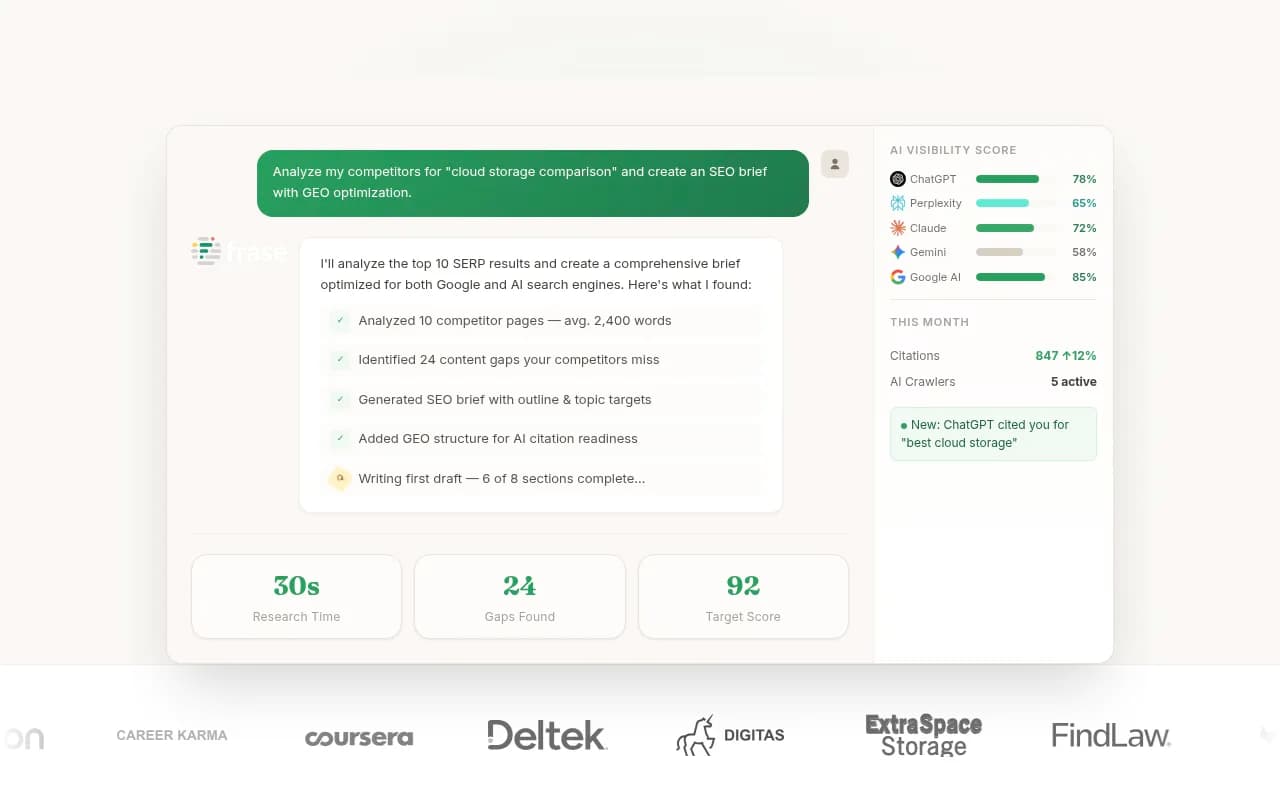
Frase is a budget content tool. According to BlazeHive's comparison, Starter is $45/month for 15 articles, Professional is $115 for 75 articles, and AI search tracking is only included at 250 prompts per month on the $195 Scale plan.
AirOps has the steepest cliff. Per the research gathered, multi-engine AI visibility tracking sits behind the roughly $2,000/month Pro plan, not the roughly $200 Solo tier, and task-based billing with overage estimates of $9 per 1,000 tasks makes monthly cost hard to predict.
Clearscope runs $129, $199 and $399 per month across its tiers and is a content optimizer with light AEO tracking.
MarketMuse starts free with 10 queries a month, then roughly $99 to $149 for Optimize and $499+ for Strategy.
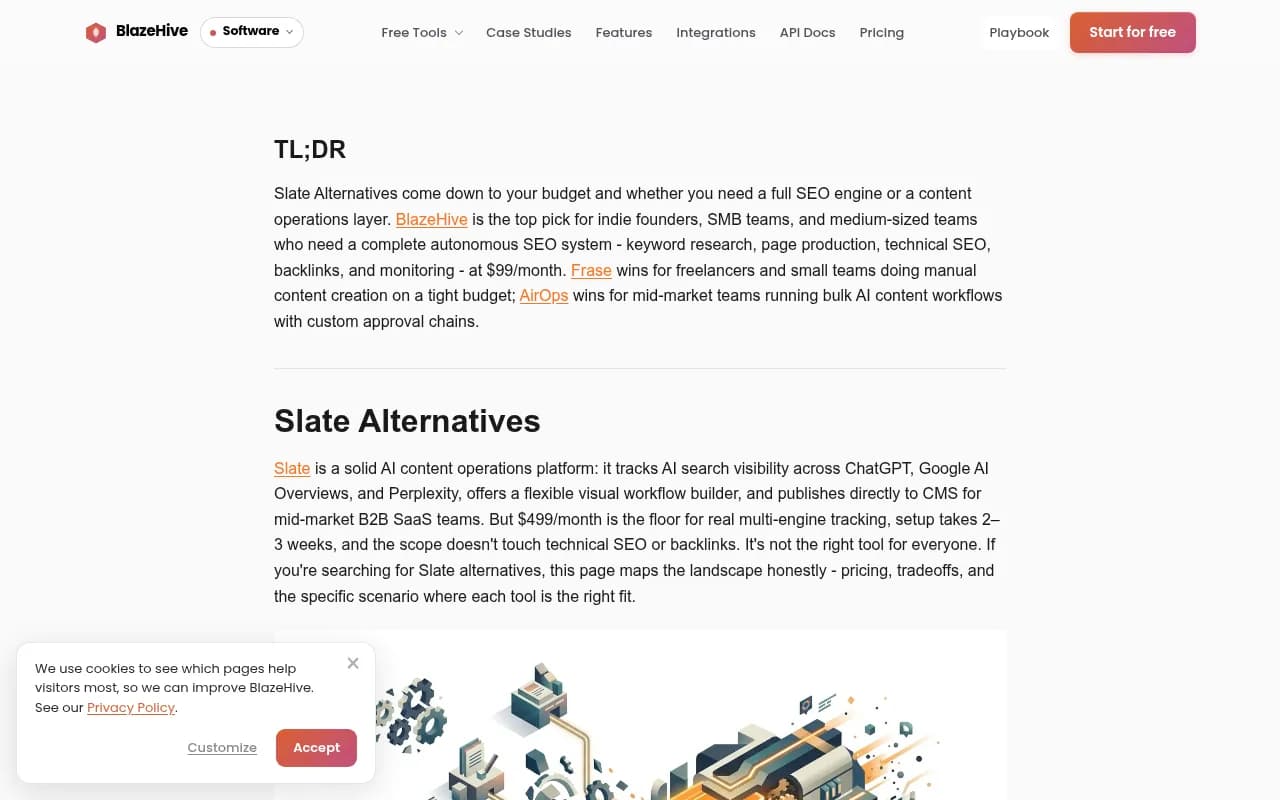
BlazeHive claims $99/month all-in, covering keyword research, page production, technical SEO, backlinks and monitoring, with a $3,000 done-for-you setup option. That is BlazeHive's own pricing claim on its own comparison page, so read it with that in mind.

Big-suite options
If your team already lives inside a platform, adding AI tracking there can make budget sense even at a worse per-response rate.
Semrush and SE Ranking both added AI visibility modules. G2 lists Semrush, Conductor and Birdeye among the top Slate alternatives for AEO.

Expect fixed prompt sets and shallower AI-specific data than in dedicated platforms. The advantage is a single invoice and a single login.
Which option fits which team
| Team | Budget band | What to look at | Why |
|---|---|---|---|
| Solo founder or one marketer | Under $200/mo | Promptwatch Essential, Peec AI, Otterly.AI | Monitoring without paying for a content engine you cannot yet operate |
| In-house content team owning AEO | $500 to $2,000/mo | Promptwatch Business, Slate Growth | Tracking plus content workflows |
| Agency with many clients | $199 to $799/mo | Promptwatch agency plans | Unlimited projects and prompts, white-label reports |
| Enterprise with governance needs | $5,000+/mo | Slate Enterprise, Profound, Promptwatch Enterprise | Audit trails, SSO and managed workflows |
| Team on a classic SEO suite | Varies | Semrush or SE Ranking AI add-ons | One vendor, shallower data |
Pitfalls that distort the comparison
A few things quietly wreck cost-per-response maths.
- Platform count. A tool tracking one platform at $0.02 per answer is not cheaper than one tracking six at $0.03.
- Regions. If you need five countries, multiply your responses by five.
- Frequency. Daily runs cost roughly 30 times weekly runs. Most brands need daily data only for their top 20 to 50 prompts.
- Add-ons. Slate's Claude and Gemini packs are priced separately and the price is not public.
- Overages. Credit and answer packs get expensive when your usage spikes.
- Onboarding. BlazeHive reports Slate setup takes 2 to 3 weeks, which is a real cost if your time is billable.
And a final caution on the sources. The BlazeHive, Metaflow and similar pricing roundups are written by vendors with their own products to sell. Use them for leads, then confirm on the official pricing page.
What I would do
Start by listing the prompts you genuinely need to track, then count platforms and regions. Work out your monthly response need. Run Slate's published rate ($0.04 to $0.05) against Promptwatch's published rate (roughly $0.012 to $0.016) for that volume, and decide whether Slate's content engine is worth the premium to you.
For most teams that need tracking plus a way to act on it, the maths favours a platform that lists its quotas and prices openly. If you want an outside opinion on whether a tool swap makes sense, an agency like 1001 SEO Media can audit your setup, and the wider catalogue at surferstack.com is a good place to keep comparing.