Key takeaways
- AI visibility platforms track whether ChatGPT, Gemini, Perplexity, Claude and Google AI Overviews mention or cite your charity. That is a different job from the AI writing and fundraising tools most nonprofit roundups cover.
- ChatGPT leans on product and landing pages (22.4% and 16.8% of its citations, Sep 28 to Oct 4, 2026). For a charity, your programme, donate and about pages are the equivalent surface.
- Social platforms matter very differently by model: 0.46% of ChatGPT citations, but 12.2% of Google AI Overviews citations in the same week.
- Pick a platform by what you need to do next. A free scan and a small tracker is enough to start. A platform that also tells you what to fix is worth the money once you have a content person to act on it.
- Check pricing and any nonprofit discount directly with each vendor. Plans change often, and I have not listed prices for tools whose terms I could not confirm.
Why nonprofits should care about AI visibility
Most charities have spent years on Google rankings, grant applications and donor email. Meanwhile a growing share of people ask ChatGPT "which charities help refugees in my area" or "is this charity legitimate" and get a single synthesized answer. If your organization is not in that answer, you do not get the donation, the volunteer sign-up or the referral.
There is also a reputational side. AI models sometimes get charity facts wrong: outdated program descriptions, a wrong leadership name, a merged charity listed as if still separate. Nobody on your team will notice unless someone checks.
The tools in this guide are not the AI writing assistants and donor-prediction products that dominate nonprofit AI lists. Those help you work faster. AI visibility platforms tell you how you show up in answers other people read. If you want the first category, the Nonprofit Tech for Good AI Hub is a reasonable curated starting point.
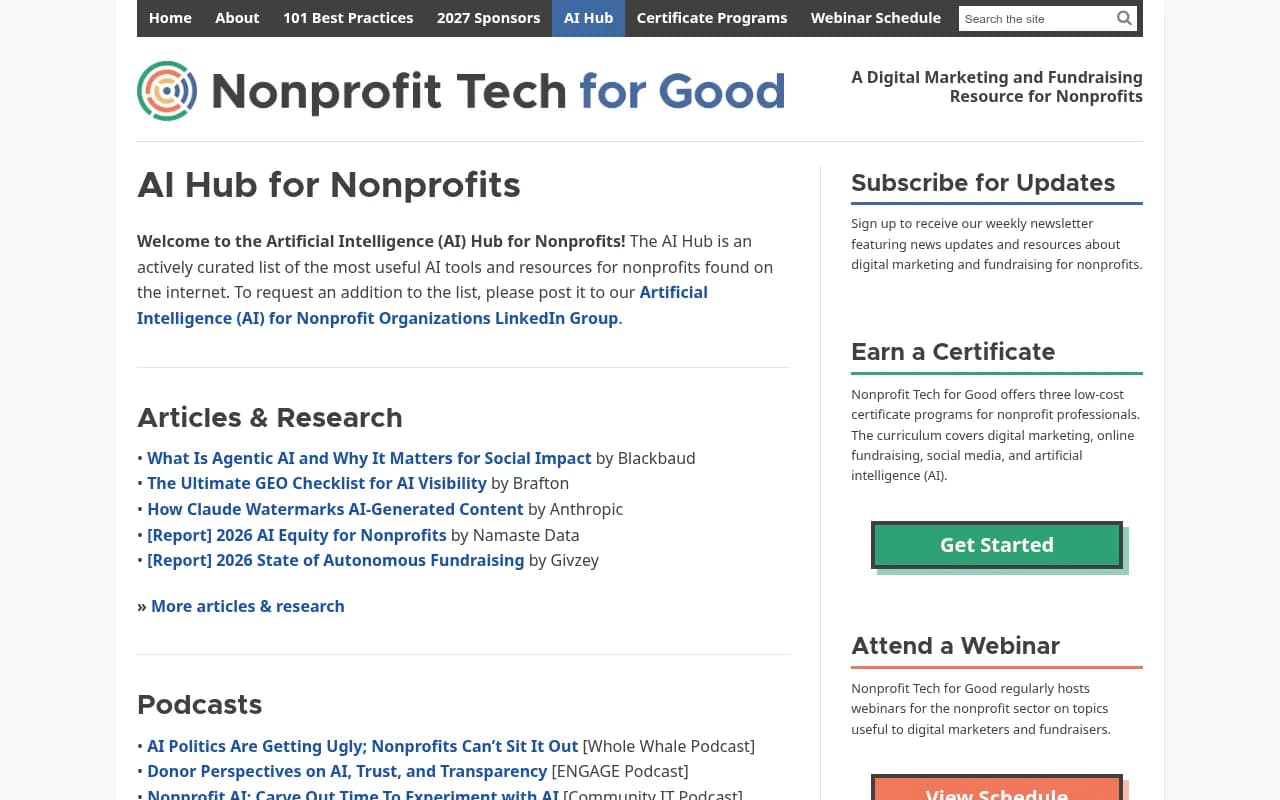
Notably, even that hub now lists GEO and AI visibility material alongside fundraising AI, which tells you where nonprofit marketers' attention is moving.
What AI visibility actually means for a charity
Three questions cover most of it:
- Are we mentioned when people ask about our cause, our region or our type of service?
- Are our own pages cited as sources, or does the model lean on a third-party listing?
- Is what the model says about us accurate?
A platform answers these by running a set of prompts across several AI models on a schedule and recording the answers, citations and sources. Good ones also show the prompts people actually use and which pages the models read.
The prompts that matter for nonprofits
Build your tracking list around real donor and beneficiary behavior:
- Cause discovery: "best charities for clean water", "organizations supporting dementia carers in Leeds"
- Trust checks: "is [charity name] legitimate", "how much of [charity] goes to programs"
- Comparison: "[charity A] vs [charity B]"
- Service seeking: "food bank near me", "free legal help for tenants"
- Giving mechanics: "how to donate stock to charity", "is my donation tax deductible"
Branded trust prompts are where reviews matter. In Promptwatch Data's ChatGPT citation share by content type report (Sep 28 to Oct 4, 2026), reviews made up 5.6% of citations for branded prompts, more than three times their share across all prompts. For a charity, that likely means rating-site profiles and reviews influence "is this charity legitimate" answers more than your own annual report does. That is my inference from the data, not something the report states about charities.
What the citation data says you should fix
Before choosing a platform, it helps to know what the platforms will end up telling you. Promptwatch's data gives a decent preview.
Your core pages are the main surface
In the same report, product pages were the most cited content type in ChatGPT at 22.4%, then landing pages at 16.8%, listicles at 13.6% and documentation at 7.5%. Charities do not have product pages, but programme pages, donate pages and "about" pages play the same role. If those pages are thin, they are not going to get cited. For branded prompts, Promptwatch's advice is to make the homepage and key pages answer questions about what you do, who you serve and how giving works, and to add an FAQ page.
If you are also working out how long your content stays cited, the half-life of ChatGPT citations (pages cited on July 6, 2026, tracked 90 days) found landing pages and docs stayed cited longest while news lost half its pages within 36 days. Evergreen programme pages beat press-release-style updates.
Social channels: depends on the model
The social media citations report (Sep 28 to Oct 4, 2026) shows a split:
| Model | Share of citations from social | Notable platforms |
|---|---|---|
| ChatGPT | 0.46% | LinkedIn about 0.3%, Reddit 0.09% |
| Google AI Overviews | 12.2% | YouTube 4.28%, Facebook 2.38%, Reddit 2.15%, Instagram 1.61%, LinkedIn 1.55% |
| Perplexity | 2.7% | LinkedIn and Reddit 0.86% each, YouTube 0.79% |
Many charities already run active Facebook pages and YouTube channels. Those count for Google's AI surfaces and barely register in ChatGPT. Reddit is no longer much of a ChatGPT lever either; Promptwatch Data recorded reddit.com's share of ChatGPT citations falling from about 4% to 0.5% on August 14, 2026. If someone has pitched your board on a Reddit strategy for AI visibility, show them that chart.
Health and medical charities: authority sources dominate
For healthcare prompts, ChatGPT cited NIH most (5.46%), with PubMed Central and PubMed accounting for most of that, then the FDA (1.76%) and the NHS (1.1%), per the healthcare citations report (Sep 9 to Oct 8, 2026). Government and public health sites earned 7.06% of citations. A health charity is unlikely to outrank NIH. The practical route is to cite and link those institutions on your own pages, align content with official guidance (NHS, NICE, CDC, FDA), and work with medical associations.
Types of AI visibility platforms
The catalog has hundreds of options. They fall into a few groups.
| Type | What it does | Examples | Fits a nonprofit that... |
|---|---|---|---|
| Free checkers | One-off snapshot of mentions | HubSpot AI Search Grader, AnswerGist, RightChoice.Ai | Wants to see the problem before spending |
| Lightweight trackers | Scheduled prompts, mentions, basic reports | Otterly.AI, Peec AI, ZipTie | Has a small team and just needs monitoring |
| Optimization platforms | Tracking plus gap analysis, content and technical fixes | Promptwatch, Profound, Scrunch | Has someone who can publish and fix pages |
| SEO suites with AI add-ons | AI tracking inside a broader SEO tool | Semrush, Ahrefs Brand Radar, SE Ranking | Already pays for one of these |
| Enterprise platforms | Large-scale GEO with services | Evertune, Conductor, BrightEdge | Is a big international charity or federation |
I could not verify pricing or nonprofit discounts for most of these, so check vendor pages. Some vendors do offer nonprofit pricing on request, and it costs nothing to ask.
The platforms worth shortlisting
Promptwatch
Promptwatch is the one I would look at first for a charity that has a content person and wants to act on what it finds. It tracks the real interfaces of ChatGPT, Google AI Overviews, AI Mode, Gemini, Perplexity, Copilot and others, and it goes beyond monitoring: it shows which prompts you are missing from, which of your pages AI crawlers actually read (via IP-verified crawler logs), and which pages get cited. Its Content Agent can draft and publish to WordPress, Webflow or Framer, and the Action Board gives a prioritized to-do list, which suits a team without a dedicated SEO.

Two features matter specifically to charities. Offsite Mentions finds third-party pages that name you without linking, which is common for charity directories and news coverage. Sentiment tracking helps catch inaccurate or negative framing. Paid plans start at $95 a month for Essential (50 prompts), with a free Explore tier limited to ChatGPT and 10 prompts. Confirm current terms at promptwatch.com/pricing and ask about nonprofit arrangements.
For agencies running this on behalf of several charities, the agency plans have unlimited projects and white-label reports. If you are looking at outside help instead, agencies such as 1001 SEO Media work with Promptwatch on AI search visibility.
Otterly.AI
A lower-cost tracker aimed at people who want prompts run on a schedule and a simple report. It monitors; it will not tell you what to write. That is fine if your goal is a monthly check that nothing has gone wrong.

Peec AI
Peec AI is another monitoring-focused option with a clean interface. As with Otterly, plan to pair it with your own content process.

ZipTie
ZipTie is pitched around deeper analysis and reporting, and appears in Zapier's roundup of AI visibility tools. It suits a communications team that needs to produce reports for trustees.
Profound
Profound is an enterprise platform with an agency mode. It is likely overbuilt for a local charity, but a national organization with a communications department and budget might consider it.

Semrush and Ahrefs Brand Radar
If you already pay for one of these for SEO, check what AI tracking is included before buying another tool. They usually work with fixed prompt sets and shallower AI-specific data, so you may outgrow them.

Free options to start with
Before buying anything, run a free check. AnswerGist offers a free audit with prioritized fixes, and Dageno AI and OpenLens both list free plans. Promptwatch also has a free AI visibility report that scans without a login.

How to choose
A few questions settle most decisions.
Do you have someone who can publish content?
If not, a monitor will produce reports nobody acts on. Either choose a platform that drafts and publishes for you, or put the money into a small agency retainer.
How many languages and regions do you serve?
International charities need tracking by country and language. Confirm that the platform tests in the real interface per region, not just through an API, because answers differ.
Do you run local services?
Food banks, shelters and legal aid clinics live on "near me" prompts. City-level tracking matters here, and listings tools such as Yext, Synup or BrightLocal can help with the underlying data.
Who needs to see the results?
Boards and funders like a PDF. Check that scheduled reports exist and that exports are not locked behind a higher tier.
A practical 30-day plan
Borrowing the spirit of the pilot advice in StratusLIVE's guide (one tool, one job, 30 days), here is a version for visibility.
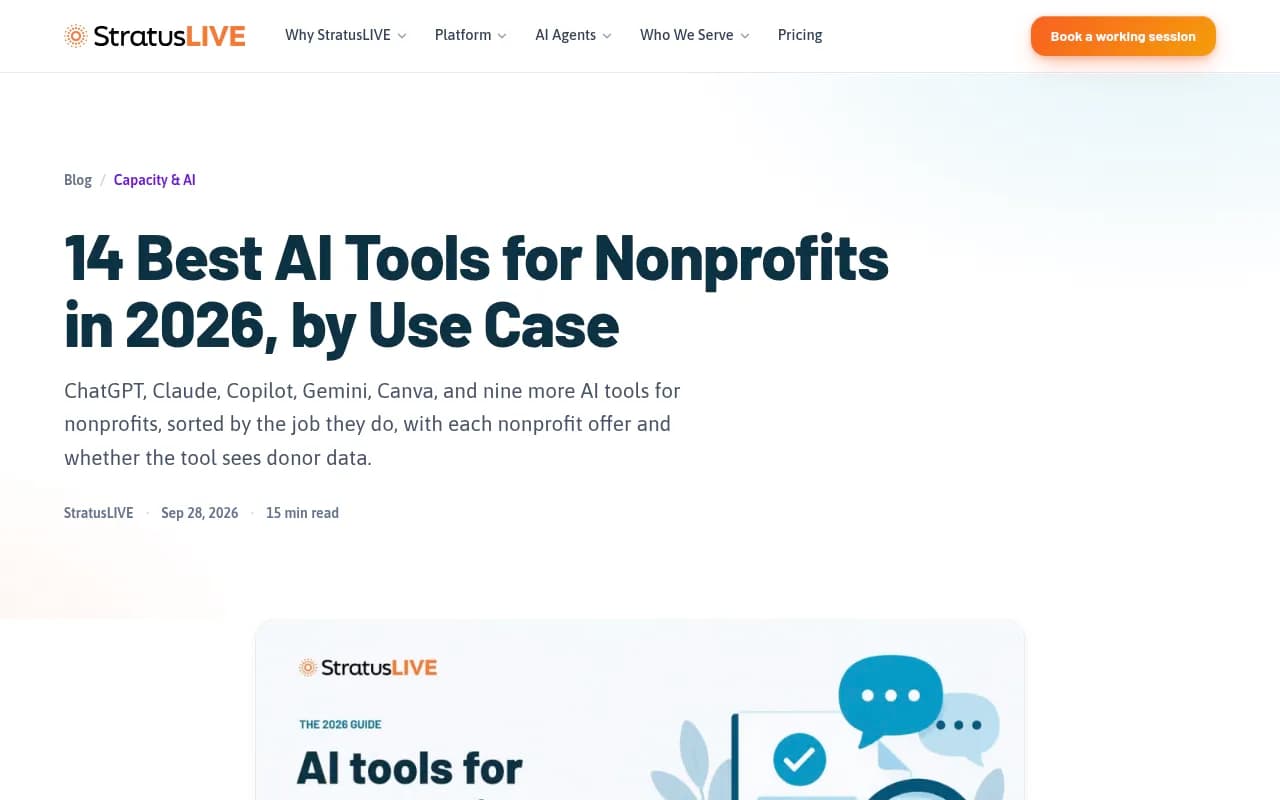
That guide is vendor-authored, so read it with that in mind, but the pilot structure is sound.
- Week 1: write 20 to 30 prompts across the five categories above. Run them manually in ChatGPT, Gemini and Perplexity and note whether you appear and whether the facts are right.
- Week 2: load the same prompts into a free checker or a trial. Compare against your manual notes.
- Week 3: fix the obvious problems. Update programme and donate pages, add an FAQ, correct your listings and any rating-site profiles, and make sure AI crawlers are not blocked in robots.txt.
- Week 4: re-run the prompts. Note what changed, and write down the hours spent.
If you see no movement, that is useful too. It usually means the problem is crawler access or thin pages rather than the tool.
Data and privacy cautions
AI visibility tools monitor public answers, so they do not need donor data. Keep it that way. Do not connect your CRM to a visibility tool unless you have to, and check any vendor's terms if you do. Also write down who owns the prompt list and the reports; it is easy for this to live in one volunteer's login.
More broadly, only 39% of nonprofit executives had written guidance on safe AI use in a 2026 NTEN and Bridgespan survey, as cited by StratusLIVE. Put a one-page policy in place before adding more AI tools of any kind.
Where to look for more options
The field is crowded and changes monthly. The GEO software directory and the AI rank tracking tools directory list many more platforms than I can cover here, and Promptwatch's full comparison of 22 GEO platforms is worth a skim if you want a vendor-written side-by-side.
Bottom line
Start free. Run your own prompts, run a free scan, and see whether the problem is mentions, accuracy or crawler access. If you only need monitoring, a lightweight tracker like Otterly.AI or Peec AI will do. If you want to fix what you find and have a person to do it, an optimization platform such as Promptwatch earns its price. Whatever you pick, spend your first month on your programme, donate and about pages, because those are the pages AI models cite.