Key takeaways
- Cannabis and CBD brands face ad restrictions on most major platforms, which makes organic AI citations (ChatGPT, Gemini, Perplexity, AI Overviews) one of the few scalable discovery channels left.
- 5W's Cannabis AI Visibility Index 2026 found Curaleaf leading at 7.5% of citations, with Charlotte's Web the most-cited CBD brand. CBD behaves like a separate citation universe from THC cannabis.
- A tracker that only tells you "you were mentioned" is not enough. Regulated brands need to see why they are missing, which pages get cited, and what to fix.
- For wellness and CBD content, ChatGPT leans on government and medical sources (NIH, FDA, NHS), so your pages should reference and agree with those sources.
- Promptwatch is the strongest all-round pick for brands that want to act on the data. Peec AI and Otterly.AI suit teams that only want monitoring, and Profound suits large enterprises.
Why cannabis, CBD and wellness brands need AI visibility more than most
Most direct-to-consumer brands can fall back on paid social and search ads when organic traffic stalls. Cannabis and CBD brands mostly can't. Age-gating, platform policies, state-by-state licensing and payment restrictions push growth toward organic channels, and AI answers are now one of them.
A shopper who types "best CBD for sleep" or "best dispensary in Florida" into ChatGPT gets a short list of brands. If you are not on it, you do not exist for that buyer. Nobody is going to scroll to page two of a chatbot answer.
The numbers back this up. 5W Public Relations ran 50+ consumer-intent prompts through ChatGPT, Claude, Perplexity, Gemini and Google AI Overviews in Q1 2026 and ranked the top 25 U.S. cannabis brands by citation share.
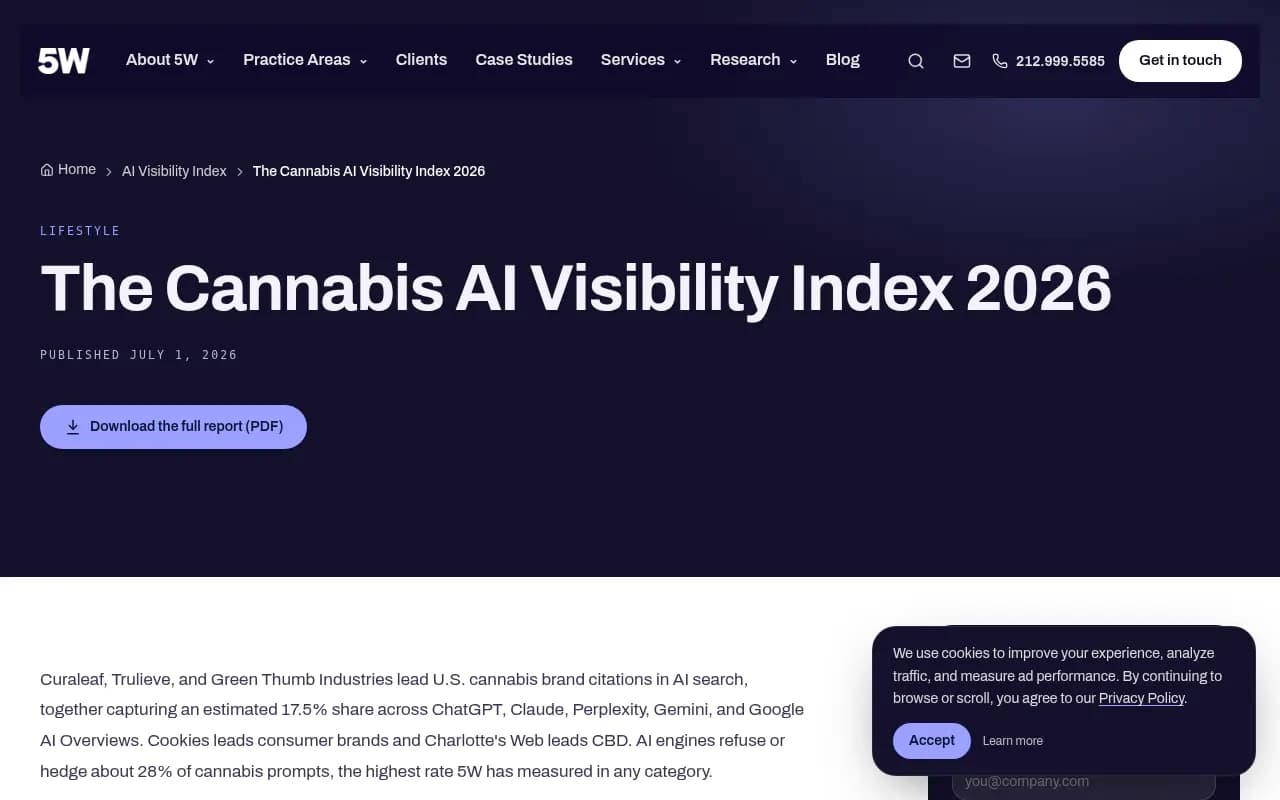
A few findings from the 5W index that shape how you should pick a platform:
- Curaleaf leads at 7.5% of citations, followed by Trulieve at 6.5%. Charlotte's Web sits at 4.5% and leads the CBD sub-category.
- Mid-tier multi-state operators (Cresco Labs, Verano, Ascend, TerrAscend and others) get routed around for generic prompts like "best cannabis dispensary". They only surface with state-specific or product-specific framing.
- CBD is its own citation surface. AI citations have consolidated around six brands: Charlotte's Web, Cornbread Hemp, Lazarus Naturals, CBDistillery, Joy Organics and Medterra.
- Niche ownership works. Cann owns the "cannabis drink" niche, Joy Organics owns "CBD without THC" and "drug-test-safe CBD", and Medterra owns athletic positioning.
One caveat. The public text of the index has gaps (several ranks and brand names did not come through in the version I reviewed), so treat the top-line numbers as directional and check the source before quoting specific ranks for brands not named above. An accompanying write-up also references a refusal-rate finding for cannabis prompts. I could not verify the exact figures, so I am not quoting them here, but it is worth reading the source: AI engines sometimes decline or hedge on cannabis questions, and that affects how you measure visibility.
What cannabis and CBD brands should look for in a platform
Generic AI visibility advice assumes you can say anything and advertise anywhere. You can't. Here is what matters when you are comparing tools.
Real answers, per region
Cannabis law is state-by-state, and a CBD answer in Texas differs from one in California. You want tracking by country and, ideally, by state or city. Tools that only query a model's API from one location miss what users actually see in the chat interface.
Citation data, not just mentions
Mentions tell you the symptom. Citations tell you which pages and third-party sources AI is leaning on. For regulated categories, third-party sources (Leafly, Weedmaps, review sites, medical sites) often get cited instead of the brand's own site. You need to see that.
Crawler visibility
Many cannabis sites sit behind age gates, aggressive bot protection or heavy JavaScript. If an AI crawler hits an age-verification wall, it reads nothing. Crawler logs showing which AI bots visit and which get errors can explain a mysterious absence faster than any amount of prompt tracking.
A way to act on it
If your team is two people and a freelancer, a dashboard that shows red numbers is not much use. Look for gap analysis, content generation that respects a brand voice, and publishing workflows with a review step. In cannabis and CBD, that review step is not optional. Medical claims can get you in trouble with regulators, so a human should approve anything touching health benefits.
Reporting for compliance-minded stakeholders
Legal and compliance teams want exports and audit trails. Check for PDF and CSV reports, and for permissions that let you control who can publish.
What AI search data says about wellness and CBD content
There is no Promptwatch report on cannabis specifically, but two reports are useful for CBD and wellness teams.
Medical and government sources dominate health prompts
Promptwatch Data's healthcare citation report for ChatGPT (Sep 9 to Oct 8, 2026) covers organic healthcare prompts. NIH is the most cited source at 5.46% of citations across six nih.gov subdomains, followed by the FDA at 1.76% and the NHS at 1.1%. Government and public health sites together hold 7.06% of all healthcare citations.
This report does not cover CBD directly. My inference, not the report's: CBD and wellness brands should cite NIH research and FDA guidance on product pages, link to PubMed or PubMed Central where claims are made, and make sure their copy does not contradict official guidance. That is also just good compliance hygiene.
Social platforms matter a lot for Google, very little for ChatGPT
In Promptwatch's social media citation data for Sep 28 to Oct 4, 2026, ChatGPT drew only 0.46% of its citations from social platforms. Google AI Overviews drew 12.2%, about 26 times as much, with YouTube at 4.28% and Facebook at 2.38%. Perplexity sat at 2.7%.
Reddit used to be the cheap trick for ChatGPT visibility. Promptwatch's Reddit citation data shows reddit.com's share of ChatGPT citations falling from about 4% to 0.5% on August 14, 2026. For cannabis brands, which struggle on most social platforms anyway, this is a useful reality check: put the effort into your own site, educational video for Google, and the guides and comparisons that ChatGPT actually cites.
The platforms, compared
The tools below are all in our catalog. I have grouped them by what kind of team they suit, because "best" depends on whether you want a dashboard or a workflow.
| Platform | Type | Real-UI tracking | Crawler logs | Content creation | Best for |
|---|---|---|---|---|---|
| Promptwatch | Optimization platform | Yes | Yes (IP-verified) | Yes, with CMS publishing | Brands that want to find gaps and fix them |
| Profound | Enterprise monitoring | Yes | Limited | Limited | Large MSOs with big budgets |
| Peec AI | Prompt tracker | Yes | No | No | Small teams that only need monitoring |
| Otterly.AI | Prompt tracker | Yes | No | No | Budget-conscious tracking |
| Frizerly | Marketing suite | Partial | No | Yes (blog publishing) | Cannabis-focused all-in-one marketing |
| Scrunch | Monitoring plus optimization | Yes | Limited | Limited | Mid-market brands |
Capabilities change quickly, so confirm current features and pricing on each vendor's site before buying.
Promptwatch
Promptwatch is the one I would start with for most cannabis, CBD and wellness brands, mainly because it goes past monitoring. It tracks the real interfaces of ChatGPT, Google AI Overviews, AI Mode, Gemini, Perplexity and others, by country and language, with state and city tracking on Business and above.

Three things stand out for this category:
- IP-verified AI crawler logs show whether GPTBot, ClaudeBot, PerplexityBot and others reach your pages or bounce off an age gate.
- Content gap analysis and the Content Agent write and publish to WordPress, Webflow or Framer, with a review inbox so a compliance person can approve every piece before it goes live.
- Citation tracking covers Reddit, YouTube and LinkedIn, plus Offsite Mentions that catch your brand named in third-party pages (for example dispensary directories or CBD roundup articles) even with no link.
Pricing runs from a free Explore tier (10 prompts, ChatGPT only) through Essential at $95/mo and Professional at $245/mo to Business at $579/mo, with agency plans from $199/mo. Check promptwatch.com/pricing for current numbers. For multi-brand operators or agencies serving several dispensaries and CBD clients, the agency tiers with white-label reporting are worth a look.
Profound
Profound is the enterprise name most people have heard. It has a strong monitoring feature set and is aimed at big organizations, which fits multi-state operators with dedicated marketing departments and budget. The tradeoffs are price and a heavier emphasis on measurement than on execution.

Peec AI
Peec AI is a clean, simple prompt tracker. At least one cannabis-focused agency, Forge Digital Marketing, says it uses Peec.ai to inform and measure its AI-SEO work. It will tell you where you show up. It will not tell you why, and it has no crawler logs or content workflow, so you will need other tools for the fixing part.

Otterly.AI
Otterly.AI is an affordable tracker that works for a small CBD shop that wants a weekly look at its visibility and nothing more. Same limitation as other pure monitors: you see the problem, then go elsewhere to solve it.

Frizerly
Frizerly pitches itself as an all-in-one AI marketing platform for cannabis brands, dispensaries and CBD retailers, combining automatic SEO blog publishing, keyword discovery and AI citation tracking. Be aware that the most prominent write-up ranking it first comes from Frizerly's own blog, so read that ranking as vendor-authored. It may suit a small dispensary that wants content and tracking in one box.

Scrunch
Scrunch monitors and optimizes how assistants like ChatGPT and Claude describe your brand. It is a reasonable middle-market option, though it comes in at a higher price than the lightweight trackers.

Budget and niche options
If you just want to test the waters, a few lightweight tools are worth trying: [tool:ziptie] for deeper analysis of AI search visibility, [tool:llmrefs] for rank-style tracking across models, and [tool:rankscale] for scaled monitoring. For a free first look, [tool:hubspot-ai-search-grader] gives a one-time diagnostic. For more options, the GEO software directory at bestgeosoftware.com lists far more tools than fit here.
Which platform fits which kind of brand
Multi-state operators and large dispensary chains
Your problem is usually prominence for generic queries against Curaleaf and Trulieve, plus consistency across states. You need state-level tracking and enough prompt volume to cover each market. Promptwatch Business or Profound are the realistic candidates. Pair either with a plan to build state-by-state retail availability pages, medical qualifying-condition guides and adult-use versus medical explainers, which is what the 5W playbook recommends.
CBD and hemp brands
The 5W data says CBD brands with a clean, federal-legal hemp positioning earn more citation share than brands trying to span CBD and THC. Your platform should help you test which niche prompts you can win ("USDA-organic CBD", "affordable CBD", "THC-free CBD") and show you which review sites and roundups AI pulls from. Promptwatch's prompt volumes, difficulty scores and query fan-outs help pick battles you can win. A tracker like Peec AI is enough if the team is tiny and just needs a pulse check.
Wellness and supplement brands
You compete in the health category, where medical and government sources dominate. Your best lever is credibility: cite research, match official guidance, and keep profiles on third-party directories complete. Pick a platform that shows which third-party sites AI cites for your prompts so you can decide where to earn mentions.
Dispensaries and local delivery brands
Local intent drives everything. Location-specific tracking matters most here, and so do listings. Local tools like [tool:yext], [tool:brightlocal] and [tool:synup] help with the listings side, while an AI visibility platform handles the answer-engine side.
Agencies serving cannabis clients
Look for unlimited projects, white-label reports and a client portal. Promptwatch's agency plans (Kick-off, Growth and Scale) are built for this. If you are weighing whether to hire help instead, an agency such as 1001 SEO Media, which uses Promptwatch for its own GEO work, can run the program end to end.
A practical playbook: your first 30 days
Here is a sequence that works regardless of which tool you choose.
- Pick 30 to 50 prompts that real buyers use. Mix generic ("best CBD oil"), niche ("CBD without THC for drug tests") and local ("dispensary in Tampa") queries. Add comparison prompts naming your competitors.
- Establish a baseline. Record visibility, share of voice, position in the answer and which sources get cited.
- Check crawler access. Make sure your age gate does not block AI bots from reading product and education pages. Fix robots.txt and bot rules that accidentally block legitimate AI crawlers.
- Find citation gaps. Which Leafly, Weedmaps or review pages get cited for your prompts? Which competitors show up where you don't?
- Publish compliant, well-sourced content. Educational pages with links to NIH and FDA material, clear product details and honest legal framing. Avoid health claims you can't support.
- Review before publishing. Route every AI-assisted draft through someone who knows your state's rules.
- Re-measure. Check at 2 to 4 weeks whether the new pages got crawled, then cited. Content age matters: Promptwatch's content half-life data shows landing pages and docs stay cited longest, while news loses half its pages within 36 days. Evergreen pages beat news posts here.
Also keep in mind which content formats win. Promptwatch's content type data shows product pages are the most cited type in ChatGPT at 22.4% of citations (Sep 28 to Oct 4, 2026), followed by landing pages and listicles. If your product pages are thin, start there.
Compliance cautions worth repeating
AI-generated content in this category carries real risk. A few rules of thumb:
- Never let a tool publish health or medical claims without human review.
- Keep state-specific legal language accurate. A page that is fine in Colorado may be a problem in Texas.
- Check that AI-written copy does not imply FDA approval or treatment of conditions.
- Keep an audit trail of who approved what.
The same compliance caution applies to SMS and email, which is outside the scope of AI visibility but part of the same growth stack. Cannabis-specific messaging tools such as SpringBig are common here.
How to choose
If you only remember one thing: decide whether you want a scoreboard or a workflow. A scoreboard (Peec AI, Otterly.AI) is cheap and fine for a small CBD shop that checks in monthly. A workflow (Promptwatch) costs more but saves the hours you would otherwise spend stitching together crawler logs, citation research and content production. Enterprise buyers with deep pockets can look at Profound, and cannabis-specific small businesses can try Frizerly while remembering it is vendor-reviewed.
Start with a free scan, run your top 10 prompts, and see whether Curaleaf-style incumbents or niche CBD brands are the ones beating you. That tells you which problem you actually have. For more category options, the AI rank tracking directory at ai-rank-tools.com is a good place to keep browsing.