Key takeaways
- Every industry has its own gatekeeper type. Healthcare is dominated by government and research sites, travel by booking and search engines, software by docs and help centers, and automotive by marketplaces and review sites.
- Citations are spread thin. The single top domain holds 5.46% of citations in healthcare (NIH), 5% in automotive (Autotrader), 1.2% in software (GitHub) and 0.78% in travel (Skyscanner).
- Brand-owned sites rarely lead. Chevrolet is the only manufacturer in the automotive top eight, and Mayo Clinic and Cleveland Clinic are the only hospitals in the healthcare chart.
- Your strategy should follow the source type: get into PubMed-linked research for health, keep listings accurate for travel and cars, and keep docs and review profiles current for software.
- The reporting windows differ between industries, so compare the shape of each list rather than the exact percentages.
Why industry matters when you study ChatGPT citations
Most advice about getting cited by ChatGPT is generic. Write clear content, add structure, earn mentions. That is fine as far as it goes, but it hides the most useful fact in the data: ChatGPT does not cite the same kinds of sources everywhere. Ask about a medication and it reaches for NIH. Ask about a flight and it goes to Skyscanner. Ask about a used SUV and it links to Autotrader.
This guide compares four industry reports from Promptwatch Data, which is built on real ChatGPT UI monitoring rather than API calls. The goal is to show what each industry's citation pattern looks like and what a brand in that industry can realistically do with it.
One caveat up front. The reporting windows are not the same:
| Industry | Window | Published |
|---|---|---|
| Healthcare | Sep 9 to Oct 8, 2026 (30 days) | Oct 9, 2026 |
| Travel | Sep 28 to Oct 4, 2026 (1 week) | Oct 6, 2026 |
| Software | Sep 28 to Oct 4, 2026 (1 week) | Oct 6, 2026 |
| Automotive | Aug 1 to 31, 2026 (1 month) | Sep 9, 2026 |
All figures are shares of every citation in that industry's organic prompt set. So 5.46% for NIH means 5.46% of all healthcare citations, not 5.46% of the listed domains. Automotive is also the oldest of the four, so treat it as a slightly dated snapshot.
The four industries at a glance
| Industry | Top domain and share | Dominant source type | Top listed domains combined | Notable absence |
|---|---|---|---|---|
| Healthcare | nih.gov, 5.46% | Government and research | 15.54% (20 domains) | Few hospitals, no big consumer health brands near the top |
| Travel | Skyscanner, 0.78% | Booking and search, 2.42% | 4.18% (17 domains) | Tripadvisor is third, behind a flight-deal service |
| Software | github.com, 1.2% | Docs and help centers, 2.64% | 7.89% (23 domains) | No single vendor beats the review sites combined |
| Automotive | Autotrader, 5% | Marketplaces and listings, 14.65% | Listings plus reviews, 27.27% | Manufacturers mostly absent from the top |
The long tail matters in every row. In travel, the 17 domains in the chart add up to only 4.18% of citations. Most of what ChatGPT cites for travel is a huge scatter of sites nobody is tracking in a chart.
Healthcare: government and research sites win
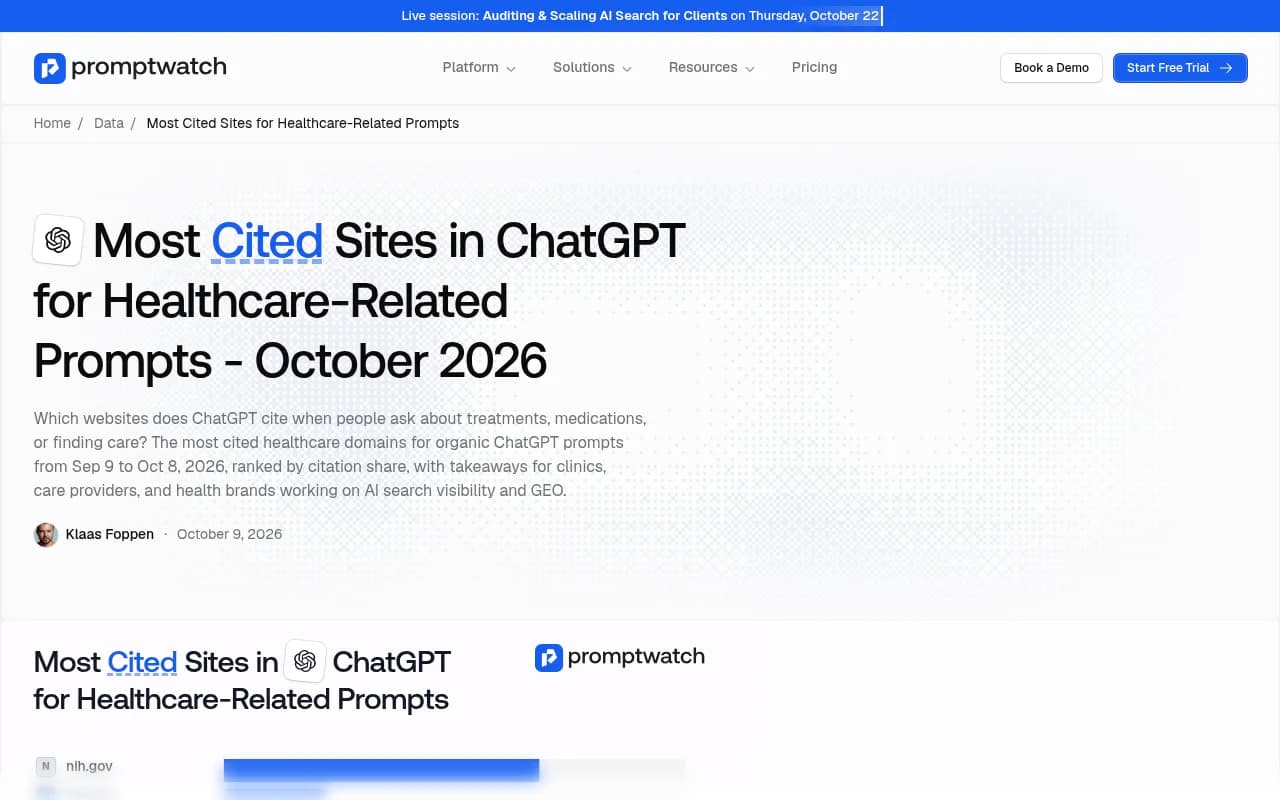
Promptwatch's healthcare report covers Sep 9 to Oct 8, 2026. The ranking starts with nih.gov at 5.46%, then fda.gov at 1.76% and nhs.uk at 1.1%. After those come cms.gov, samhsa.gov, plasticsurgery.org (0.64%), aad.org (0.54%), cdc.gov, medlineplus.gov and mayoclinic.org (0.49%).
What the numbers say
NIH earns more than the FDA, NHS, CMS and SAMHSA combined. And its share is not one website's worth of pages. It is spread across six nih.gov subdomains, with PubMed Central at 2.38% and PubMed at 2.33%. In practice, ChatGPT is leaning on the research literature itself.
By source type, the 20 listed domains split like this:
- Government and public health: 7.06%
- NIH and medical research: 5.46%
- Medical associations: 1.39%
- Hospitals and clinics: 0.89%
- Reviews and directories: 0.46%
- Pharmacy (Boots only): 0.28%
Hospitals are a small slice. Mayo Clinic and Cleveland Clinic are the only hospitals in the chart at all. Specialty associations do better: the American Academy of Dermatology and the American Society of Plastic Surgeons together (1.18%) outrank Mayo and Cleveland Clinic combined. ASPS is the top non-government site in the entire list.
A conflicting study, and why I would not lean on it
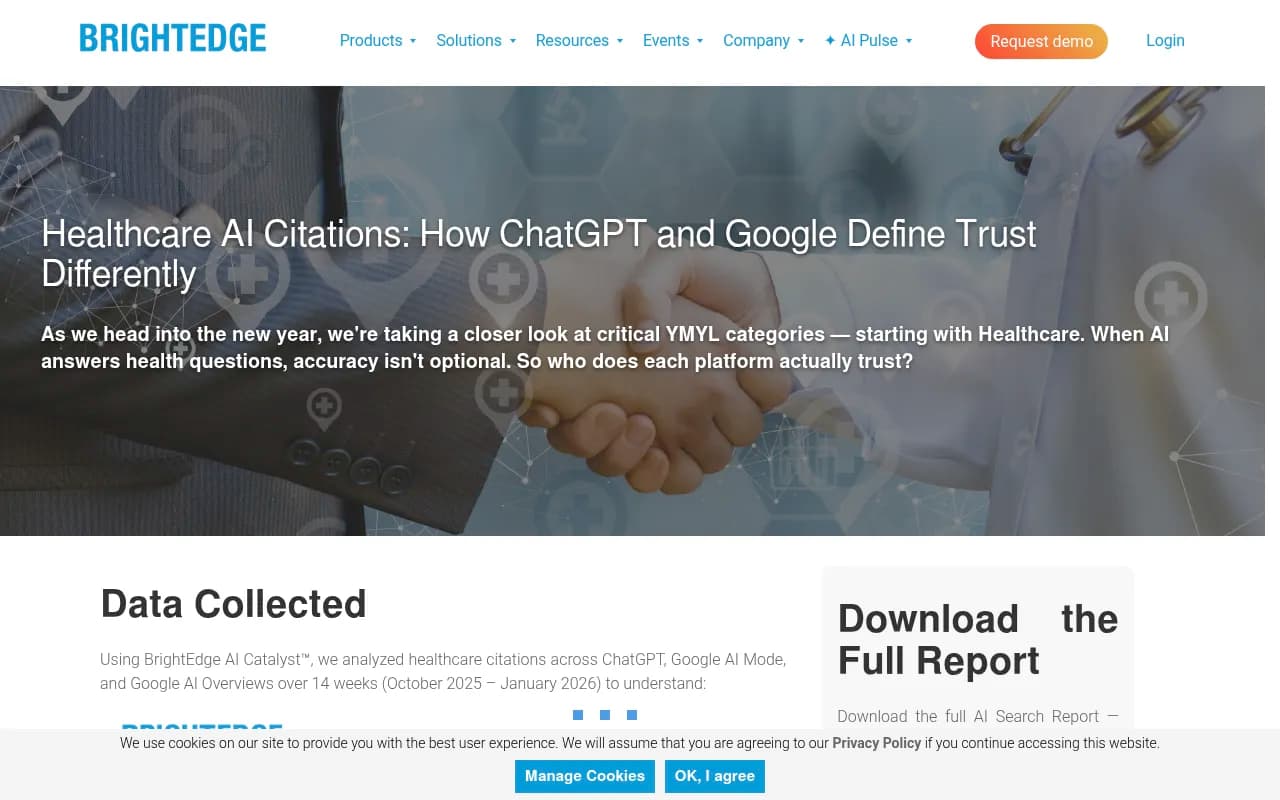
BrightEdge published a healthcare analysis finding that 57% of ChatGPT healthcare citations came from major hospital systems. That is wildly different from Promptwatch's 0.89% for hospitals and clinics. The BrightEdge data covers a different period (October 2025 to January 2026) and a different method, and the two simply disagree. Another BrightEdge write-up of the same dataset says ChatGPT pulled 27% of healthcare citations from .gov sources and just 1% from elite hospitals, which points the same way as the Promptwatch data. I would take the more recent first-party numbers and be skeptical of any claim that hospital brands dominate ChatGPT.
What to do in healthcare
- Link your clinical claims to PubMed or PubMed Central records. Those are the most cited pages in the category.
- Align your pages with FDA, CDC, NHS and NICE guidance so your content says what those sources say.
- If you are in a specialty, work with your professional association. Their pages are cited more than hospital brands.
- Keep Doctify and WebMD doctor profiles complete if you are a provider.
Travel: booking engines beat review brands
Promptwatch's travel report covers a single week, Sep 28 to Oct 4, 2026. Skyscanner leads at 0.78% (skyscanner.net and .com combined), followed by Going.com at 0.52% and Tripadvisor at 0.49%. Kayak is at 0.37%, Airbnb and Reddit at 0.27% each, and Expedia sits at 0.13%, level with Lonely Planet and Time Out.
The surprise is Going.com. A flight-deal service ranks above tripadvisor.com, a name most travel marketers would assume sits near the top of any list.
Source type breakdown
- Booking and search: 2.42%
- Reviews and advice: 0.86%
- Guides and reference: 0.37%
- Reddit: 0.27%
- Tours: 0.16%
- Government: 0.1%
Booking and search sites earn more than half of the citations shown. That reflects what people ask ChatGPT in travel: they want prices, routes and availability, and the engines that hold that data get linked.
What to do in travel
- Make sure your listings on Skyscanner, Kayak, Airbnb and Expedia are accurate and complete. That is where ChatGPT looks first.
- Collect Tripadvisor and Trustpilot reviews, and aim for coverage by Which? in UK markets.
- Pitch Lonely Planet and Time Out for features. They are small in share but they are the guide sources in the chart.
A separate third-party study found companies and other commercial sites take 76.2% of citations in AI answers to travel questions, the highest of 12 industries. That study covers AI answers in general rather than ChatGPT specifically, but it fits the commercial tilt of the Promptwatch list.
Software: docs and help centers lead
Promptwatch's software report also covers Sep 28 to Oct 4, 2026. The top of the list: github.com at 1.2%, learn.microsoft.com at 0.98%, g2.com at 0.73%, docs.aws.amazon.com at 0.41%, Google Cloud docs at 0.35%, gartner.com at 0.34%, capterra.com at 0.32%, intercom.com at 0.28% and zapier.com at 0.24%.
Source type breakdown
- Docs and help centers: 2.64%
- Vendor sites: 2.01%
- Review sites and analysts: 1.57%
- GitHub: 1.2%
- App stores: 0.47%
Vendor sites plus docs total 4.65%, about three times what review sites earn. But look at the other side: G2, Gartner, Capterra and Software Advice combined (1.57%) still exceed any single vendor, Microsoft included. Aggregated across its domains, Microsoft takes 1.35% (three domains), Google 0.98% (four), AWS 0.69% (two) and OpenAI 0.42% (two).
That is a useful split. If you are a big platform, your own documentation is a citation machine. If you are a smaller SaaS company, review profiles are probably the cheaper route in.
What to do in software
- Write documentation and help articles as if they were landing pages. They are the most cited type.
- Keep a public GitHub presence with a clear README. GitHub is the single most cited domain here.
- Keep G2 and Capterra profiles current, with recent reviews and accurate feature lists.
- Check whether your app store listings describe the product the way you want it described.
Automotive: marketplaces and reviews, not manufacturers
Promptwatch's automotive report covers all of August 2026 and lists 31 domains. Autotrader leads at 5%, Cars.com follows at 4.6%, and chevrolet.com is fourth at 2.62%. It is the only manufacturer in the top eight. Reddit is ninth at 1.34%. Even a single UK dealer group, birchwoodgroup.co.uk, shows up at 0.28%.
Source type breakdown
- Marketplaces and listings: 14.65%
- Reviews and research: 12.62%
- Manufacturer sites: 7.92%
- Community and news, dealerships, and service and finance combined: 2.12%
Listings plus reviews come to 27.27%. Seven of the top eight domains are marketplaces or research and review sites. Car brands, which spend heavily on their own sites, trail the third parties that hold inventory and reviews.
What to do in automotive
- Keep inventory, pricing and specs accurate on marketplaces. Stale listings are the main risk.
- Maintain DealerRater, Birdeye and BBB profiles if you are a dealer.
- Give each model and trim a stable, permanent page rather than rotating campaign URLs.
- Local dealer pages can appear alongside national sites, so do not ignore your own location pages.
What the four industries have in common
Concentration is low everywhere
The top domain holds 5.46% in healthcare, 5% in automotive, 1.2% in software and 0.78% in travel. Nowhere does one site take a quarter of the answers. For brands, that means the target is a broad portfolio of third-party presence, not one big placement. Promptwatch's data on unique domains per response backs this up: almost half of ChatGPT responses cite 10 or more unique domains (Sep 28 to Oct 4, 2026).
The winning type matches what people ask
Health questions need authority, so government and research win. Travel and cars involve live prices and stock, so booking engines and marketplaces win. Software buyers need to know how a product works, so docs win. Before choosing tactics, ask what a user wants from the answer and which kind of source holds it.
Reddit is patchy
Reddit shows up in travel (0.27%) and automotive (1.34%) but not in the healthcare or software top lists. It is also worth knowing that reddit.com's share of ChatGPT citations fell from about 4% to 0.5% on August 14, 2026. Some third-party sources still quote Reddit at double-digit shares of ChatGPT citations. Those numbers predate or ignore that drop, and I would not plan around them. For wider context, Promptwatch's social media citation data shows ChatGPT drawing just 0.46% of its citations from social platforms between Sep 28 and Oct 4, 2026, while Google AI Overviews drew 12.2%.
Content type matters too
Across all industries, product pages are the most cited content type in ChatGPT at 22.4% of citations, followed by landing pages and listicles. And landing pages and docs stay cited longest, while news loses half its pages within 36 days. That fits the software finding: docs are durable, and durable pages keep earning citations.
Does domain authority decide this?
Not in the way people expect. In Promptwatch's August 2026 domain rank data, sites with domain rank 46 to 75 earned almost half of ChatGPT citations, while DR 91 to 100 fell to about 3%. The industry lists above are consistent with that: topical specialists such as ASPS, Going.com and a single dealer group show up next to giants.
A practical workflow for your own industry
- Pick 20 to 50 prompts that your customers actually ask, split by intent: research, comparison, buying.
- Run them and record which domains get cited, then classify each as government, marketplace, review site, docs, vendor, community or similar.
- Find the top three source types for your category. That tells you where third-party presence matters.
- Check your presence on each of the top domains: is the listing accurate, current and complete?
- Look at where your own pages are cited and where they are not, and fix the gap pages first.
- Re-run monthly. Citation patterns shift, as the Reddit drop showed.
Tools like Promptwatch can run this kind of prompt tracking and citation analysis against the real ChatGPT interface, and show which domains and pages are cited for your prompts.

If you want to compare options, the GEO software directory at bestgeosoftware.com lists a wide range of trackers. Some alternatives in our catalog that monitor AI citations:



| Approach | What you get | Where it falls short |
|---|---|---|
| Manual prompt checks in ChatGPT | Free, quick for a handful of prompts | Hard to repeat, no history, personalised results |
| Monitoring-only trackers | Mention and citation counts over time | Usually stop at reporting |
| Platforms with crawler logs and content tools | Citations plus what AI reads on your site and what to fix | Higher cost, more setup |
Common mistakes
- Assuming your own site is the main way into ChatGPT answers. In three of four industries here, third-party sites hold most of the visible share.
- Treating the numbers across industries as directly comparable. The windows differ, and a one-week figure is noisier than a 30-day one.
- Chasing a single viral source. With top domains between 0.78% and 5.46%, one placement will not move your visibility much.
- Ignoring freshness. News-type pages decay fast, while docs and landing pages last.
What I would do first
If I ran marketing in healthcare, I would audit which of my claims can link to PubMed. In travel, I would check every booking-engine listing this week. In software, I would rewrite the three most-viewed help articles and refresh G2. In automotive, I would fix marketplace inventory feeds before anything else. None of these is glamorous, but each one maps straight onto the type of source ChatGPT actually cites in that industry.
For current numbers, check the underlying reports on the Promptwatch Data hub, since each one is updated and the windows will have moved on by the time you read this.