Key takeaways
- Both Google AI Mode and ChatGPT use query fan-out, but they do not behave the same. Third-party research puts Google at roughly 5 to 11 sub-queries per prompt, while Promptwatch Data shows ChatGPT averaging only about 1.0 to 2.2 tracked fanouts per response in 2026.
- ChatGPT's fan-out behavior changes overnight. On August 8, 2026, the share of fanouts using the site: operator jumped from about 0.4% to about 17%.
- ChatGPT fan-out queries are short and keyword-like (about six to eight words in April 2026), so headings that read like search queries tend to match better than conversational ones.
- The practical answer for both engines is the same: build clusters of focused pages (comparisons, pricing, alternatives, how-tos) rather than one mega-page, then monitor each engine separately.
- Treat any claim that "all engines fan out identically" with suspicion. The mechanism is similar, the output is not.
What query fan-out actually is
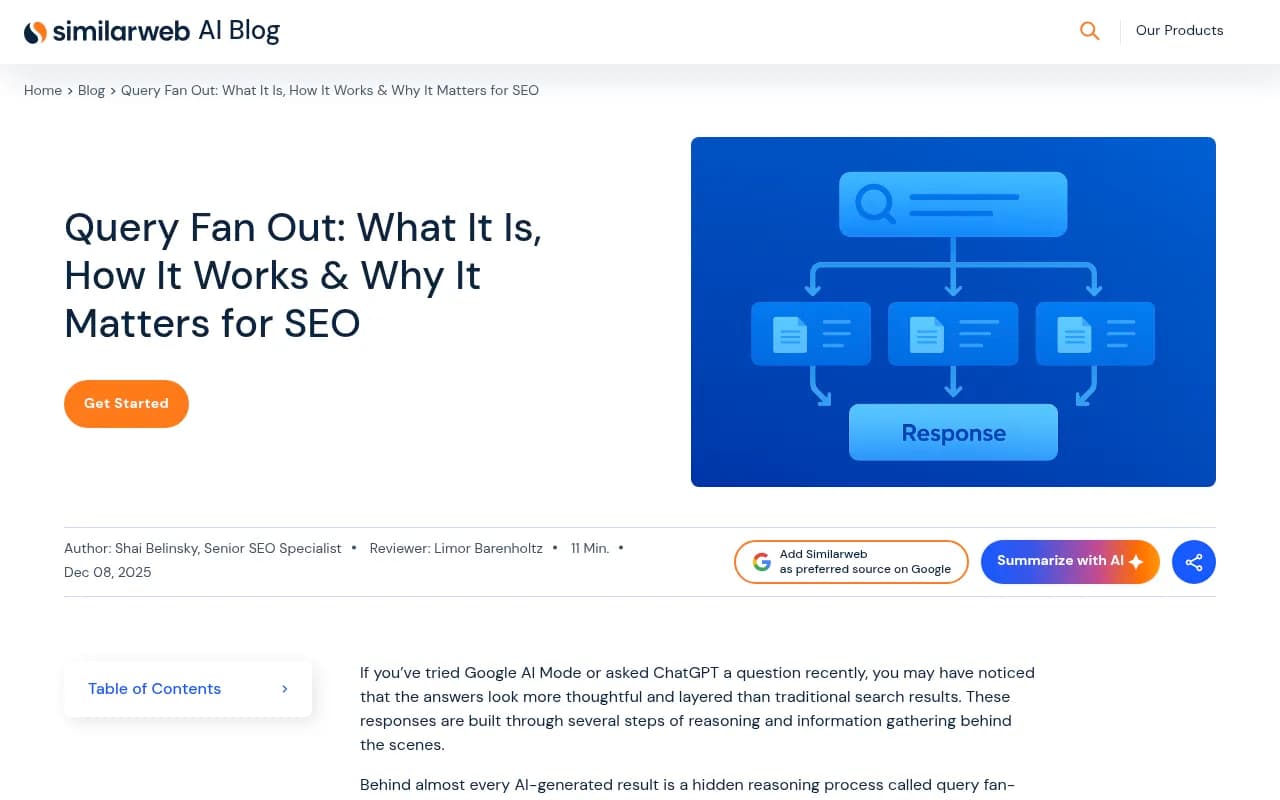
You type one question. The AI system rewrites it into several smaller searches, runs them, reads what comes back, and writes a single answer that cites sources from across those searches. That is query fan-out, sometimes called query decomposition.
Google introduced the technique with AI Mode in March 2025 and explained it at Google I/O that May. As Elizabeth Reid put it on stage, search "calls on our custom version of Gemini to break the question into different subtopics." ChatGPT, Copilot and Claude also write their own searches from a prompt.
The consequence for SEO is simple to state and annoying to live with: you are no longer competing for the typed query. You are competing for every sub-query the engine generates, including ones nobody typed. A page can be cited for a search that no human ever ran.
The popular claim, and why I do not fully trust it
A lot of vendor content says something like this: ChatGPT, Google AI Mode and Perplexity all fan out into 8 to 12 sub-queries, and the mechanism is identical. It makes a tidy story. It also does not hold up well against what we can actually measure.
The cleaner version: the mechanism is conceptually similar (intent detection, rewriting, expansion, parallel retrieval, citation synthesis), but the implementations differ, and the numbers differ a lot. One 2026 vendor write-up even concedes that a strategy that works for ChatGPT citations can underperform on Google AI Mode for the same topic and the same typed query. If the engines behaved identically, that would not happen.
How Google AI Mode fans out
Google is the engine that most obviously leans into fan-out. Some data points worth knowing:
- Nectiv analyzed around 60,000 Google fan-out queries and found Google typically generates about 5 to 11 sub-queries per prompt, sometimes far more. I could not independently verify that study, so treat it as a useful range rather than a law.
- Google says Deep Search in AI Mode "can issue hundreds of searches." That is a different mode with a different purpose, but it shows how elastic the ceiling is.
- Google's own search index is the retrieval layer, which means classic ranking signals and indexing still matter for what gets pulled in.
- Descriptions of AI Mode behavior emphasize satisfying implicit questions and offering multiple perspectives: comparisons, alternatives, constraints the user did not state, and follow-ups they are likely to ask next.
The pattern, in practice, is breadth. A prompt like "best protein powders for runners" can branch into ingredient questions, recovery timing, digestive tolerance, brand comparisons and price tiers, all in one pass. Your page needs to be a good answer to one of those branches, and ideally several.
Google-side caveat: I found no Promptwatch Data specifically on AI Mode fan-outs, so the Google numbers here come from third parties. Keep that in mind before building a strategy on the exact figures.
How ChatGPT fans out
ChatGPT is where the measured data diverges most from the folklore. Promptwatch Data's ChatGPT query fanouts report tracks it daily, and the picture is quite different from "8 to 12 sub-queries":
- Average fanout queries per response were about 2.15 in early December 2025 and about 1.84 by early March 2026.
- After a gap in the data, fanouts returned in April at roughly 1.0 per response.
- Average query length fell from about 117 characters in December to the high 80s through February and March, then to about 53 characters in April. That is roughly six to eight words.
- The length drops came in steps, which points to behavior changes on OpenAI's side rather than gradual drift.
So ChatGPT, as tracked, tends to run fewer and much shorter searches than the headline numbers suggest. Other studies see bigger counts in particular tests (Writesonic recorded eight searches for a CRM question on a GPT-5.4 Thinking model in April 2026), which is a reminder that reasoning models and free-tier search behave differently. Prompt type, model and mode all move the number.
The content of ChatGPT's searches is also telling. In about 15 million fan-out queries from free ChatGPT, Ahrefs found the current year in 22.9% of English queries in September 2026 (up from 17.6% in August), with "official" and "price" also common. ChatGPT is hunting for fresh, official and priced information.
The August 8 site: operator shift
The most useful illustration of how fast this changes: on August 8, 2026, ChatGPT started using the site: operator at scale. Promptwatch Data recorded the share of fanouts using site: jumping from 0.37% to 16.8% in a single day, roughly 46 times higher, or about one in six fanouts. Average fanouts per response rose from about 1.08 to about 1.83 on the same day and stayed there.
The reading that fits the data is that site: searches were layered on top of generic searches, not swapped in for them. If they had replaced generic queries, the average would have stayed flat. And because it happened in one day, it was almost certainly a model or system-prompt rollout, not something individual sites did.
What it means for you: your own domain became a retrieval surface. Thin category pages, broken internal search and unindexed content can now cost you answers.
Side-by-side comparison
| Dimension | Google AI Mode | ChatGPT |
|---|---|---|
| Typical sub-queries per prompt | About 5 to 11 (Nectiv, third-party, unverified) | About 1.0 to 2.2 tracked average per response in 2026 (Promptwatch Data); higher in reasoning-model tests |
| Query shape | Broader, intent-driven, covers implicit questions and multiple perspectives | Short, keyword-like (about 53 characters in April 2026), often with the year, "official" or "price" |
| Retrieval layer | Google's own index | Third-party search partners, plus site: searches at scale since Aug 8, 2026 |
| Stability | Evolves, but fewer documented one-day shifts | Can change overnight; step changes in length and operator use |
| Maximum depth | Deep Search can issue hundreds of searches | Reasoning models can run more searches per prompt |
| Transparency | No official fan-out visibility; third-party tools extract or model it | Limited "Thinking" panel hints; tools and extensions can capture fanouts |
One more difference worth noting: the cited pages are often not the ones Google ranks. In Writesonic's April 2026 test of 30 prompts, 84% to 87% of domains cited by ChatGPT's thinking models were missing from the first page of Google and Bing for the prompt. Ranking well in Google is neither necessary nor sufficient for ChatGPT citation.

What the differences mean for your content
Match query shape, not just topic
Google's sub-queries are broad enough that topical coverage wins: answer the main question and four or five of the likely follow-ups. ChatGPT's are short and literal, so wording matters more. Promptwatch Data's recommendation from its fanout report is to write headings that read like search queries ("Best CRM for small agencies 2026") rather than conversational questions ("What should you look for when choosing a CRM?"), and to put the entity and category first in titles and H2s.
Build clusters, not mega-pages
Both engines punish the 3,000-word page that touches ten sub-topics lightly. Build a pillar for the broad query and separate, focused pages for:
- comparisons (X vs Y)
- pricing
- alternatives
- how-tos
- official or documentation-style pages
These map neatly to the sub-query types engines produce: reformulations, related queries, implicit queries, entity expansions and personalized variants.
Make your own domain a good retrieval surface
After August 8, site: queries mean ChatGPT may search your domain directly. Check that key pages are crawlable and indexed, that your internal search and category pages are not thin, and that your sitemap is not hiding pages. This is basic technical SEO, but it now has a direct line to answer inclusion.
Keep dates and prices fresh
The year and "price" show up constantly in ChatGPT's searches. Pages with a visible current-year label, clear pricing and an official-looking source tend to line up with those queries. For longevity, Promptwatch Data's content half-life study found landing pages and docs stayed cited longest, while news lost half its pages within 36 days.
Do not assume Google rank equals citation
Because most domains ChatGPT cites in tests are absent from page one, you need to measure each engine on its own. Mid-authority sites also do well: Promptwatch Data on domain rank shows DR 46 to 75 sites earning almost half of ChatGPT citations in August 2026, while DR 91 to 100 fell to about 3%.
A practical workflow
- Pick 20 to 50 prompts that matter to revenue.
- Capture the actual fan-outs for each, per engine.
- Map each sub-query to a page on your site. Mark gaps as missing, partial or covered.
- Rewrite headings to match the literal wording the engine uses.
- Fill gaps with focused pages, and interlink them into a cluster.
- Re-run the analysis after any major model update.
- Track whether the new pages get crawled, cited and clicked.
A fast, free experiment before any tooling: run your target prompt in ChatGPT, Gemini and Perplexity, and look at the headings, follow-ups and sources. If the engine breaks the topic into compliance, encryption and remote access and you have no page for one of them, that is your fan-out gap.
Tools for seeing and acting on fan-outs
No engine officially exposes full fan-out sets, so you either extract them, simulate them or track them at scale. Here is how the options split.
| Tool | What it does for fan-outs | Best for |
|---|---|---|
| Promptwatch | Tracks real-UI prompts with query fan-outs, volumes and difficulty, plus crawler logs and a Content Agent | Teams that want to track and then fix gaps |
| Otterly.AI | Query Fan-Out Simulator modeled on AI Mode behavior | Quick modeled expansions |
| queryfanout.ai (Dejan) | Claims to extract real fan-out strings from Google's API | Seeing authentic Google strings |
| Similarweb | AI visibility measurement alongside web analytics | Market-level benchmarking |
| Conductor | Conversational query analysis tied to content optimization | Enterprise content teams |
| Google Search Console | Generative AI performance reports (impressions by page, country, device, no query data) | Free Google-side measurement |
Promptwatch is the one I would reach for first, because it pairs fan-out data with IP-verified AI crawler logs and page-level tracking, so you can see whether a fix was crawled and then cited instead of just guessing.

Otterly.AI's simulator is handy for a modeled view of how a seed query might expand.

Similarweb is useful when you want fan-out thinking tied to broader market and traffic data.
Conductor's approach starts from conversational query analysis, and its case study (a credit union page restructured around specific questions) reported an 18% increase in page sessions and citations in ChatGPT, Copilot and Perplexity.

For free Google-side data, Search Console's generative AI reports launched in June 2026 and rolled out worldwide on August 31 for sites with enough impressions.
If you want to compare more options, the GEO software directory at bestgeosoftware.com lists a wide range of trackers.
Common mistakes
- Optimizing for a fixed number of sub-queries. The count moves by engine, mode and week.
- Treating a fan-out analysis as permanent. Anything mapped before August 8, 2026 for ChatGPT is stale.
- Writing for conversational questions only. ChatGPT's searches are short and keyword-like.
- Ignoring your own domain's crawlability now that site: searches are common.
- Assuming Google rankings predict ChatGPT citations.
The bottom line
Google AI Mode fans out wide and ranges from a handful to hundreds of searches depending on mode, built on its own index. ChatGPT, as tracked by Promptwatch Data in 2026, fans out narrower, shorter and more erratically, and it changes behavior with little warning. The strategy that works for both is the same unglamorous one: focused pages for each real sub-topic, headings that match how searches are actually phrased, crawlable and indexed content, and continuous monitoring. Re-check your fan-out map every time a major engine update lands, and start with the one prompt that drives the most revenue.