Orchly.ai Review 2026
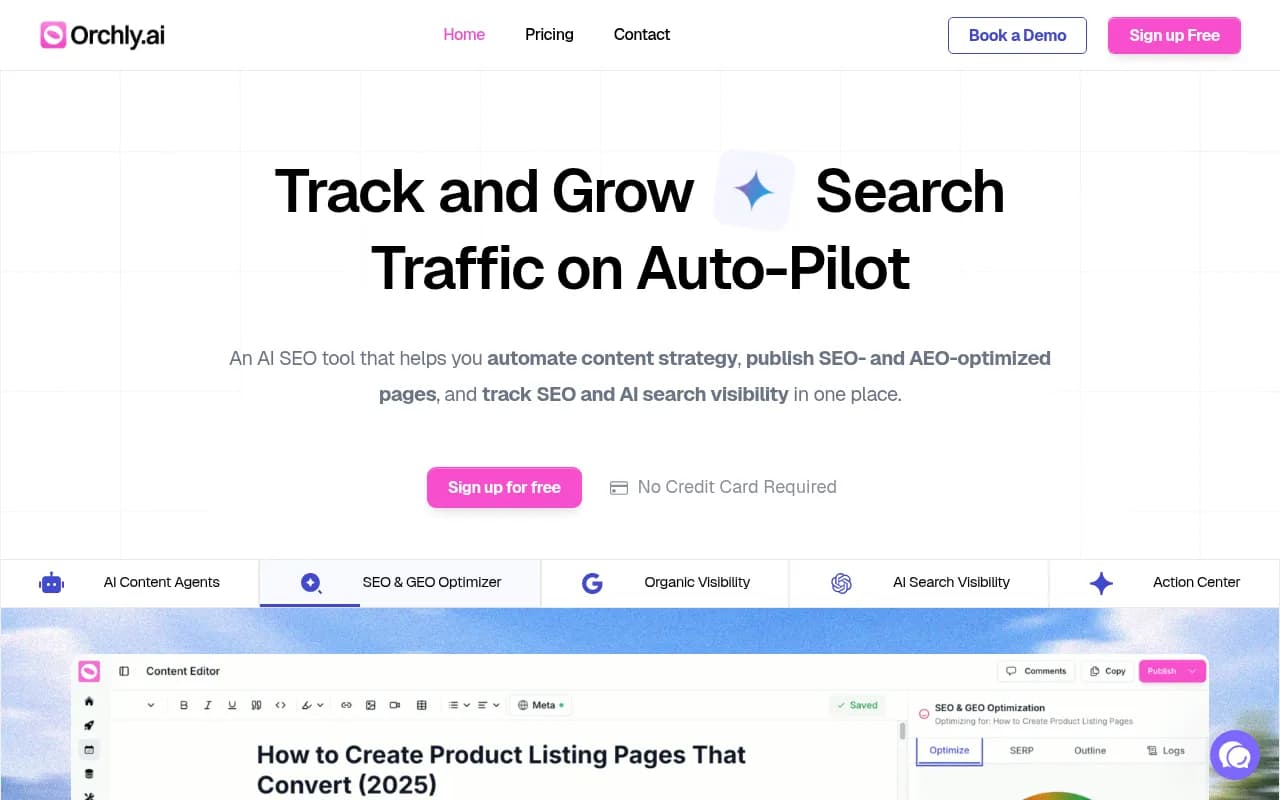
Orchly.ai automates content strategy for marketing teams with AI agents that research, write, and publish SEO- and AEO-optimized content. Track brand visibility across Google, ChatGPT, Claude, Perplexity, and Gemini while AI agents handle content creation, optimization, and publishing workflows with
Key Takeaways:
- Monitoring-only limitation: Orchly.ai lacks the content gap analysis, AI crawler logs, and traffic attribution that Promptwatch offers -- it's built for content creation but doesn't show you which specific prompts competitors rank for that you don't
- Strong for content automation: AI agents handle research, writing, optimization, and publishing with human-in-the-loop approval -- not just a text generator
- Dual visibility tracking: Monitors both traditional SEO (Google) and AI search engines (ChatGPT, Claude, Perplexity, Gemini) in one dashboard
- Best for content teams: Marketing teams and agencies producing 20+ articles/month who want to automate repetitive workflows while maintaining quality control
- Pricing starts at $49/mo: Essential plan includes 1,500 task credits, 25 tracked prompts, and AI agent access with no credit card for trial

Orchlly.ai positions itself as an end-to-end content operations platform that combines AI visibility tracking with automated content production. Unlike pure monitoring tools, it's designed around a workflow loop: track where you're invisible, create content to fill gaps, optimize for both Google and AI search engines, then publish and measure results. The company targets marketing teams and agencies who are drowning in manual content work and want to automate research, writing, and optimization without sacrificing quality.
The platform launched in 2025 and competes in the crowded GEO/AEO space where tools like Promptwatch, Otterly.AI, and Peec.ai are fighting for market share. Orchly's angle is automation -- it's less about showing you data and more about doing the work for you through specialized AI agents.
AI Agent Workflows (Core Differentiator)
Orchlly's main selling point is its agent-based architecture. Instead of one generic AI writer, you get specialized agents for specific tasks: SERP research agents, citation verification agents, internal linking agents, content refresh agents, and publishing agents. You chain these together into custom workflows. For example: Research Agent pulls SERP data and competitor analysis → Writing Agent drafts the article → Optimization Agent adds structured data, NLP keywords, and links → Publishing Agent pushes to WordPress or Webflow.
The human-in-the-loop design means you review and approve at each stage instead of letting AI run wild. This is smarter than fully automated content mills but still requires oversight -- you're not just clicking "generate 50 articles" and walking away. The agents reference your brand kit (tone, vocabulary, example docs) and website sitemap to maintain consistency, which helps avoid the generic "in this fast-paced digital world" AI slop that plagues most AI writers.
Task credits control usage: each agent action (research, write, optimize, publish) consumes credits. The Essential plan gives you 1,500 credits/month, Pro gives 5,000. A full article workflow might use 50-100 credits depending on complexity.
SEO & GEO Optimization Engine
Orchlly analyzes 150+ ranking factors across traditional SEO and GEO (Generative Engine Optimization). The optimizer automatically adds internal links, external citations to authoritative sources, structured data markup, NLP keywords, and rich formatting (images, tables, videos). It checks for technical issues like crawl errors, schema gaps, and indexing problems.
The GEO side focuses on making content AI-readable: clear structure, factual claims with citations, entity recognition, and formatting that LLMs can parse cleanly. This matters because AI search engines like ChatGPT and Perplexity prioritize well-structured, citation-heavy content over keyword-stuffed SEO articles.
One nice touch: the optimizer suggests both internal links (to your own pages) and external links (to trusted sources) contextually. Most AI writers just dump generic links or skip them entirely. Orchly's linking is based on semantic relevance and authority signals.
AI Search Visibility Tracking
Orchlly monitors brand mentions across Google, ChatGPT, Claude, Perplexity, and Gemini. You add prompts you care about (e.g. "best project management tools for agencies"), and Orchly tracks whether your brand appears in AI-generated answers, how often, and in what context. You can benchmark against competitors to see who's winning for each prompt.
The tracking covers up to 25 prompts on the Essential plan, 100 on Pro, and 500+ on Enterprise. This is significantly fewer than Promptwatch's 50-350 prompts on comparable tiers, and there's no mention of prompt volume estimates, difficulty scoring, or query fan-outs -- features that help you prioritize which prompts to target first.
Orchlly also surfaces Reddit discussions and other sources that influence AI recommendations, though the depth here is unclear compared to Promptwatch's dedicated Reddit and YouTube tracking modules.
Content Creation & Publishing
The writing agents produce articles, listicles, comparisons, and how-to guides. You start with a topic or keyword, the research agent pulls SERP data and competitor content, then the writing agent drafts based on your brand guidelines. The output is structured with headings, bullet points, and formatting ready for web publishing.
Citation verification is built in -- agents fact-check claims and add source links automatically. Plagiarism scanning ensures originality. Accuracy scoring flags low-confidence sections for human review.
Direct CMS publishing works with WordPress, Webflow, Framer, and Ghost. Once you approve an article, it can go live instantly or be scheduled. You can also export as Markdown or HTML if you use a different CMS.
The content refresh agent is useful for updating old posts: it identifies outdated stats, broken links, and missing keywords, then rewrites sections to bring the page current. This is a workflow most teams do manually and hate.
White-Label Reports
Agencies get branded, client-ready reports and audits with one click. These include visibility scores, content recommendations, technical SEO issues, and competitor benchmarks. The reports are designed to win clients or justify retainers without manual work.
Who Is It For
Orchlly is built for marketing teams and agencies producing content at scale -- think 20-50+ articles per month. If you're a solo blogger writing 2-3 posts a month, the automation is overkill and the pricing doesn't make sense. But if you're managing content for multiple clients or running an in-house content team, the time savings add up fast.
Ideal users: SEO agencies with 5-20 clients, in-house marketing teams at SaaS companies or ecommerce brands, content studios producing thought leadership at volume. Team size: 2-10 people who need to coordinate workflows and maintain quality standards.
It's less suited for technical SEO specialists who want deep crawl analysis or developers who need API access for custom integrations. Orchly is a marketer's tool, not an engineer's tool.
Integrations & Ecosystem
CMS integrations: WordPress, Webflow, Framer, Ghost. No mention of Shopify, HubSpot, or other major platforms, which is a gap for ecommerce and B2B teams.
No API access mentioned, even on Enterprise plans. This limits custom workflows and data exports compared to platforms like Promptwatch that offer Looker Studio integration and full API access.
Browser extensions or mobile apps: none mentioned.
Pricing & Value
Essential: $49/month (or $37/month annual) -- 1,500 task credits, 25 tracked prompts, 1 brand kit, 1 user. Good for solo marketers or consultants testing the platform.
Pro: $125/month (or $93/month annual) -- 5,000 task credits, 100 tracked prompts, 5 brand kits, 5 users. This is the sweet spot for small agencies or in-house teams producing 30-50 articles/month.
Enterprise: Custom pricing -- unlimited task credits, 500+ tracked prompts, unlimited brand kits and users, dedicated CSM. For large agencies or brands with high-volume content needs.
Free trial available with no credit card required, which is rare and appreciated.
Compared to competitors: Orchly's $49 entry point undercuts Promptwatch's $99 Essential plan, but you get far fewer tracked prompts (25 vs 50) and no crawler logs or traffic attribution. The Pro tier at $125 is cheaper than Promptwatch's $249 Professional plan, but again, you're missing content gap analysis, prompt intelligence, and visitor analytics. If you only need content automation and basic visibility tracking, Orchly is cheaper. If you want optimization insights and traffic data, Promptwatch justifies the higher price.
Strengths & Limitations
Strengths:
- Agent-based workflows are more sophisticated than generic AI writers -- you get specialized tools for each content task
- Human-in-the-loop design prevents low-quality AI slop from going live
- Dual tracking of SEO and AI search visibility in one platform
- Direct CMS publishing saves time vs manual copy-paste
- White-label reports are a win for agencies
- No credit card required for free trial
Limitations:
- No content gap analysis: Orchly doesn't show you which specific prompts competitors rank for that you don't, or what content your site is missing. Promptwatch's Answer Gap Analysis solves this by highlighting exactly what to create next.
- No AI crawler logs: You can't see which AI models are crawling your site, which pages they read, or errors they encounter. Promptwatch provides real-time logs of ChatGPT, Claude, Perplexity, etc. hitting your site.
- No traffic attribution: Orchly tracks visibility but doesn't connect it to actual visitor traffic or revenue. Promptwatch offers code snippets, GSC integration, and server log analysis to close the loop.
- Limited prompt tracking: 25-100 prompts on paid plans vs Promptwatch's 50-350. No prompt volume estimates or difficulty scoring to help prioritize.
- No Reddit or YouTube depth: Orchly mentions surfacing discussions but lacks dedicated tracking modules for these platforms like Promptwatch offers.
- Fewer AI models: Tracks Google, ChatGPT, Claude, Perplexity, Gemini. Promptwatch adds Grok, DeepSeek, Mistral, Meta AI, Copilot, and Google AI Mode.
- No API or Looker Studio integration: Limits custom reporting and data exports.
- CMS integrations are narrow: WordPress, Webflow, Framer, Ghost only -- no Shopify, HubSpot, Contentful, or other major platforms.
Bottom Line
Orchlly.ai is a solid choice for marketing teams and agencies who want to automate content production workflows while maintaining quality control. The AI agent architecture is smarter than generic AI writers, and the dual SEO/GEO tracking is useful for understanding visibility across traditional and AI search. The pricing is competitive at the low end.
But it's a monitoring and creation tool, not an optimization platform. If you want to know what to create (content gap analysis), how AI engines crawl your site (crawler logs), and whether visibility drives traffic (attribution), Promptwatch is the stronger choice. Orchly shows you where you rank and helps you create content. Promptwatch shows you where you're invisible, why, and gives you the tools to fix it with data-backed precision.
Best use case: Agencies producing 30+ articles/month for multiple clients who need workflow automation and client reporting without deep optimization insights.
Tags:
Similar and alternative tools to Orchly.ai