Key takeaways
- Claude is a strong reasoning and drafting layer, but it has no live search data. Feed it exports from a keyword tool and a GEO platform, or it will guess.
- The workflow has four stages: gather data, interpret with Claude, produce content, measure in AI search and Google. Then loop back.
- Claude Skills (saved instruction files) and Projects turn one-off prompts into repeatable processes your whole team can run.
- AI search rewards different things than classic rankings. Per Promptwatch Data (Sep 28 to Oct 4, 2026), product and landing pages make up about 39% of ChatGPT citations, so map your content to prompt intent.
- Always check that AI crawlers can reach your site before you invest in new content.
Why a three-part stack beats any single tool
Most people start by pasting a keyword into Claude and asking for an article. The output reads fine and ranks for nothing. Claude has no search volume, no SERP, no idea what ChatGPT cites in your category. It reasons over whatever you hand it.
That is why the workflow that keeps showing up among agencies in 2026 is a hybrid. AmazeTech describes it as data from SEO platforms, interpretation with Claude, then execution through Claude Code or CMS integrations. A Reddit thread on r/seogrowth makes the same point from the budget side: Claude's API for clustering plus manual sense checks gets you about 80 percent of the way.
So you need three things:
- A keyword tool for demand data (volume, difficulty, SERP features).
- Claude for clustering, briefing, drafting and analysis.
- A GEO platform for what keyword tools cannot see: which prompts mention you, which pages get cited, whether AI crawlers can read your site.
Here is how the pieces fit.
| Layer | Job | What it gives Claude | Example tools |
|---|---|---|---|
| Keyword tool | Demand and SERP data | Keyword exports, difficulty, competitor URLs | Semrush, Ahrefs, Mangools, Google Search Console |
| Claude | Clustering, briefs, drafts, audits | Reasoning over large files | Claude Projects, Claude Code |
| GEO platform | AI visibility, citations, crawler logs | Prompt lists, citation gaps, crawl errors | Promptwatch, Profound, Otterly.AI |
| CMS and automation | Publishing and glue | Nothing, it receives output | WordPress, Zapier, n8n |
Stage 1: Set up Claude so it stops starting from zero
Use Projects for context
Create one Claude Project per site or client. Upload your brand voice notes, product facts, a list of your best pages and any standing keyword exports. Claude supports large context windows, so crawl exports and keyword lists that choke other tools usually fit in one go. Metaflow's comparison puts Claude at 200,000 tokens against 128,000 for GPT-4 Turbo, though both numbers move fast, so check current limits.
Turn repeated prompts into Skills
A Claude Skill is a saved instruction file that loads at the start of a session. Instead of re-explaining your title tag rules every time, you write them once. Ryze AI's write-up claims Skills save 10 to 30 minutes per session, which sounds plausible to me for agency work, where you run the same audit forty times.
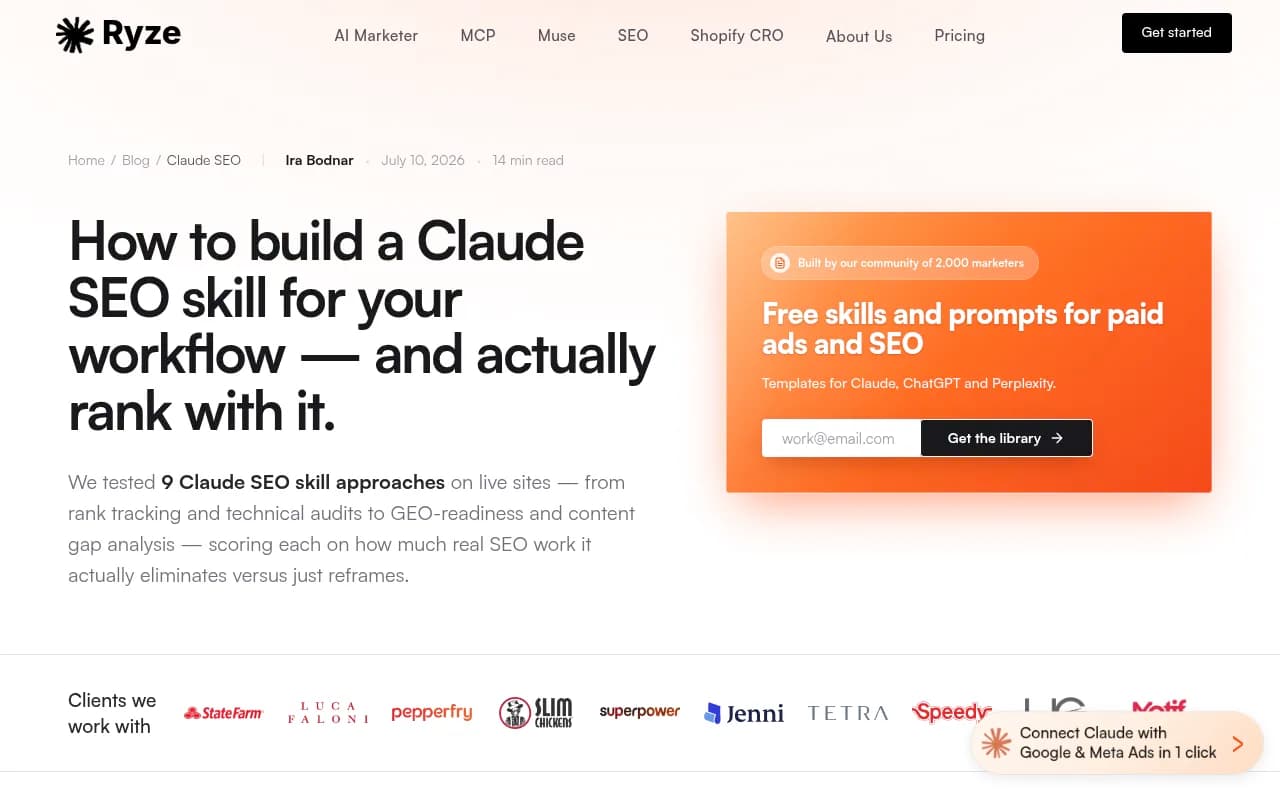
Start with six skills, the same core stack Metaflow recommends: keyword research, content brief, on-page optimization, technical audit, AI visibility (AEO/GEO) and reporting. Here is a trimmed example of the formatting rules inside an on-page skill:
### Title tag formula
[Primary keyword] + [Specificity hook] + [Brand]
- Keep to 50-60 characters
- Primary keyword first

### Heading rule
Every H2 is followed by a 40-60 word direct answer.
Headings read like short search queries, e.g. "Best CRM for small agencies 2026".
The direct-answer rule matters more than it looks. AI systems extract clean question and answer pairs far more easily than meandering intros.
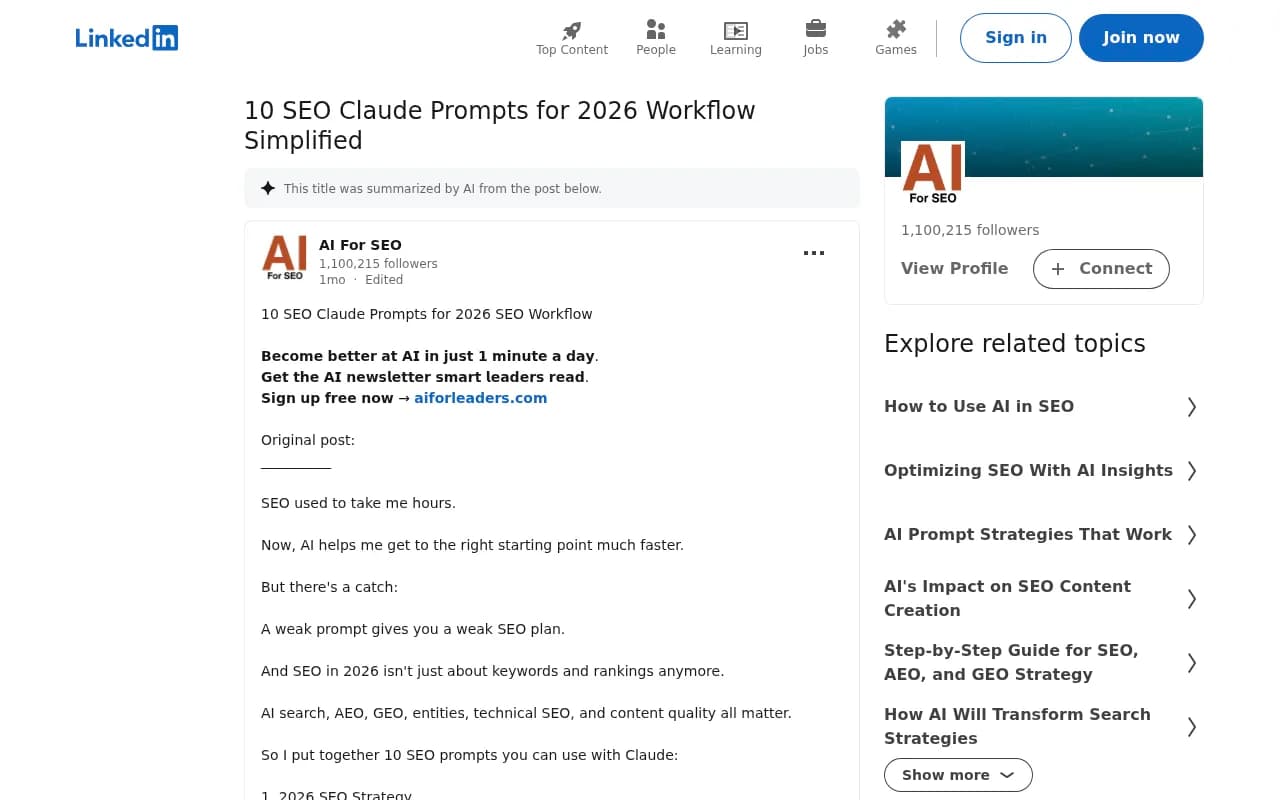
The LinkedIn prompt list above is a decent starting point for skill ideas. Treat any borrowed prompt as a draft and rewrite it around your own site.
Stage 2: Pull real demand data with a keyword tool
Pick whatever keyword tool you already pay for. The point is the export, not the brand.
Semrush and Ahrefs give the deepest competitive data. If budget is tight, [tool:mangools] and [tool:ubersuggest] are cheaper, and [tool:google-search-console] is free and shows what you already rank for, which is the best seed list you have.
For question-style research, [tool:answerthepublic] and [tool:alsoasked] surface People Also Ask patterns that map well to how people prompt AI assistants.
What to export
- Target keywords with volume, difficulty and intent
- Top three ranking URLs per keyword
- Your own queries from Search Console with impressions, clicks and average position
Keep the files as CSV. Claude handles them well.
The clustering prompt
Upload the CSV to your Project and run something like:
Cluster these keywords by search intent. For each cluster return:
- a cluster name
- the primary keyword (highest volume, lowest difficulty)
- supporting keywords
- intent (informational, commercial, transactional, navigational)
- recommended page type (guide, comparison, landing page, FAQ)
Flag any cluster where two of my existing URLs could compete.
Do not invent volumes. Use only numbers in the file.
The last line is not decoration. Claude will cheerfully make up a number if you leave it room. Spot-check ten rows against the source file every time. That is the "manual sense check" the Reddit thread was talking about.
Stage 3: Add the GEO layer
This is the stage most Claude SEO tutorials skip, and it is where the 2026 workflow actually differs from the 2022 one. Keyword tools tell you what people search. They do not tell you what AI assistants say about you, which pages they cite, or whether their crawlers can even load your site.
Check crawler access first
Before writing anything new, make sure AI bots can read what you already have. Per Promptwatch Data's AI crawler traffic report (Jun 8 to Sep 6, 2026), OpenAI accounted for 79.8% of verified AI crawler requests in the week of Aug 31 to Sep 6, down from 94.8% in mid-June. The mix is shifting, so a provider that is large in that data but near zero in your logs suggests you are blocked somewhere.
A quick checklist to hand to Claude along with your robots.txt:
- GPTBot, OAI-SearchBot, ClaudeBot, PerplexityBot and Google-Extended are not disallowed
- Your CDN or WAF is not blocking AI bots by default (Cloudflare has a toggle for this, so check it rather than assume)
- Critical content appears in raw HTML, not only after client-side rendering
- Training bots and answer-time fetchers are treated deliberately, not lumped together
Paste the robots.txt and ask Claude to flag conflicts. That takes two minutes and sometimes uncovers a year-old rule quietly killing your visibility.
Get prompt-level data
Promptwatch is the GEO platform I would put in this slot. It tracks real interfaces of ChatGPT, Google AI Overviews, Gemini, Perplexity and others, gives you prompt volumes and difficulty, and its IP-verified crawler logs show which AI bots read which pages. The part that matters for this workflow is the export: citation gaps, prompts where competitors appear and you do not, and pages that get crawled but never cited.

Other options exist if you only need monitoring. [tool:otterly-ai] and [tool:peec-ai] track mentions at a lower price but stop there. [tool:profound] is the enterprise name. For a wider scan, the GEO software directory at bestgeosoftware.com lists dozens more.
| Need | Keyword tool | GEO platform |
|---|---|---|
| Search volume and difficulty | Yes | Partly (prompt volumes) |
| Google rankings | Yes | Via Search Console import |
| Mentions in ChatGPT, Gemini, Perplexity | No | Yes |
| Which pages AI cites | No | Yes |
| AI crawler logs | No | Some platforms |
| Content gap analysis for AI prompts | No | Some platforms |
What the citation data says about page types
Promptwatch's ChatGPT citation share by content type (Sep 28 to Oct 4, 2026) shows product pages at 22.4% of citations, landing pages at 16.8%, listicles at 13.6%, how-to guides at 8.7% and documentation at 7.5%. For commercial prompts, product pages hit 26.0% and landing pages 20.6%.
My read: a blog-only content plan is leaving most of the citation pool untouched. When you ask Claude to recommend page types for each cluster, tell it this and make it justify any blog post recommendation for a commercial query.
Lifespan matters too. Promptwatch's content half-life report found landing pages and docs stay cited longest, while news lost half its pages within 36 days. Evergreen pages deserve more of your drafting budget than news-style posts.
Match headings to query fanouts
ChatGPT does not search your prompt once. It breaks it into sub-queries. Promptwatch's query fanout data measured averages of 2.15 fanouts per response in early December 2025 and about 1.84 by early March 2026, with fanout queries getting shorter over time (roughly 117 characters down to the high 80s). Treat any claim of "3 to 8+ searches per prompt" as a ceiling, not a norm.
The practical move: ask Claude to rewrite your H2s as short, keyword-style queries with the entity and category first. "Best CRM for small agencies 2026" beats "What should small agencies think about when choosing software?"
Stage 4: Turn it into briefs and drafts
Now Claude has three inputs: clustered keywords, a list of AI citation gaps and your crawler findings. Ask for a brief, not an article.
Using the cluster file and the citation-gap export, write a content brief for the cluster "[name]".
Include:
1. Page type and why (reference the citation data I uploaded)
2. Primary keyword and 5 supporting keywords
3. H2 list written as short search queries
4. A 40-60 word direct answer for each H2
5. Facts and numbers I must source myself (do not invent them)
6. Internal links to existing pages from my page list
7. Which prompts from the GEO export this page should win
Brief tools like [tool:dashword], [tool:clearscope] and [tool:surfer-seo] still earn their keep when you want term-level scoring on top. [tool:frase] and [tool:marketmuse] sit in the same space. I would not replace them with Claude for scoring, but I would use Claude for the judgment calls they cannot make, like whether a page should exist at all.
Drafting rules that keep quality up
- Feed Claude your Brand Book or style notes in the Project, not in each prompt.
- Supply the facts. Specs, prices and positioning come from you.
- Have a human edit every draft. Claude is good at structure and bad at knowing what your company actually does.
- Keep pages focused. One mega-page covering everything performs worse than several focused pages, as Promptwatch's fanout guidance suggests.
Some GEO platforms close this loop themselves. Promptwatch's Content Agent, for example, plans and publishes against visibility gaps. If you prefer full control, keep drafting in Claude and use the platform for gaps and measurement.
Stage 5: Publish and automate the glue
Claude will not push to your CMS by itself unless you connect it. Options:
- Claude Code or MCP connections to Search Console, SerpAPI or Screaming Frog for data pulls. Ryze AI reports teams building full strategies in under 30 minutes of agent run-time this way. Verify any such claim on your own data.
- [tool:zapier], [tool:make-formerly-integromat] or [tool:n8n] to move approved drafts from a review sheet to WordPress or Webflow.
- [tool:screaming-frog-seo-spider] for scheduled crawls whose exports go back into the Project.
Keep a human approval step between draft and publish. Always.
Stage 6: Measure in both worlds
Track two sets of numbers.
| Metric | Where | What it tells you |
|---|---|---|
| Impressions, clicks, position | Google Search Console | Classic SEO performance |
| Visibility score, share of voice | GEO platform | How often you appear in AI answers |
| Citation rate per page | GEO platform | Whether AI actually uses the page |
| AI crawler hits and errors | GEO platform or server logs | Whether bots can read you |
| AI referral traffic and conversions | Analytics | Business impact |
A useful monthly question for Claude: "Which pages rank in Google but are never cited by AI?" Those pages usually have a structure problem, thin answers or a crawl problem. Give Claude the Search Console export and the citation export together and it will produce a ranked fix list.
Re-run your keyword-to-heading audit after major ChatGPT updates, too. Promptwatch Data recorded fanout behavior changing sharply in March 2026, and in August 2026 ChatGPT started using the site: operator at scale (report). Retrieval behavior drifts, so workflows that never get re-checked go stale.
A monthly rhythm that works
| Week | Task | Who or what |
|---|---|---|
| 1 | Export keywords, Search Console and GEO data | Keyword tool, GEO platform |
| 1 | Crawler access check | Claude plus robots.txt and logs |
| 2 | Cluster, prioritize, write briefs | Claude Skills |
| 2-3 | Draft, edit, publish | Claude plus human editor |
| 4 | Report, find gaps, refresh underperformers | Claude plus GEO platform |
Where this workflow breaks
Be honest about the limits.
- Claude cannot see live SERPs or live AI answers. Everything it knows about your market comes from files you give it.
- It invents numbers when it is allowed to. Add "use only numbers in the file" to every data prompt.
- Skills drift. Review them quarterly as platforms and bot lists change.
- AI citation sources move fast. Promptwatch Data shows reddit.com's share of ChatGPT citations fell from roughly 4% to 0.5% on August 14, 2026 (report). Any static platform advice, including the matrices in popular skill templates, can be outdated within months. Pull current data.
If you would rather hand the stack to specialists than assemble it, an agency such as 1001 SEO Media runs this kind of technical, content and GEO work for clients. For tool research, surferstack.com has reviews and comparisons across the categories above.
Quick start checklist
- Create a Claude Project and upload brand notes plus your best pages.
- Export keywords and Search Console data. Cluster them with the prompt above and spot-check ten rows.
- Audit robots.txt and CDN rules for AI crawlers.
- Pull citation gaps from a GEO platform and decide page types per cluster.
- Write briefs with Claude, with headings as short queries and direct answers under each.
- Publish with human review, then measure in Search Console and your GEO platform.
- Refresh quarterly, and re-audit headings after major ChatGPT changes.
Start small. One cluster, one brief, one published page, measured for a month. That tells you more about whether this stack works for you than any tool comparison will.