Key takeaways
- For a data team, a GEO platform is only as useful as its API and MCP server. A dashboard you can't query, schedule or pipe into a warehouse is a reporting silo.
- Vendors gate access very differently. Profound limits its REST API and MCP server to Enterprise, Peec AI starts API access at its $245 Pro plan, and Searchable needs its $400 Scale plan. Promptwatch includes API and MCP on every plan, starting at $95/mo.
- Read-only MCP is the baseline. The better question is whether agents can also write: build dashboards, queue content, publish, and move work through a task board.
- Normalise exports per engine before comparing them. Average citations per response differ widely between ChatGPT, AI Overviews and Perplexity.
- Before signing, run a proof of concept on rate limits, scoped keys, audit logs and whether date ranges are wide enough for quarterly pulls.
Why data teams care about APIs and MCP in GEO
Most GEO tools started as dashboards. You log in, look at a visibility score, screenshot it for a deck. That works for one marketer. It falls apart when a data team gets involved, because the questions change. Can we join AI citations to Search Console data in the warehouse? Can an analyst ask Claude "which competitors gained share this week" without opening a browser? Can a nightly job push AI-referred conversions into the BI layer?
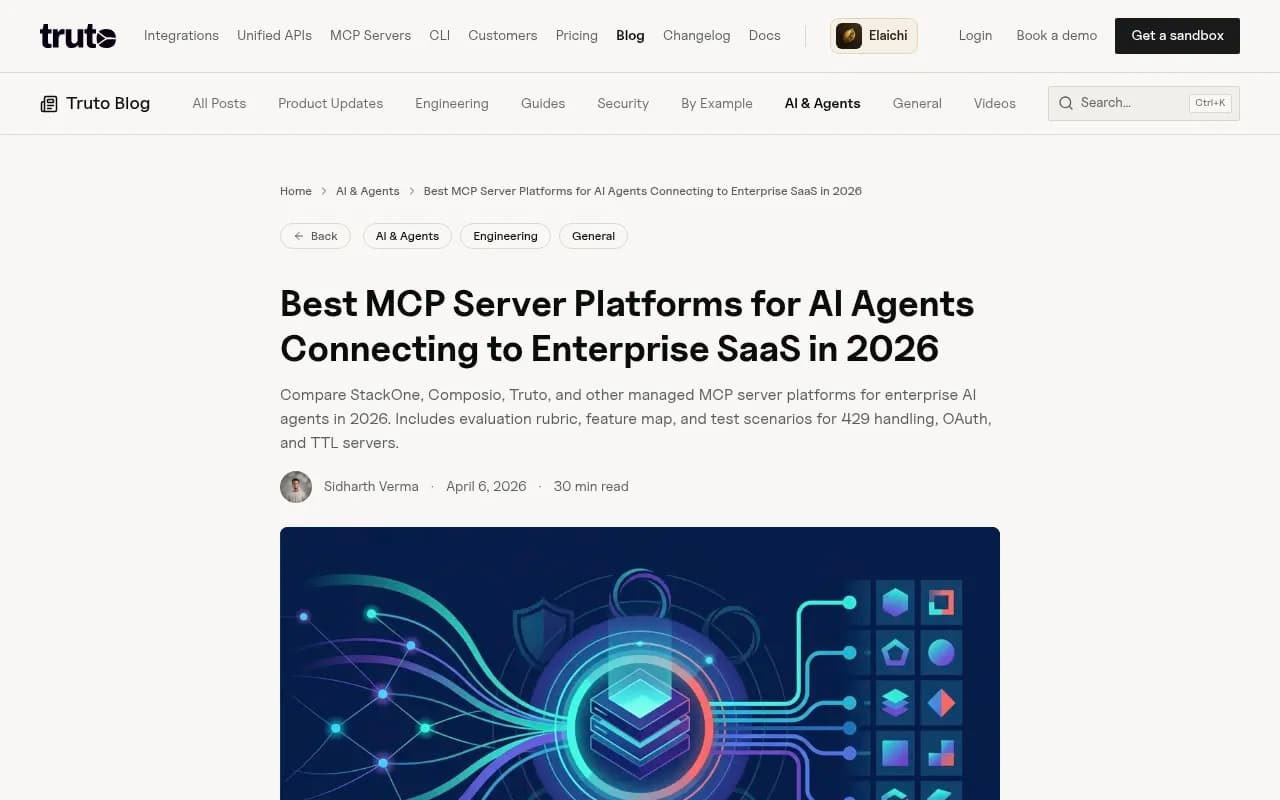
That is where APIs and MCP servers come in. The Model Context Protocol is now a common way to let AI clients call tools and read data. Truto's 2026 overview traces its path: launched by Anthropic in November 2024, adopted by OpenAI in April 2025, Microsoft Copilot Studio in July 2025, AWS Bedrock in November 2025, with all major providers on board by March 2026. For a GEO team, that means the question is no longer "does the vendor have MCP" but "what can an agent actually do with it, and who is allowed to."
I'll be upfront about the limits of the evidence here. Most of the vendor-specific detail below comes from vendor docs and a vendor-authored comparison page, and I could not independently verify rate limits or Enterprise pricing for every tool. Treat the tables as a starting shortlist and confirm on each vendor's pricing and docs pages.
What to evaluate before you shortlist
A checklist beats a feature list. These are the criteria that tend to matter once an integration leaves the demo stage.
Access model and plan gating
Some vendors include API and MCP everywhere. Others hide them behind an Enterprise conversation. If your data team wants to prototype before procurement gets involved, gating decides whether you can start next week or next quarter.
Read versus write
An MCP server that only reads analytics is useful for ad hoc questions. One that can create dashboards, track new prompts, queue content or update monitors changes how an analyst works. It also raises the governance stakes, which is why the next point matters.
Auth, scopes and audit
Look for scoped keys (read-only, project-level, organization-level), OAuth for interactive clients, and an audit log that says whether a change came from the UI, the API or an MCP client. Speakeasy's 2026 gateway roundup makes a similar argument for MCP in general: the hard part is not sign-in, it is who could reach a tool on a given day and whether the log records the access decision, not just the calls that succeeded.
Data shape and date windows
Check what the API exposes: visibility, prompts, raw responses, citations, sentiment, crawler logs, visitor analytics. Also check how far back one request can go. A 92-day window means a full quarter fits in a single pull. A 7-day cap means a loop and a lot of glue code.
Normalisation
Promptwatch Data's Average Sources Per Response report shows why this matters. ChatGPT cites about 5 sources per web-search answer, Google AI Overviews about 10, and Perplexity almost exactly 10 every day, while Copilot swung from under 2 to nearly 17 within a few weeks before settling low. If your pipeline compares raw citation counts across engines, you will draw wrong conclusions. Normalise per engine, and judge Copilot on monthly trends rather than weekly snapshots.
The platforms compared
Here is how the main enterprise-relevant options stack up on API and MCP access, based on each vendor's documentation and Promptwatch's own 2026 comparison page (vendor-authored, so read it with that in mind).
| Platform | API access | MCP server | Entry point for API/MCP | Notes |
|---|---|---|---|---|
| Promptwatch | REST API v2 | Hosted, 110+ read and write tools | Essential, $95/mo | Reads and writes; ISO/IEC 27001, GDPR |
| Profound | REST API, JS and Python SDKs | Hosted, reads analytics and builds or runs Agents | Enterprise, on request | Pricing not independently confirmed |
| Peec AI | API with reference docs | Live, listed with Claude, Cursor, n8n | Pro, $245/mo | Looker Studio connector shown at $495+ |
| Searchable | API | MCP | Scale, $400 | Fewer public details |
| Semrush, Ahrefs Brand Radar, HubSpot AEO | Varies | Varies | Not verified | SEO suites adding AI tracking |
A few notes on each.
Promptwatch
Promptwatch is the option I would put first on a data team's list, mainly because the API and MCP are on every plan rather than a sales-gated add-on. Essential is $95/mo, Professional $245/mo, Business $579/mo, and agency plans run $199 to $799/mo. Confirm current numbers at promptwatch.com/pricing.

The hosted MCP server has 110+ read and write tools and connects to Claude, Claude Code, ChatGPT, Cursor, Lovable, Codex and any MCP client through one-click OAuth or an API key. The REST API v2 covers visibility, prompts, responses, citations, sentiment, crawler and visitor analytics, shopping, Ads Radar, site audit, content and publishing, with date ranges up to 92 days. Hourly limits scale by plan: 500 requests per hour on Essential, 2,000 on Professional, 10,000 on Business, and 50,000 on Enterprise.
The write side is what separates it from monitoring-only tools. Agent Chat or the MCP can build a dashboard, track a Prompt Explorer suggestion, queue content, move items on the Action Board or update a monitor. For governance, the Business, Agency Scale and Enterprise tiers add an audit log that shows whether each change came from the dashboard, the API, an MCP client or Agent Chat, and there are scoped project, organization and read-only keys. It is also ISO/IEC 27001 certified and GDPR compliant, which tends to matter more to your security reviewer than any feature.
Data coverage is the other draw. Prompts are collected from the real interfaces of ChatGPT, Google AI Overviews, AI Mode, Gemini, Perplexity, Copilot and others, and the same API surfaces IP-verified AI crawler logs and AI-referred visitor analytics. That lets a warehouse join answer data, crawl behaviour and conversions without stitching three vendors together. There is a Looker Studio connector from Professional, and Excel and CSV exports for the rest. See Promptwatch vs Profound and Promptwatch vs Peec for the head-to-head detail, or the full 2026 platform comparison.
The 7-day free trial on monthly billing is a cheap way to test the MCP against your own questions.
Profound
Profound documents a substantial REST API, official JavaScript and Python SDKs, and a hosted MCP server that can read analytics and build or run Agents. The catch is access: according to Promptwatch's comparison and Profound's own announcement, the API is available on request and MCP is limited to Enterprise customers. Promptwatch's grid also marks its ChatGPT/Claude app support as Claude only. The SDKs are a genuine plus for engineering-heavy teams. Profound's own MCP workflow examples cover comparing competitor pages against live citation data and building category reports.
Peec AI
Peec AI says on its homepage that Peec MCP is live, with Claude, Cursor and n8n listed, and has public API reference docs. API access starts at the $245 Pro plan, which is friendlier than an Enterprise gate. A third-party blog listed no official SDKs for Peec versus Python and JavaScript for Profound, but that post carries a 2025 date, so check before relying on it. Peec is a monitoring product; it doesn't write or publish content for you.

Searchable
Searchable requires its $400 Scale plan for API and MCP. Public detail is thin, so ask for a sandbox before committing.
Others worth a look
A LinkedIn post lists Radarkit, Peec AI, Profound, OtterlyAI and SE Ranking as the "5 best MCP servers for AI visibility 2026." I could not verify that list, but those are reasonable names to check. Radarkit and Otterly.AI are in our catalog:

For enterprise SEO suites that bundle AI search tracking, see Botify, Conductor and seoClarity. I did not verify their MCP or API details, so ask each for current documentation.
What the MCP layer should look like inside your stack
Choosing a GEO vendor is only half the job. The MCP server has to live somewhere in your architecture, and the broader MCP ecosystem has opinions about how.
Gateways and access control
If your company already routes agent traffic through a gateway, the GEO vendor's MCP server becomes one more upstream. Speakeasy's roundup covers thirteen options, including Cloudflare MCP server portals, Kong, AWS AgentCore Gateway, TrueFoundry, LiteLLM and Docker's gateway. The practical advice: if you already run Cloudflare Zero Trust, Kong or AWS, start with the gateway your platform ships. Then check that access derives from directory groups and that the audit trail records grants and denials, not only successful calls.
Managed MCP platforms
Truto's guide frames the choice as three architectures: a gateway to servers you build, a large catalog of prebuilt tool actions, or a unified API that generates MCP tools from existing integrations. Pipedream, for example, offers MCP servers for more than 3,000 APIs with 10,000 prebuilt tools. For GEO this is mostly relevant when you want one agent to combine GEO data with CRM or ticketing data.
If you want glue between a GEO API and the rest of your systems without writing a service, general automation tools are the usual answer:
BI and warehouse side
Knowi's roundup of analytics MCP servers makes a distinction that applies directly to GEO data: servers that build inside one pre-modelled platform versus servers that can work across SQL, NoSQL and API sources in a single call. If your GEO exports land in Snowflake or BigQuery next to Search Console and product analytics, you will probably want the second kind, or a warehouse-first pattern where the GEO vendor's API feeds nightly loads and the BI MCP handles the querying.
A sensible proof of concept
Two weeks is enough. Run it like this.
- Pick five questions your team currently answers by hand, such as "which competitor gained share of voice this month by topic" or "which pages rank in Google but never get cited."
- Ask each question through the vendor's MCP from your actual client (Claude, Cursor, whichever you use) and note where the agent needs a second or third tool call.
- Pull a full quarter through the API. Count requests, note rate-limit responses, and see whether the response shape maps cleanly to your warehouse schema.
- Create a read-only key and a project-scoped key. Confirm the read-only one cannot write through MCP.
- Make a change through the API and through MCP, then check whether the audit log tells you which was which.
- Normalise citations per engine and see whether the vendor's own numbers match your recomputed ones.
If a vendor can't let you do steps 3 and 4 without a sales call, that tells you something.
Which one should you pick?
| If you are... | Start with | Why |
|---|---|---|
| A data team that wants to prototype this week | Promptwatch | API and MCP on every plan, trial available |
| An engineering-heavy team that wants official SDKs | Profound | JS and Python SDKs, if you accept the Enterprise gate |
| Budget-conscious, monitoring only | Peec AI | API from $245, MCP live |
| Needing agents that act, not just report | Promptwatch | Write tools, Action Board, content publishing via MCP |
| Already standardised on a gateway | Any, behind your gateway | Control access centrally |
My honest take: the API and MCP gap between vendors is mostly about gating and about whether agents can write. Read-only MCP on top of a dashboard is table stakes by now. What data teams should push on is rate limits, scopes, audit and the width of the date window, because those are the things that bite once a pipeline runs every night.
If you are still building the shortlist, the directories at bestgeosoftware.com and ai-rank-tools.com list more tools by category. If you are weighing whether to build this in-house or hire help, 1001 SEO Media runs GEO programs for brands on top of Promptwatch.
Gaps in this guide
To be clear about what I could not confirm: per-vendor rate limits and API pricing, OAuth and scope details for most MCP servers, verified API and MCP details for Scrunch, AthenaHQ, Semrush, Ahrefs and Otterly, and independent confirmation of Profound's Enterprise pricing. Ask each vendor for those before you sign.