Key takeaways
- Adobe Brand Visibility is the renamed and expanded Adobe LLM Optimizer. Adobe's own page says "Formerly Adobe LLM Optimizer", so treat them as one buying decision, not three options.
- Early coverage said Brand Visibility was announced but not purchasable, while later sources say only Brand Visibility is sold since July 31, 2026. Confirm current packaging with Adobe sales.
- Adobe wins when you already run Adobe Experience Manager, Adobe Analytics or Customer Journey Analytics and want AI visibility, edge fixes and revenue attribution under one contract.
- Brandlight is a standalone, enterprise-only platform with prompt tracking, content agents, shopping, AI ads and a service layer. It works on any stack.
- Neither vendor publishes pricing. Treat any figure you see as unverified until you have a quote.
The naming mess, sorted out
The title of this guide lists three products. In practice there are two buying decisions, and the confusion is Adobe's doing.
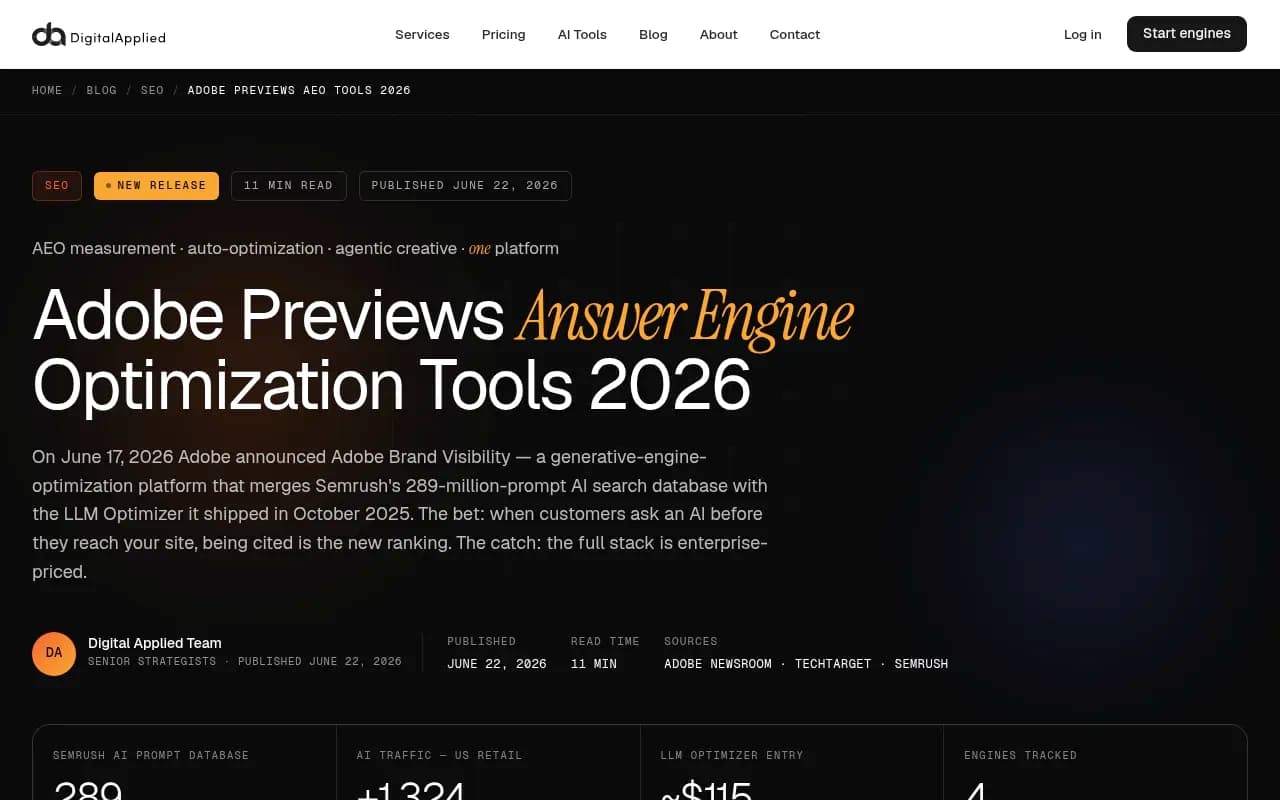
Adobe shipped LLM Optimizer in October 2025. On April 28, 2026 it closed its Semrush acquisition, and on June 17, 2026 it announced Adobe Brand Visibility, which layers Semrush's AI search data (reported as a 289-million-prompt database) over LLM Optimizer. A Digital Applied write-up from late June described Brand Visibility as previewed, with LLM Optimizer being the thing you could actually purchase. A later DeepSmith comparison says LLM Optimizer was folded into Brand Visibility and that only Brand Visibility has been sold since July 31, 2026.
Adobe's product page now reads "Adobe Brand Visibility (Formerly Adobe LLM Optimizer)". That settles most of it. My read: it is a rename plus a data upgrade, not two separate SKUs. Ask your Adobe rep to put the exact entitlements in writing, because older analyst posts and competitor blogs still treat them as separate.
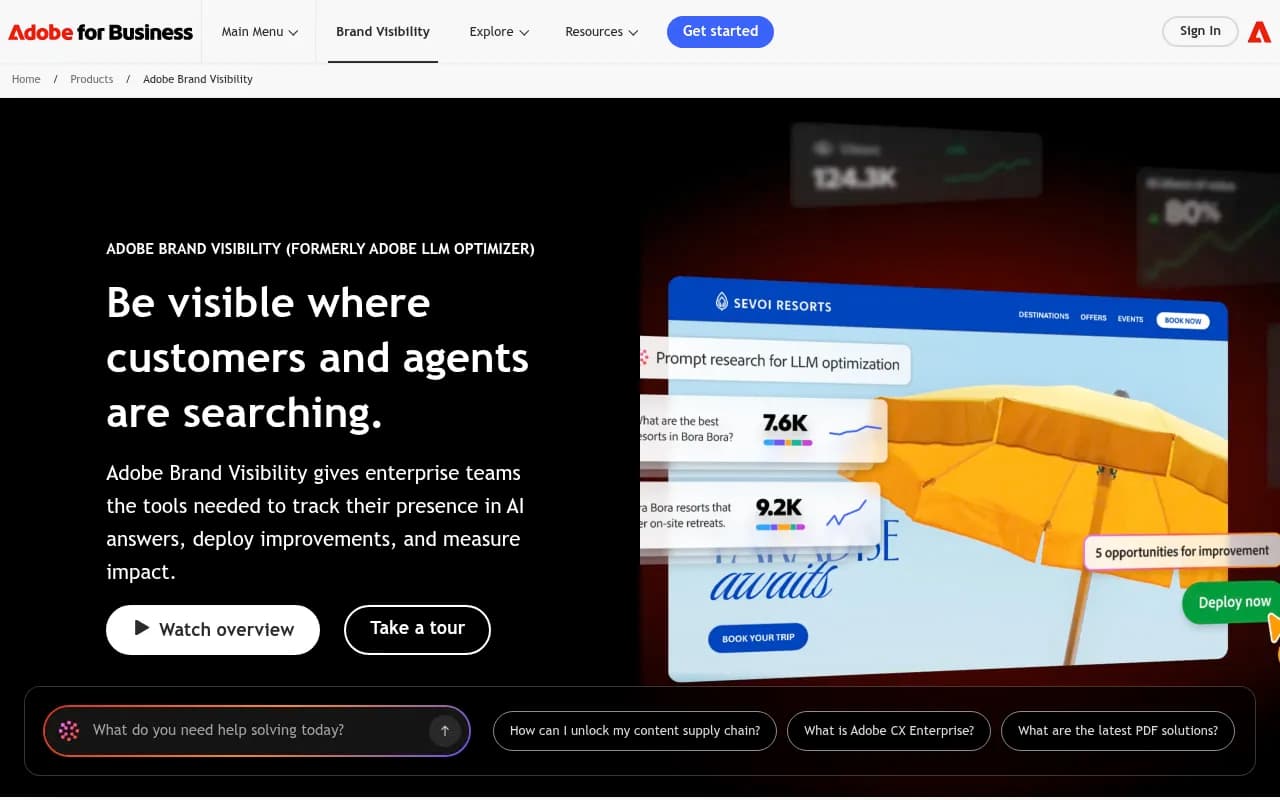
The Adobe side is covered by [tool:adobe-brand-visibility] and the Brandlight side by [tool:brandlight-ai].
What Adobe Brand Visibility actually is
Adobe describes it as a unified generative engine optimization product for enterprises: track your presence in AI answers, deploy improvements, measure impact. It sits inside Adobe CX Enterprise, and Adobe pairs it with its content and asset management stack.
Profound's competing write-up breaks the bundle into three parts:
- LLM Optimizer, the platform, with AI visibility tracking, an opportunities dashboard and attribution reporting.
- Optimize at Edge, which renders AI-friendly versions of pages for AI crawlers.
- Semrush's prompt database, feeding the visibility layer.
That is a vendor with an agenda describing a rival, so weigh it accordingly. It does line up with how Adobe's own materials talk about "agentic traffic" and one-click fixes, especially for Adobe Experience Manager users. A Real Story Group review raised bigger questions about how much of that works well outside AEM.
Engines and data
Digital Applied reports four engines tracked at launch (ChatGPT, Google AI Mode, Copilot, Perplexity) with Gemini planned. DeepSmith says up to 10 LLM families. Those two numbers conflict, so ask for the current engine list per contract tier.
Profound's article also claims Adobe's documentation describes its method as a statistical approximation of answers to selected prompts, rather than capturing what real users see. If that matters to you, and for audit-grade reporting it should, ask Adobe how responses are collected.
Pricing
Adobe does not publish it. Digital Applied cites a reported entry point of roughly $115K per year for LLM Optimizer, from a third party. Full-stack deployments are quote-based inside CX Enterprise. Take that number as a ballpark for budgeting a conversation, not a quote.
Reputation signal
DeepSmith's table lists a G2 rating of 3.7/5 for Adobe Brand Visibility and no SOC 2 listing. It is a competitor's table, so verify against G2 and Adobe's trust center directly.
What Brandlight is
Brandlight positions itself as AI visibility for the world's leading enterprises, and claims to be the number one AEO platform globally. That claim is the vendor's own and I could not verify it.
Modules shown on its site:
- Prompt tracking per market
- Technical health: crawler access, schema and server issues, with fix guidance
- Content agents that draft answer pages with review steps
- Shopping and product visibility across merchants
- Publisher and PR targeting, meaning the outlets AI trusts most
- An AI ads manager showing spend, impressions and clicks
- Social: cited creators and communities
- A leadership overview by engine and competitor
The visibility layer gives a score per engine and category, competitive benchmarking, and sentiment per topic, engine and market. The content product suggests page edits down to the wording, with an estimated impact score, and a one-click send to a writing agent. Brandlight also has a dedicated AEO team working with customers, so you are buying software plus a service.
The AI ads piece is the clearest difference. Brandlight's demo shows ad presence across 118,681 relevant monthly queries, with a split between your share, competitors and unclaimed space. Adobe's materials I reviewed do not mention anything equivalent.
Customers and proof
Quoted customers include Kimberly-Clark, Mediaocean, You.com and Samsung. Another source adds Volkswagen, LG, TD Bank and Estee Lauder. The Samsung quote claims ChatGPT-referred traffic grew 7x in 12 weeks and converts better than any other channel. Brandlight reports 4.9/5 from about 240 reviews on its own site, and G2 lists 253 reviews. It raised a $30M Series A.
Pricing
Also unpublished. LLM Pulse, a competing vendor, claims entry plans from about $199 a month and enterprise contracts of roughly $4K to $15K a month depending on brands, regions and modules. Unverified, and the source is biased. Brandlight is sales-led, with dedicated strategists during onboarding.
Side-by-side comparison
| Criterion | Adobe Brand Visibility (ex-LLM Optimizer) | Brandlight |
|---|---|---|
| Positioning | GEO module inside Adobe CX Enterprise | Standalone enterprise AI visibility platform |
| Best stack fit | AEM, Adobe Analytics, Customer Journey Analytics | Any stack |
| Visibility tracking | Yes, Semrush prompt data plus own tracking | Yes, per engine, category and market |
| Engines | Reported 4 to 10, confirm current list | ChatGPT, Gemini, Claude, Grok, Perplexity, Copilot (sources vary) |
| Fix deployment | Optimize at Edge for AI crawlers | Technical health guidance, content agents with review |
| Content generation | Partial per third-party review | Content agents plus impact-scored edits |
| Revenue attribution | Yes, ties to Adobe Analytics | Customer-reported traffic gains; confirm attribution method |
| AI ads tracking | Not shown in materials | Yes |
| Shopping visibility | Not shown in materials | Yes |
| Service model | Adobe account team and partners | Software plus dedicated AEO team |
| Pricing | Quote-based, reported ~$115K/yr entry (third party) | Quote-based, unverified third-party ranges |
| G2 | 3.7/5 (per DeepSmith) | 4.9/5 (vendor site), 253 reviews on G2 |
Which one fits which enterprise
Pick Adobe if you live in Adobe
If your content runs on Adobe Experience Manager and your measurement runs on Adobe Analytics or Customer Journey Analytics, the case is straightforward. Fixes deploy at the edge, attribution lands in tools your analysts already use, and procurement is one more line on an existing contract. Adobe has also positioned Brand Visibility as one link in a chain that includes its creative agents and audience simulation, which matters if you want creative and optimization under one vendor.
The risk is that AI visibility becomes one product among many. Profound's pitch against Adobe is exactly that, and while biased, it names a real concern: how fast will a module in a 15-product suite iterate compared with a specialist?
Pick Brandlight if you are not on Adobe, or want specialist coverage
Brandlight makes more sense when your stack is mixed, say Contentful or a headless CMS, Google Analytics and a handful of regional sites. It covers shopping, ads and social citations in the same product, and the service layer helps teams without a dedicated GEO function. The tradeoffs are opaque pricing, sales-led onboarding and a product built for large organizations rather than lean teams.
Run a real bake-off
Because neither side publishes numbers, do this before signing:
- Pick 50 to 100 prompts per market, including branded, competitor and category prompts.
- Ask both vendors to run them and export raw responses, not just scores.
- Compare against what you see in the real ChatGPT, AI Overviews and Perplexity interfaces.
- Ask how citations are attributed to your pages, and whether you can see which of your URLs earn them.
- Request a written list of engines, refresh frequency, and data retention per contract tier.
- Get a security package: SOC 2 or ISO 27001 status, SSO and audit logging.
Citation inventory differs by engine, which is why a single blended score can mislead. Promptwatch Data's average sources per response report shows ChatGPT citing about 5 sources per web-search answer, while Google AI Overviews and Perplexity each cite about 10. A slot in ChatGPT is far scarcer, so insist on per-engine reporting from whichever vendor you choose.
Questions to ask on any enterprise AEO call
- Do you capture responses from the real user interface, or approximate them via API?
- Can I see AI crawler activity on my own site, verified by IP?
- How is AI referral traffic tied to revenue, and does it survive the ChatGPT referrer changes?
- What actually ships to my CMS, and who approves it?
- What happens to my historical data if we leave?
The crawler question matters more than it looks. Promptwatch Data's AI crawler traffic report tracks weekly IP-verified requests from OpenAI, Anthropic, Google, Perplexity and Mistral, and shows that crawler mix changes quickly. A tool that cannot show you what bots do on your site leaves you guessing whether a visibility gap is an access problem or a content problem.
Other enterprise options worth a look
If neither Adobe nor Brandlight clicks, the shortlist usually includes a few specialists and suites.
Promptwatch is an end-to-end AI visibility platform that monitors real ChatGPT, Gemini, Perplexity, AI Overviews and Copilot interfaces, then goes on to fix gaps with a Content Agent that publishes to WordPress, Webflow or Framer. It also includes IP-verified crawler logs and visitor analytics tied to AI traffic, plus ISO/IEC 27001 certification. Published pricing runs from $95 a month up to $579 for Business, with Enterprise tailored, so you can test it before a procurement cycle. See Promptwatch vs Brandlight for a direct comparison.


Profound is the specialist most often named against both Adobe and Brandlight, and [tool:conductor] and [tool:botify] are options if you want AI visibility next to an enterprise SEO suite. [tool:bluefish-ai] and [tool:evertune] also target large brands. For wider browsing, the GEO software directory at bestgeosoftware.com lists more.
| Option | Type | Public pricing | Notes |
|---|---|---|---|
| Adobe Brand Visibility | Suite module | No | Best inside Adobe stack |
| Brandlight | Specialist plus service | No | Ads, shopping, AEO team |
| Promptwatch | End-to-end platform | Yes | Crawler logs, Content Agent, trial available |
| Profound | Specialist | No | Closest rival to both |
| Conductor | SEO suite with AEO | No | Unified SEO and AEO workflow |
Bottom line
If you are an Adobe shop, Brand Visibility is the path of least resistance, and the renaming should not worry you as long as your contract names the entitlements. If you are not, Brandlight is a credible standalone with broader surface area (ads, shopping, social), but expect a sales-led process and unpublished pricing. Either way, run the same prompt set through each vendor and the real engines, and make them show you raw responses. The vendor that agrees to that is usually the one you can trust with a six-figure budget.