Key takeaways
- Brandlight is an enterprise platform with custom pricing, no free trial, and a strategy team that works alongside you. Frase and Writesonic are self-serve.
- Frase is the cheapest entry point ($39/mo billed yearly) and has a 7-day free trial with no card, but its own pricing page says AI Visibility does not auto-fix pages.
- Writesonic's self-serve tiers track only 3 engines (ChatGPT, Gemini, Google AI Overviews). Perplexity, Claude and the full Action Center are Enterprise-only.
- Most claims about these three come from the vendors themselves. I found no independent head-to-head test, so treat every ranking, including Frase's blog ranking itself #1, as biased.
- If you want tracking, crawler logs and content production in one product, include an end-to-end platform like Promptwatch in your shortlist.
Why compare these three at all
These tools get lumped together because each one claims to do more than watch a dashboard. Each says it will help you fix what AI gets wrong, and each has some kind of content workflow attached. But they come from very different places.
Brandlight is an enterprise AI visibility platform built for multi-brand, multi-market companies. Writesonic started as an AI writing and SEO tool and added AI visibility tracking on top. Frase started as a content research and optimization tool and added AI visibility tracking and a GEO score. Those origins still shape what each one is good at.
Before getting into the tools, one number worth keeping in mind. Promptwatch Data (a report dated September 2025, based on 26B+ data points) found ChatGPT cites about 5 sources per web-search answer, while Google AI Overviews and Perplexity cite around 10. With only about five slots in ChatGPT, which prompts and engines your tool actually covers matters more than how pretty the dashboard looks. That is my inference from the report, not a figure in it.
Quick comparison table
| Brandlight | Writesonic | Frase | |
|---|---|---|---|
| Origin | Enterprise AI visibility | AI writing and SEO | Content research and SEO |
| Best for | Multi-brand enterprises | Growth teams wanting tracking plus articles | Small teams and agencies on a budget |
| Pricing | Custom, demo-led, no free trial | $79, $199, $399/mo billed yearly, plus Enterprise | $39, $103, $239/mo billed yearly, plus Enterprise |
| Free trial | No (paid 3-month pilot is typical) | Free start advertised | 7 days, no card |
| Engines (self-serve) | Not published | ChatGPT, Gemini, Google AI Overviews | ChatGPT and Google AI on Starter; Perplexity from Professional; Claude and Gemini on Scale |
| Content tools | Multi-agent writing with brand and legal rules, routed to your CMS for review | AI articles, site audits, Action Center (trial on Growth) | Article drafting, SEO and GEO scores, Content Guard, CMS publishing |
| Human support | AEO team and AI strategists | Standard | Standard |
| Security claims | SOC 2-level posture | SOC 2 Type II, HIPAA, GDPR (Enterprise) | SOC 2 Type II, GDPR |
Pricing comes from each vendor's own pages. Confirm before buying, since all three change plans often.
Brandlight: enterprise governance with a strategy team
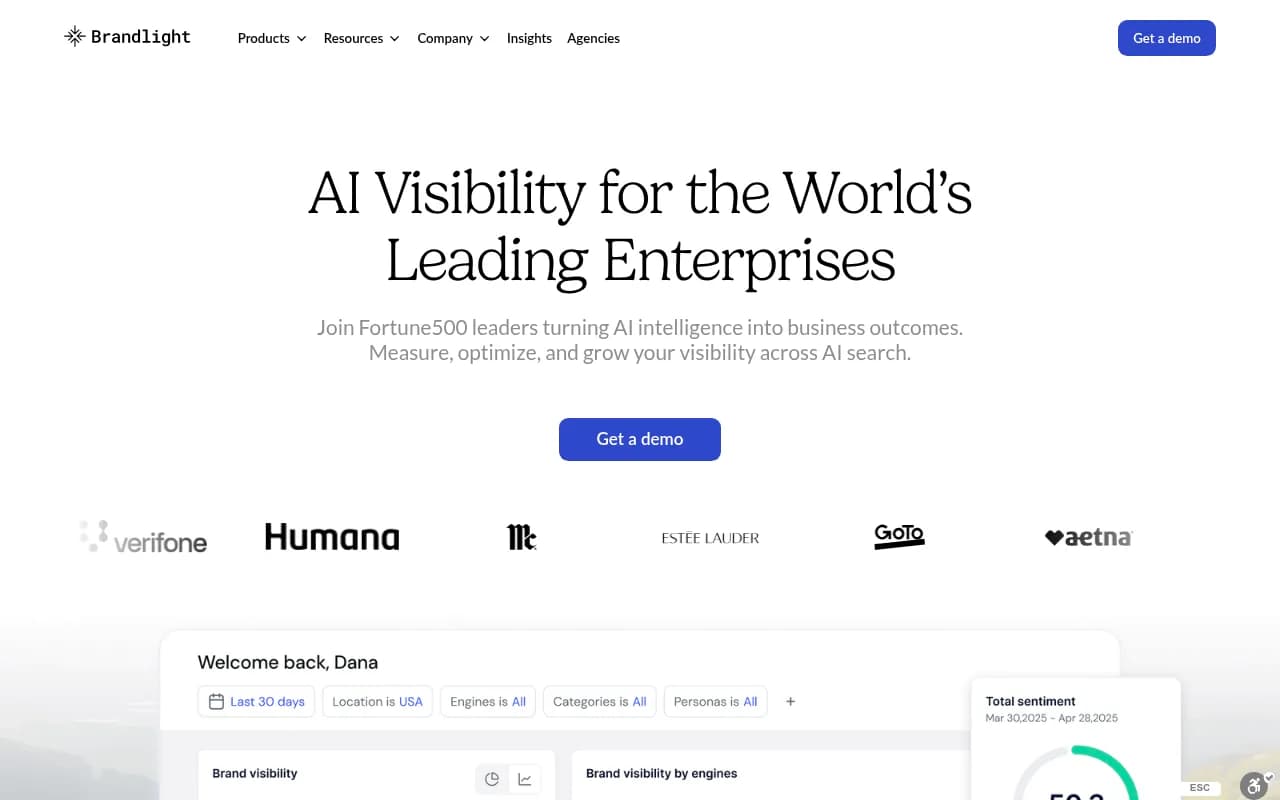
Brandlight positions itself as the intelligence layer for global CMOs. The pitch is a loop that runs through seeing, shaping and acting on how AI describes your brand, across owned, third-party, social, retail and paid surfaces.
What stands out
The homepage lists modules for tracking every prompt in every market, technical health (crawl and schema fixes), content agents, shopping, publisher outreach, an AI ads manager and social. That is wider than what the other two cover.
A few features are genuinely different:
- A Brand Entity feature that catches wrong facts. Brandlight's example is a product price AI quotes as $295 in 6 of 10 responses when the real price is $380.
- Funnel-tagged prompt sets it builds for you, so you do not have to guess which questions to track.
- Wording-level page edits with an estimated impact score and a send-to-writing-agent button.
- A writing workflow (strategist, writer, editor, validator) that enforces brand and legal rules and routes drafts to your CMS for review. It does not auto-publish, which compliance teams will like.
It also leans on a very specific claim: Brandlight's own analysis says roughly 85% of the sources AI cites for category questions are third-party or social. Whether that number holds for your category, the principle is sound. Winning AI answers means working on review sites, editorial and communities, not only your own pages.
Where it falls short
Pricing is not published and there is no free trial. Brandlight's own comparison says engagements typically start with a paid 3-month pilot. Support is ticket and email, Monday to Friday, 9am to 6pm. I could not verify its engine list beyond the logos on the homepage and its blog, or any prompt limits.
The proof points (Kimberly-Clark moving 12 of 12 brands into the top three, 4.9/5 on G2 from 240 reviews, "#1 AEO platform") are all self-reported. G2 itself lists 253 reviews, so the numbers are roughly right, but I would ask for references during the demo.
If you are a solo marketer or a 10-person SaaS company, this is not for you. It is priced and scoped for Fortune 500-style procurement.
Writesonic: tracking bolted onto a content tool
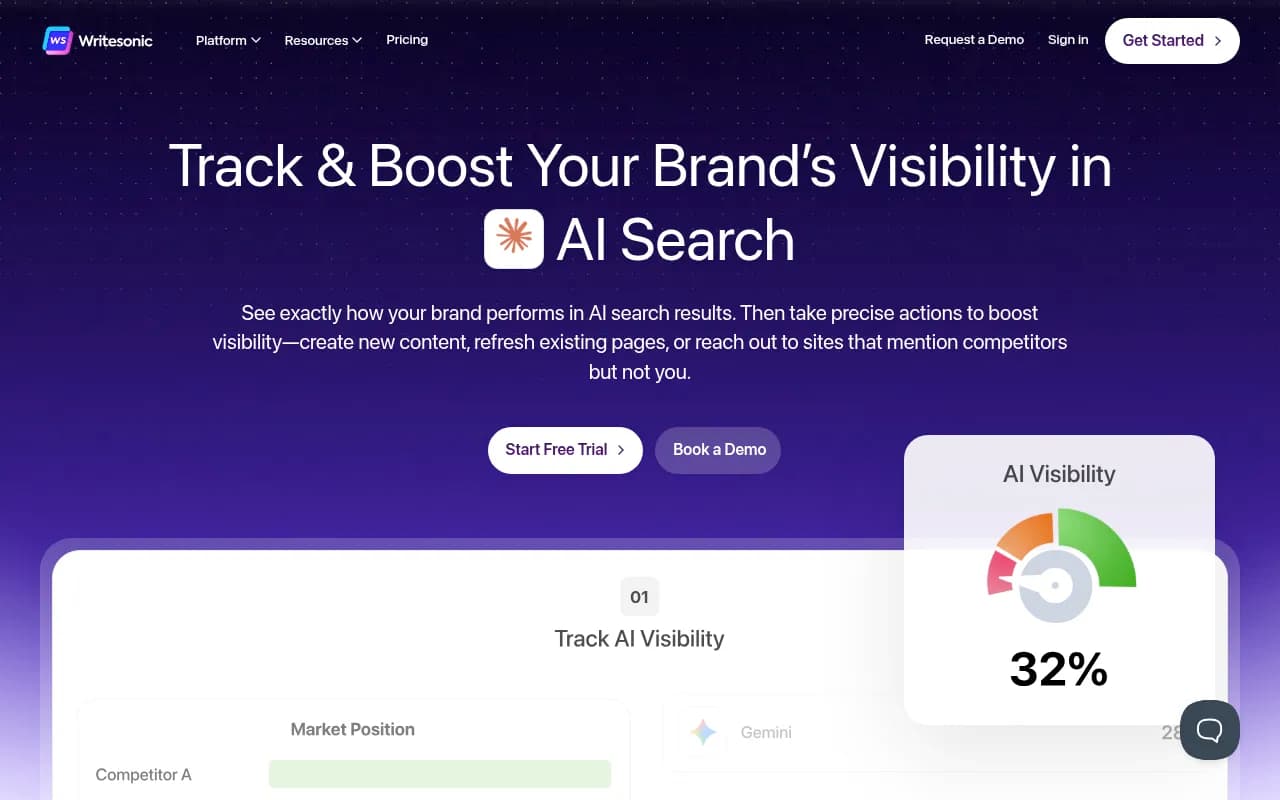
Wriesonic is the one that people already know as an AI writer. Its AI search suite tracks prompts, citations, sentiment and AI bot activity, then suggests actions.
Pricing and what each tier actually gets you
Billed annually, per Writesonic's pricing page:
| Plan | Price | Prompts | Notable limits |
|---|---|---|---|
| Starter | $79/mo | 50 | 15 articles, 1 user, 1 project |
| Basic | $199/mo | 100 | 25 articles, 2 users |
| Growth | $399/mo | 200 | 50 articles, sentiment, Action Center trial (5 on-page and 5 off-page actions per month), 3 users, 2 projects |
| Enterprise | Custom | Custom | All 9 engines, full Action Center, Fact Check, social citations, shopping |
The catch is that self-serve plans track only ChatGPT, Gemini and Google AI Overviews. Perplexity, Claude, Grok, Copilot, Google AI Mode and Muse Spark are Enterprise-only, as are Fact Check and the full Action Center. If your buyers use Perplexity or Claude, you will be paying for an upgrade fast.
What reviewers found
The most detailed hands-on review I found was from Profound, a direct competitor, so read it with that in mind. They called Writesonic's tracking of citations, prompts and sentiment relatively thorough, but said the optimization ideas were thin. In their test, the listicle outlines were just lists of H2 and H3 headings with no reasoning, and some outlines did not even include the brand being optimized. They also noted its AI bot analytics only supported WordPress, Vercel and Cloudflare. That review is from November 2025, so Writesonic may have changed things since.
The fair summary: it is an SEO and content generation tool first. Every AI search plan carries a long list of writing features you may or may not need. If you already write a lot and want visibility tracking in the same place, that is a plus. If you only want visibility data, you are paying for tools you will not touch.
Frase: the cheapest route from finding to fixing
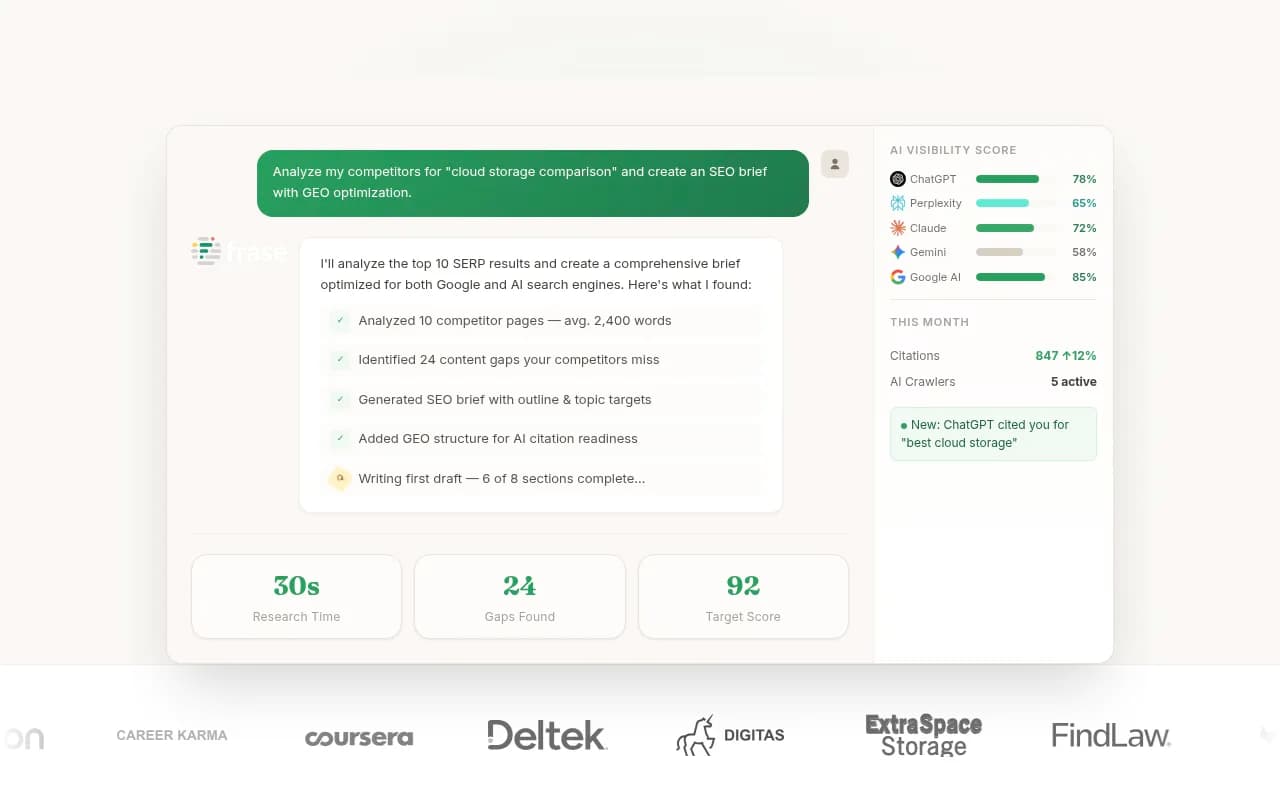
Frase has been a content brief and optimization tool for years. It now adds AI visibility tracking and a GEO score next to its SEO score.
Pricing
Billed yearly, per Frase's pricing page (monthly is a bit higher, and all plans have a 7-day free trial with no card):
| Plan | Price | Seats and sites | Articles | Engines |
|---|---|---|---|---|
| Starter | $39/mo | 1 seat, 1 site | 10 | ChatGPT, Google AI |
| Professional | $103/mo | 3 seats, 5 sites | 40 | Adds Perplexity, AI crawler monitoring |
| Scale | $239/mo | 5 seats, 10 domains | 100 | Adds Claude and Gemini, client-ready reports |
| Enterprise | Custom | White-label portal, SSO/SAML, SLA | Custom | Adds Grok, Copilot, DeepSeek |
Starter stops at its limits with no overage charges. Professional and Scale have optional pay-as-you-go, off by default. Frase has a 4.8/5 rating on G2, though I did not verify that independently.
The honest caveat on automation
Frase's own blog says its monitoring ends in a published fix. Its pricing page is more modest: AI Visibility does not auto-fix. Content Guard, the feature that watches published pages and drafts corrections, covers Google ranking and traffic decay only, with republishing on approval. So the workflow is: see where you are cited, research the page, draft in your voice, score for SEO and GEO, publish to WordPress, Sanity, Webflow, Wix or FraseCMS. That is useful. It is not a hands-off loop for AI visibility.
Also worth noting, Frase's ranking of AI search monitoring tools puts itself first and Writesonic fifth. It is a vendor-authored list, so I would not weight it.
Head-to-head by what you actually need
Engine coverage
Wriesonic self-serve covers three engines. Frase covers two on Starter and five by Scale. Brandlight reports tracking 13 engines but does not publish a plan-by-plan breakdown. If Claude and Perplexity matter, Frase Scale at $239/mo is the cheapest published way to get them among these three.
Content creation
Wriesonic gives the most volume per dollar at the top (50 articles on Growth at $399). Frase gives more articles per dollar at the bottom and pairs drafts with a GEO score. Brandlight gives the strictest governance, with deterministic brand and legal rules and human review before anything is published. These are different philosophies, not different quality levels.
Agencies
Frase Scale covers 10 domains and 5 seats with client-ready reports, and Enterprise adds white-label reports and a client portal. Writesonic's Growth plan has only 2 projects. Brandlight is built for in-house multi-brand teams, not for resold agency work.
Transparency
Frase and Writesonic publish prices. Brandlight does not. Brandlight is the only one that says outright you will start with a paid pilot.
Which one should you pick
- Pick Brandlight if you are a large, multi-market brand, want a strategy partner, and have budget and a procurement process. Ask for references and a clear price before you commit to the pilot.
- Pick Writesonic if you already create a lot of content, are happy with three engines to start, and want tracking in the same tool. Budget for Enterprise if you need Perplexity or Claude.
- Pick Frase if you are a small team or agency that wants the lowest-cost route from tracking to a rewritten, scored page, and you can accept that the AI side is not fully automated.
A practical test works for all three: pick 20 prompts your buyers actually ask, run the 7-day trial or a demo, and see whether the tool finds your gaps and whether the suggested edits are specific enough to ship without rewriting them from scratch.
Where a fuller platform fits
None of these three is the only way to get tracking plus content. If your priority is the whole loop, including what AI crawlers actually read on your site and whether the traffic converts, look at Promptwatch. It tracks the real interfaces of ChatGPT, Gemini, Perplexity, Google AI Overviews and others, shows IP-verified AI crawler logs, and its Content Agents write and publish to WordPress, Webflow or Framer, then check whether the page gets crawled, cited and clicked. Plans start at $95/mo (Essential) and the Content Agent arrives on Business at $579/mo; confirm current prices at promptwatch.com/pricing. There is also a free AI visibility report if you want a quick read before choosing anything.

For a wider shortlist, the GEO software directory at bestgeosoftware.com lists dozens of alternatives by category.
What I could not verify
Some honesty about the limits of this comparison. I found no independent head-to-head test of Brandlight against Writesonic and Frase. I did not verify Brandlight's engine list or prompt limits, Writesonic's G2 rating, or whether Frase's blog description of Writesonic matches current plans beyond the self-serve tier language. Vendor claims, including customer outcomes and analyst recognition, are self-reported. Treat the table above as a starting point and verify the details that matter to you in a trial or demo.