Key takeaways
- Daily refresh is the baseline in 2026. Peec AI, SE Visible, Goodie, Scrunch and most Profound alternatives run each prompt about once every 24 hours.
- Verified faster-than-daily tracking is rare. Among the tools covered here, Promptwatch is the one that documents it: Business and Agency Scale monitors can run every 12, 6, or 1 hours. For the others, ask the vendor in writing.
- Profound removed its self-serve Starter and Growth brand plans in September 2026, so the old $99 and $399 price points are mostly gone. Check its pricing page for the current offer.
- Price is driven by prompts x engines x frequency. A $95 plan that tracks three engines is not comparable to a $99 plan that tracks four.
- Run a 30-day parallel test before you cancel anything.
Why refresh frequency matters more than it used to
AI answers are not stable. Ask the same prompt twice and you can get two different brand lists. Worse, the platform itself can change behavior overnight. According to Promptwatch Data's report on the ChatGPT citation drop, ChatGPT cited about 6.4 sources per search-enabled response in the week before the GPT-5.3 rollout on March 4, 2026. By late March it had settled around 4.7 to 4.9, roughly 27% fewer, and it did not recover a month later.
If you only check weekly, a shift like that looks like a mystery visibility loss. With daily data you can see it was a platform-wide change, not something your content did.
Different content also decays at different speeds. In Promptwatch's ChatGPT content half-life data, which followed every page ChatGPT cited on July 6, 2026 through October 4, 2026, news pages lost half their citations within 36 days. Landing pages were still cited at 78% after 30 days, and docs at 76%. The practical reading: news and fast-moving topics deserve tight tracking, while evergreen landing pages can be checked less often.
What Profound looks like now
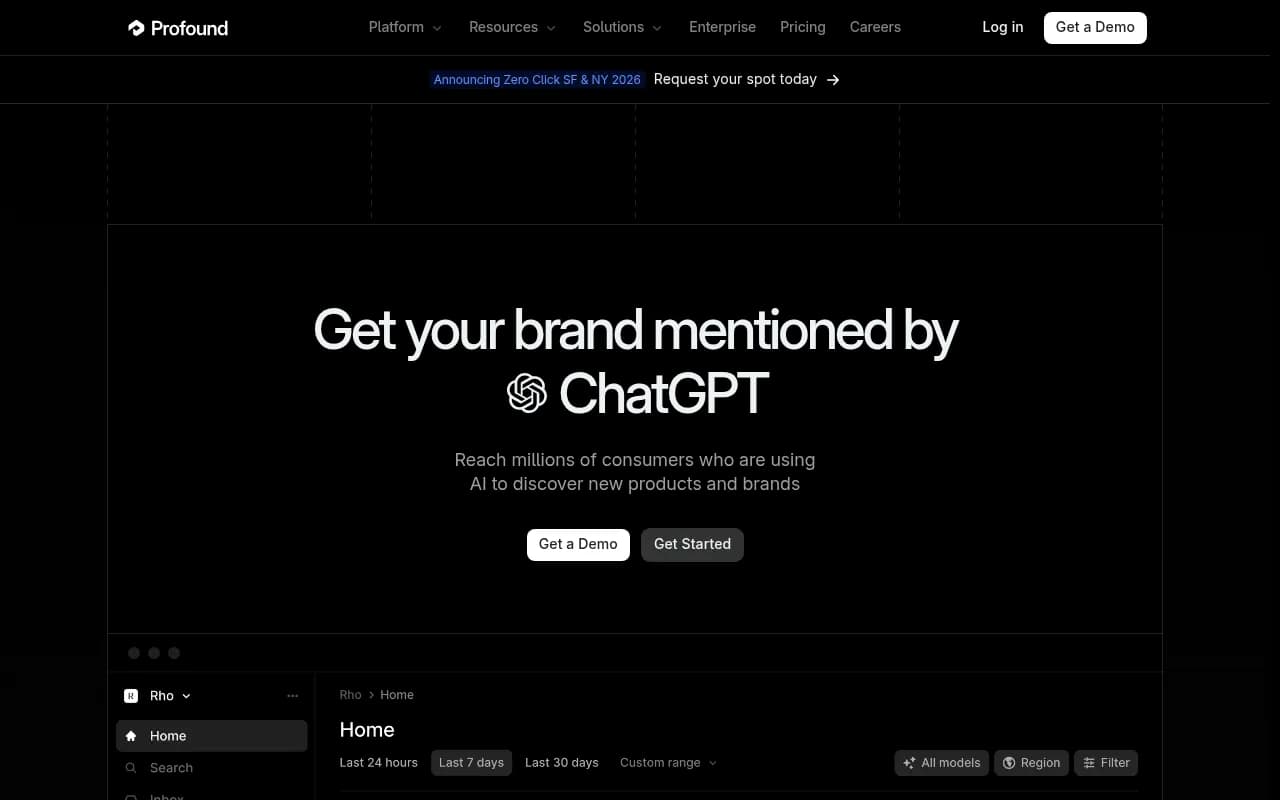
Profound is a strong product. It has real-user prompt volume data, front-end response capture, an Amazon Rufus shopping module, and Agent Analytics that reads CDN logs from Cloudflare, Akamai, Fastly, CloudFront, Google Cloud CDN and Netlify.
But the buying experience changed. Per ContentMonk's September 2026 write-up, Profound raised a $180M Series D and, around the same time, dropped its self-serve Starter and Growth plans for brands. Its pricing page now shows a 7-day free trial and then a custom Enterprise quote, plus a separate agency plan. Before that, third-party roundups listed Starter at $99/mo (ChatGPT only, 50 prompts, 1 seat) and Growth at about $399/mo (adds Perplexity and AI Overviews, 100 prompts, 3 seats). Those figures came from roundups, not Profound's page, so verify anything you rely on.
One gap worth flagging: I could not find documented refresh cadence per Profound tier. If daily versus faster matters to you, ask the sales team directly.
Daily versus hourly: what is actually available
Here is the honest picture from research. Daily is the verifiable standard. Peec runs each prompt once every 24 hours, and one reviewer recommends daily runs for the prompts you care about because answers vary from run to run, with weekly runs for larger sets of secondary prompts.
True hourly tracking is a different story. Across the vendor pages and roundups reviewed for this guide, the only documented faster-than-daily option is Promptwatch's. Elsewhere, hourly shows up as a marketing line, such as a LinkedIn post mentioning hourly monitoring across 1,000 prompts, without matching vendor documentation. Treat hourly claims from anyone else as unverified until you see it in writing or in a trial.
When do you actually need hourly? Mostly during a product launch, a PR crisis, a pricing change, or a campaign where you want to watch a number move in near real time. For steady-state reporting, hourly just multiplies cost and noise. Hourly runs also help you smooth a noisy visibility number, since more samples per day means a steadier average.
Comparison of refresh and pricing
Prices below come from third-party roundups and vendor snippets collected in 2026, except Promptwatch, which is quoted from its own plan details. Confirm everything on the vendor's pricing page.
| Tool | Entry price | Prompts included | Refresh | Notes |
|---|---|---|---|---|
| Promptwatch | $95/mo Essential | 50 (Business: 350) | Daily on all plans; 12, 6, or 1 hour on Business and Agency Scale | All AI models on every plan, 7-day free trial |
| Peec AI | $95/mo (some sources list EUR 89) | 50 | Daily | 3 engines of your choice; extra engines from $35/mo each |
| SE Visible | $99/mo | 200 | Daily | ChatGPT, Gemini, AI Mode, AI Overviews |
| Goodie AI | $295/mo | 200 | Daily | Billed annually |
| AthenaHQ | $295/mo | Not confirmed | Not confirmed | Bundles 11 models |
| Scrunch AI | Not confirmed | Not confirmed | Daily (reported) | Core covers 4 engines; Enterprise covers 9 |
| Semrush AI Visibility Toolkit | $199/mo per domain | Not confirmed | Not confirmed | ChatGPT, Gemini, AI Mode, AI Overviews |
| Ahrefs Brand Radar | $50 to $250/mo by checks | 2,500 to 25,000 checks | Not confirmed | $199/mo per AI index or $699 for all 6 |
| Otterly.AI | Budget tier | Not confirmed | Daily (reported) | 7-day trial |
The alternatives, one by one
Promptwatch
Promptwatch is the one tool here that documents faster-than-daily tracking, and it is also the most complete platform in the group, not just a tracker. Every plan runs prompts daily. On Business ($579/mo) and Agency Scale ($799/mo), and on Enterprise by request, a monitor can run every 12, 6, or 1 hours, which is useful for watching a launch or steadying a noisy score.
Data comes from the real interfaces of ChatGPT, Google AI Overviews, Google AI Mode, Copilot, Gemini, Perplexity and others, in each country and language, rather than only API outputs. Beyond tracking, it traces which pages get cited, logs AI crawler visits with IP verification, measures AI-referred traffic, and its Content Agent writes and publishes pages to WordPress, Webflow or Framer. It also tracks Reddit, YouTube and LinkedIn citations and ChatGPT Shopping.
Plans: Essential $95/mo, Professional $245/mo, Business $579/mo, with agency tiers at $199, $399 and $799. Annual billing gives 12 months for the price of 10. All plans include every supported model, which sidesteps the engine-cap math that bites on other tools. Confirm current pricing at promptwatch.com/pricing. There is a head-to-head comparison with Profound if that is your starting point. The 7-day free trial or the free AI visibility report are the easiest ways to test it.

Peec AI
Peec is the usual first stop for budget-minded teams. Starter is about $95/mo with 50 prompts, three engines of your choice, daily checks and unlimited users. Pro is $245 and Advanced is $495, and both keep the three-engine limit. That limit is the catch: add Perplexity and you pay extra, and one roundup worked out that ChatGPT, AI Overviews, Gemini and Perplexity together land around $130/mo, not $95. Annual billing saves about 15%, the API is Enterprise-only, and there is an MCP server. It monitors well but does not write or publish content. See the Promptwatch vs Peec page for a side-by-side.

SE Visible
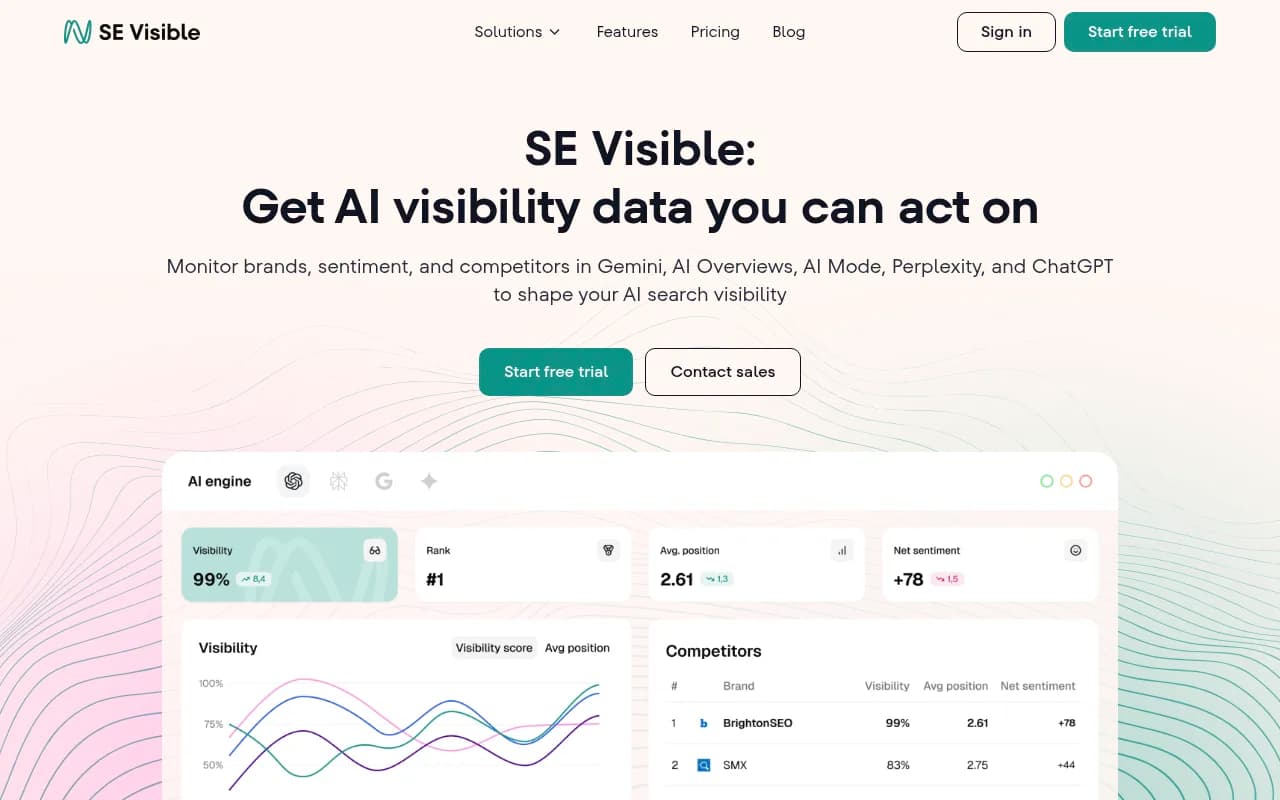
SE Ranking's AI product is $99/mo for 200 prompts tracked daily across ChatGPT, Gemini, AI Mode and AI Overviews, which is the best prompt count at that price in this list. One source says Perplexity is no longer tracked, so check that if Perplexity matters to you. The trial is 10 days.
Scrunch AI
Scrunch is the closest to Profound in feel, with a monitoring-first approach. Core covers ChatGPT, Perplexity, AI Overviews and Copilot, and Enterprise reaches nine engines including Claude and Gemini. Reports say it tracks daily. Pricing is less transparent, so budget for a sales conversation.
Goodie AI and AthenaHQ
Goodie's Starter is $295/mo with 200 prompts and daily tracking, Pro is $495, and everything is billed annually. AthenaHQ starts at $295/mo and bundles 11 models. Both cost roughly three times Peec or SE Visible, so you should have a concrete reason, such as breadth of models or shopping coverage, before paying that.

Semrush and Ahrefs Brand Radar
If you already live in one of these suites, the add-on is convenient. Semrush's AI Visibility Toolkit is $199/mo per domain. Ahrefs Brand Radar prices by checks ($50, $100 or $250 a month) with AI indexes at $199/mo each. Ahrefs stands out on data origin: its prompts come from People Also Ask questions with real search volume behind them, rather than invented ones. Neither is built for sub-daily refresh, and neither gives you AI crawler logs.

Otterly.AI
Otterly is a low-cost tracker with daily monitoring and a 7-day trial. It is fine for a small brand that just wants to see mentions. Do not expect crawler analytics or content tooling.

How to compare the real cost
Most tools in this category share the same core mechanic: schedule prompts, store responses, draw a dashboard. What separates them is data source (real UI capture or API), prompt volume data, and whether the product helps you act. So compare on cost per answer, not sticker price.
A quick example. Peec Starter: 50 prompts x 3 engines x 30 days is 4,500 answers a month for $95. If you need five engines, the effective price climbs. Run the same math on every vendor: prompts, engines, frequency, then seats, exports and API calls.
Also be skeptical of prompt volume scores. Roundups note that the volume numbers in Peec, Semrush, Profound and AthenaHQ are estimates built from other data.
Questions to ask any vendor about refresh
- Is the cadence once per 24 hours, or a rolling window? Can I pick the time of day?
- Is faster-than-daily available, on which plan, and is it written in the contract?
- Does a sub-daily run consume extra credits or responses?
- Are results captured from the real UI or from an API?
- Can I export raw responses so I can audit variance myself?
A 30-day switching plan
Demand-Genius lays out a simple migration sequence that works well here.
- Week 1: audit your current setup. List tracked prompts, engines, competitors and reports that stakeholders actually read.
- Week 2: run the new tool in parallel with the same prompts.
- Week 3: check fit. Compare visibility numbers, usability and exports.
- Week 4: finalize and move reporting over.
One extra tip: put your top 10 prompts on the fastest cadence you can afford and leave the long tail on daily. That gets you speed where it matters without paying for it everywhere.
Which one should you pick
| If you need | Start with |
|---|---|
| Cheapest daily tracking for one brand | Peec AI or SE Visible |
| Faster-than-daily tracking plus fixing gaps | Promptwatch Business |
| Profound-style monitoring at enterprise scale | Scrunch AI |
| Tracking inside an SEO suite you already pay for | Semrush or Ahrefs Brand Radar |
| Minimal budget, basic mention monitoring | Otterly.AI |
For a wider list of options, the GEO software directory at bestgeosoftware.com is a good place to browse.
The bottom line: daily is easy to find and cheap. Hourly is rare, so verify it before you pay for it. Whatever you pick, test it against your own prompts for a month before you commit.