Key takeaways
- Multi-brand GEO is an operations problem first: separate logins per domain stop working somewhere around 30 brands, so workspace structure, permissions and pricing model matter as much as features.
- A blended visibility score hides what is really happening. Insist on per-engine, per-market reporting for every brand.
- Monitoring-only tools leave every fix as a manual CMS task. At portfolio scale, look for content gap analysis, publishing integrations and a way to measure whether a fix worked.
- Security review items (SSO, audit logs, ISO 27001 or SOC 2, GDPR) and API access to feed BI tools usually decide enterprise deals.
- Most public pricing for rival tools comes from competitor blogs. Confirm every number on the vendor's own pricing page before you build a business case.
What makes a multi-brand portfolio different
A single brand can get by with a prompt tracker and a spreadsheet. A portfolio can't. Once you are running a parent company with a dozen sub-brands, regional sites, or acquired products, you hit problems that single-brand buyers never see.
Each brand has its own competitors. Each market has its own language and its own local publishers. Legal wants to see one thing, the CMO another, and the analyst on brand number nineteen needs write access to just that brand. Meanwhile, finance wants one invoice that doesn't triple when you add the next acquisition.
A vendor-authored buyer's guide from Botric puts the breaking point for separate logins per domain at roughly 30 brands. That's a vendor's rule of thumb, but it matches what I'd expect: the pain starts well before you hit that number, when reporting has to be stitched together by hand.
A note on sources. Nearly every comparison article in this space is written by a vendor that also ranks itself. Botric ranks Botric, Meikai ranks Meikai. I've used those pieces for evaluation criteria, not for rankings.
What to evaluate before you shortlist
Workspace structure and permissions
You want one organization with many projects (brands), not many separate accounts. Check whether roles can be scoped per project, so a regional analyst sees only their brand. Check for an audit log that records who changed what, and whether the change came from the UI, the API, or an automation.
Pricing model
Per-seat pricing is a procurement headache when dozens of people need read access. Per-tracked-domain pricing gets expensive fast at 30+ brands. The models that tend to survive a portfolio are those priced on response volume, credits, or project bundles, with unlimited seats. Ask for a quote based on your real brand count, not the list price of the entry tier.
Security and compliance
SSO (SAML or OIDC), role-based access, GDPR-compliant data handling and a recognized certification (ISO/IEC 27001 or SOC 2 Type II) are standard asks from procurement in regulated industries. If you are in healthcare or finance, ask for the specific attestations in writing.
API and BI integration
Manual CSV exports break at portfolio scale. You want a REST API, ideally an MCP server for agent workflows, and connectors for Looker Studio, Looker, Tableau or Power BI so brand-level numbers roll up into the dashboards your executives already open.
Per-engine, per-market measurement
This is the one most buyers skip. Meikai's buyer's guide shares a case where a publisher removed a directory of cited pages, and the retention of baseline citations differed wildly by platform: Perplexity at 109.5%, Copilot at 26.3%, ChatGPT at 12.2%, and Google AI Mode at 0%. The blended average, 37%, describes none of them. If a vendor only shows you one number, you can't diagnose anything.
The same applies to markets. Most tools are built and demoed in English. Ask where non-English prompts come from (machine-translated prompts are a red flag), and whether the cited sources are local publishers.
Measure engines separately, because they behave differently
Promptwatch Data shows why one blended view misleads. ChatGPT cites about 5 sources per web-search answer, Google AI Overviews about 10, and Perplexity almost exactly 10 every day. Copilot's average swung from under 2 to nearly 17 within weeks before settling low (figures from a September 2025 report, so treat them as directional). The practical upshot: use Perplexity as a steadier test bench, and judge Copilot on monthly trends, not weekly snapshots.
There is also a brand-level wrinkle. In Promptwatch's ChatGPT unique-domains data (Sep 28 to Oct 4, 2026), 52.5% of organic prompts cite 10 or more domains, but only 21.3% of brand-specific prompts do. Brand-specific answers lean on a handful of sources, so each brand's own site and a few review sites carry heavy weight. Organic and comparison answers are crowded, and third-party listicles and forums are often how a brand gets in. For a portfolio, that means every brand needs its own prompt set across prompt types, not one shared list.
Enterprise GEO tools compared
Here is the shortlist, with the caveat that pricing below is mostly as reported by rival vendors' blogs and not verified against vendor sites. Only Promptwatch's prices come from the product's own published plans.
| Tool | Strongest at | Multi-brand handling | Security and controls | Reported price floor |
|---|---|---|---|---|
| Promptwatch | Monitoring plus execution (content, publishing, crawler logs, traffic) | Projects per plan, unlimited seats, Enterprise multi-project | ISO/IEC 27001, GDPR, SSO and white-label on Enterprise, audit log | $95/mo (Essential), $579/mo (Business), Enterprise custom |
| Profound | Prompt volume data, automated content workflows | Custom | SOC 2 Type II, HIPAA (per Botric) | Custom, sales-led |
| Scrunch | Citation intelligence, AI-ready content serving | Enterprise-scale prompt volumes | Confirm with vendor | Confirm with vendor |
| AthenaHQ | Monitoring plus content agents | Yes | SAML/OIDC SSO, RBAC (per Botric) | $295/mo Growth (per Botric) |
| Rankscale | Many dashboards for agencies and portfolios | 100 dashboards (per Botric) | Custom enterprise tier | EUR 780/mo Enterprise (per Botric) |
| Evertune | Enterprise brand perception | Yes | No SOC 2 reported | $3,000/mo (per Botric) |
| Bluefish | Broad enterprise marketing suite, AI commerce | Enterprise | Confirm with vendor | Custom |
| Peec AI | Focused analytics and reporting | Yes | Confirm with vendor | Confirm with vendor |
Promptwatch
Promptwatch is the one I'd put first on a shortlist where fixing visibility matters as much as measuring it. It is an end-to-end platform, not a tracker: it monitors prompts in the real interfaces of ChatGPT, Google AI Overviews, Google AI Mode, Gemini, Perplexity, Copilot, Meta AI and others in each country and language, traces which pages and third-party sources get cited, then acts through the Action Board, content gap analysis and the Content Agent, which publishes to WordPress, Webflow or Framer. Afterwards it checks the result through IP-verified AI crawler logs, Page Tracker and visitor analytics.
For portfolios the details that matter are practical. Every plan has unlimited team seats and API and MCP access. Monitors fix their language and location at creation, so markets never blend. Brand Narrative breaks out what AI claims about each brand and competitor, and Fact Check (Business and up) shows which of your own pages teach the wrong claim. Enterprise adds SSO, an audit log, a white-label dashboard and client portal, and a dedicated success manager. The company is ISO/IEC 27001 certified and GDPR compliant, with data handled by an EU-based company, which tends to help in procurement.

Pricing: Essential is $95/mo, Professional $245/mo, Business $579/mo (5 projects, 350 prompts, the Content Agent, hourly tracking options, local GEO targeting), and Enterprise is tailored. Agencies running many client brands have Kick-off ($199/mo), Growth ($399/mo) and Scale ($799/mo) with unlimited projects. Confirm everything at promptwatch.com/pricing. There is a 7-day free trial on monthly plans, and a free AI visibility report if you want a quick read first. Head-to-head pages exist for Profound, Scrunch and AthenaHQ.
Honest limits: the Content Agent and Agentic AI Search Optimization start at Business, and agency plans don't include the Content Agent or Knowledge Base, so agencies that need content generation or SSO go to Enterprise.
Profound
Profound is the name most enterprise buyers already know. It is strong on prompt-volume data and automated content workflows, and Botric lists SOC 2 Type II and HIPAA. The trade-offs reported are a sales-led process with no free trial and custom pricing, so budget cycles take longer.
Scrunch
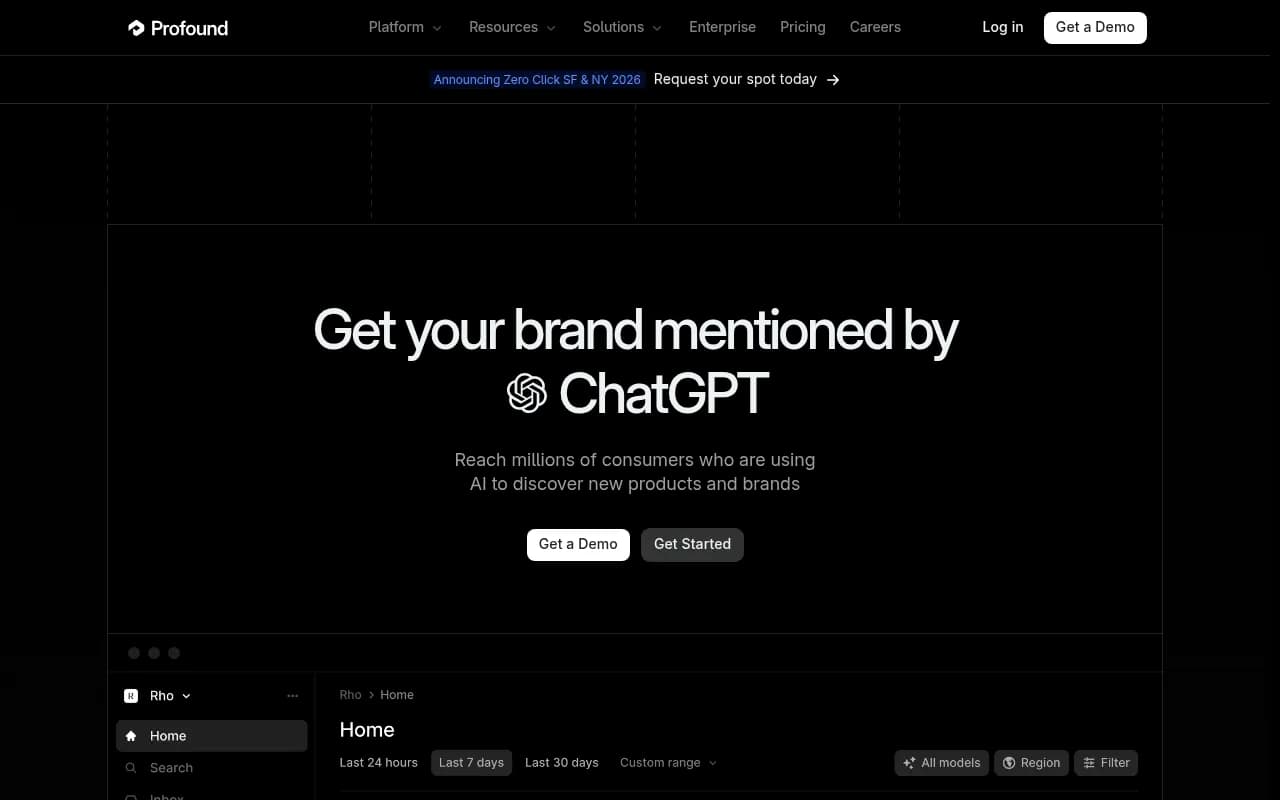
Scrunch stands out for citation intelligence and its Agent Experience Platform, which serves AI-ready versions of content to bots. That is a distinct approach: it addresses the technical readiness side. Nogood's guide describes enterprise clients monitoring millions of prompts across hundreds of thousands of pages.
AthenaHQ
AthenaHQ combines monitoring, content agents and enterprise controls such as SAML/OIDC SSO and RBAC. Botric flags that its credit model can burn fast at scale, which is exactly the kind of thing to model against your brand count before signing.
Rankscale
Rankscale is pitched for multi-brand portfolios and agencies, with 100 dashboards reported. The listed limitations are no PDF exports and an English-only interface, which matters if your regional teams need local-language reporting.
Evertune, Bluefish and Peec AI
Evertune targets Fortune 500 brands but reportedly has no SOC 2 and no confirmed API, a poor fit if you need BI integration. Bluefish leans toward a broad enterprise marketing suite with custom measurement and AI commerce. Peec AI keeps analytics, source tracking and reporting focused, which suits a measurement-only brief but not execution.

Enterprise SEO suites with AI add-ons
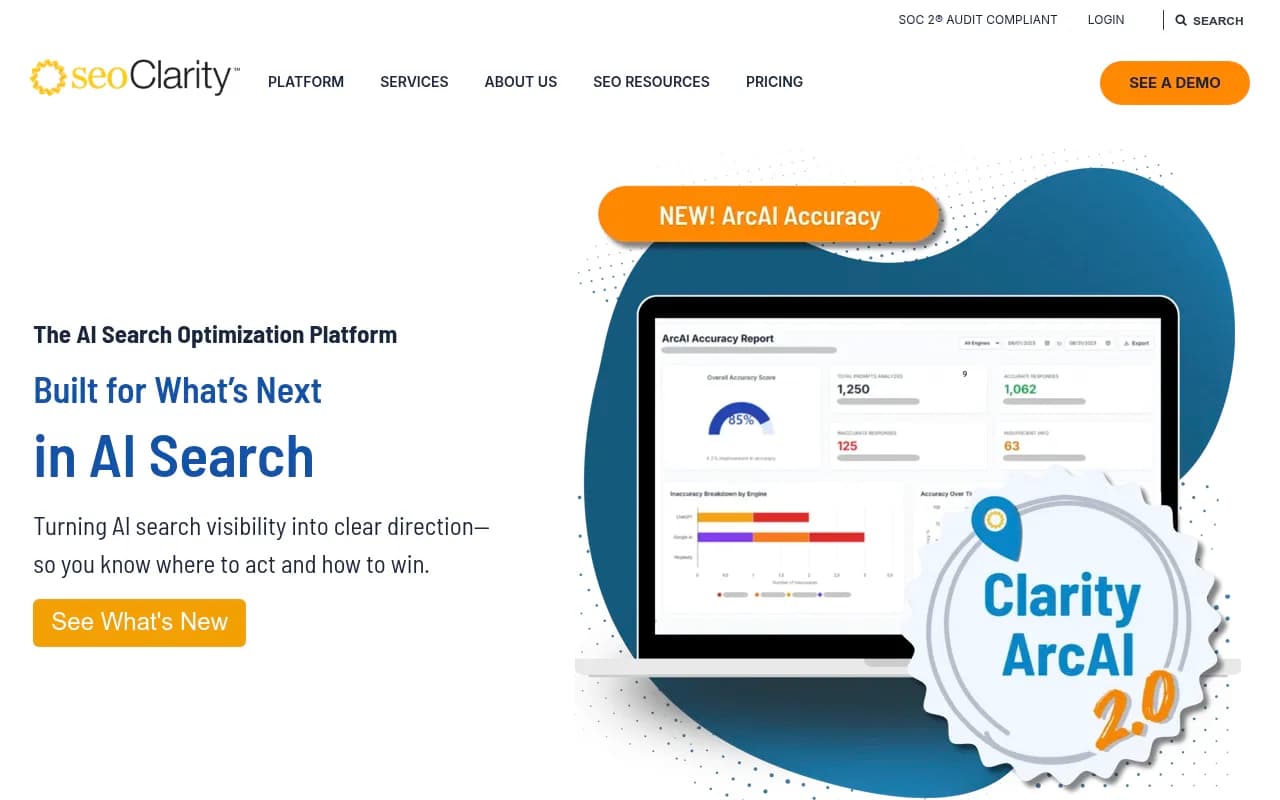
If your portfolio already runs on an enterprise SEO platform, check what it adds. BrightEdge, Conductor, seoClarity and Botify all now include AI visibility tracking. These make sense when you want one vendor and one contract. The usual compromise is shallower AI-specific data and fewer execution tools than a dedicated platform.
For broader lists, the GEO software directory at bestgeosoftware.com tracks more vendors than fit here.
Which approach fits which buyer
Meikai's guide frames four buying situations, and I find them useful because each one has a different demo test.
| If you are... | Test in the demo | Likely fit |
|---|---|---|
| Measurement-led | Run the same prompts twice. Ask where prompts come from. | Peec AI, Profound, Promptwatch |
| Workflow-led | Approval gates, CMS integration, audit history | Promptwatch, AthenaHQ, Profound |
| Technical-readiness-led | Bot identification against your own server logs, client-side rendering | Promptwatch (crawler logs), Scrunch, Botify |
| Execution-led | Who writes and ships on-site and off-site changes | Promptwatch Agentic AI Search Optimization, Bluefish, managed services |
A practical rollout for a portfolio
- Tier your brands. Put the five that matter most on full tracking, everything else on a lighter prompt set. Don't start with all 40.
- Build prompt sets per brand across organic, brand-specific and competitor-comparison prompts. One shared list tells you almost nothing.
- Set up per-market monitors. Language and location should be fixed per monitor, with local competitors added.
- Check crawler access first. If AI bots can't read a brand's site, no content plan will help. Promptwatch's AI crawler logs and the free Agentic Readiness Check are quick ways to find out.
- Pick fixes by evidence. Use content gap analysis and citation data to choose pages, then track each one through crawl, citation and traffic.
- Roll up reporting through the API or Looker Studio, with per-brand and per-engine views, not a single score.
The 90-day GEO program in the Promptwatch Academy is a reasonable template for the first quarter.
Questions to ask every vendor
- Can you show per-engine and per-market numbers for one of my brands, with access to raw answers?
- How are non-English prompts created?
- What does it cost at my actual brand count, in year two?
- Which security attestations can you provide in writing, and is SSO included or an add-on?
- When the tool finds a gap on brand 23, what happens next? Who fixes it, and how do we know it worked?
- Can I export everything through an API without a separate contract?
Where an agency can help
Some portfolios don't have the headcount to run this in-house. An SEO and GEO agency such as 1001 SEO Media can run the program on top of a platform. It uses Promptwatch as its AI visibility platform, so that is a disclosure as much as a pointer. If you go that route, make sure the contract gives you access to the underlying data.
Bottom line
For a multi-brand portfolio, shortlist two or three tools and run the same real-world test on each: three of your brands, two markets, per-engine reporting, and one fix carried through to a measurable result. Monitoring-only products are easier to buy and harder to justify a year later. Start with Promptwatch's trial or free report, compare it against Profound or AthenaHQ on your own prompts, and verify every price on the vendor's own site before it reaches a spreadsheet.