Evertune Review 2026
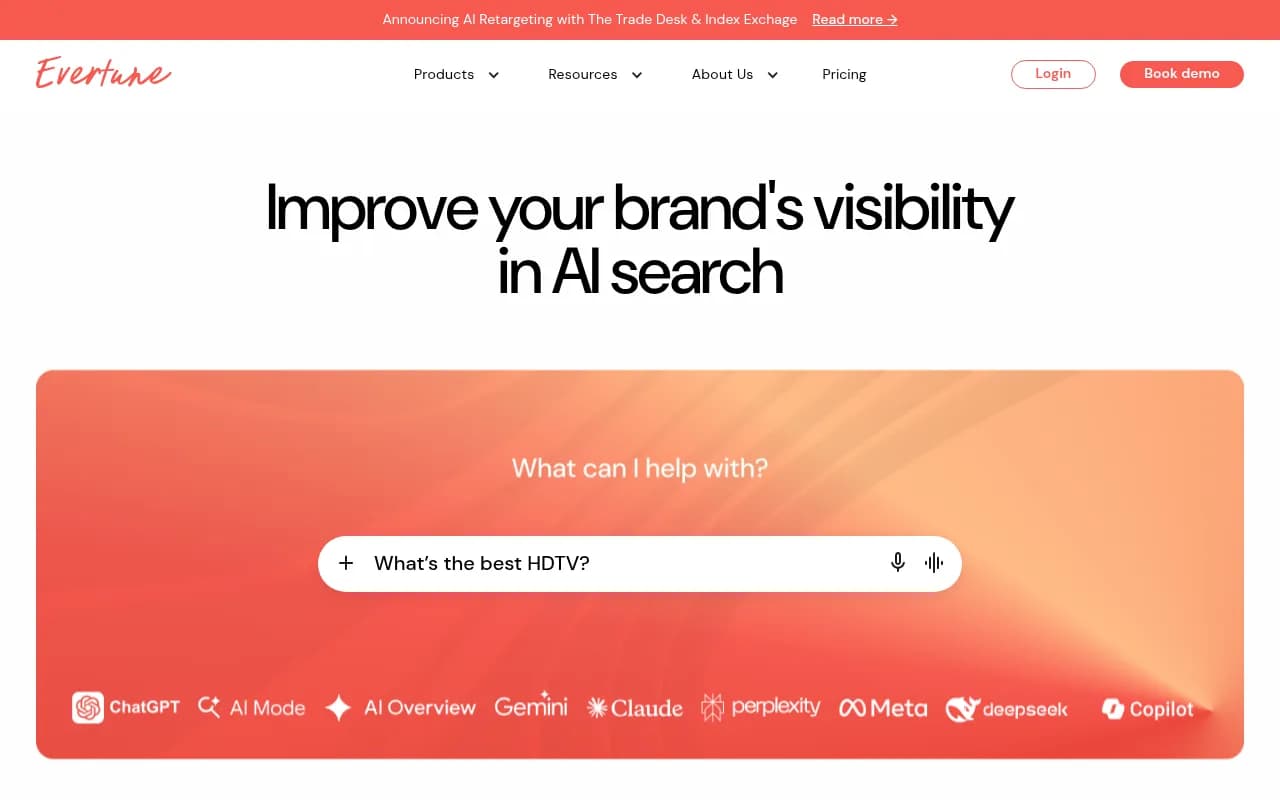
Evertune is a comprehensive Generative Engine Optimization (GEO) platform that helps Fortune 500 brands improve visibility across ChatGPT, Google AI Overviews, Gemini, Claude, and other AI search engines. It combines AI brand monitoring, website optimization, content strategy, and AI retargeting to
Summary
- Enterprise-focused GEO platform used by Fortune 500 brands like Roku, Miro, athenahealth, and Virgin Voyages -- not a monitoring-only tool
- Lacks content generation, AI crawler logs, and traffic attribution that Promptwatch offers -- Evertune focuses on brand monitoring, website audits, and content strategy insights rather than optimization automation
- Starts at $3,000/month -- significantly more expensive than most GEO platforms, positioned for enterprise marketing teams with substantial budgets
- Strong on competitive intelligence and source analysis -- shows which sources influence AI recommendations and maps product attributes that drive visibility
- AI retargeting capability through The Trade Desk and Index Exchange -- unique feature that lets brands reach users who click through AI citations

Evertune positions itself as the enterprise-grade answer to AI search visibility. Founded in 2024 and backed by $4 million in seed funding, it's built for Fortune 500 marketing teams who need to understand and influence how AI models like ChatGPT, Google AI Overviews, Gemini, and Claude represent their brands. The company has landed major clients including WPP's Choreograph, Roku, Miro, and athenahealth -- brands with serious marketing budgets and complex visibility challenges.
The platform's core promise is turning AI search into a measurable growth channel. With Gartner predicting a 25% decline in traditional search volume by 2026 and Capgemini research showing 58% of consumers now use AI tools for product recommendations, Evertune is betting that enterprise brands need dedicated infrastructure to compete in this new landscape. The question is whether its approach delivers enough value to justify the $3,000/month starting price.
AI Brand Monitoring
Evertune's brand monitoring tracks how your brand appears across nine major AI platforms: ChatGPT, Google AI Mode, Google AI Overviews, Claude, Gemini, Perplexity, Meta AI, DeepSeek, and Copilot. The platform generates an "AI Brand Index" that scores your visibility relative to competitors, showing not just whether you're mentioned but how you're being described and positioned.
The competitive intelligence component is more sophisticated than most GEO tools. You can see which competitors are winning specific prompts, what attributes AI models associate with each brand, and how sentiment varies across different AI platforms. For categories like "luxury SUVs" or "project management software," Evertune maps the entire competitive landscape and shows where your brand ranks.
What sets this apart from basic monitoring tools is the statistical significance claim. Evertune emphasizes that its data is based on large sample sizes and direct LLM integration, not just spot-checking a handful of prompts. The company also operates "EverPanel," which appears to be a consumer panel that provides real-world usage data to validate AI response patterns.
However, the platform lacks the granular prompt-level tracking and volume estimates that tools like Promptwatch provide. You can see overall brand performance, but you won't get detailed breakdowns of which specific prompts drive the most visibility or how to prioritize optimization efforts based on search volume and difficulty scores.
AI Website Optimization
The website optimization module audits how AI crawlers interpret your site. Evertune analyzes your content structure, metadata, and technical setup to identify barriers that prevent AI models from understanding and citing your pages. The output is a prioritized list of fixes -- specific changes to improve discoverability.
This is useful for brands that suspect their site isn't being crawled or indexed properly by AI models, but it's a one-time audit approach rather than continuous monitoring. You don't get real-time logs of AI crawler activity (which pages they're hitting, how often, what errors they encounter) like you would with Promptwatch's AI crawler logs feature. You also don't get page-level citation tracking to see exactly which URLs are being cited and how often.
The recommendations focus on content structure and semantic clarity -- making sure AI models can extract key facts about your products, services, and brand positioning. For enterprise sites with complex information architectures, this can surface real issues. But the lack of ongoing monitoring means you're flying blind between audits.
AI Content Strategy
This is where Evertune differentiates itself most clearly. The platform analyzes which product attributes drive AI recommendations in your category. For example, if you sell TVs, it might reveal that AI models prioritize "picture quality," "smart features," and "value for money" when making recommendations -- and show you how your brand scores on each attribute relative to competitors.
Evertune also identifies the most influential sources that shape AI's perception of your brand. It shows which websites, review platforms, Reddit threads, and YouTube videos AI models cite most frequently in your category. This source analysis is genuinely valuable -- it tells you where to focus PR efforts, content partnerships, and review generation.
The platform then connects you to content distribution partners through "Partner Connect." This appears to be a network of publishers and platforms where you can place content to improve AI visibility. Evertune claims to turn insights into "ready-to-publish blog posts," though it's unclear whether this is AI-generated content or just content briefs.
What's missing here is the content gap analysis and AI writing agent that Promptwatch offers. Evertune tells you which attributes matter and which sources are influential, but it doesn't show you the specific prompts your competitors are visible for that you're missing. You don't get automated content generation grounded in citation data, prompt volumes, and competitor analysis. The workflow is more manual -- you get insights, then you have to create and distribute content yourself.
AI Retargeting
This is Evertune's most unique feature. Through partnerships with The Trade Desk and Index Exchange, the platform lets you run programmatic ads on the URLs that AI models cite most frequently in your category. The logic: 12% of users click through from AI responses to validate sources before making decisions (according to Gener8 research). If your brand isn't in the AI response, you can still reach these high-intent buyers when they fact-check.
Evertune identifies the exact URLs AI models cite, then sets up PMP (private marketplace) deals so you can target those URLs with display ads. For brands that can't crack the top AI recommendations organically, this is a paid workaround to capture the same audience.
The feature is available to any Trade Desk or Index Exchange customer, even without an Evertune subscription. Evertune has pre-built source lists and PMP deals covering 250+ product categories. This suggests the company is positioning AI retargeting as a standalone product that could drive revenue independent of the core GEO platform.
Whether this is a smart strategy or a band-aid depends on your perspective. It's a creative way to monetize AI search traffic when you can't win organically, but it doesn't solve the underlying visibility problem. You're paying for ads instead of earning citations.
Who Is It For
Evertune is built for enterprise marketing teams at Fortune 500 brands with six-figure marketing budgets. The $3,000/month starting price immediately excludes small businesses, startups, and most mid-market companies. The client roster (Roku, Miro, athenahealth, Virgin Voyages, HexClad) confirms this is an enterprise play.
The platform makes sense for brands in competitive categories where AI recommendations directly influence purchase decisions -- consumer electronics, SaaS, travel, CPG, automotive, pharma. If you're competing for visibility in prompts like "best project management tool" or "top luxury SUVs," and your competitors are already showing up in ChatGPT and Perplexity, Evertune gives you the intelligence to fight back.
It's also a good fit for brands working with large agencies. WPP's Choreograph (the global CEO is quoted as a testimonial) uses Evertune across multiple client accounts. The platform's competitive benchmarking and source analysis are valuable for agencies that need to justify GEO investments to clients.
Who should NOT use Evertune: Small businesses, solopreneurs, content creators, and anyone without a dedicated marketing team. The platform requires significant internal resources to act on its insights. You need people to create content, manage partnerships, coordinate with PR teams, and execute on website optimization recommendations. If you're a one-person operation or a small team, you need a tool that automates more of the optimization work -- something like Promptwatch that generates content for you and tracks results automatically.
Integrations & Ecosystem
Evertune integrates directly with nine AI platforms for data collection: ChatGPT, Google AI Mode, Google AI Overviews, Claude, Gemini, Perplexity, Meta AI, DeepSeek, and Copilot. The company claims to use "direct LLM integration" rather than just scraping responses, which should provide more reliable data.
On the advertising side, Evertune has partnerships with The Trade Desk and Index Exchange for AI retargeting. These integrations let you activate programmatic campaigns on high-value citation URLs directly from the platform.
The "Partner Connect" feature connects you to content distribution partners, though the specific publishers and platforms aren't listed publicly. This appears to be a curated network rather than open API access.
There's no mention of API availability for developers, no browser extensions, no mobile apps. The platform is web-based and designed for marketing teams to use collaboratively. A help center (docs.evertune.ai) provides documentation, but there's no public API documentation visible.
Pricing & Value
Evertune starts at $3,000 per month with annual contracts. The company describes this as "transparent pricing with no hidden costs," but there's no public pricing page with tier breakdowns. You have to book a demo to get detailed pricing.
Based on the website copy, the $3,000/month tier includes AI brand monitoring, website optimization audits, content strategy insights, and access to the Partner Connect network. AI retargeting through The Trade Desk and Index Exchange appears to be an add-on or separate product.
For context, this is 12x more expensive than Promptwatch's Professional plan ($249/mo) and 5x more expensive than Promptwatch's Business plan ($579/mo). Competitors like Otterly.AI and Peec.ai are also significantly cheaper, typically in the $200-500/month range.
The value proposition depends entirely on your scale. If you're a Fortune 500 brand spending millions on marketing, $36,000/year for AI search intelligence is a rounding error. The competitive benchmarking, source analysis, and strategic insights could easily justify the cost if they inform a major content or partnership initiative.
But for most companies, the ROI is questionable. You're paying for insights and audits, not for automated optimization. You still need to create content, fix your website, build partnerships, and execute campaigns. Tools like Promptwatch give you content gap analysis, AI-generated articles, crawler logs, and traffic attribution for a fraction of the price. The action loop is built in -- you see what's missing, generate content to fill the gaps, and track the results.
Strengths & Limitations
Strengths:
- Enterprise credibility -- client roster includes Fortune 500 brands and major agencies like WPP, which validates the platform for large organizations
- Competitive intelligence depth -- the attribute mapping and source analysis are more sophisticated than most GEO tools
- AI retargeting innovation -- the programmatic ad integration is a unique feature that provides a paid path to AI search traffic
- Statistical rigor -- emphasis on large sample sizes and direct LLM integration suggests more reliable data than spot-checking tools
- Multi-platform coverage -- monitors nine AI platforms including newer entrants like DeepSeek
Limitations:
- No content generation -- unlike Promptwatch, Evertune doesn't have an AI writing agent to automatically create optimized content based on gap analysis
- No AI crawler logs -- you can't see real-time logs of which pages AI crawlers are hitting, how often, or what errors they encounter
- No traffic attribution -- no way to connect AI visibility improvements to actual website traffic or revenue
- No prompt volume data -- you don't get search volume estimates or difficulty scores to prioritize which prompts to target
- No page-level citation tracking -- you can't see exactly which URLs are being cited and how often across different prompts
- Expensive for most companies -- $3,000/month starting price excludes small businesses and mid-market companies
- Requires significant internal resources -- the platform provides insights and audits, but you need a team to execute on recommendations
Bottom Line
Evertune is a solid choice for Fortune 500 brands and large agencies that need competitive intelligence and strategic insights for AI search. The platform excels at showing you where you stand relative to competitors, which sources influence AI recommendations, and what attributes drive visibility in your category. The AI retargeting feature is genuinely innovative for brands that can't crack the top organic recommendations.
But for most companies, the $3,000/month price tag is hard to justify when you're getting insights without optimization automation. You're paying for audits and analysis, then you still need to create content, fix your website, and execute campaigns manually. Tools like Promptwatch offer content gap analysis, AI-generated articles, crawler logs, traffic attribution, and page-level tracking for a fraction of the cost -- and they close the optimization loop instead of leaving you stuck with a to-do list.
Best use case in one sentence: Enterprise brands with large marketing teams and budgets who need competitive intelligence and source analysis to inform AI search strategy, and who have the internal resources to execute on recommendations.
Tags:
Frequently asked questions
What is Evertune and what does it do?
How much does Evertune cost?
Who is Evertune designed for?
Does Evertune offer a free plan or trial?
What AI platforms does Evertune monitor?
What are the key features of Evertune?
What is Evertune missing compared to other GEO platforms?
When was Evertune founded and how is it funded?
Similar and alternative tools to Evertune