Bear AI Review 2026
Tracks brand mentions and citations across ChatGPT, Perplexity and other AI agents, with sentiment and share-of-voice reporting.
Key takeaways
- Bear AI is a YC F25-backed GEO tool that tracks brand mentions and citations across ChatGPT, Perplexity, Google AI Overviews and other AI engines, with competitor benchmarking, a blog generation agent and an outreach workflow for cited sources.
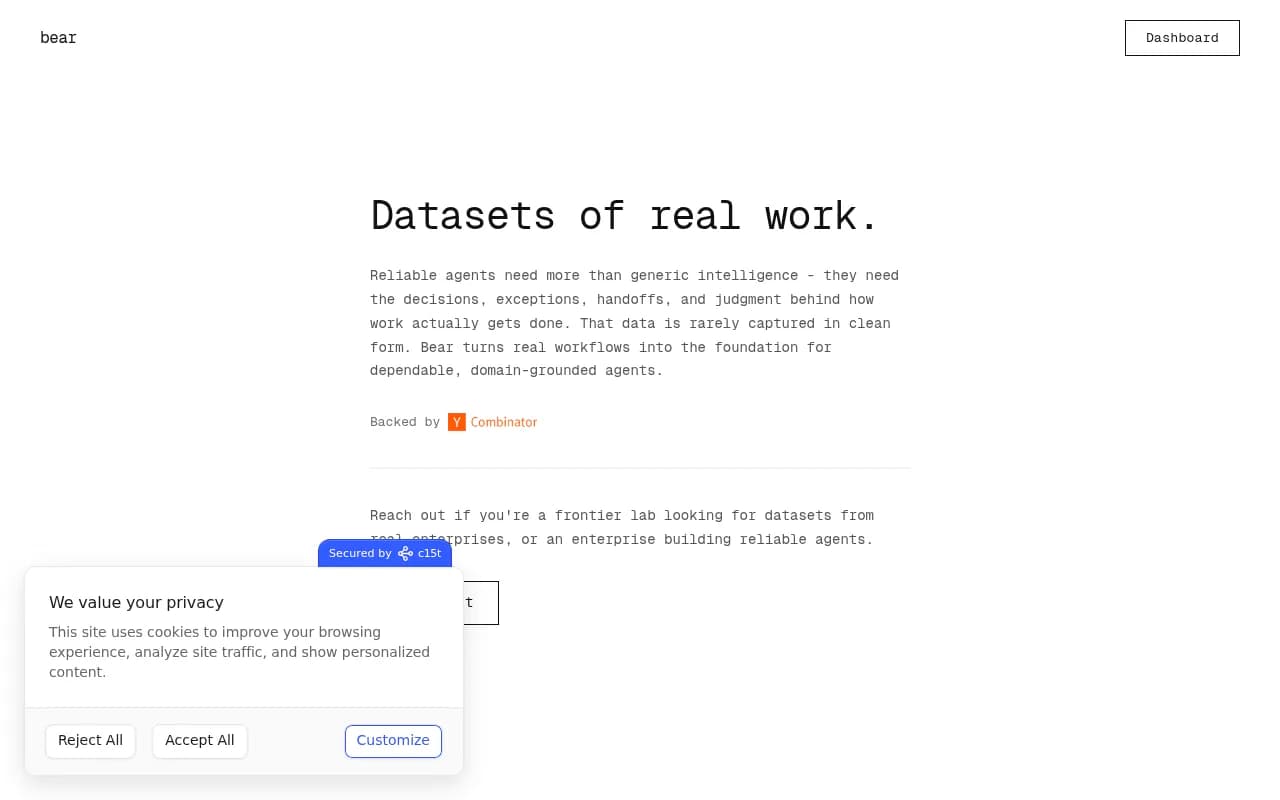
- The company behind it (Bear AI Inc.) has pivoted to "Specific Labs," an enterprise data business selling real-workflow datasets to frontier AI labs. The usebear.ai homepage now describes the pivot, while the pricing page still sells the legacy GEO product. That mismatch is the single biggest thing to know before buying.
- Compared with Promptwatch, Bear AI lacks AI crawler logs, AI traffic attribution and conversion tracking, Reddit and YouTube citation tracking, ChatGPT Shopping and ads monitoring, prompt volume and difficulty scoring, query fan-outs, and page-level citation analytics.
- Pricing is $100/month for Basic (30 prompts, GPT-5 tracking, 2 blog posts/month) and custom Enterprise pricing. No free tier or trial. Third-party reporting from late 2025 cited a $199/mo entry tier, so pricing has already changed once.
- No independent reviews exist on G2 or Capterra. This is a very early-stage product, and the pivot makes its roadmap as a GEO tool genuinely uncertain.
What Bear AI is (and what it's becoming)
Bear AI launched in Y Combinator's Fall 2025 batch with a clear pitch: get your brand recommended by AI agents like ChatGPT, Google AI Mode, Perplexity, Cursor and Claude Code. It was a Generative Engine Optimization tool in the same category as Peec.ai, Otterly and Profound, aimed at growth and marketing leads at B2B SaaS companies who suddenly realized buyers were asking ChatGPT instead of Google.
The core product works by simulating real user queries directly inside AI interfaces rather than pulling from official APIs. That approach has a real advantage: it captures what users actually see, including live citations and answer formatting, which can differ from API outputs. From those simulations, Bear builds dashboards showing how often your brand appears, which prompts you win and lose, and how you stack up against named competitors.
Here's the complication. Sometime in 2026, the company began repositioning as Specific Labs, described on withspecific.com as "an applied AI research lab building dependable, domain-grounded agents." The privacy policy confirms continuity: Specific Labs is owned and operated by Bear AI Inc. The homepage of usebear.ai now leads with "Datasets of real work" and pitches frontier labs and enterprises on training data, not marketers on visibility tracking. The contact email on the homepage is [email protected].
So the site you'd land on as a prospective customer is in a genuinely confusing state. The homepage sells the pivot. The pricing page still sells the old product. Whether the $100/month Basic plan is actively maintained or a legacy holdover being phased out, I can't verify, and I'd ask that question directly on any sales call before committing.
Features
Based on the live pricing page and third-party reporting, the GEO product includes:
- Brand visibility tracking across ChatGPT, Claude, Gemini, Perplexity and Google AI surfaces (Basic is limited to GPT-5 tracking; multi-model coverage is an Enterprise feature).
- Prompt monitoring with mention and citation reporting, capped at 30 prompts on Basic and unlimited on Enterprise.
- Competitor benchmarking, showing your visibility score against competitors and which prompts they win.
- Source tracking that identifies which sites AI models cite, paired with an email outreach workflow to pursue links or partnerships with those sources.
- A blog agent that generates posts modeled on content structures that already get cited, at 2 posts per month on Basic.
- Lead generation that identifies companies and decision-makers among visitors arriving via AI discovery.
- Traffic insights showing which of your pages get cited and which drive AI-referred visits.
That feature list reads well on paper. The blog agent and outreach workflow are the parts that differentiated Bear from pure monitoring tools, at least in theory. A third-party guide claimed Bear "outperforms competitors like Profound and Peec, which only track mentions without offering ways to improve them," but that guide has an affiliate feel, and the claim hasn't aged well anyway. The category moved fast in 2026, and several platforms now pair monitoring with content execution.
Pricing
The live pricing page shows two tiers:
- Basic at $100/month: GPT-5 tracking, up to 30 prompts, 2 blog posts per month, email outreach workflow.
- Enterprise at custom pricing: tracking across GPT-5, Google AI, Claude, Gemini and Perplexity, unlimited prompts and blog generation, lead generation, automated PR, priority Slack support and custom integrations. The CTA is a demo booking through app.usebear.ai.
There's no free tier and no free trial. For context, Peec.ai's self-serve tiers run from €89 to €499 per month, so Bear's $100 entry point sits at the low end of the category. But note the pricing history: a November 2025 guide reported a $199/month Starter plan, and FYI Combinator's company report used $199/month in its revenue modeling. The entry price has been cut roughly in half at some point, which is normal for a YC startup still searching for product-market fit, but it means you shouldn't treat the current numbers as permanent.
Strengths and limitations
Strengths
- Real UI simulation rather than API-only data, so you see what users actually see in ChatGPT and Perplexity answers.
- Goes beyond raw tracking with a blog agent and an outreach workflow, at least on paper.
- YC backing and a small, technically credible founding team (ex-Coinbase, ex-Intel, prior YC-adjacent experience).
- Low entry price relative to most of the GEO category.
Limitations
- The pivot is the elephant in the room. A company whose homepage pitches frontier labs on training datasets is not obviously investing in its GEO dashboard. Buy accordingly.
- No independent reviews on G2, Capterra or anywhere else. You're betting on an unverified product.
- Missing capabilities that mature platforms in this category now treat as table stakes. Compared with Promptwatch, Bear AI has no AI crawler logs (so you can't see when ChatGPTBot or ClaudeBot visit your site, what they read, or what errors they hit), no AI traffic attribution or conversion analytics, no Reddit or YouTube citation tracking, no ChatGPT Shopping or ads monitoring, no prompt volume or difficulty scoring, no query fan-out data, and no page-level citation analytics. Promptwatch also monitors more than ten AI models including Grok, DeepSeek, Copilot and Mistral, while Bear's Basic tier tracks one.
- Prompt cap of 30 on the entry tier is tight for anyone running a real GEO program.
- Pricing has already changed once, and the site's transitional state makes current information hard to trust.
For context on why those missing pieces matter: citation behavior in AI search is measurable and fast-moving. Promptwatch's data shows, for instance, that product pages overtook listicles as the most-cited content type in ChatGPT during July 2026, and that Reddit's share of ChatGPT citations collapsed from roughly 4% to 0.5% in mid-August 2026. A tracker without crawler logs, source-level analytics or traffic attribution can tell you that you're invisible, but not why, and not what it costs you.
Who it's for
Honestly, the honest answer is narrowing. The original product targeted growth and marketing leads at mid-market B2B SaaS companies, small marketing teams automating AEO work without added headcount, and agencies running AI-visibility programs for clients. If you're in one of those groups and considering Bear AI today, the pivot means you should weigh the risk that the product goes unmaintained. A demo call is mandatory here, not optional, and I'd ask pointedly about the roadmap before signing anything.
Bottom line
Bear AI was a promising early entrant in the GEO category with a sensible feature set and a low entry price. But the company has visibly moved on to a different business, the website is in a contradictory transitional state, there are zero independent reviews, and the feature set lags well behind where the category has gone. If you want a platform that tracks visibility across ten-plus AI models, shows you why you're visible or not through crawler logs, attributes actual AI-driven traffic and conversions, and then fixes the gaps with content agents and CMS publishing, Promptwatch is the stronger and more established choice, with 1,840+ customers and a 4.7/5 G2 rating. Bear AI is only worth a look if a demo convinces you the GEO product still has a future.

Tags:
Frequently asked questions
What is Bear AI?
How much does Bear AI cost?
Is Bear AI still an active product?
How does Bear AI compare to Promptwatch?
Who founded Bear AI?
Similar and alternative tools to Bear AI