GenPressa Review 2026
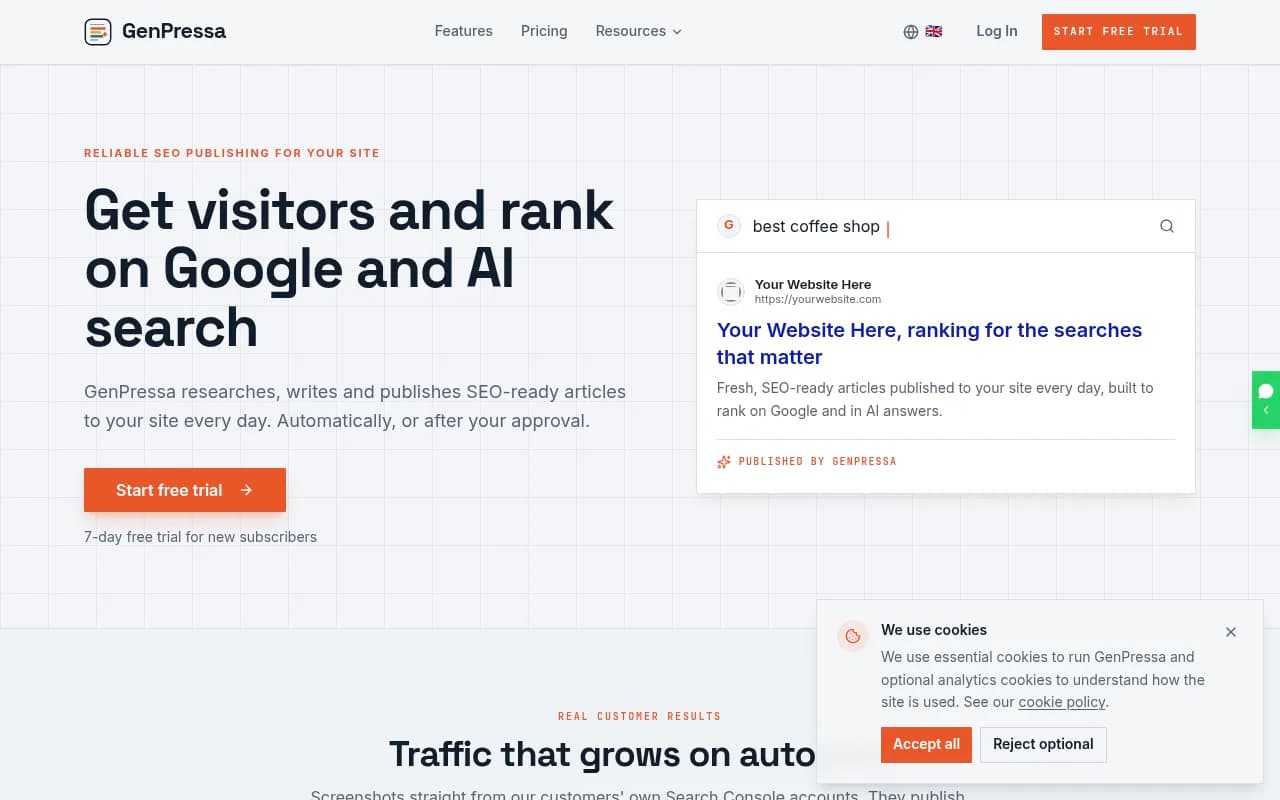
Finds ranking opportunities your site can win, writes the articles, and publishes them to your site automatically, so content output doesn't bottleneck on your team.
Key takeaways
- GenPressa runs the entire publishing pipeline: it finds topics from Search Console opportunities and live research, drafts articles with schema, images, and internal links, then publishes to WordPress, Shopify, Wix, or Ghost on a schedule you set. You can review drafts first or let it run hands-off.
- The pre-publish quality gate is the best idea in the product. Nothing goes live until keyword placement, metadata, internal links, citations, schema, and a featured image all pass. Most AI writing tools leave that work to you.
- It cannot measure AI search performance. Unlike Promptwatch, GenPressa has no citation tracking, no AI crawler logs, and no attribution for traffic from ChatGPT or AI Overviews, so the "rank in AI answers" promise is unverifiable from inside the tool.
- Pricing is aggressive: $32/month for roughly 60 articles. But every growth claim on the site is self-reported, and there are no independent reviews on G2, Trustpilot, Capterra, or Reddit yet.
- Best for affiliate marketers, niche publishers, and solo site owners who need steady output. Riskiest for anyone auto-publishing 8 articles a day with no human reading them.
What GenPressa does
The pipeline runs Discover → Draft → Gate → Publish. Connect a site, set rules for topics, tone, language, and daily volume, and GenPressa researches and writes to those rules. Articles either publish on schedule or wait as drafts for your approval. That approval toggle matters more than it sounds. Plenty of automation tools treat your site like a printing press; GenPressa at least fits a brake pedal.
Topic discovery pulls from Google Search Console opportunities and live web research, which is the right instinct. Selecting topics based on where your site already earns impressions beats a random keyword list every time.
The cluster planner is the feature I'd actually pay for. Approve one topic and GenPressa drafts a pillar page plus 8 to 12 interlinked supporting articles, all auto-linked to each other. Building topical depth through clusters is the correct strategy, and doing it by hand takes weeks per cluster.
The refresh workflow covers the other end of the lifecycle. Every published post gets scored with a keep, refresh, or rewrite verdict, and the one-click rewrite preserves the original URL, which protects whatever equity a declining page still holds.
Credit where due: the showcase section links to full articles GenPressa published on its own site, not cherry-picked samples. You can judge the writing yourself before paying anything, which is more transparency than most competitors offer.
Publishing and integrations
WordPress (plugin or app password), Shopify (native OAuth), Wix, and Ghost (Admin API) are live today. Webflow, Joomla, Drupal, and Blogger sit on the roadmap. On WordPress, GenPressa fills Yoast, RankMath, and WPML fields natively and falls back to JSON-LD when no SEO plugin is detected. Every post ships with Article, FAQ, HowTo, Breadcrumb, and Author schema plus an auto-generated 16:9 featured image with alt text. Publishing is blocked without an image, which sounds petty until you've seen how many AI tools ship posts with empty metadata.
The WordPress-only Site Toolkit adds broken-link audits, an orphan post finder, an image scanner, auto-relinking with a 30-day undo, IndexNow pings, and NewsArticle schema with a Google News sitemap. For news publishers, that last item alone justifies the setup.
Multilingual publishing covers 27 languages, or 28 if you trust the About page over the features page. WPML sync handles WordPress.
Pricing
Starter runs $32/month for 2 articles a day, roughly 60 per month. Growth runs $75/month for 8 a day, roughly 240. Enterprise is custom. A sitewide 20% code (GENPRESSA20) is advertised directly on the pricing page, which makes the list prices feel a bit like furniture-store tags. The 7-day trial applies to first-time subscribers only; cancel and resubscribe, and you're billed immediately with no second trial. Refunds are case-by-case, and downgrades only take effect at the end of a billing period. Read the terms before paying annually upfront.
At list price, Growth works out to roughly 31 cents per article. Cheap enough that the real question stops being affordability and becomes whether you should publish that much at all.
Where it falls short
The biggest gap is measurement on the AI side. The homepage promises content "built to rank on Google and in AI answers," but the product cannot tell you whether a single article ever appeared in an AI answer. No citation tracking across ChatGPT, Gemini, Perplexity, Claude, or AI Overviews. No crawler logs showing whether AI bots read your pages or hit errors. No attribution for visitors arriving from AI platforms. No prompt volumes or difficulty scores, no query fan-outs, no Reddit or YouTube citation tracking, no ChatGPT Shopping data. Its gap analysis runs against Search Console and competitors, not against actual AI responses.
That blind spot matters because AI citation behavior is specific and measurable. In July 2026, product pages made up roughly a third of ChatGPT's citations, with listicles the fastest-growing format, per Promptwatch's ChatGPT citation type data. And after the GPT-5.3 rollout in March 2026, ChatGPT started citing fewer sources per response, per Promptwatch's data on the citation drop, which makes every citation slot more contested. A publishing tool with no window into any of this is writing for an audience it cannot see. Promptwatch closes that loop from the other direction: it shows which pages get cited, where AI finds your content, and what traffic it drives, and its content agents plan and publish articles grounded in that data instead of guesswork.
Next concern: volume itself. Google's spam policies explicitly name scaled content abuse, meaning mass-produced content created primarily to game rankings. A gate that checks keyword placement and schema is checking mechanics, not editorial value. At 2 articles a day with human review, you're probably fine. At 8 a day, fully automated, in a competitive niche, you're rolling dice with your domain.
The marketing also overpromises. "Zero hallucinations guaranteed" is not something any AI writer can guarantee. Live Google-grounded research and recency gates genuinely reduce errors on news-adjacent topics, but the showcase articles are conveniently the kind with abundant, checkable sources. A guarantee is a marketing word, not an engineering spec.
Then there's the evidence problem. The 45,075 published-articles counter, the customer Search Console screenshots, the growth graphs: all self-reported. No third-party reviews exist anywhere yet. The X account has around 3,800 followers and near-zero engagement on recent posts. Support runs through WhatsApp, which is unusual for a business product. It's a small team founded by Dale Logan, a longtime WordPress site operator, which at least explains why the deepest features are WordPress-only. None of this proves anything is wrong. It means you should trust your own trial more than their graphs.
There's also no public API or developer documentation, so if your stack isn't one of the four supported CMSs, you're waiting on a roadmap.
Who it's for
- Affiliate marketers running portfolio sites who need consistent output and can accept moderate editorial risk.
- News and niche publishers who want a daily publishing rhythm plus Google News schema and IndexNow.
- Solo bloggers who can't write daily but can review drafts.
- Agencies managing client sites, with a caveat: Starter and Growth are single-site plans, extra sites are paid add-ons, and bigger portfolios need Enterprise pricing.
If you're weighing options in this category, the agentic SEO tools directory at agenticseotools.com collects similar tools worth a look.
Bottom line
GenPressa is one of the more thoughtful AI content automation tools I've looked at. The pre-publish gate, cluster planning, and slug-preserving rewrites show a real understanding of what SEO content production involves day to day, and the pricing is almost embarrassingly low. If your bottleneck is writing volume and you keep a human in the loop, the 7-day trial is worth your time.
What it isn't is a visibility platform. It publishes and hopes. A serious AI search strategy needs measurement: which prompts you appear for, which pages get cited, whether AI crawlers can reach your site at all, and what traffic and conversions actually arrive from AI platforms. Promptwatch covers that entire loop, from citation analytics and crawler logs to content agents that write and publish based on what the data says will work. Use GenPressa for volume if it fits, but pair it with something that can see the results. Or start with a platform that does both.

Tags:
Frequently asked questions
Which platforms can GenPressa publish to?
How much does GenPressa cost?
Can I review articles before they go live?
Does GenPressa track AI search visibility or citations?
How does the free trial and refund policy work?
Similar and alternative tools to GenPressa