Key takeaways
- Bluefish AI is built exclusively for enterprise brands (think Fortune 500) with pricing that starts around $4,000/month. Orchly.ai starts at $49/month with a free trial -- a roughly 80x price difference at entry level.
- Orchly.ai combines AI visibility tracking with content creation, SEO monitoring, and auto-publishing in one platform. Bluefish AI focuses on monitoring, influence analysis, and optimization workflows -- no built-in content generation.
- Both track major AI platforms (ChatGPT, Claude, Perplexity, Gemini, Grok), but Orchly.ai also covers Google organic rankings, making it a more unified SEO + AEO tool.
- Bluefish AI's enterprise positioning comes with real advantages: custom audience segmentation, infosec compliance, agentic commerce tracking, and deeper "how AI thinks" analysis. These matter a lot to large brands, less so to everyone else.
- Orchly.ai includes white-label reports and an agency-friendly feature set. Bluefish AI is sales-led with no self-serve option.
- If you're a mid-size brand or agency, Orchly.ai is the practical choice. If you're a global brand running multi-market AI campaigns and need enterprise-grade control, Bluefish AI is worth the conversation.
Overview
Bluefish AI
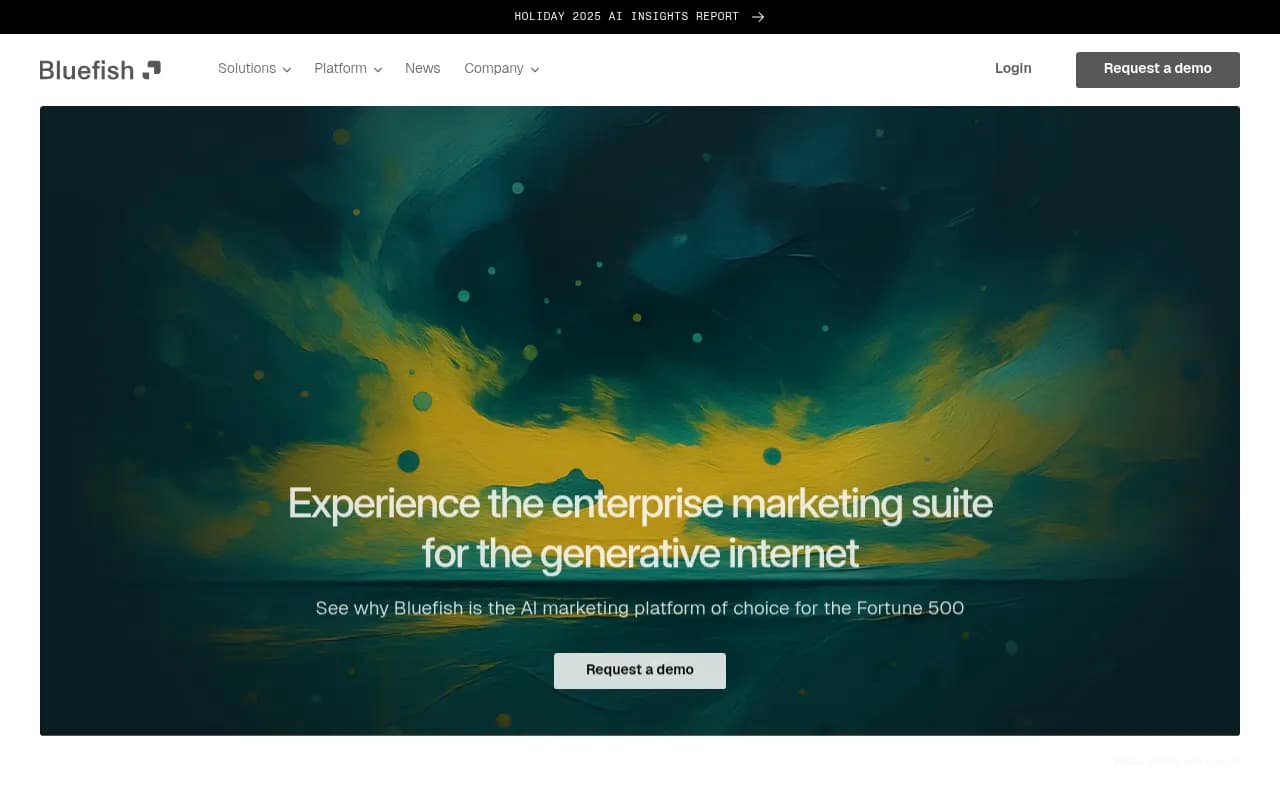
Bluefish AI positions itself as the AI marketing platform for Fortune 500 companies. The pitch is authority and influence -- not just tracking where your brand shows up in AI responses, but understanding why AI models describe your brand the way they do and shaping that narrative. Features include AI monitoring, GEO optimization, measurement frameworks, and what they call "AI Commerce" tracking (agentic shopping experiences). Everything is sold through a sales process with custom pricing. There's no self-serve signup, no public pricing page, and no free trial.
Orchly.ai
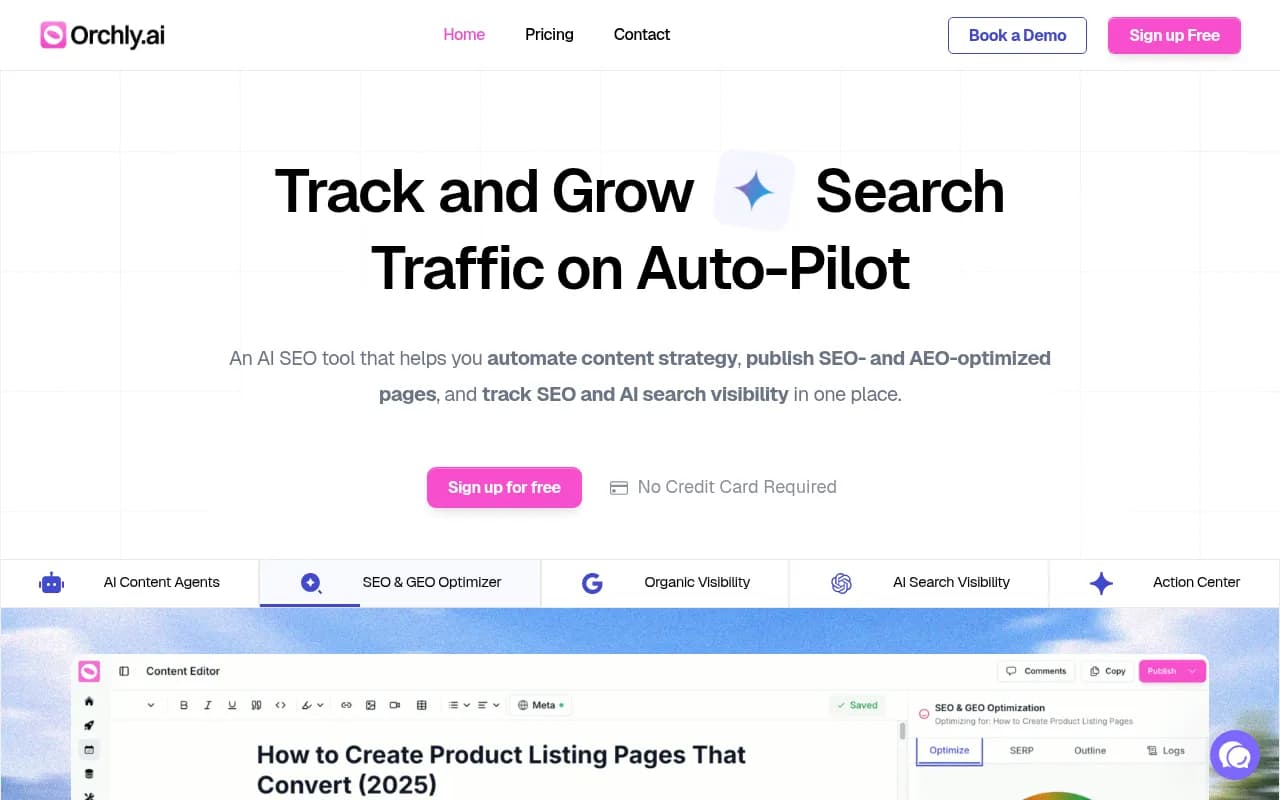
Orchly.ai takes a different angle. It's an all-in-one AI SEO platform that handles visibility tracking across AI engines and Google, plus content creation, scheduling, and publishing. The idea is that tracking where you're invisible is only useful if you can do something about it -- so Orchly bundles AI agents that write and publish optimized content alongside the monitoring dashboard. It's accessible to solo marketers and agencies alike, with plans starting at $49/month and a free trial to get started without a sales call.
Side-by-side comparison
| Feature | Bluefish AI | Orchly.ai |
|---|---|---|
| Starting price | ~$4,000+/month (quote) | $49/month (Essential) |
| Free trial | No | Yes |
| Self-serve signup | No (sales-led) | Yes |
| AI platforms tracked | ChatGPT, Claude, Perplexity, Gemini, Grok + others | ChatGPT, Claude, Perplexity, Gemini, Grok |
| Google organic tracking | Not mentioned | Yes (keyword rankings) |
| Content generation | No | Yes (AI content writer) |
| Auto-publish | No | Yes |
| Brand sentiment analysis | Yes | Yes |
| Competitor tracking | Yes | Yes |
| White-label reports | Not mentioned | Yes |
| Agentic commerce tracking | Yes | Not mentioned |
| Custom audience segmentation | Yes | Limited |
| Infosec / enterprise compliance | Yes (passes reviews) | Not specified |
| API access | Not specified | Yes |
| Target audience | Fortune 500 / large enterprise | SMBs, agencies, mid-market |
Head-to-head feature deep-dive
AI visibility monitoring
Both platforms track brand mentions and citations across the major AI engines. Bluefish AI's monitoring goes deeper on the enterprise side -- custom prompt sets, tailored audience personas, and segmentation that generic datasets can't match. They also track "agentic commerce," meaning AI-driven shopping experiences where your product might (or might not) get recommended. That's a genuinely differentiated capability for retail and e-commerce brands.
Orchly.ai covers ChatGPT, Claude, Perplexity, Gemini, and Grok, and layers in Google organic rankings alongside AI visibility. For most teams, having both in one dashboard is genuinely useful -- you don't need a separate rank tracker. The monitoring is solid, though it doesn't claim the same depth of segmentation or influence analysis as Bluefish.
Verdict: Bluefish AI wins on depth and enterprise customization. Orchly.ai wins on breadth (Google + AI in one place) and accessibility.
Content creation and optimization
This is where the two tools diverge most sharply. Orchly.ai has a full content workflow built in: AI agents research topics, write SEO- and AEO-optimized content, and can auto-publish to your site. You can train it on your brand voice and integrate your style guide. Content scheduling is included. For teams that want to close the loop between "we're not visible" and "we published something to fix that," this is a real advantage.
Bluefish AI doesn't appear to offer content generation. Their optimization angle is more about workflow automation and measurement frameworks -- helping teams understand what's working and what to prioritize, rather than writing the content itself. That's a legitimate approach for enterprise teams with dedicated content operations, but it means you're still doing the writing elsewhere.
Verdict: Orchly.ai wins clearly here. Content creation is a core part of the platform. Bluefish AI doesn't compete on this dimension.
Pricing and accessibility
| Plan | Bluefish AI | Orchly.ai |
|---|---|---|
| Free tier | No | Free trial available |
| Entry-level | ~$4,000+/month (estimated) | $49/month (Essential) |
| Mid-tier | Custom | $125/month (Pro) |
| Enterprise | Custom | Custom |
| Annual discount | Not specified | 25% |
| Signup process | Sales call required | Self-serve |
The pricing gap is stark. Bluefish AI is a serious budget commitment -- the kind you need board approval for. Orchly.ai is something a solo marketer can expense without a conversation. That's not a knock on Bluefish; enterprise software costs enterprise money for a reason. But it does mean these tools are serving fundamentally different buyers.
Verdict: Orchly.ai wins on price and accessibility by a wide margin. Bluefish AI is only viable for organizations with significant marketing budgets.
Enterprise features and compliance
Bluefish AI is built around enterprise requirements. They explicitly mention passing infosec reviews "with ease," which matters enormously when a Fortune 500 procurement team is involved. Custom data segmentation, tailored measurement frameworks, and dedicated support are part of the package. The platform is designed to fit into complex organizational structures.
Orchly.ai offers API access and white-label reports, which are useful for agencies and larger teams. But there's no mention of SOC 2 compliance, SSO, or enterprise security features. For a company running a formal vendor evaluation, that gap matters.
Verdict: Bluefish AI wins on enterprise compliance and customization. Orchly.ai is fine for agencies and mid-market teams but isn't positioned for Fortune 500 procurement processes.
Competitor analysis
Both platforms let you track competitor AI visibility. Orchly.ai shows competitor rankings across AI platforms in real time and includes brand sentiment breakdowns (positive, neutral, negative). It's a clean, practical implementation.
Bluefish AI's competitive analysis is framed around "category leadership" -- understanding how AI models position your brand relative to competitors in a given category, not just whether you appear. The depth of that analysis is harder to evaluate without a demo, but the positioning suggests it goes beyond simple share-of-voice metrics.
Verdict: Roughly even for most use cases. Bluefish AI likely goes deeper for enterprise competitive intelligence; Orchly.ai is more immediately usable.
Reporting and integrations
Orchly.ai includes white-label reports (useful for agencies), an API, and bot traffic analytics alongside human traffic analytics. That's a solid set of outputs for a tool at this price point.
Bluefish AI mentions custom measurement frameworks and data team capabilities, suggesting strong reporting flexibility. Their "Collections" feature (launched February 2026) is designed to measure the ROI of digital marketing campaigns in the AI channel -- a specific and useful capability for brands running paid campaigns alongside their AI visibility work.
Verdict: Bluefish AI has more sophisticated reporting for enterprise use cases. Orchly.ai's white-label reports and API are better suited to agencies.
Pros and cons
Bluefish AI
Pros:
- Genuine enterprise-grade depth -- custom segmentation, tailored prompts, infosec compliance
- Agentic commerce tracking is a differentiator for retail/e-commerce brands
- "Collections" feature ties AI visibility to campaign ROI
- Built for organizations that need to understand how AI models think about their brand, not just whether they appear
Cons:
- No public pricing; estimated $4,000+/month puts it out of reach for most teams
- No self-serve signup or free trial -- you need a sales conversation to see anything
- No built-in content creation or publishing
- Overkill for brands that just need basic AI visibility monitoring
Orchly.ai
Pros:
- Genuinely affordable entry point ($49/month) with a free trial
- Content creation, scheduling, and auto-publishing built in -- closes the gap between insight and action
- Tracks Google organic rankings alongside AI visibility in one dashboard
- White-label reports and API make it agency-friendly
- Brand voice training and style guide integration for consistent output
Cons:
- Less depth on enterprise segmentation and custom audience analysis
- No mention of infosec compliance or enterprise security features
- Agentic commerce tracking not available
- Newer platform; less established track record than some competitors
Who should pick which tool
Pick Bluefish AI if:
- You're at a large enterprise or Fortune 500 brand with a serious AI marketing budget
- Your procurement process requires infosec compliance and formal vendor evaluation
- You need custom audience segmentation and deep "how AI thinks" analysis
- You're running paid campaigns and need to measure their impact on AI recommendations (Collections feature)
- You have a dedicated content team and don't need the platform to write for you
Pick Orchly.ai if:
- You're a marketing team, agency, or mid-size brand that needs AI visibility tracking without a six-figure annual commitment
- You want content creation and publishing built into the same platform as your monitoring
- You need to track Google organic rankings alongside AI visibility
- You're running a content-first strategy and want AI agents to help execute it
- You need white-label reports for client deliverables
A note on the broader landscape
If you're evaluating either of these tools, it's worth knowing that the GEO space has matured quickly in 2026. Platforms like Promptwatch sit between these two extremes -- more capable than Orchly.ai on the AI visibility and gap analysis side, more accessible than Bluefish AI on pricing -- and are worth including in any serious evaluation.

Final verdict
These two tools aren't really competing for the same customer. Bluefish AI is for large enterprises that need deep, customized AI influence analysis and can justify the cost. Orchly.ai is for teams that want a practical, affordable tool that combines AI visibility tracking with content creation in one place.
If you're reading this comparison and wondering which to pick: unless you're at a Fortune 500 brand with a dedicated AI marketing budget, Orchly.ai is the more sensible starting point. You can be up and running today, at a price that doesn't require executive sign-off, with content tools included. Bluefish AI is a serious platform for serious enterprise budgets -- but for most teams, it's more than you need and more than you can spend.