Key Takeaways
- LLM Pulse is a dedicated AI visibility tracker (€49-€299/mo) -- it monitors how ChatGPT, Perplexity, and other AI models describe your brand but doesn't create or optimize content for you
- Orchly.ai is a full content ops platform ($49-$125/mo) that tracks AI visibility AND automates content creation, optimization, and publishing with AI agents
- If you only need monitoring and citation analysis, LLM Pulse gives you deeper tracking features (weekly prompt runs, detailed citation breakdowns, competitor benchmarking)
- If you want to close the loop from tracking to action, Orchly.ai's AI agents write and publish SEO/AEO-optimized content based on the gaps it finds
- LLM Pulse tracks 10+ AI models; Orchly.ai tracks 5 (Google, ChatGPT, Claude, Perplexity, Gemini) but adds Google Search Console integration and technical SEO audits
- Orchly.ai is cheaper at the entry level ($49 vs €49) and includes content generation credits; LLM Pulse costs more but offers more granular AI search analytics
Overview
Both LLM Pulse and Orchly.ai help you understand how AI search engines describe your brand. The core difference: LLM Pulse is built for monitoring and analysis, while Orchly.ai is built for the full workflow -- track visibility, then create content that improves it.
LLM Pulse
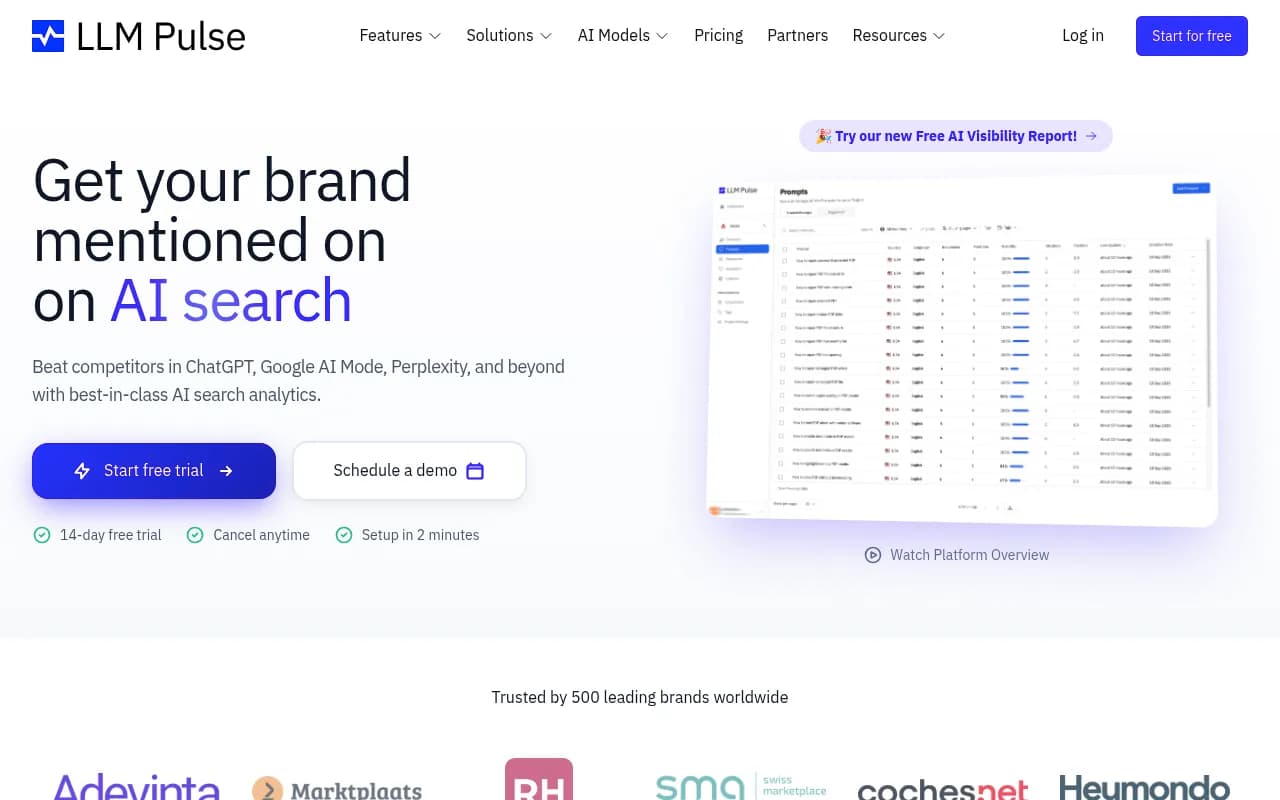
LLM Pulse is a specialized AI visibility tracker used by 500+ brands. It monitors what ChatGPT, Perplexity, Gemini, Google AI Mode, and other models say when people ask about your industry. You define the prompts that matter ("best CRM for small business", "top project management tools"), and LLM Pulse runs them weekly across 10+ AI models. You get visibility scores, citation analysis, sentiment tracking, and competitor benchmarking. The platform doesn't write content or optimize pages -- it shows you the data so you can make decisions.
Orchly.ai
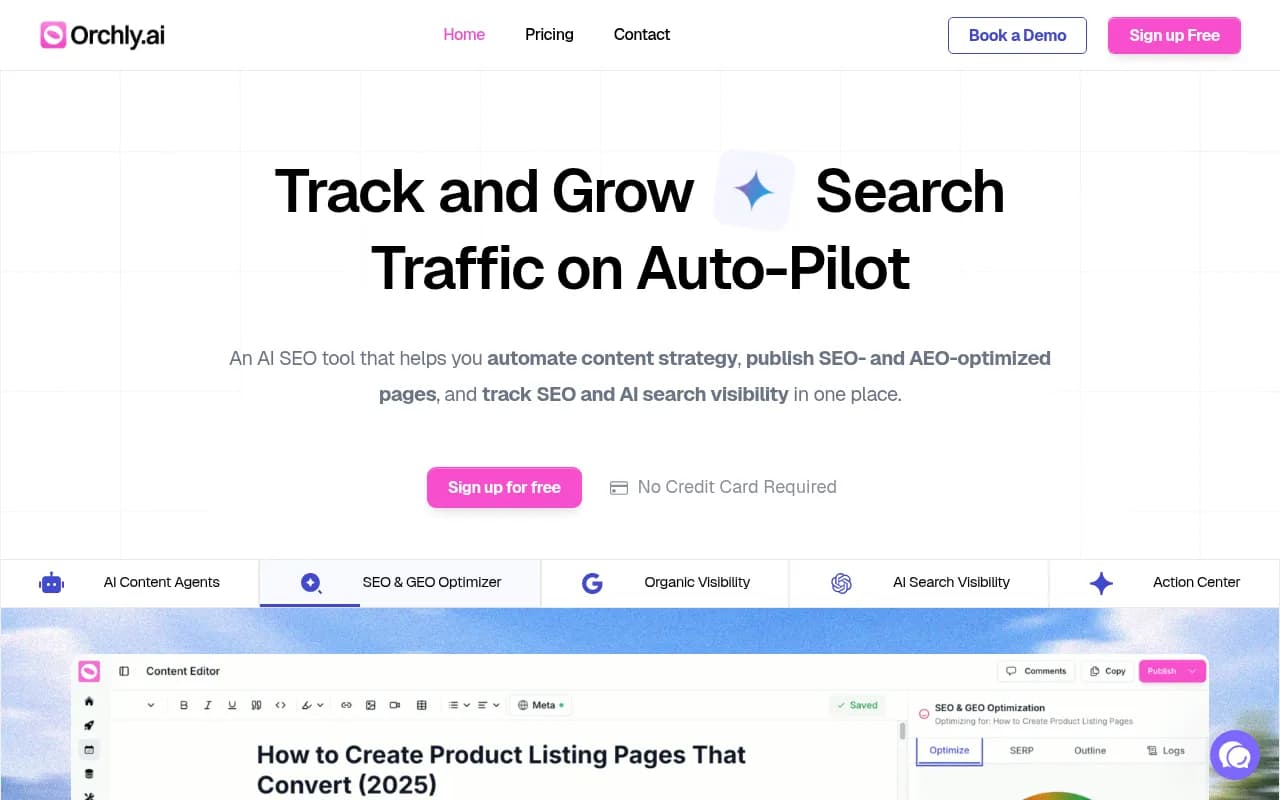
Orchly.ai positions itself as an "AI-powered content ops platform." It tracks AI visibility across 5 models (Google, ChatGPT, Claude, Perplexity, Gemini) but the real focus is what happens next: AI agents that research topics, write articles, refresh existing content, and publish directly to your CMS. The platform combines visibility tracking with SEO/AEO optimization, technical audits, and automated content workflows. You're not just monitoring -- you're running a content engine.
Side-by-Side Comparison
| Feature | LLM Pulse | Orchly.ai |
|---|---|---|
| AI models tracked | 10+ (ChatGPT, Perplexity, Gemini, Google AI Mode, AI Overviews, DeepSeek, Grok, Claude, Copilot, Meta AI) | 5 (Google, ChatGPT, Claude, Perplexity, Gemini) |
| Prompt tracking | Weekly runs, custom prompts | Custom prompts, real-time tracking |
| Citation analysis | Yes -- detailed source breakdowns | Yes -- shows which sources AI models cite |
| Competitor benchmarking | Yes -- share of voice, visibility scores | Yes -- compare AI visibility vs competitors |
| Content creation | No | Yes -- AI agents write, refresh, publish |
| SEO optimization | No | Yes -- 150+ factors, technical audits |
| Google Search tracking | No | Yes -- GSC integration |
| Free trial | 14 days | Yes (freemium model) |
| Starting price | €49/mo (1 project, 40 prompts) | $49/mo (Essential plan) |
| Mid-tier price | €149/mo (3 projects, 150 prompts) | $125/mo (Pro plan) |
| Top tier | €299/mo (5 projects, 300 prompts) | Custom Enterprise |
| Annual discount | 17% | 25% |
| CMS integrations | No | Yes -- auto-publish to WordPress, etc. |
Tracking depth and AI model coverage
LLM Pulse tracks more AI models. You get ChatGPT, Perplexity, Gemini, Google AI Mode, AI Overviews, DeepSeek, Grok, Claude, Copilot, and Meta AI. Some models (DeepSeek, Grok, Claude, Copilot, Meta AI) are Enterprise-only, but the base plan still covers the most important ones. Each prompt runs weekly, and you see exactly what each model said, which sources it cited, and how your visibility score changed over time.
Orchly.ai tracks 5 models: Google, ChatGPT, Claude, Perplexity, and Gemini. That's fewer models but still covers the platforms most people actually use. The tracking feels less granular -- you don't get weekly scheduled runs or detailed prompt-by-prompt history. Instead, Orchly.ai surfaces insights in an "Action Center" that tells you what to fix rather than showing you raw data.
Verdict: If you need comprehensive multi-model tracking with detailed historical data, LLM Pulse wins. If you only care about the top 5 models and want actionable insights over raw data, Orchly.ai is enough.
Citation and source analysis
Both platforms show you which sources AI models cite when they mention (or don't mention) your brand.
LLM Pulse gives you a detailed citation breakdown for each prompt. You see the exact URLs, domains, and content types (articles, Reddit threads, YouTube videos) that influenced the AI's response. The platform highlights whether your own content got cited, or if competitors and third-party sources are shaping the narrative. You can drill into individual responses and see the full text of what the AI said.
Orchly.ai also shows citation data but packages it differently. Instead of a prompt-by-prompt breakdown, you get a list of "sources that shape AI visibility" with recommendations on which backlinks to build or which Reddit discussions to participate in. It's less about forensic analysis and more about "here's what you should do next."
Verdict: LLM Pulse is better for deep citation forensics. Orchly.ai is better if you want the platform to interpret the data and suggest actions.
Content creation and optimization
This is where the platforms diverge completely.
LLM Pulse doesn't create content. It gives you "AI-powered content recommendations" -- suggestions on what topics to cover or how to improve existing pages -- but you're on your own to actually write and publish. The platform is monitoring-only.
Orchly.ai is built around content automation. You get AI agents that:
- Research topics based on visibility gaps
- Write full articles optimized for SEO and AEO (Answer Engine Optimization)
- Refresh existing content with updated facts, links, and structure
- Publish directly to WordPress or other CMS platforms
The agents are "trained on your data" (you can upload brand guidelines, tone of voice, product info) so the output isn't generic AI slop. There's a human-in-the-loop workflow -- you review and approve before publishing. The platform also handles technical optimization: structured data, internal linking, NLP keywords, schema markup, and fixes for crawl issues.
Verdict: If you need content creation and publishing, Orchly.ai is the only option here. LLM Pulse doesn't play in this space at all.
SEO and technical optimization
LLM Pulse focuses exclusively on AI search visibility. It doesn't track Google Search rankings, doesn't integrate with Google Search Console, and doesn't audit your site for technical SEO issues.
Orchly.ai combines AI visibility tracking with traditional SEO. You get:
- Google Search Console integration (track organic rankings alongside AI visibility)
- Technical SEO audits (crawl errors, indexing issues, schema gaps)
- On-page optimization (150+ factors analyzed per page)
- Internal and external link automation
- Rich formatting (images, videos, tables, structured data)
The platform treats SEO and AEO as two sides of the same coin. You're optimizing for both Google's algorithm and AI models' citation logic at the same time.
Verdict: Orchly.ai is a full SEO platform. LLM Pulse is AI-only. If you want one tool for both, Orchly.ai makes sense. If you already have SEO tools (Ahrefs, Semrush) and just need AI tracking, LLM Pulse fits better.
Pricing comparison
| Plan | LLM Pulse | Orchly.ai |
|---|---|---|
| Free tier | 14-day trial | Freemium (limited features) |
| Entry plan | €49/mo (Starter: 1 project, 40 prompts) | $49/mo (Essential: basic tracking + content) |
| Mid-tier | €149/mo (Growth: 3 projects, 150 prompts) | $125/mo (Pro: advanced features) |
| Top tier | €299/mo (Scale: 5 projects, 300 prompts) | Custom Enterprise |
| Annual discount | 17% off | 25% off |
LLM Pulse pricing is straightforward: you pay for projects (brands/websites) and prompts (questions to track). The Starter plan (€49/mo) gives you 1 project and 40 prompts, which is enough for a single brand tracking a handful of key questions. The Scale plan (€299/mo) supports 5 projects and 300 prompts -- useful for agencies or multi-brand companies.
Orchly.ai pricing is less transparent. The website lists $49/mo (Essential) and $125/mo (Pro) but doesn't specify prompt limits, project limits, or how many AI-generated articles you get per month. The freemium tier exists but it's unclear what's included. Annual billing saves 25%, which is better than LLM Pulse's 17%.
Verdict: LLM Pulse is more expensive but clearer about what you're paying for. Orchly.ai is cheaper at the entry level but you'll need to contact sales to understand the limits.
User interface and workflow
LLM Pulse feels like a dashboard built for analysts. You see charts, tables, and detailed breakdowns. The main view shows your visibility score over time, with filters for AI model, prompt, competitor, and date range. You can drill into individual prompts to see the full AI response, citations, and sentiment. The interface is clean but data-heavy -- you're expected to interpret the numbers yourself.
Orchly.ai feels like a project management tool. The "Action Center" is the hub -- it surfaces tasks like "optimize this page for AI search" or "write a new article on [topic]" based on visibility gaps. You assign tasks to AI agents, review their output, and approve for publishing. The interface is more visual and workflow-oriented. Less raw data, more "here's what to do next."
Verdict: LLM Pulse is better for people who want to dig into data. Orchly.ai is better for people who want the platform to tell them what to do.
Competitor benchmarking
Both platforms let you track competitors.
LLM Pulse shows share of voice (how often you're mentioned vs competitors for each prompt), visibility scores, and citation comparisons. You can add multiple competitors per project and see side-by-side performance across AI models. The data updates weekly with each prompt run.
Orchly.ai also tracks competitors but the focus is on "what are they doing that you're not?" You see which topics competitors rank for in AI search, which sources cite them, and which content gaps you should fill. The platform then suggests content to create based on those gaps.
Verdict: LLM Pulse gives you more granular competitor data. Orchly.ai turns competitor data into content recommendations.
Integrations and API
LLM Pulse doesn't advertise integrations or an API. It's a standalone dashboard. You export data manually if you want to use it elsewhere.
Orchly.ai integrates with WordPress and other CMS platforms for auto-publishing. It also connects to Google Search Console for organic ranking data. No mention of a public API.
Verdict: Orchly.ai has more integrations because it's designed to fit into a content workflow. LLM Pulse is self-contained.
If you're also looking to track how your brand shows up in AI search results with more advanced features like crawler logs and content gap analysis, Promptwatch is worth checking out.

Pros and cons
LLM Pulse pros
- Tracks 10+ AI models (most comprehensive coverage)
- Weekly scheduled prompt runs with historical data
- Detailed citation and source analysis
- Clear pricing based on projects and prompts
- 500+ brands using it (proven track record)
- Strong competitor benchmarking features
LLM Pulse cons
- No content creation or optimization features
- No Google Search tracking or SEO tools
- More expensive than Orchly.ai at every tier
- No CMS integrations or auto-publishing
- Data-heavy interface requires interpretation
Orchly.ai pros
- AI agents automate content research, writing, and publishing
- Combines AI visibility tracking with SEO optimization
- Google Search Console integration
- Technical SEO audits and on-page optimization
- Cheaper entry price ($49 vs €49)
- 25% annual discount (vs 17% for LLM Pulse)
- Freemium tier available
Orchly.ai cons
- Tracks only 5 AI models (vs 10+ for LLM Pulse)
- Less granular prompt tracking and historical data
- Pricing details unclear (prompt limits, content credits)
- Newer platform with less proven track record
- Action-oriented interface may feel limiting for analysts
Who should pick which tool
Pick LLM Pulse if you:
- Need comprehensive AI model coverage (10+ platforms)
- Want deep citation forensics and historical tracking
- Already have content creation and SEO tools in place
- Prefer raw data over automated recommendations
- Are tracking multiple brands or running an agency
- Have budget for a dedicated AI visibility tracker (€149-€299/mo)
Pick Orchly.ai if you:
- Want one platform for tracking AND content creation
- Need to automate content workflows with AI agents
- Care about Google Search rankings alongside AI visibility
- Want technical SEO audits and optimization
- Have a smaller budget ($49-$125/mo)
- Prefer actionable insights over raw data
- Need CMS integrations for auto-publishing
Pick neither if:
- You're not actively working on AI search visibility (both tools assume you care about this)
- You only need basic monitoring (both are overkill for casual tracking)
- You want a platform that also handles social media, email, or other marketing channels (both are search-focused)
Final verdict
LLM Pulse is the better AI visibility tracker. Orchly.ai is the better content ops platform.
If your job is to monitor and report on AI search visibility -- for yourself or clients -- LLM Pulse gives you more data, more models, and more granular tracking. You'll pay more (€149-€299/mo for most use cases) but you get a purpose-built analytics tool.
If your job is to improve AI search visibility by creating and optimizing content, Orchly.ai makes more sense. The tracking is less detailed but the AI agents close the loop from insight to action. You're paying for a content engine, not just a dashboard.
Most teams will eventually need both capabilities -- deep tracking and automated content creation. Right now, no single platform does both at a high level. LLM Pulse + a separate content tool (or Orchly.ai + a separate analytics tool) is the realistic setup for serious AI search optimization in 2026.