Brevo Review 2026
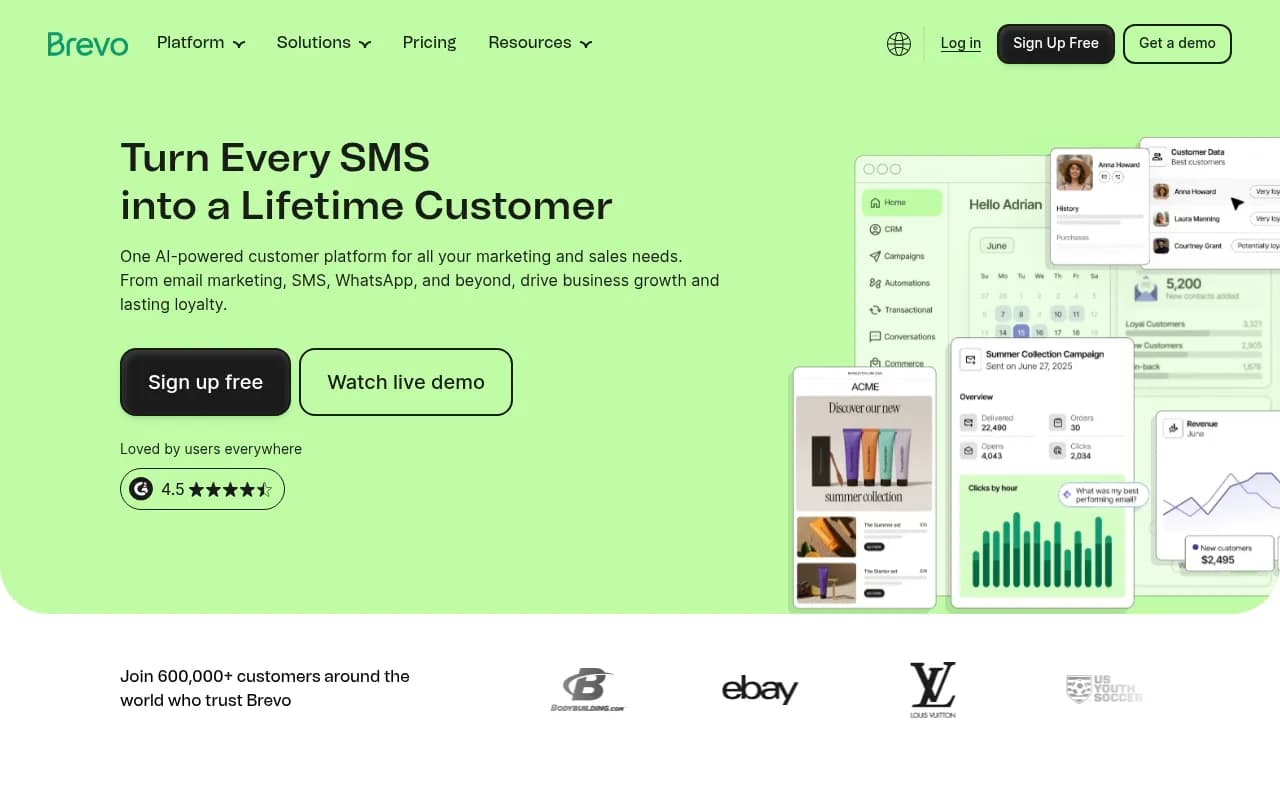
Brevo is a Paris-built marketing platform combining email, SMS, WhatsApp, live chat, and CRM in one dashboard. Best for small businesses and growing teams that want automation and AI tools without stitching together five separate apps, with pricing starting free and scaling to enterprise.
Key takeaways
- Brevo bundles email marketing, SMS, WhatsApp, live chat, and a CRM into one platform, which makes it attractive for small teams that don't want to pay for five separate tools.
- The free plan is genuinely generous on contacts (up to 100,000) but capped at 300 emails/day, which trips up businesses that need to send in bursts.
- Aura, Brevo's AI layer, now covers campaign generation from a prompt, 18-language translation of full campaigns, and an MCP server that lets tools like Claude or ChatGPT query your Brevo data directly.
- G2 reviewers rate it 4.5/5 across 2,702 reviews, but a recurring complaint is inconsistent customer support and occasional deliverability hiccups, especially for lower-engagement senders.
- Removing the "Sent by Brevo" branding on the Starter plan costs an extra $10.80/month, a detail that's easy to miss at signup.
Brevo started in 2012 as a French startup called Mailin, became Sendinblue, then rebranded to Brevo in May 2023. Armand Thiberge has run it as CEO the whole way through, and the company has quietly built one of the more complete marketing stacks in the mid-market space. In December 2025 it closed a €500 million round with General Atlantic and Oakley Capital, crossing unicorn status, with Partech fully exiting its position. Brevo is projecting more than €200 million in ARR for 2025 with double-digit EBITDA margin, and it's aiming for €1 billion in annual revenue by 2030.
The pitch is simple: instead of running Mailchimp for email, Twilio for SMS, Intercom for chat, and a separate CRM, you run all of it through Brevo. That consolidation story is why it's popular with small businesses, e-commerce shops, and lean marketing teams, though enterprise names like AXA, Sanofi, Michelin, and the UN show up in its customer base too, even if they're a tiny sliver (0.28%) of the overall account count.
Key features
Multichannel campaign builder. The core of Brevo is still email and SMS marketing with a drag-and-drop editor, ready-made templates, and no-code automation workflows. You can layer in WhatsApp campaigns, push notifications, and mobile wallet messaging from the same contact list, which most competitors at this price point don't offer natively.
Aura AI agents. Brevo's AI suite is organized into distinct agents rather than one generic assistant. The Marketing Agent writes copy, auto-segments audiences, and recommends optimal send times. The Sales Assistant enriches contact records, drafts sales emails, and auto-creates deals. The Conversations Agent summarizes live chats and rewrites messages to match your tone. A newer Data Analyst agent lets you ask plain-language questions about your data and get charts back. In practice, the prompt-to-campaign feature (still in beta) is the most useful of the bunch: type a description and Aura generates layout, subject line, preview text, and copy in one pass.
18-language campaign translation. Once a campaign is built, Aura can translate the entire thing, subject line, preview text, and design, into 18 languages across any of Brevo's editors (Drag & Drop, Simple, or HTML). For teams running the same campaign across multiple markets, this cuts a lot of manual duplication.
Built-in CRM and sales tools. Brevo's Sales module is a real CRM with pipelines, deal tracking, and a free tier (Sales Free, one seat). Sales Essentials runs $27.92/month for more advanced sales automation, and a Sales Advanced add-on ($58.50/month/user) is available on Professional plans and above. It won't replace HubSpot or Salesforce for complex B2B sales motions, but for a small business that just needs to track leads alongside its email list, it removes the need for a separate CRM subscription entirely.
Live chat, chatbot, and VoIP phone. Beyond marketing, Brevo has quietly built out a support and conversations stack: live chat widgets, a chatbot builder, and even a VoIP phone feature. The Conversations plan (live chat plus messaging integrations) runs $15/month per user, with a limited free tier.
Marketing automation and segmentation. Automation workflows are no-code and include web tracking for behavioral triggers. Advanced segmentation, including contact scoring based on RFM/CLV models, is reserved for Professional and above, which is a meaningful gate if you're trying to do lifecycle marketing on a lower tier.
MCP server for AI tool access. This is the feature that stands out from a developer's perspective. Brevo shipped an MCP server that lets external AI assistants such as Claude or ChatGPT query contacts, companies, deals, pipelines, campaigns, and analytics directly. It's an early and fairly forward-looking move for a marketing platform, most competitors in this space haven't built anything comparable yet.
Transactional email and developer API. Brevo maintains official API clients on GitHub for Node.js, PHP, Python, Go, Ruby, C#, and Java, plus a newer command-line tool (brevo-cli) with a Homebrew tap. Transactional email is priced and managed separately from marketing sends, which developers appreciate since it keeps deliverability reputations isolated.
Who is it for
Brevo fits best for small businesses and solo operators who want one login for email, SMS, chat, and a lightweight CRM instead of juggling separate subscriptions. Think a Shopify store owner running abandoned-cart emails and WhatsApp order updates, or a five-person agency managing newsletters for a handful of clients. The free plan's 100,000-contact allowance is unusually generous for this segment, even if the 300-emails-per-day cap means it's really a testing ground rather than a production tier for anyone with real volume.
Mid-market marketing teams that need advanced segmentation, A/B testing, and AI send-time optimization will land on the Standard or Professional tier. The Professional plan's contact scoring and AI segmentation features start to resemble what you'd get from a dedicated marketing automation platform, at a fraction of the price of something like Marketo.
Who should skip it: teams sending very high daily volumes with tight burst requirements will find the daily sending caps on lower tiers frustrating, and anyone needing enterprise-grade deliverability guarantees or white-glove support should budget for Enterprise ($2,499/month) rather than assume Standard or Professional will cover it. Businesses that need a deeply specialized CRM (complex B2B sales cycles, multi-stage approval workflows) will outgrow Brevo's Sales module quickly and are better served by Salesforce or HubSpot.
Integrations and ecosystem
Brevo connects to more than 150 tools according to its own integrations marketplace, with native connectors for Shopify, WooCommerce, WordPress, Magento, Wix, BigCommerce, Stripe, PayPal, Google Analytics, Zapier, Make, Typeform, Eventbrite, and Elementor. G2 separately lists 31 verified integrations including Calendly, Canva, and Zoho's Bigin CRM.
On the developer side, Brevo maintains actively updated GitHub repositories for API clients in seven languages plus the new brevo-cli tool. The REST API covers contacts, campaigns, transactional email, and CRM objects. The MCP server is the newest addition and the one worth paying attention to if you're building AI-driven workflows on top of your marketing data.
No dedicated Discord community was found; instead, Brevo runs its own forum at community.brevo.com for peer support.
Pricing and value
Brevo's pricing structure is where things get a little more complicated than the marketing pages suggest. The Free plan has no credit card requirement, up to 100,000 contacts, and 300 emails per day. Starter runs $9/month list price ($8.08/month billed annually) starting at 5,000 emails/month, but removing the "Sent by Brevo" footer costs an extra $10.80/month on top, a detail that catches a lot of new users off guard.
Standard is $18/month list ($16.17/month annual) and is where automation, A/B testing, heatmaps, and AI send-time optimization unlock, with branding removal included this time. Professional jumps considerably to $499/month list ($449.08/month annual), starting at 150,000 emails/month, and adds WhatsApp, web push, 10 included seats, contact scoring, and AI segmentation. Enterprise starts at $2,499/month for 1M+ contacts, custom integrations, dedicated IP, and SSO.
Pay-as-you-go email credits are available with no expiration and no daily cap, useful for occasional senders who don't want a recurring subscription. Compared to Mailchimp, Brevo's per-email pay-as-you-go pricing runs 25-60% cheaper according to third-party pricing comparisons. Against Klaviyo or ActiveCampaign, Brevo undercuts on price at every tier but trades some of the deeper e-commerce segmentation those platforms specialize in.
Strengths and limitations
What Brevo does well: the free tier's contact limit is genuinely useful for list-building before you're ready to pay, the multichannel bundling (email, SMS, WhatsApp, chat, CRM) actually replaces multiple subscriptions rather than just checking boxes, and the Aura AI features, particularly campaign generation from a prompt and multi-language translation, save real time on repetitive work. The MCP server is a legitimately forward-thinking move that few competitors have matched.
Where it falls short: G2 reviewers and independent deliverability testing put inbox placement in the 79-89% range, which isn't best-in-class, and several users report account suspensions tied to low-engagement campaigns without much warning. Customer support responsiveness is a recurring complaint, particularly for anyone below Professional tier who doesn't get phone support. The daily sending cap on lower tiers is also a real constraint if your business sends in bursts (product launches, flash sales) rather than steadily throughout the day.
Bottom line
Brevo makes the most sense for small businesses and lean teams that want to consolidate email, SMS, chat, and basic CRM into one bill without paying enterprise prices, and who can live within its sending caps at the lower tiers. The best use case: a small e-commerce or services business that wants automated email and WhatsApp flows, a lightweight CRM, and AI-assisted campaign creation, all without stitching together separate tools for each function.
Frequently asked questions
What is Brevo?
Who is Brevo designed for?
Is Brevo free to use?
How much does Brevo cost?
What features does Brevo offer?
How is Brevo different from Mailchimp?
Does Brevo include a CRM?
Can Brevo send transactional emails?
Does Brevo support SMS and WhatsApp marketing?
Is Brevo good for ecommerce businesses?
Does Brevo offer marketing automation?
What is the difference between Brevo and Sendinblue?
Similar and alternative tools to Brevo