Key Takeaways
- Scrunch is monitoring-first: Strong AI visibility tracking across ChatGPT, Perplexity, Claude with real-time bot crawl logs and citation analysis, but content creation is not its core strength
- Orchly.ai is execution-first: Built around AI content agents that research, write, and publish SEO/AEO-optimized content automatically, with visibility tracking as a supporting feature
- Pricing gap: Orchly.ai starts at $49/mo (Essential) vs Scrunch at $250/mo (Starter) -- 5x difference at entry level
- Best for agencies: Scrunch's white-label reports and multi-client dashboard make it agency-ready out of the box
- Best for lean teams: Orchly.ai's AI agents handle the full content workflow from research to publishing, reducing manual work
- Integration approach: Scrunch's Agent Experience Platform serves AI-optimized content to bots without changing your live site; Orchly.ai publishes directly to your CMS
Overview
Scrunch
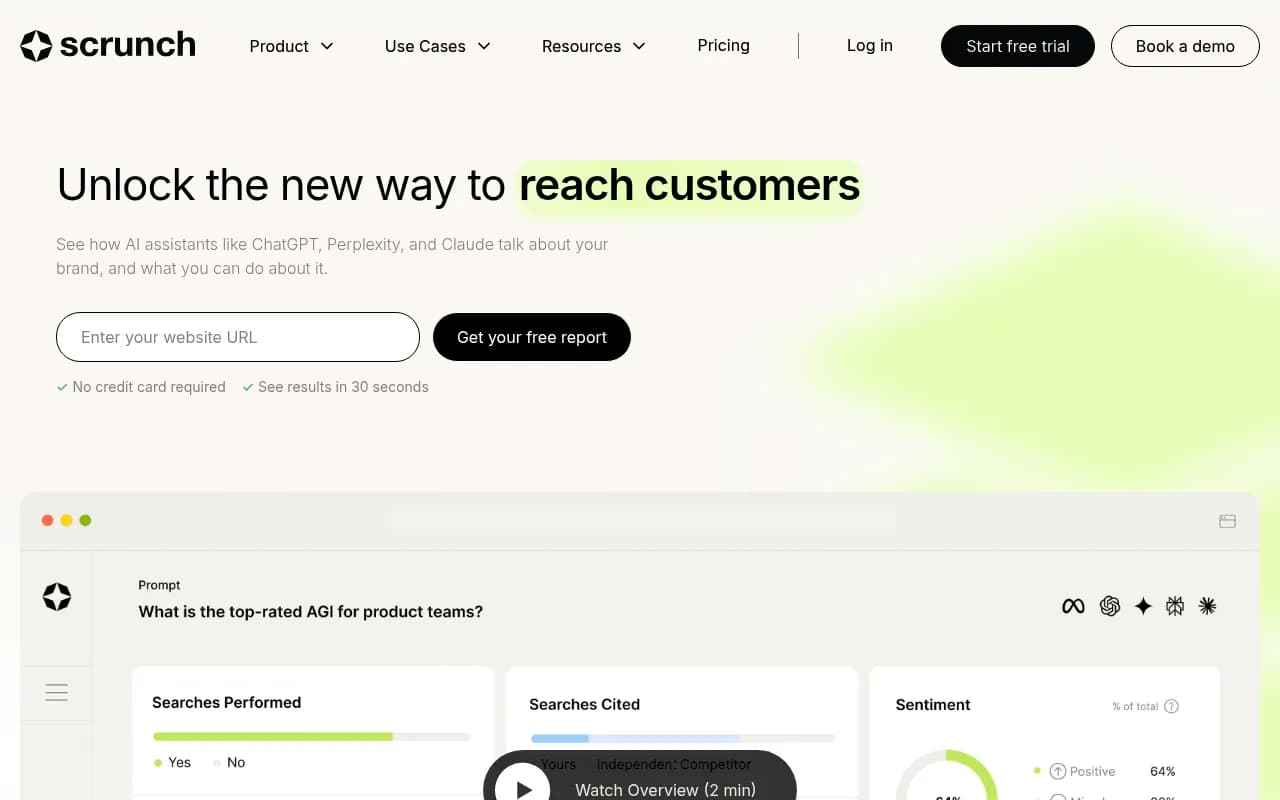
Scrunch positions itself as an AI Customer Experience Platform focused on monitoring and optimizing brand visibility across LLMs. It tracks how ChatGPT, Perplexity, Claude, and other AI assistants talk about your brand, monitors AI bot crawling behavior in real time, and provides optimization insights to improve rankings. The Agent Experience Platform (AXP) lets you serve AI-optimized content to bots without disrupting the human user experience. Used by over 500 companies including Lenovo, Skims, and Penn State University.
Orchly.ai
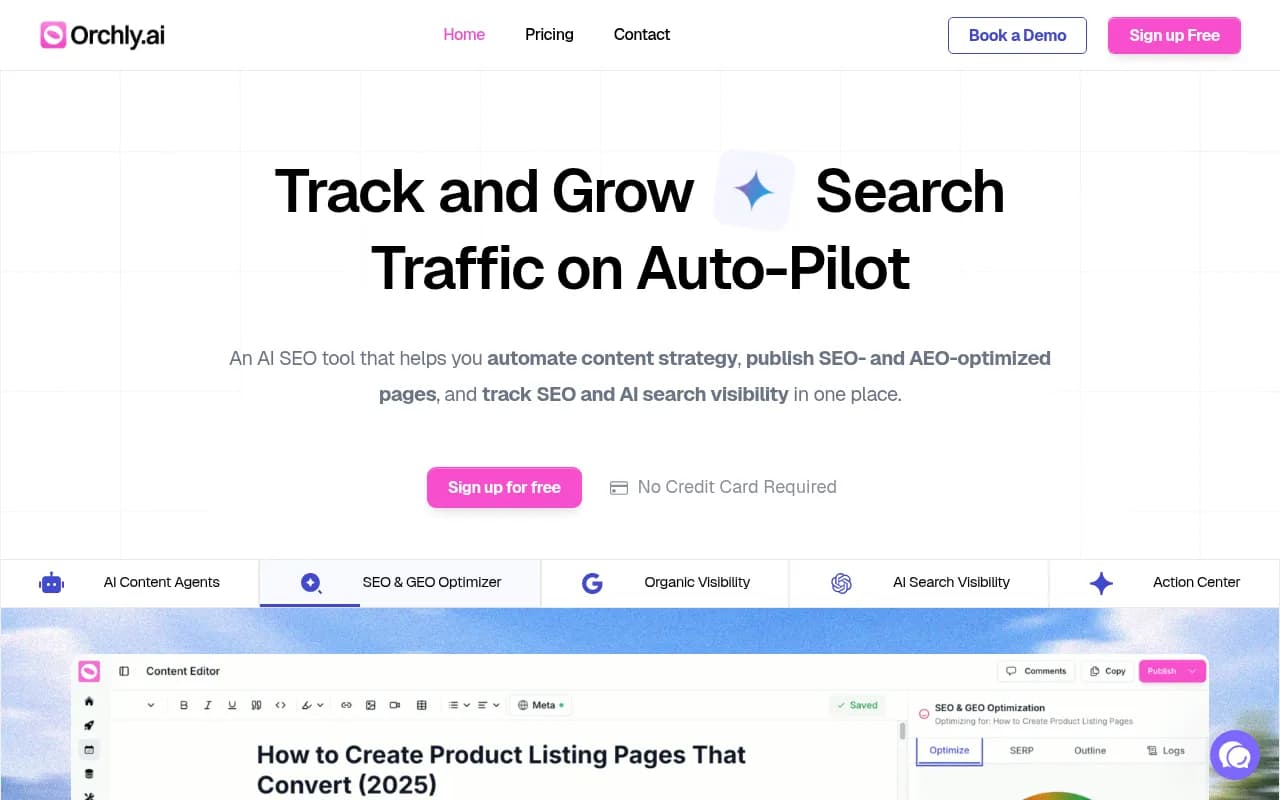
Orchly.ai takes a different angle -- it's an AI-powered content ops platform that automates the entire content strategy workflow. AI agents handle research, writing, optimization, and publishing of SEO- and AEO-optimized content. Visibility tracking across Google, ChatGPT, Claude, Perplexity, and Gemini is built in, but the core value is execution: creating and publishing content that ranks, not just monitoring what's already there. The platform targets marketing teams that want to automate repetitive content tasks while maintaining human oversight.
Side-by-Side Comparison
| Feature | Scrunch | Orchly.ai |
|---|---|---|
| Starting price | $250/mo (annual billing) | $49/mo (Essential) |
| Free trial | 7 days | Yes (freemium model) |
| AI models tracked | ChatGPT, Perplexity, Claude, others | Google, ChatGPT, Claude, Perplexity, Gemini |
| Real-time bot crawl logs | ✓ Yes | ✗ No |
| Citation analysis | ✓ Deep citation tracking | ✓ Basic citation tracking |
| Content generation | ✗ Not core feature | ✓ AI agents for full workflow |
| Auto-publishing | ✗ No | ✓ Yes (CMS integration) |
| Agent Experience Platform | ✓ Serve AI-optimized content | ✗ No |
| White-label reports | ✓ Yes | ✗ No |
| SEO optimization | Insights only | ✓ 150+ factors analyzed |
| Competitor benchmarking | ✓ Yes | ✓ Yes |
| Best for | Agencies, enterprise monitoring | Lean teams, content automation |
Monitoring and visibility tracking
Scrunch built its reputation on monitoring. The platform tracks brand presence, performance, and position across every major LLM with granular breakdowns by competitor, persona, topic, and geography. The real-time AI bot crawl feed shows exactly when ChatGPT, Perplexity, or Claude crawlers hit your site, which pages they read, and any errors they encounter. This level of visibility into bot behavior is rare -- most competitors don't offer it at all.
Prompt analytics in Scrunch let you track trends, citations, competitors, and rankings for any specific prompt. You can see how your visibility changes over time and compare performance against competitors for the same queries. The citation analysis goes deep, showing which sources AI models prefer and why.
Orchly.ai tracks visibility across Google and four AI platforms (ChatGPT, Claude, Perplexity, Gemini), but the monitoring features are lighter. You get competitor benchmarking and can see where you rank, but there's no real-time bot crawl log and the citation analysis is more basic. The visibility tracking exists to inform content strategy -- it tells you what to write next, not necessarily why AI models are making specific citation decisions.
If you're looking to track how your brand shows up in AI search results with granular detail, tools like Promptwatch cover that angle with 880M+ citations analyzed and page-level tracking across 10 AI models.

Verdict: Scrunch wins on monitoring depth. The bot crawl logs and detailed citation analysis give you visibility that Orchly.ai doesn't match.
Content creation and automation
This is where the platforms diverge sharply.
Scrunch is not a content creation tool. It provides optimization insights and tips to improve rankings, but you're responsible for actually creating or updating the content. The Agent Experience Platform lets you serve AI-optimized versions of pages to bots without changing what humans see, which is clever for brands with strict content governance, but it doesn't write content for you.
Orchly.ai is built around content automation. The platform deploys AI agents that handle research, writing, refreshing, and publishing. These aren't generic AI writers spitting out "In this fast-paced digital world" fluff -- the agents are trained on your data and structured to produce factual, search-ready content. You maintain human oversight (the "human in the loop" model), but the agents handle repetitive tasks like updating old posts, creating new articles based on keyword gaps, and scheduling publication.
The content workflow in Orchly.ai includes:
- AI agents that research topics and competitors
- Automated writing with brand voice training
- SEO and AEO optimization (150+ factors analyzed)
- Auto-scheduling and direct publishing to your CMS
- Internal and external link automation
- Rich formatting (images, videos, tables, schema)
For teams drowning in content backlogs, this is the core value. Orchly.ai doesn't just tell you what's missing -- it creates it.
Verdict: Orchly.ai wins decisively if content creation is part of your workflow. Scrunch offers insights; Orchly.ai executes.
Optimization capabilities
Scrunch provides actionable optimization tips based on what it sees in AI responses and bot behavior. You get recommendations on what to fix, which pages to improve, and how to expand visibility. The error detection feature spots when AI bots can't crawl your site and flags technical issues. But again, you're taking those insights and implementing them yourself.
Orchly.ai's optimizer analyzes 150+ SEO and GEO factors and applies fixes automatically. It enriches content with structured data, NLP keywords, contextual links, and signals tuned for both Google and LLM search engines. Technical SEO issues (crawl errors, schema gaps, indexing problems) get flagged and often resolved within the platform. The optimization happens as part of the content creation and refresh workflow, not as a separate manual step.
| Optimization Feature | Scrunch | Orchly.ai |
|---|---|---|
| Actionable insights | ✓ Yes | ✓ Yes |
| Error detection | ✓ Bot crawl errors | ✓ Technical SEO issues |
| Automated fixes | ✗ Manual implementation | ✓ 150+ factors auto-applied |
| Structured data | Recommendations only | ✓ Auto-added |
| Internal linking | Insights only | ✓ Automated |
| External citations | Analysis only | ✓ Auto-added |
Verdict: Orchly.ai wins on execution. Scrunch tells you what to do; Orchly.ai does it.
Agent Experience Platform vs direct publishing
Scrunch's Agent Experience Platform (AXP) is a unique feature. It creates a parallel version of your site optimized for AI traffic. When a bot visits yoursite.com/pricing, it gets a streamlined, AI-readable version. When a human visits, they see the normal page. This approach works well for brands with complex user experiences, heavy JavaScript, or strict content governance where you can't just rewrite pages for SEO.
Orchly.ai doesn't have an equivalent. It publishes content directly to your CMS (WordPress, Webflow, etc.). The content is optimized for both humans and AI from the start, so there's no need for a separate AI-facing version. This is simpler but less flexible if you have constraints on changing live content.
Verdict: Depends on your setup. Scrunch's AXP is clever for complex sites with governance issues. Orchly.ai's direct publishing is simpler for most teams.
Pricing comparison
| Plan | Scrunch | Orchly.ai |
|---|---|---|
| Free tier | 7-day trial | Freemium (limited features) |
| Entry plan | $250/mo (Starter, annual) | $49/mo (Essential) |
| Mid-tier | $417/mo (Growth, annual) | $125/mo (Pro) |
| Enterprise | Custom pricing | Custom pricing |
| Annual discount | Billed annually (prices above) | 25% off with annual billing |
The pricing gap is significant. Scrunch's Starter tier at $250/mo is 5x the cost of Orchly.ai's Essential plan at $49/mo. That difference reflects the target audience: Scrunch is aimed at agencies and enterprise teams with bigger budgets; Orchly.ai targets lean marketing teams and startups.
Scrunch's higher price includes white-label reporting, deeper monitoring, and agency-focused features. Orchly.ai's lower price reflects a self-service model with AI agents doing the heavy lifting instead of a large support team.
Verdict: Orchly.ai wins on affordability. Scrunch's pricing makes sense for agencies billing clients, less so for small in-house teams.
User experience and learning curve
Scrunch has a polished interface with dashboards for performance tracking, prompt analytics, and AI traffic. The learning curve is moderate -- you need to understand how to interpret citation data and bot crawl logs, but the UI is clean. The platform assumes you have some SEO or content strategy knowledge.
Orchly.ai's interface centers around the Action Center, which surfaces SEO and AI search opportunities in a prioritized list. The AI agents handle complexity behind the scenes, so the user experience is more about reviewing and approving content than configuring settings. The learning curve is lower if you're focused on content output, higher if you want to customize agent behavior.
Verdict: Tie. Scrunch is cleaner for monitoring; Orchly.ai is simpler for content execution.
Integration and workflow fit
Scrunch integrates with your existing site without requiring CMS access. The AXP serves optimized content to bots via a separate layer. White-label reports export easily for client presentations. This makes it a good fit for agencies managing multiple clients or brands with strict IT policies.
Orchly.ai requires CMS integration (WordPress, Webflow, etc.) to auto-publish content. It's designed to slot into your content workflow as an automation layer. If you're already publishing regularly and want to scale output without hiring more writers, this fits. If you have a complex approval process or can't give a tool publishing access, it's harder to implement.
Verdict: Scrunch fits more workflows (no CMS access needed). Orchly.ai requires deeper integration but delivers more automation.
Reporting and analytics
Scrunch offers white-label reports, which is a big deal for agencies. You can brand the reports with your logo and share them with clients. The analytics cover performance trends, competitor comparisons, citation sources, and bot behavior. Reports are presentation-ready.
Orchly.ai's analytics focus on SEO and AI search visibility with competitor benchmarking, but there's no white-label reporting feature. The data is actionable (it feeds into the Action Center), but if you need client-facing reports, you're exporting data and building them yourself.
Verdict: Scrunch wins for agencies. Orchly.ai's analytics are fine for internal use but lack the polish for client delivery.
Pros and cons
Scrunch pros
- Real-time AI bot crawl logs (rare feature)
- Deep citation analysis across multiple LLMs
- Agent Experience Platform for serving AI-optimized content without disrupting UX
- White-label reports for agencies
- Strong competitor benchmarking
- No CMS access required
Scrunch cons
- No content creation capabilities
- Higher price point ($250/mo entry)
- Insights-only -- you implement the fixes
- Overkill for small teams just starting with AI visibility
Orchly.ai pros
- AI agents automate research, writing, and publishing
- Much lower entry price ($49/mo)
- 150+ SEO/AEO factors optimized automatically
- Direct CMS publishing with scheduling
- Freemium model for testing
- Execution-focused (not just monitoring)
Orchly.ai cons
- No real-time bot crawl logs
- Lighter citation analysis compared to Scrunch
- Requires CMS integration for full value
- No white-label reporting
- Less suitable for agencies managing multiple clients
Who should pick Scrunch
Scrunch makes sense if:
- You're an agency managing AI visibility for multiple clients and need white-label reports
- You have a content team that can execute on optimization insights and don't need automated writing
- You want deep visibility into AI bot behavior and citation patterns
- You have a complex site where serving AI-optimized content via AXP is cleaner than rewriting pages
- Budget isn't a constraint ($250+/mo is reasonable)
- You're focused on monitoring and analysis more than content production
Who should pick Orchly.ai
Orchly.ai makes sense if:
- You're a lean marketing team that needs to scale content output without hiring more writers
- You want AI agents to handle repetitive tasks (research, writing, optimization, publishing)
- Budget is tight and $49-125/mo fits better than $250+/mo
- You're comfortable giving a tool CMS access to auto-publish
- You care more about execution (creating content that ranks) than deep monitoring analytics
- You don't need white-label reports for clients
Final verdict
These platforms solve different problems. Scrunch is a monitoring and insights platform for teams that want to understand AI visibility in depth and have the resources to act on those insights. Orchly.ai is a content automation platform that uses AI agents to execute strategy, with visibility tracking as a supporting feature.
If you're an agency or enterprise team with budget and you need deep AI visibility analytics, Scrunch is the better pick. If you're a lean team drowning in content work and you need AI agents to automate execution, Orchly.ai delivers more value per dollar.
The pricing gap reflects this: Scrunch charges for depth and polish; Orchly.ai charges for automation and output. Pick based on whether your bottleneck is understanding what to do (Scrunch) or actually doing it (Orchly.ai).