Key Takeaways
- Pricing difference is massive: LLMrefs starts at $79/mo for 500 prompts with unlimited seats, while Scrunch starts at $250/mo ($3,000/year) with seat limits -- Scrunch costs 3x more at entry level
- LLMrefs is pure monitoring: tracks rankings and citations across 8 AI engines but offers no optimization tools or content generation -- you see the data, then you're on your own
- Scrunch adds optimization layers: includes actionable insights, error detection, citation analysis, and an Agent Experience Platform (AXP) to serve AI-optimized content directly to bots
- Team access: LLMrefs includes unlimited team seats at all tiers; Scrunch limits seats and charges per user on higher plans
- Best for agencies/consultants: LLMrefs wins on price and unlimited seats. Best for enterprises with budget: Scrunch wins on depth and optimization features.
- Neither offers content generation: both are monitoring platforms -- if you need AI content creation to fill gaps, you'll need a third tool like Promptwatch that combines tracking with an AI writing agent
Overview
Scrunch
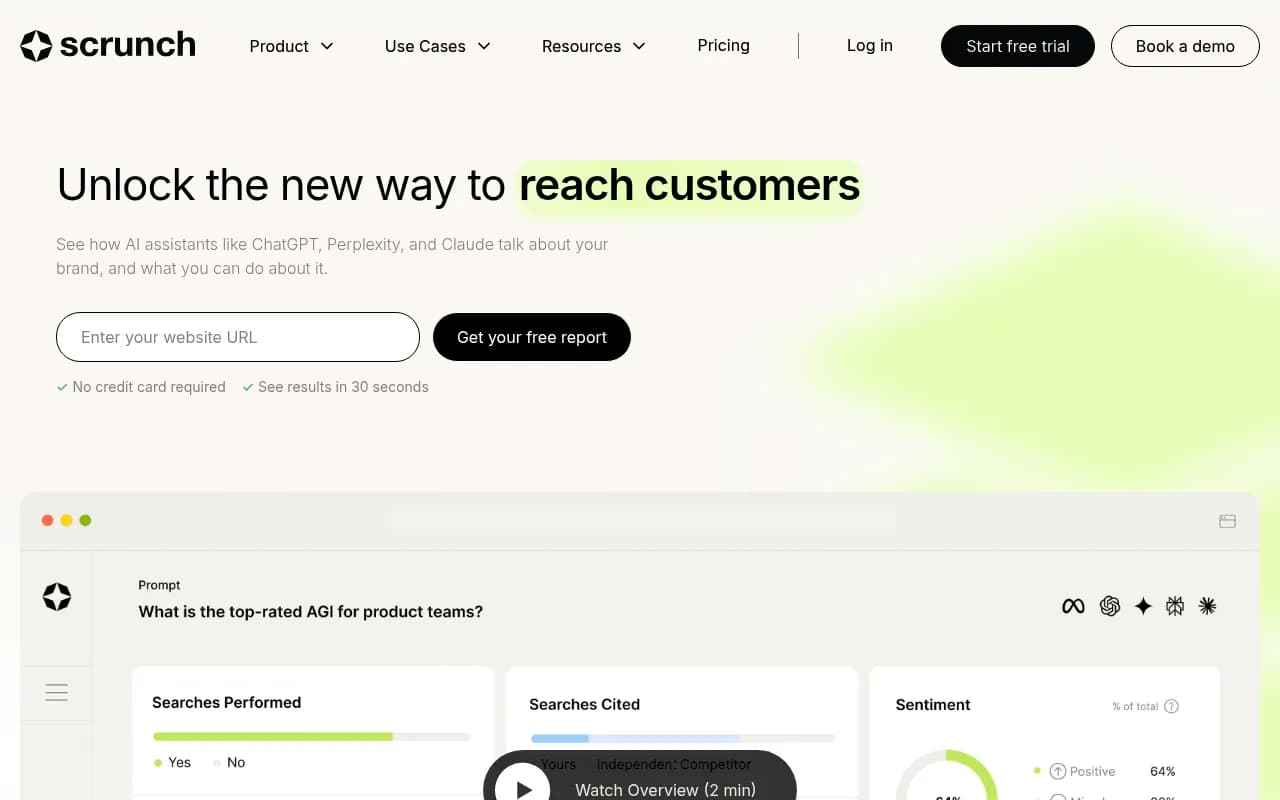
Scrunch positions itself as an "AI Customer Experience Platform" that goes beyond monitoring. It tracks brand visibility across ChatGPT, Perplexity, Claude, and other LLMs, monitors AI bot crawling behavior, provides optimization insights, and offers an Agent Experience Platform to serve AI-optimized content. Used by Lenovo, BairesDev, Clerk, Skims, and Penn State University. Pricing starts at $250/mo (billed annually) with a 7-day free trial.
Scrunch's pitch: "Your most important visitor isn't human." The platform emphasizes not just tracking but understanding why AI engines cite certain sources and what you can do to improve your visibility.
LLMrefs
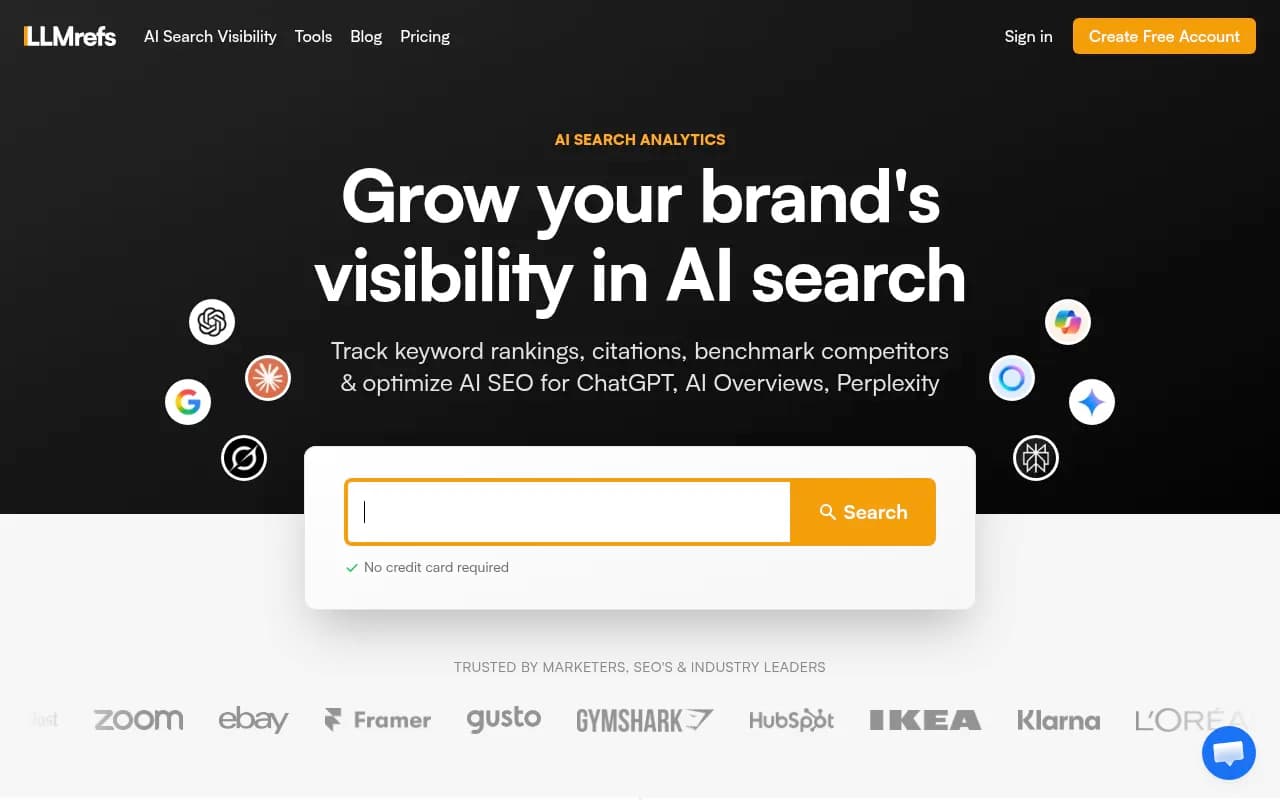
LLMrefs is a straightforward AI search analytics platform that tracks brand rankings, citations, and competitor visibility across ChatGPT, Google AI Overviews, Perplexity, Claude, Gemini, and more. It monitors keyword rankings across 50+ countries and is used by eBay, HubSpot, Shopify, Gymshark, and 10,000+ marketers. Pricing starts at $79/mo for 500 prompts with unlimited projects and team seats. 7-day free trial, no credit card required.
LLMrefs focuses on being the "AI search analytics" layer -- track where you rank, see who's citing you, benchmark competitors. It's a monitoring dashboard, not an optimization suite.
Side-by-Side Comparison
| Feature | Scrunch | LLMrefs |
|---|---|---|
| Starting price | $250/mo (annual billing) | $79/mo |
| Free trial | 7 days | 7 days |
| AI engines monitored | ChatGPT, Perplexity, Claude, others (exact count unclear) | 8 engines: ChatGPT, Perplexity, Claude, Gemini, AI Overviews, Grok, Copilot, Meta AI |
| Prompt/keyword volume | Starter: unclear, Growth: unclear | 500 prompts (20-25 keywords) at $79/mo |
| Team seats | Limited (seat-based pricing on higher tiers) | Unlimited at all tiers |
| Geo/country tracking | Yes (state/city level mentioned) | 50+ countries |
| Citation tracking | Yes, with source analysis | Yes |
| Competitor benchmarking | Yes | Yes |
| AI bot crawl monitoring | Yes (real-time feed) | No |
| Error detection | Yes (spots when bots can't crawl) | No |
| Optimization insights | Yes (actionable tips) | No |
| Agent Experience Platform | Yes (serve AI-optimized content) | No |
| Content generation | No | No |
| API access | Unknown | Unknown |
| Target audience | Enterprise brands, agencies with budget | SMBs, agencies, consultants, cost-conscious teams |
Pricing
The pricing gap is the first thing you'll notice.
| Plan | Scrunch | LLMrefs |
|---|---|---|
| Entry tier | $250/mo (Starter, annual billing = $3,000/year) | $79/mo |
| Mid tier | $417/mo (Growth, annual billing = $5,004/year) | Same plan scales with prompt volume |
| Enterprise | Custom pricing | Not offered (single tier model) |
| Team seats | Limited/paid add-ons | Unlimited |
| Free trial | 7 days | 7 days |
LLMrefs is 68% cheaper at the entry level. For agencies managing multiple clients or teams that need broad access, the unlimited seats at LLMrefs are a huge advantage. Scrunch's seat-based pricing can balloon costs quickly.
Scrunch justifies the premium with deeper features -- optimization insights, error detection, and the Agent Experience Platform. Whether that's worth 3x the cost depends on your use case.
Monitoring capabilities
Both platforms cover the core AI engines -- ChatGPT, Perplexity, Claude, Gemini. LLMrefs explicitly lists 8 engines; Scrunch's exact count is less clear from their site but appears comparable.
LLMrefs strengths:
- Clean keyword ranking tracking across 50+ countries
- Unlimited projects and team seats make it easy to manage multiple brands or clients
- Simple, focused interface -- you're here to see rankings and citations, and that's what you get
Scrunch strengths:
- Real-time AI bot crawl feed -- see exactly when ChatGPT, Perplexity, etc. hit your site
- Error detection -- alerts when AI bots encounter crawl errors or can't access pages
- Deeper prompt analytics and performance tracking by persona, topic, geo
If you just need to know "where do we rank for X keyword in ChatGPT?", LLMrefs does that well and cheaply. If you need to understand why you're not ranking and what's blocking AI bots, Scrunch gives you more diagnostic depth.
Optimization and insights
This is where the platforms diverge sharply.
LLMrefs: Pure monitoring. You see your rankings, citations, and competitor positions. The platform doesn't tell you what to do about it. You export the data and figure out your next move.
Scrunch: Adds an optimization layer. The "Insights" module provides:
- Actionable tips to improve rankings ("Optimize" feature)
- Citation analysis -- which sites AI engines love to cite, so you know where to get links or mentions
- Error detection -- spots when AI bots can't crawl your site and flags the issue
Scrunch also offers an Agent Experience Platform (AXP) -- a parallel version of your site optimized for AI traffic. The idea: serve AI bots structured, clean content that's easier for them to parse and cite. This is a unique feature. Whether it's worth the cost depends on how much traffic you're getting from AI search and whether you have dev resources to implement it.
Neither platform offers content generation. If you're looking at gaps in your AI visibility and thinking "we need to create content to fill these holes," both tools leave you hanging. You'll need to write the content yourself or use a separate tool. Worth noting that tools like Promptwatch can complement either option here by tracking AI search visibility and generating content grounded in citation data to actually close the gaps.

User interface and ease of use
Both platforms emphasize clean dashboards and fast setup.
LLMrefs: Straightforward keyword-based interface. Add keywords, see rankings across engines, benchmark competitors. The simplicity is the point -- no learning curve, just data. Unlimited team seats mean you can onboard your whole team without friction.
Scrunch: More feature-dense interface with separate modules for Monitoring, Insights, and AXP. The added complexity comes with more diagnostic power, but there's a steeper learning curve. The real-time bot crawl feed is visually engaging but can feel overwhelming if you're just trying to answer "do we rank for this keyword?"
For agencies juggling multiple clients, LLMrefs' simplicity and unlimited seats are a practical win. For in-house teams with time to dig into optimization, Scrunch's depth pays off.
Citation and competitor analysis
Both platforms track citations and let you benchmark competitors.
LLMrefs: Shows which competitors rank for your target keywords and how often they're cited. Clean comparison views. You see the landscape but don't get much guidance on why competitors are winning.
Scrunch: Goes deeper on citation analysis -- surfaces the specific sites and sources AI engines cite most often. This helps you identify link targets or content partnerships. The competitor heatmaps show where you're winning vs losing across different LLMs.
If you're doing competitive intelligence and want to reverse-engineer why a competitor ranks, Scrunch gives you more to work with. If you just need a quick "who ranks for X?" answer, LLMrefs is faster.
AI bot crawl monitoring
This is a Scrunch-only feature. The real-time feed shows when ChatGPT, Perplexity, Claude, etc. crawl your site -- which pages they hit, how often, and any errors they encounter.
Why it matters: AI engines don't crawl like Google. They might hit your site once a month, or they might ignore entire sections. If you're investing in content to rank in AI search, you need to know if the bots are even seeing it.
LLMrefs doesn't offer this. You're flying blind on whether AI bots are actually indexing your new pages.
For brands serious about AI search optimization, this is a meaningful gap. For teams just tracking rankings, it's a nice-to-have.
Agent Experience Platform (AXP)
Scrunch's most distinctive feature. The AXP lets you create a parallel version of your site optimized for AI traffic -- cleaner markup, structured data, stripped-down content that's easier for LLMs to parse.
The pitch: your human visitors see the polished marketing site; AI bots see a streamlined version designed for citation.
This is forward-thinking but requires dev work to implement. It's not a plug-and-play feature. If you have engineering resources and significant AI search traffic, it could be a competitive edge. If you're a small team or just starting with AI search, it's overkill.
LLMrefs has no equivalent feature.
Reporting and team collaboration
LLMrefs wins on team access -- unlimited seats at all tiers. You can invite your entire marketing team, agency partners, and clients without worrying about per-seat costs.
Scrunch limits seats and charges for additional users on higher plans. For agencies, this gets expensive fast.
Both platforms offer dashboards and reporting, but neither has robust white-label or client reporting features that agencies typically want. You'll likely export data to build client reports in Google Slides or Looker Studio.
Pros and cons
Scrunch pros
- Real-time AI bot crawl monitoring and error detection
- Optimization insights with actionable tips
- Citation source analysis to identify link targets
- Agent Experience Platform for serving AI-optimized content
- Deeper diagnostic tools for understanding why you rank or don't
Scrunch cons
- 3x more expensive than LLMrefs at entry level
- Seat-based pricing adds cost for teams and agencies
- Steeper learning curve with more complex interface
- AXP requires dev resources to implement
- No content generation -- you still need to write the content yourself
LLMrefs pros
- 68% cheaper ($79/mo vs $250/mo)
- Unlimited team seats at all tiers -- huge for agencies
- Simple, focused interface with minimal learning curve
- Tracks 8 AI engines across 50+ countries
- Fast setup and clean keyword-based tracking
LLMrefs cons
- Pure monitoring -- no optimization insights or recommendations
- No AI bot crawl tracking or error detection
- No citation source analysis
- Limited diagnostic depth -- you see rankings but not why
- No content generation or optimization tools
Who should pick which tool
Choose LLMrefs if:
- You're an agency managing multiple clients and need unlimited seats
- Budget is a primary concern ($79/mo vs $250/mo)
- You want simple keyword ranking tracking without complexity
- You're comfortable analyzing data and building your own optimization strategy
- You're just starting with AI search monitoring and want a low-risk entry point
Choose Scrunch if:
- You're an enterprise brand with budget for premium tools
- You need diagnostic depth -- bot crawl logs, error detection, citation analysis
- You want actionable optimization insights, not just raw data
- You have dev resources to implement the Agent Experience Platform
- You're serious about AI search as a channel and want to invest in optimization, not just tracking
Consider both if:
- You're a mid-sized brand that wants monitoring (LLMrefs) but also needs a tool that helps you create content to fill visibility gaps (neither platform does this -- look at tools like Promptwatch that combine tracking with AI content generation)
Final verdict
LLMrefs is the better choice for most teams. It's 68% cheaper, includes unlimited seats, and covers the core use case -- tracking where you rank in AI search engines. The interface is clean, setup is fast, and you're not paying for features you might never use.
Scrunch is the better choice if you have the budget and need diagnostic depth. The bot crawl monitoring, error detection, and optimization insights are genuinely useful for brands treating AI search as a serious channel. But you're paying a 3x premium for those features, and the seat-based pricing makes it expensive for agencies.
The bigger gap: neither platform helps you create content to improve your rankings. Both show you where you're invisible, then leave you to figure out what to do about it. If you're looking for a platform that closes the loop -- tracks visibility, identifies gaps, and generates optimized content -- you'll need to combine one of these with a content generation tool or look at platforms like Promptwatch that integrate tracking and creation in one workflow.
One-liner: LLMrefs is the smart default for most teams; Scrunch is worth the premium if you need enterprise-grade diagnostics and have the budget to match.