Key takeaways
- LLMrefs costs $79/month with a free trial. Bluefish AI starts around $4,000/month and requires a sales demo -- that's a 50x price difference before you've even logged in.
- Bluefish is built exclusively for enterprise: Fortune 500 clients, infosec reviews, custom audience segmentation, and dedicated support. LLMrefs is self-serve and works for teams of any size.
- LLMrefs covers 8+ AI models across 50+ countries with keyword-level tracking. Bluefish covers major AI channels too, but doesn't publish its model list or feature details publicly.
- Bluefish goes deeper on AI commerce tracking and campaign ROI measurement -- useful if you're running paid media and want to see how it influences AI recommendations. LLMrefs doesn't have a direct equivalent.
- Neither tool includes built-in content generation or AI crawler logs. If you want to move from monitoring to actually fixing your AI visibility, you'll need to look beyond both of these platforms.
- LLMrefs has a broader self-reported customer base (10,000+ marketers, eBay, HubSpot, Shopify). Bluefish targets fewer, larger clients and positions itself as the Fortune 500's choice.
Overview
Bluefish AI
Bluefish AI pitches itself as the enterprise GEO platform for brands that need more than a dashboard. The core idea is "authority, influence, and control" -- not just tracking where you appear in AI results, but understanding how AI models form opinions about your brand and then influencing those outputs. It covers AI monitoring, GEO optimization, and AI commerce measurement, and it's built to pass enterprise infosec reviews. The tradeoff is that everything about it is opaque until you talk to sales: no public pricing, no self-serve trial, no feature breakdown on the website. You're buying into a relationship, not a product.
LLMrefs
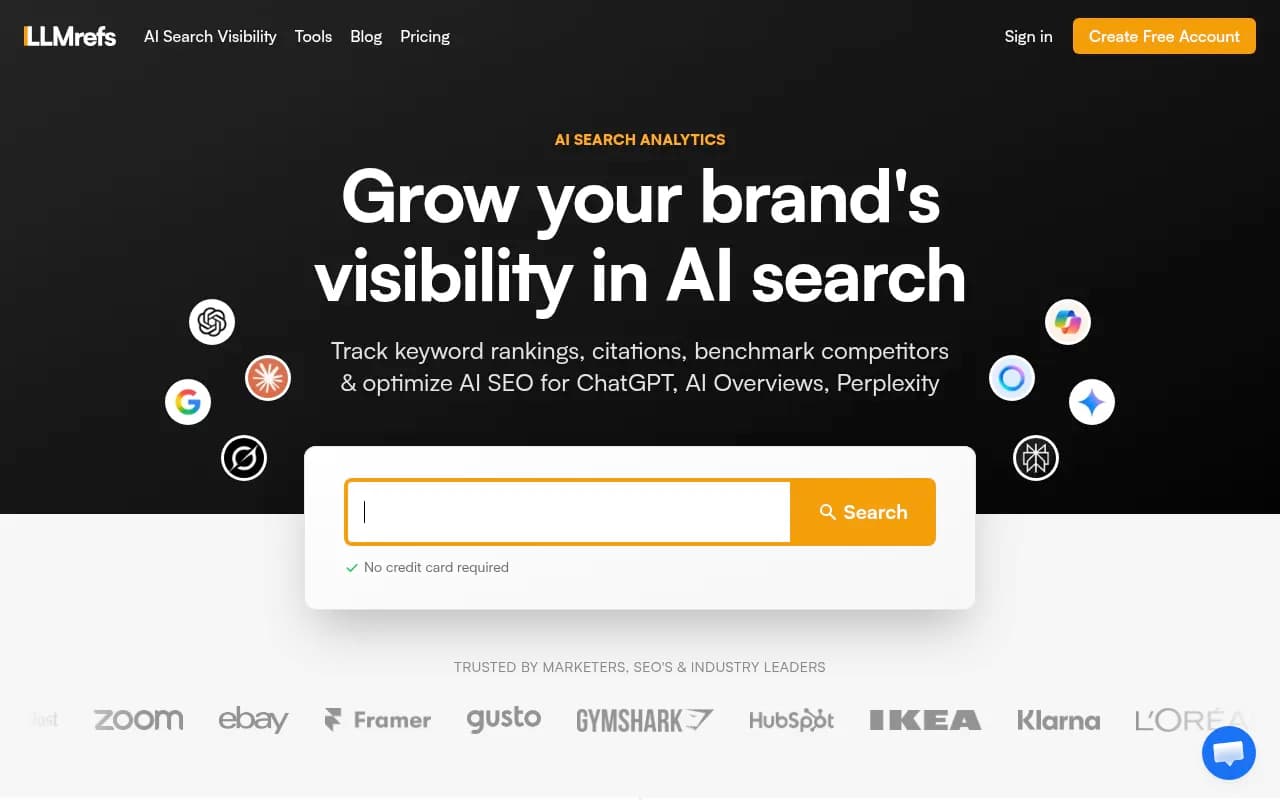
LLMrefs takes the opposite approach. It's a self-serve AI search analytics platform that tracks keyword rankings, citations, and competitor visibility across ChatGPT, Google AI Overviews, Perplexity, Claude, Gemini, Grok, Meta AI, and Copilot. You can start a 7-day trial without a credit card, and the $79/month entry plan covers 500 prompts with unlimited projects and team seats. The customer list -- eBay, HubSpot, Shopify, Gymshark, IKEA, NVIDIA -- is impressive for a tool at this price point. It's monitoring-focused, but it does that job accessibly and at scale.
Side-by-side comparison
| Feature | Bluefish AI | LLMrefs |
|---|---|---|
| Starting price | ~$4,000/mo (estimated) | $79/mo |
| Free trial | No (demo required) | 7-day free trial, no credit card |
| Pricing model | Quote-based / enterprise | Self-serve subscription |
| AI models tracked | Major AI channels (not publicly listed) | ChatGPT, Perplexity, Claude, Gemini, Grok, Meta AI, Copilot, Google AI Overviews, Google AI Mode |
| Countries supported | Not publicly disclosed | 50+ countries |
| Keyword/prompt tracking | Yes | Yes (500 prompts on entry plan) |
| Competitor benchmarking | Yes (custom audiences) | Yes |
| AI commerce tracking | Yes (campaign ROI in AI channel) | No |
| Content generation | No | No |
| AI crawler logs | Not disclosed | No |
| Team seats | Enterprise (custom) | Unlimited on all plans |
| API access | Not disclosed | Not disclosed |
| Target audience | Fortune 500 / large enterprise | SMB, mid-market, enterprise |
| Setup process | Sales demo required | Self-serve |
| Infosec / compliance | Yes (passes enterprise reviews) | Not disclosed |
Head-to-head feature deep-dive
Pricing and accessibility
This is where the two tools diverge most sharply. LLMrefs is one of the more affordable AI search tracking tools on the market -- $79/month gets you 500 prompts, unlimited projects, and unlimited team seats. There's no credit card required to try it. That's a genuinely low barrier for a team that wants to start understanding their AI search presence.
Bluefish AI doesn't publish pricing. Based on what's publicly known, enterprise clients are looking at roughly $4,000/month or more. That's not unusual for enterprise software, but it does mean Bluefish is simply not an option for most companies. You also can't evaluate it without going through a sales process, which adds friction and time.
Verdict: LLMrefs wins on accessibility by a wide margin. Bluefish's pricing is only justified if you need the enterprise-specific features it offers.
AI model and geographic coverage
LLMrefs is transparent about what it tracks: ChatGPT, Google AI Overviews, Google AI Mode, Perplexity, Claude, Gemini, Grok, Meta AI, and Copilot. That's 9 models, across 50+ countries. For most teams, that's comprehensive enough.
Bluefish covers "major AI channels" but doesn't publish a specific list. Given its enterprise positioning, it likely covers the same core models, but you'd need to confirm during a demo. The lack of public information here is a real frustration -- if you're evaluating tools, you shouldn't have to schedule a call just to find out which AI engines are supported.
Verdict: LLMrefs wins on transparency. The actual coverage may be comparable, but LLMrefs lets you verify that before committing.
Competitor benchmarking
Both tools offer competitor analysis, but they approach it differently. LLMrefs gives you side-by-side visibility comparisons across keywords and AI models -- useful for understanding where you stand relative to competitors in AI search results.
Bluefish goes further with what it calls "custom audiences" and tailored prompt sets. The idea is that generic competitor datasets aren't enough for category leaders -- you need to benchmark against the specific audience segments and query types that matter to your business. That's a legitimate point for large brands with complex competitive landscapes. Whether it's worth the price premium depends entirely on how sophisticated your needs are.
Verdict: Bluefish has more depth here for enterprise use cases. LLMrefs is sufficient for most teams.
AI commerce and campaign measurement
This is one area where Bluefish has a clear, unique capability. Its "Collections" feature (launched February 2026) lets marketers measure the ROI of digital marketing campaigns specifically in the AI channel -- so if you run a Super Bowl ad or a paid campaign, you can see whether it moved the needle on how AI models recommend your brand. That's genuinely interesting and not something most GEO tools offer.
LLMrefs doesn't have an equivalent. It tracks rankings and citations, but connecting those to campaign spend or offline marketing activity isn't part of the product.
Verdict: Bluefish wins here, and it's not close. If AI commerce tracking and campaign attribution matter to you, Bluefish is the only option between these two.
Content optimization and gap analysis
Neither tool helps you create content or identify what you're missing. Both are monitoring platforms. You can see where you rank and where competitors outperform you, but neither will tell you which specific topics or questions you need to cover to improve your AI visibility -- and neither has a built-in writing tool to act on that information.
This is worth flagging because it's a real limitation of both platforms. Tracking visibility is useful, but it's only half the job. If you want to move from "we know we're invisible" to "we've fixed it," you'll need additional tooling. Promptwatch is worth a look here -- it combines AI visibility tracking with answer gap analysis and a built-in content generation agent specifically designed to improve AI search rankings.

Verdict: Neither tool wins -- both stop at monitoring.
Enterprise readiness
Bluefish is built for enterprise from the ground up. It passes infosec reviews, supports custom data segmentation, and offers the kind of dedicated support and customization that large organizations need. If you're at a Fortune 500 company with procurement requirements, security reviews, and a need for custom reporting, Bluefish is designed for that environment.
LLMrefs has an impressive customer list (IKEA, NVIDIA, L'Oreal, The Washington Post), which suggests it can handle enterprise-scale usage. But it doesn't explicitly market enterprise compliance features, and its self-serve model means you're largely on your own for setup and support.
Verdict: Bluefish wins for true enterprise requirements. LLMrefs can serve large brands but isn't purpose-built for enterprise procurement processes.
Ease of use and time to value
LLMrefs wins this one easily. You can sign up, start a free trial, and have data in front of you within minutes. No sales calls, no onboarding process, no waiting. For a team that wants to quickly understand their AI search presence, that speed matters.
Bluefish requires a demo request, a sales conversation, presumably a contract negotiation, and then an onboarding process. That's weeks, not minutes. Justified for a $4,000+/month platform, but it means you can't evaluate it quickly.
Verdict: LLMrefs wins on time to value.
Pricing comparison
| Plan | Bluefish AI | LLMrefs |
|---|---|---|
| Free trial | No | 7 days (no credit card) |
| Entry plan | ~$4,000/mo (estimated) | $79/mo (500 prompts) |
| Mid-tier | Custom | Not publicly listed |
| Enterprise | Custom | Custom |
| Billing model | Annual contract (assumed) | Monthly or annual |
| Pricing transparency | None (quote only) | Partially public |
Pros and cons
Bluefish AI
Pros:
- Deep enterprise capabilities: custom audiences, tailored prompts, advanced segmentation
- AI commerce tracking and campaign ROI measurement (Collections feature)
- Built to pass enterprise infosec and compliance reviews
- Focuses on influence and control, not just visibility metrics
- Dedicated support and expertise for large accounts
Cons:
- No public pricing -- you can't evaluate cost without a sales conversation
- No self-serve trial -- high friction to evaluate
- Estimated $4,000+/month puts it out of reach for most companies
- Limited transparency about which AI models are covered
- No content generation or gap analysis features
- Overkill for teams that just need basic AI search tracking
LLMrefs
Pros:
- $79/month entry price with unlimited team seats -- genuinely affordable
- 7-day free trial, no credit card required
- Covers 9 AI models across 50+ countries
- Self-serve setup with fast time to value
- Impressive customer list suggests reliability at scale
- Unlimited projects on all plans
Cons:
- Monitoring-only -- no content generation, no gap analysis
- No AI commerce or campaign attribution features
- No AI crawler logs
- Limited enterprise compliance features
- Support model is self-serve, which may not work for large organizations
- Feature depth is limited compared to enterprise-focused competitors
Who should pick which tool
Choose Bluefish AI if:
- You're at a Fortune 500 or large enterprise brand with a serious GEO budget
- You need to pass infosec reviews and have enterprise procurement requirements
- AI commerce tracking and campaign ROI measurement in the AI channel are priorities
- You need custom audience segmentation and tailored prompt sets
- You have a dedicated team to work with a vendor on an ongoing basis
Choose LLMrefs if:
- You're a marketing or SEO team at an SMB or mid-market company
- You want to start tracking AI search visibility quickly and affordably
- You need coverage across multiple AI models and countries without a big budget
- You want unlimited team seats without paying per user
- You're evaluating AI search tracking for the first time and want low commitment
Consider neither if:
- You want to move beyond monitoring and actually improve your AI visibility through content gap analysis and content creation -- both tools stop at tracking
Final verdict
These two tools aren't really competing for the same customer. Bluefish AI is a specialized enterprise platform for large brands that need deep control, AI commerce tracking, and the kind of vendor relationship that comes with a five-figure monthly contract. LLMrefs is a self-serve tracking tool that punches above its weight for $79/month, covering most of what a typical marketing team needs to understand their AI search presence.
If you're a Fortune 500 brand with a real GEO budget and specific enterprise requirements, Bluefish is worth the demo. For everyone else, LLMrefs is the practical starting point -- and you can be up and running today without talking to anyone.