Content Harmony Review 2026
Content Harmony is a content intelligence platform that helps SEO teams and agencies create comprehensive content briefs 10x faster. Built by former agency operators, it combines keyword research, search intent analysis, competitor structure mapping, and AI-driven topic modeling into a single workfl
Summary
- Best for: SEO agencies, in-house content teams, and freelance strategists who create detailed content briefs at scale -- especially those managing 10+ briefs per month
- Standout strength: Turns the manual 60-90 minute brief creation process into a 10-15 minute workflow by consolidating keyword research, SERP analysis, competitor structure mapping, and source citation into one platform
- Limitation: Primarily a briefing and research tool -- it doesn't write the actual content for you (though it does grade drafts against its topic model)
- Pricing: Credit-based model starting at $99/mo for ~10 workflows, with rollover credits and unlimited users
- Notable users: Directive, KlientBoost, Mole Street, K Health, iTacit
Content Harmony is a content intelligence platform designed to solve one specific problem: the hours SEO strategists and content marketers spend manually researching topics, analyzing SERPs, and compiling briefs. Built by Kane Jamison and team -- who ran a content marketing agency for years before launching the software in 2020 -- it's a tool that understands the actual workflow of someone who's created hundreds of briefs by hand.
The core insight: most content teams follow the same research process every time (analyze search intent, review overlapping keywords, study competitor structure, build an outline, cite sources, identify visual requirements), but they're doing it manually across 5-10 different tools. Content Harmony consolidates that entire workflow into a single platform, cutting brief creation time from 60-90 minutes down to 10-15 minutes.
How the workflow actually works
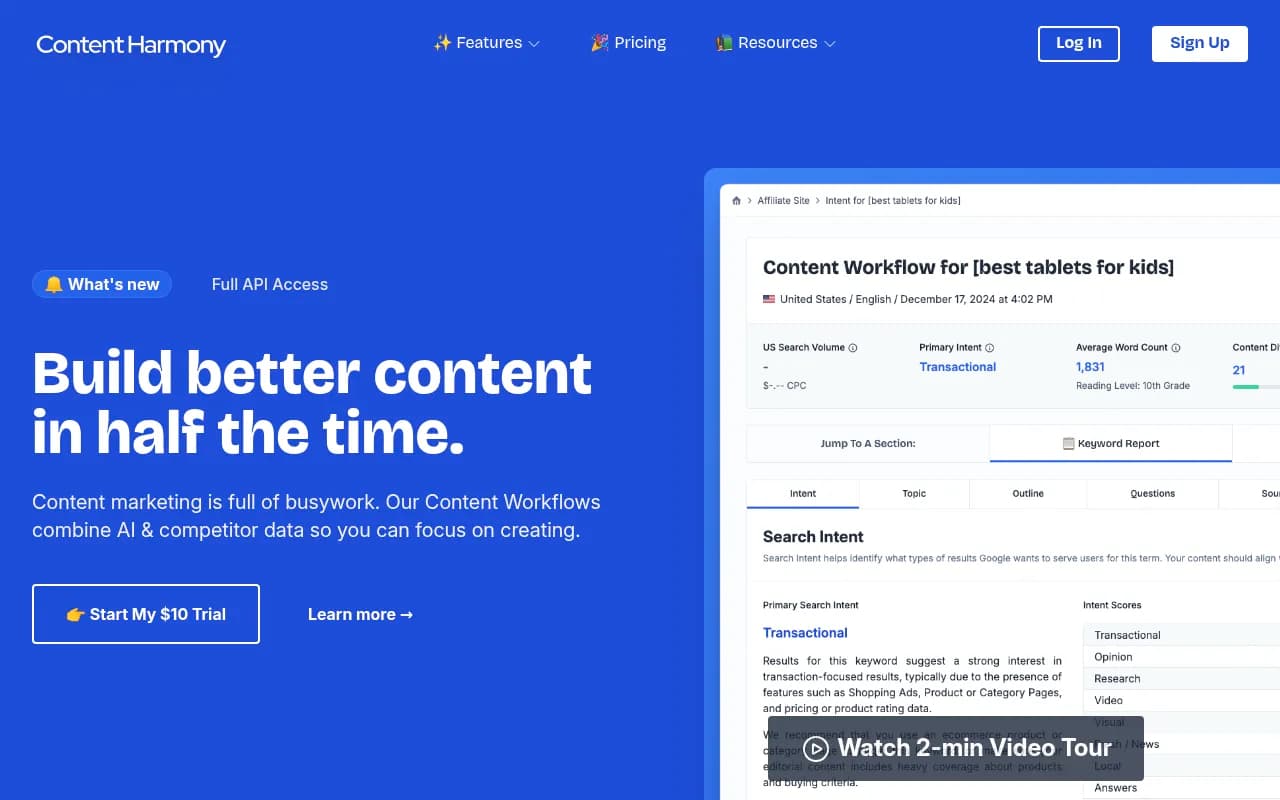
You start by entering a target keyword. Content Harmony pulls SERP data and runs it through a proprietary search intent classifier -- not the old transactional/informational/navigational model, but a more nuanced system that scores intent across multiple dimensions (commercial, informational, navigational, local). This gives you a clearer picture of what type of content actually ranks.
From there, the platform generates a detailed keyword report that includes:
- Primary and secondary keywords with search volume, difficulty scores, and relevance ratings
- Related entities and topics that need to be covered (pulled from NLP analysis of top-ranking pages)
- Questions readers are asking (sourced from People Also Ask, Reddit, Quora, and other forums)
- Competitor content structure -- how top-ranking pages are organized, what sections they include, average word counts
- Visual content requirements -- what types of images, charts, or videos appear in top results
- Authoritative sources to cite -- academic papers, high-quality publications, and trusted domains that lend credibility
All of this data feeds into a standardized brief template that you can customize for your team's needs. The brief includes suggested outlines (based on competitor analysis), key points to cover, internal linking opportunities, and formatting recommendations. You can share briefs with writers, editors, clients, or freelancers via a clean, shareable URL -- no login required for viewers.
Once a draft is written, Content Harmony's content grader scores it against the AI-driven topic model. The grader highlights missing entities, under-covered topics, and structural gaps -- essentially a checklist of what needs to be added or expanded before publishing. It's not a word count target or keyword density checker; it's a comprehensiveness audit based on what actually ranks.
Search intent classification (the technical differentiator)
Content Harmony's search intent classifier is more sophisticated than most competitors. Instead of bucketing queries into three rigid categories, it uses a scoring system across multiple intent dimensions. A query like "best project management software" might score high on both commercial intent (people are comparing options) and informational intent (they want to learn features). This nuance helps strategists understand what mix of content types to create -- a comparison table plus educational explainers, not just a product roundup.
The classifier was trained on thousands of manually-labeled SERPs and continues to improve as the team refines the model. It's one of the features that gets mentioned most often in user testimonials -- people notice when intent classification actually matches reality instead of forcing everything into outdated buckets.
Who this tool is actually for
Content Harmony is built for people who create content briefs professionally. That means:
- SEO agencies managing 20-50+ client sites and producing dozens of briefs per month. The standardized format ensures consistency across strategists, and the shareable brief URLs make client handoffs seamless.
- In-house content teams at SaaS companies, eCommerce brands, or media publishers who need to scale content production without sacrificing quality. Teams like K Health and iTacit use it to coordinate between strategists, writers, and editors.
- Freelance content strategists who charge per brief and need to deliver high-quality research quickly. The tool pays for itself if it saves even 30 minutes per brief.
- Content writers who want to do their own research instead of relying on client briefs. Rosanna Campbell (freelance B2B SaaS writer) uses it primarily for sourcing high-quality stats and surfacing Reddit/Quora discussions, not for creating briefs.
It's NOT for:
- Teams that don't create detailed briefs (if you're just assigning topics and letting writers figure it out, this is overkill)
- Solo bloggers publishing 1-2 posts per month (the credit-based pricing doesn't make sense at that volume)
- Anyone looking for an AI content generator -- Content Harmony is a research and briefing tool, not a writing tool
Integrations and workflow fit
Content Harmony doesn't have a long list of native integrations, which is actually intentional. The platform is designed to be the central hub for brief creation, not a node in a complex automation chain. That said:
- Briefs export cleanly to Google Docs, Notion, or any other writing platform
- The content grader works with drafts from any source (paste in text or upload a doc)
- Teams often use it alongside tools like Ahrefs or Semrush for broader keyword research, then dive into Content Harmony for the actual brief creation
- No API currently, though the team has indicated it's on the roadmap for enterprise customers
Pricing breakdown
Content Harmony uses a credit-based model. One credit = one "content workflow" (keyword report + brief + content grading). Pricing tiers:
- Starter: $99/mo for ~10 workflows (exact credit count varies based on plan details)
- Professional: $249/mo for ~30 workflows
- Agency: $579/mo for ~100 workflows
- Enterprise: Custom pricing for teams needing 200+ workflows per month
All plans include unlimited users, unlimited projects, and rollover credits (unused credits carry forward for at least 90 days). There's also a one-time $10 trial offer for 10 workflows, or you can schedule a demo and get 10 credits free.
Compared to competitors like MarketMuse (which starts at $600/mo for similar functionality) or Clearscope ($350/mo for 20 credits), Content Harmony is competitively priced -- especially for agencies that need high volume. The rollover credits are a nice touch; most competitors force a use-it-or-lose-it model.
What it does exceptionally well
- Speed: Cuts brief creation time by 70-80% without sacrificing quality. Multiple users mention going from 60+ minutes per brief to 10-15 minutes.
- Reddit and Quora integration: Surfaces real user discussions and questions that inform content angles. Most competitors ignore these channels entirely.
- Standardized brief formats: Ensures consistency across team members, which is critical for agencies juggling multiple strategists and clients.
- Content grading: The post-draft audit catches gaps before publishing, reducing revisions and improving rankings.
- Built by practitioners: The team ran an agency for years before building the software, so the workflow matches how real strategists actually work.
Honest limitations
- No content generation: If you're looking for an AI writer, this isn't it. Content Harmony helps you research and plan; you still need humans (or separate AI tools) to write the actual content.
- Limited integrations: No Zapier, no API (yet), no direct publishing to WordPress or other CMS platforms. It's a standalone tool.
- Learning curve for advanced features: The basic workflow is intuitive, but getting the most out of the topic model and content grader takes some practice. The team offers free training, which helps.
- Credit model can feel restrictive: If you're used to unlimited-use SaaS tools, the per-workflow pricing takes adjustment. That said, rollover credits soften the blow.
Bottom line
Content Harmony is the best tool on the market for teams that create detailed, SEO-optimized content briefs at scale. It won't write your content for you, but it will cut your research and planning time by 70%+ while ensuring your briefs are comprehensive, data-driven, and consistent. If you're an agency producing 20+ briefs per month, or an in-house team trying to scale content without hiring more strategists, this tool pays for itself immediately. Best use case in one sentence: SEO agencies and content teams that need to turn keyword research into actionable briefs in 10 minutes instead of an hour.
Tags:
Similar and alternative tools to Content Harmony