Key Takeaways
- LLM Pulse starts at €49/month (40 prompts) vs LLMrefs at $79/month (500 prompts) -- LLMrefs gives you 12x more prompts for 60% more cost
- LLMrefs offers unlimited projects and team seats at every tier; LLM Pulse caps you at 1-5 projects depending on plan
- LLM Pulse emphasizes sentiment analysis and detailed competitor benchmarking; LLMrefs focuses on keyword rankings and citation tracking
- LLMrefs has a larger enterprise client base (eBay, HubSpot, Shopify) and tracks 50+ countries; LLM Pulse serves 500+ brands with strong European presence
- Both track the same core AI models (ChatGPT, Perplexity, Gemini, AI Overviews) but LLM Pulse includes more enterprise-tier models in higher plans
- LLM Pulse offers AI-powered content recommendations for optimization; LLMrefs focuses on analytics and reporting without built-in content generation
Overview
LLM Pulse
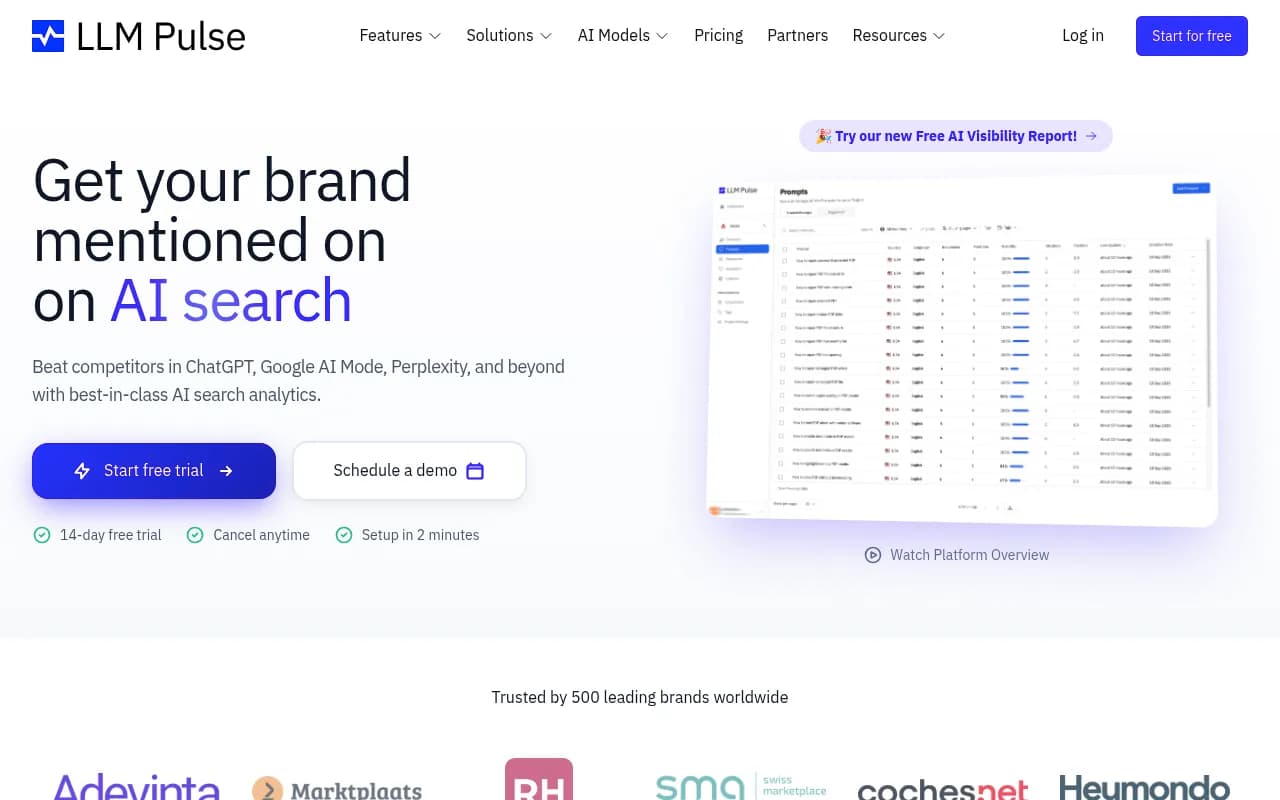
LLM Pulse positions itself as "your radar in the world of generative AI." The platform tracks how AI chatbots like ChatGPT, Perplexity, Gemini, and Google AI Mode describe your brand. It monitors key prompts weekly, measures visibility scores, analyzes citations, and benchmarks against competitors. Used by 500+ brands, LLM Pulse takes a three-step approach: track what AI says, analyze your visibility metrics, and optimize with AI-powered content recommendations. The platform emphasizes sentiment analysis and catching problems before they reach your audience.
LLMrefs
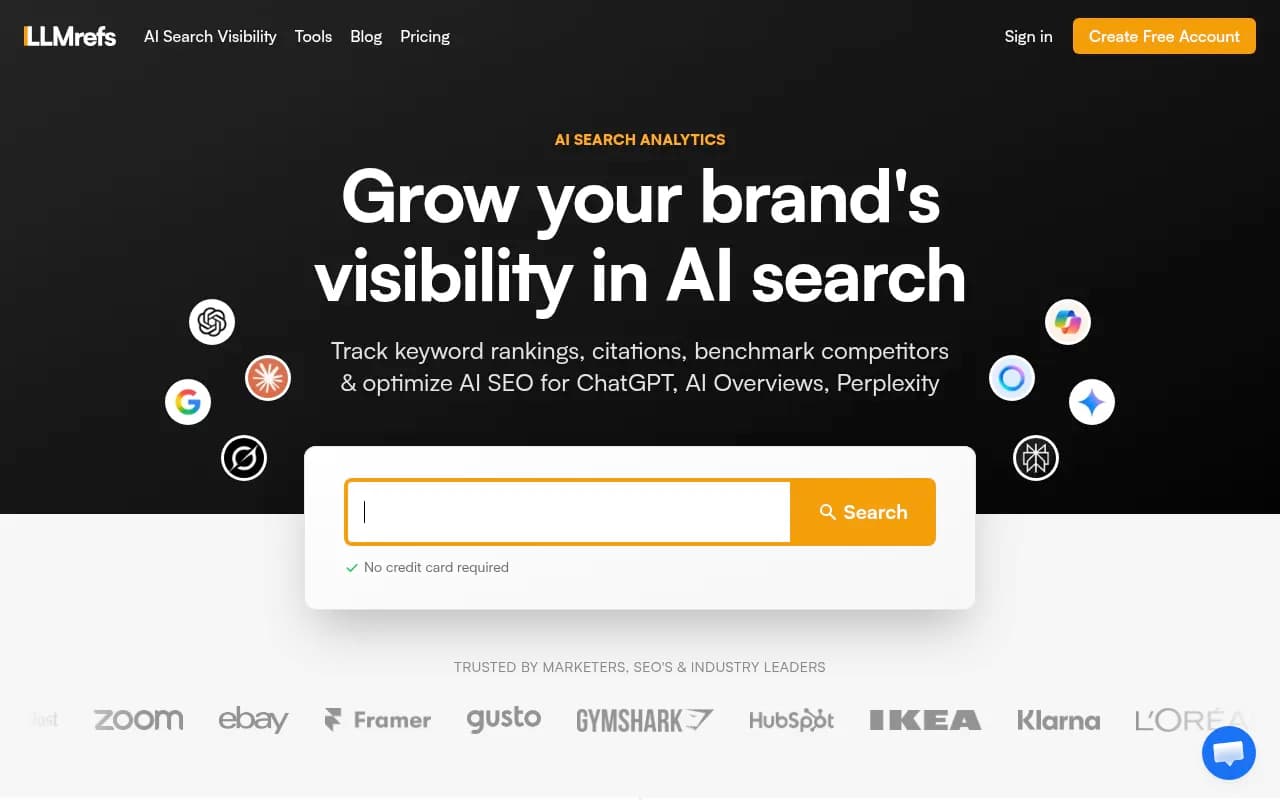
LLMrefs calls itself an "AI search analytics platform" focused on keyword rankings and citations across generative answer engines. The tool tracks how brands rank in ChatGPT, Google AI Overviews, Perplexity, Claude, Gemini, and other AI models across 50+ countries. Used by major brands like eBay, HubSpot, Shopify, and over 10,000 marketers, LLMrefs emphasizes keyword tracking, competitor benchmarking, and citation analysis. The platform offers unlimited projects and team seats at every pricing tier, making it attractive for agencies and teams managing multiple brands.
Side-by-Side Comparison
| Feature | LLM Pulse | LLMrefs |
|---|---|---|
| Starting price | €49/month | $79/month |
| Prompts (starter) | 40 prompts | 500 prompts (20-25 keywords) |
| Projects (starter) | 1 project | Unlimited projects |
| Team seats | Limited by plan | Unlimited at all tiers |
| Free trial | 14 days | 7 days |
| AI models tracked | 10+ (ChatGPT, Perplexity, Gemini, AI Overviews, DeepSeek, Grok, Claude, Copilot, Meta AI) | 8+ (ChatGPT, Perplexity, Gemini, AI Overviews, Claude, Grok, Copilot, Meta AI) |
| Geographic coverage | Not specified | 50+ countries |
| Sentiment analysis | ✓ Strong focus | Basic |
| Citation tracking | ✓ | ✓ |
| Competitor benchmarking | ✓ Detailed | ✓ Standard |
| Content recommendations | ✓ AI-powered | ✗ |
| Keyword ranking focus | Secondary | Primary |
| White-label | Basic (higher tiers) | Not mentioned |
| Annual discount | 17% | Not specified |
Pricing comparison
Both platforms use subscription pricing but structure their tiers differently.
| Plan | LLM Pulse | LLMrefs |
|---|---|---|
| Starter/Entry | €49/mo (1 project, 40 prompts) | $79/mo (500 prompts, unlimited projects) |
| Mid-tier | Not specified publicly | Same tier structure |
| Scale/Pro | €299/mo (5 projects, 300 prompts) | Same pricing for all |
| Enterprise | Custom pricing | Custom pricing |
| Free trial | 14 days, cancel anytime | 7 days, no credit card |
| Annual billing | 17% discount | Not specified |
The pricing structures reveal different philosophies. LLM Pulse charges based on projects and prompt volume, scaling up as you need more capacity. LLMrefs offers a single flat rate with unlimited projects and team seats, betting that most users will stay within the 500-prompt limit (roughly 20-25 keywords tracked weekly).
For a single brand tracking 40 prompts, LLM Pulse is cheaper. For agencies or companies managing multiple brands, LLMrefs becomes more cost-effective quickly -- you'd pay €49 per project with LLM Pulse vs one $79 fee for unlimited projects with LLMrefs.
Feature deep-dive
Prompt and keyword tracking
LLM Pulse tracks "prompts" -- the questions users ask AI models about your industry or brand. You define these prompts, and the platform monitors them weekly across all supported AI models. The focus is on understanding the narrative: what AI says, how it frames your brand, and whether the sentiment is positive or negative.
LLMrefs takes a keyword-centric approach borrowed from traditional SEO. You track keywords (like "winter surfing wetsuits" or "best CRM software"), and the platform shows you where your brand ranks in AI responses for those queries. The 500-prompt allowance translates to roughly 20-25 keywords checked across multiple AI models and countries. This makes LLMrefs feel more familiar to SEO teams used to rank tracking.
Verdict: If you think in terms of SEO keywords and rankings, LLMrefs maps better to your mental model. If you care more about the full narrative and sentiment of what AI says, LLM Pulse gives you richer context.
AI model coverage
Both platforms track the major AI models that matter in 2026:
| Model | LLM Pulse | LLMrefs |
|---|---|---|
| ChatGPT | ✓ | ✓ |
| Perplexity | ✓ | ✓ |
| Google Gemini | ✓ | ✓ |
| Google AI Overviews | ✓ | ✓ |
| Google AI Mode | ✓ | ✓ |
| Claude | ✓ (Enterprise) | ✓ |
| Grok | ✓ (Enterprise) | ✓ |
| Copilot | ✓ (Enterprise) | ✓ |
| Meta AI | ✓ (Enterprise) | ✓ |
| DeepSeek | ✓ (Enterprise) | Not listed |
LLM Pulse gates some models (Claude, Grok, Copilot, Meta AI, DeepSeek) behind enterprise plans. LLMrefs appears to include all listed models at the base $79 tier, though the website doesn't explicitly break down model access by plan.
Verdict: LLMrefs likely gives you broader model access at the entry price point. LLM Pulse reserves some models for higher-paying customers.
Citation and source analysis
Both platforms track which sources AI models cite when mentioning your brand. This is critical -- if AI is citing competitor content or third-party reviews instead of your own site, you know where the narrative is coming from.
LLM Pulse shows "which sources AI trusts in your space" and whether your content gets cited or if competitors are shaping the narrative. The platform captures full AI responses with context, giving you the exact words AI uses.
LLMrefs emphasizes citation tracking as a core metric alongside rankings. You see which domains AI models reference and can benchmark your citation rate against competitors.
Verdict: Functionally similar. Both give you citation visibility. LLM Pulse's emphasis on capturing full responses might give you slightly more context, but LLMrefs covers the same ground.
Competitor benchmarking
LLM Pulse highlights "detailed competitor benchmarking" as a strength. You can compare your visibility score, citation rate, and share of voice against competitors. The platform shows you where competitors outperform you across different AI models.
LLMrefs offers competitor benchmarking as well, letting you see how your brand ranks relative to others for the same keywords. The focus is on comparative rankings and citation frequency.
Verdict: LLM Pulse appears to put more emphasis on this feature in their messaging, but both platforms cover competitor comparison. The difference is likely in presentation and depth of analysis rather than capability.
Content optimization and recommendations
This is where the platforms diverge significantly.
LLM Pulse includes a third step in their workflow: "Optimize." The platform provides AI-powered content recommendations to improve how you appear in LLM responses. This suggests some level of content gap analysis or suggestions for what to publish.
LLMrefs focuses purely on analytics and reporting. The platform tells you where you rank and what's being cited, but doesn't offer built-in content recommendations or optimization guidance.
Verdict: LLM Pulse wins here if you want actionable next steps. LLMrefs is analytics-only. If you're looking for a platform that not only tracks but helps you improve, tools like Promptwatch take this even further with content gap analysis and an AI writing agent that generates articles grounded in citation data.

Geographic and language coverage
LLMrefs explicitly mentions tracking across 50+ countries, making it clear they support multi-region monitoring. This matters if you operate in multiple markets and want to see how AI describes your brand in different geographies.
LLM Pulse doesn't specify geographic coverage on their website. The platform is European-based (pricing in euros, 500+ brand clients), which might suggest a European focus, but they don't advertise multi-country tracking as a feature.
Verdict: LLMrefs is the clear choice for global brands needing multi-country visibility.
Team collaboration and project management
LLMrefs offers unlimited projects and unlimited team seats at every pricing tier, including the $79/month entry plan. This is a huge advantage for agencies or in-house teams managing multiple brands or clients.
LLM Pulse limits projects by plan: 1 project at €49/month, 5 projects at €299/month. Team seat limits aren't specified but are likely tied to plan tier.
Verdict: LLMrefs is built for agencies and multi-brand scenarios. LLM Pulse charges per project, which gets expensive fast if you're managing multiple clients.
User interface and ease of use
Both platforms emphasize quick setup. LLM Pulse claims "setup in 2 minutes" and shows a clean dashboard with prompt tracking, visibility scores, and citation analysis. The three-step workflow (Track, Analyze, Optimize) is straightforward.
LLMrefs highlights a keyword-first interface that will feel familiar to anyone who's used Ahrefs or SEMrush. You enter keywords, see rankings across AI models, and drill into citations and competitor data.
Neither platform has a reputation for being difficult to use. The choice comes down to whether you prefer a narrative-focused interface (LLM Pulse) or a keyword-ranking interface (LLMrefs).
Verdict: Tie. Both are accessible. Your preference depends on whether you think in terms of prompts/narratives or keywords/rankings.
Reporting and analytics
LLM Pulse provides visibility scores, citation rates, sentiment analysis, and share of voice metrics. You can see trends over time (weekly tracking) and compare performance across AI models.
LLMrefs offers keyword ranking reports, citation tracking, and competitor benchmarking. The platform emphasizes trend reporting and live keyword crawling.
Both platforms likely export data for custom reporting, though neither website specifies integrations with tools like Looker Studio or APIs for custom workflows.
Verdict: Functionally similar. LLM Pulse leans into sentiment; LLMrefs leans into rankings. Both give you the core metrics you need.
Enterprise features
LLM Pulse offers custom enterprise pricing with access to additional AI models (Claude, Grok, Copilot, Meta AI, DeepSeek) and basic white-label capabilities at higher tiers.
LLMrefs offers custom enterprise pricing but doesn't detail specific enterprise features on their public site. Given their client base (eBay, HubSpot, Shopify), they clearly support large organizations, but the feature set isn't transparent.
Verdict: Both have enterprise tiers. LLM Pulse is more transparent about what you get. LLMrefs likely negotiates custom features per client.
Pros and cons
LLM Pulse pros
- Lower entry price (€49/month) for single-brand use cases
- Strong emphasis on sentiment analysis and narrative context
- AI-powered content recommendations for optimization
- 14-day free trial (longer than LLMrefs)
- Detailed competitor benchmarking highlighted as a strength
- Captures full AI responses with context
LLM Pulse cons
- Only 40 prompts at the starter tier (vs 500 with LLMrefs)
- Limited to 1 project at entry level -- expensive for agencies
- Geographic coverage not specified
- Some AI models gated behind enterprise plans
- Smaller prompt allowance even at €299/month (300 prompts)
LLMrefs pros
- 500 prompts (20-25 keywords) at $79/month -- 12x more than LLM Pulse starter
- Unlimited projects and team seats at all tiers
- Tracks 50+ countries for global brands
- Larger enterprise client base (eBay, HubSpot, Shopify)
- Keyword-ranking approach familiar to SEO teams
- No credit card required for 7-day trial
LLMrefs cons
- No built-in content optimization or recommendations
- Shorter free trial (7 days vs 14)
- Less emphasis on sentiment analysis
- Higher entry price ($79 vs €49) if you only need 40 prompts
- Annual discount not advertised
Who should pick which tool
Pick LLM Pulse if:
- You're tracking a single brand with a modest number of prompts (under 50)
- Sentiment analysis and narrative context matter more to you than keyword rankings
- You want AI-powered content recommendations, not just analytics
- You prefer a longer free trial to evaluate (14 days)
- You're a European company and prefer euro-denominated pricing
- Detailed competitor benchmarking is a priority
Pick LLMrefs if:
- You're an agency or managing multiple brands/clients
- You need to track 100+ prompts or 20+ keywords across AI models
- You operate in multiple countries and need geographic coverage
- You think in terms of keyword rankings (SEO background)
- You want unlimited team seats without paying per user
- You're comfortable with analytics-only (no content recommendations)
- You're a larger enterprise and want a platform with proven scale (eBay, Shopify)
Consider alternatives if:
- You need both monitoring and content generation in one platform -- Promptwatch offers content gap analysis, an AI writing agent, and crawler logs alongside tracking
- You're on a tight budget and need basic monitoring -- some competitors start lower
- You need deep integrations with existing SEO tools (Looker Studio, APIs) -- verify what each platform offers
Final verdict
LLM Pulse and LLMrefs solve the same core problem -- tracking brand visibility in AI search -- but they're built for different users.
LLM Pulse is the better choice for single-brand companies that care about narrative, sentiment, and optimization guidance. The €49 entry point is attractive, and the AI-powered content recommendations add value beyond pure analytics. But the 40-prompt limit and per-project pricing make it expensive for agencies or multi-brand scenarios.
LLMrefs is built for scale. Unlimited projects, unlimited team seats, and 500 prompts at $79/month make it the obvious pick for agencies, in-house teams managing multiple brands, or companies tracking a large keyword set. The trade-off is you lose content optimization features and pay more upfront even if you only need 40 prompts.
For most agencies and mid-to-large brands, LLMrefs offers better economics. For smaller companies focused on a single brand with under 50 prompts, LLM Pulse's lower entry price and optimization features make more sense. Both platforms are competent at the core job of tracking AI visibility -- your choice comes down to pricing structure, prompt volume, and whether you value content recommendations.