Temso AI Review 2026
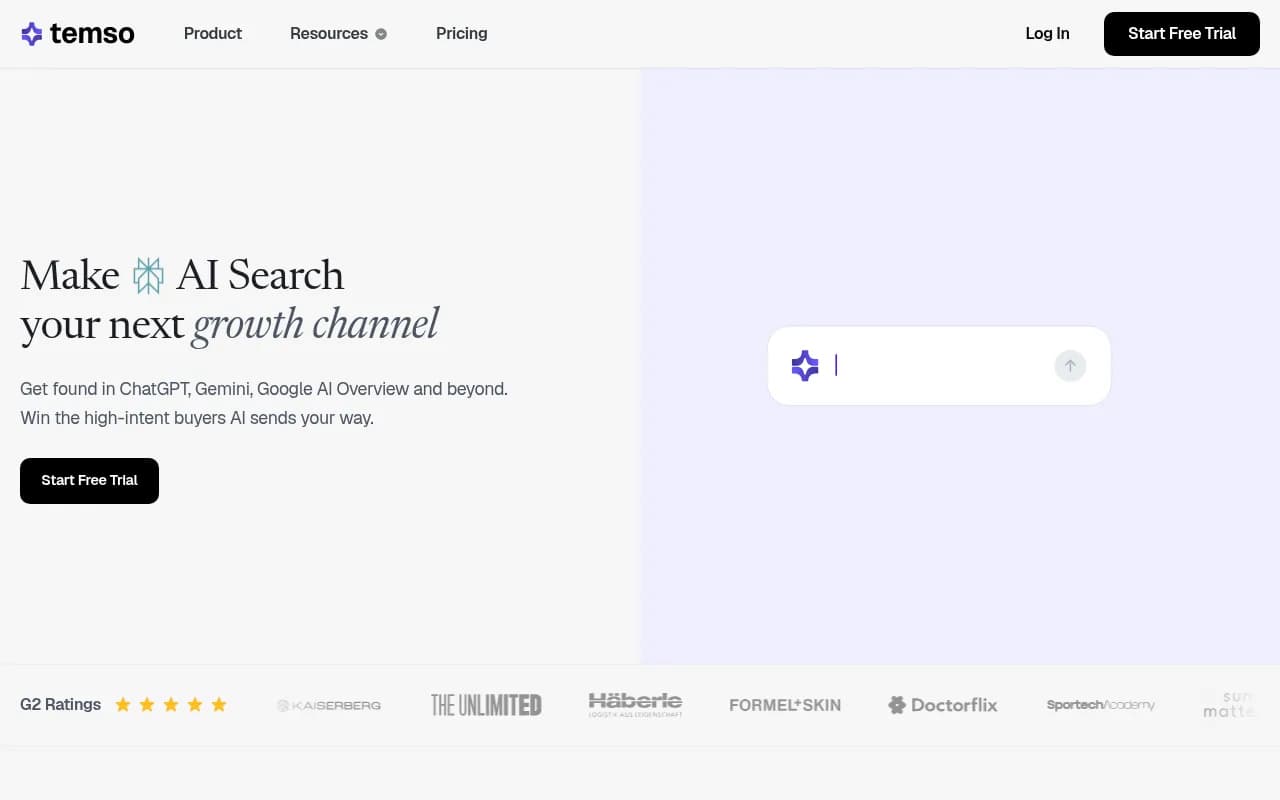
Temso AI is a GEO/AEO platform that monitors brand visibility across ChatGPT, Gemini, Perplexity, Claude, and more -- then uses an AI agent to execute content and optimization tasks. Built for lean marketing teams. From $29/mo.
Key takeaways
- Temso AI monitors brand and competitor visibility across major AI search engines (ChatGPT, Gemini, Perplexity, Claude, Grok, Copilot) and provides actionable recommendations -- not just reports
- The built-in AI agent can draft and execute content, outreach, and on-page optimizations, which separates it from pure monitoring tools like Peec.ai or Otterly.AI
- Lacks several capabilities that Promptwatch offers: no AI crawler logs, no Reddit/YouTube citation tracking, no ChatGPT Shopping monitoring, no query fan-outs, and no traffic attribution connecting AI visibility to actual revenue
- Pricing starts at $29/month, making it one of the more accessible entry points in the GEO space
- Best suited for solo marketers, lean SME teams, and early-stage startups who want some execution help without hiring an AEO specialist
Temso AI is a generative engine optimization (GEO) platform built for businesses that want to show up in AI-powered search results -- ChatGPT, Google AI Overviews, Gemini, Perplexity, Claude, Grok, and Copilot. The pitch is straightforward: most brands have no idea whether AI models are recommending them, ignoring them, or actively recommending competitors instead. Temso tries to fix that, and unlike a lot of tools in this space, it doesn't stop at showing you a dashboard.
The product is aimed squarely at lean marketing teams -- solo marketers, small in-house teams, and SME founders who don't have an AEO specialist on staff and can't afford to hire one. The comparison table on their homepage puts it bluntly: traditional approaches cost $2,000-$10,000 per month and require external expertise. Temso starts at $29 and claims to handle the strategic work through its agent. That's a bold claim, and it's worth examining how much of it holds up.
The company has a small but growing roster of customers including Doctorflix, Papora, Sportech Academy, and Kaiserberg. Case studies on the site show real results -- one founder (Roberto Guerra of RevenueHub) reportedly went from 7% to 36% AI visibility in a matter of weeks. Temso holds a 4.8 rating on G2, which is a reasonable signal of early user satisfaction, though the review volume is still modest compared to more established players.
Key features
AI visibility monitoring is the foundation. Temso tracks where your brand appears across ChatGPT, Gemini, Google AI Overviews, Perplexity, Claude, Grok, and Copilot. You can see which prompts trigger mentions of your brand, which ones don't, and where competitors are getting recommended instead. The monitoring is multi-LLM by default, which is important because different models have meaningfully different citation patterns.
Competitor intelligence and share of voice gives you a breakdown of how your brand stacks up against named competitors across the prompts you care about. The share-of-voice view (shown as a donut chart in their UI) lets you see at a glance who's winning in your category and by how much. This is useful for prioritizing where to focus -- if a competitor is dominating a specific cluster of prompts, you know where the gap is.
Prompt strategy helps you identify which buyer prompts matter most for your category. Rather than tracking arbitrary queries, Temso tries to surface the high-intent prompts that are most likely to drive actual customers. There's volume data attached to prompts, which helps with prioritization. This is a meaningful feature -- knowing that a prompt gets asked frequently is what separates useful tracking from noise.
Recommendations engine is where Temso starts to differentiate from pure monitoring tools. After analyzing your visibility gaps and competitor positioning, the platform generates a prioritized action plan. These aren't generic suggestions -- they're tied to specific prompts and gaps in your current content or positioning. The recommendations cover content creation, outreach, and on-page optimizations.
The AI agent (content execution) is the feature Temso leans on hardest in its marketing, and for good reason. Rather than just telling you what to do, the agent can draft content, run outreach tasks, and handle on-page optimizations within guardrails you define. You set the boundaries (approved sources, tone, editorial preferences), and the agent works within them. You review and approve before anything goes live. For a lean team that doesn't have bandwidth to act on every recommendation, this is genuinely useful -- though the quality and depth of agent output will vary depending on your category and how well you've configured the brand knowledge base.
Brand sentiment and perception tracking monitors not just whether your brand appears in AI responses, but how it's described. Temso tracks the attributes AI models associate with your brand (e.g., "affordable," "enterprise-grade," "unreliable") and flags negative sentiment shifts before they become entrenched. This is a useful early-warning system, especially for brands in competitive or reputation-sensitive categories.
AI search health audits diagnose technical issues that might be hurting your AI search performance -- things like pages blocked from AI crawlers, structural problems, or content gaps. This is a lighter version of what dedicated crawler log tools offer, but it gives you a starting point for technical fixes.
Branded knowledge base lets you feed Temso your brand's tone, messaging guidelines, approved sources, and editorial preferences. The agent then uses this context when generating content or recommendations. This is important for regulated industries (healthcare, finance, legal) where generic AI output won't cut it.
Who is it for
Temso's clearest fit is solo marketers and small marketing teams at SMEs and startups who are just starting to think about AI search visibility. If you're a founder running your own marketing, or a two-person team at a growing startup, Temso's agent-led approach means you can get traction in AI search without hiring a specialist or stitching together five different tools. The $29 entry tier makes it accessible for bootstrapped businesses that can't justify a $500/month monitoring tool.
Growing SMEs with some marketing budget but limited headcount are the other strong fit. The Growth tier at $199/month is positioned for this segment -- enough features to run a real AEO program, with the agent handling execution so your team isn't buried in manual content work. Businesses in competitive categories (e-commerce, professional services, SaaS) where AI search is already driving meaningful traffic will get the most value here.
Temso is less suited for large enterprise marketing teams with dedicated SEO/content departments, or for agencies managing dozens of client accounts simultaneously. The platform doesn't appear to have robust multi-client management features, and enterprise teams with complex reporting needs may find the analytics too lightweight. Similarly, if you need deep technical SEO integration, AI crawler log analysis, or traffic attribution connecting AI visibility to revenue, Temso's current feature set won't cover those needs -- that's where more comprehensive platforms become necessary.
Integrations and ecosystem
Temso's integration story is relatively thin at this stage. The platform covers six AI models natively (ChatGPT, Gemini, Perplexity, Claude, Grok, Copilot) plus Google AI Overviews and Google AI Mode. There's no mention of a public API, Zapier integration, or Looker Studio connector on the website. Export capabilities aren't prominently featured.
The branded knowledge base functions as an internal integration layer -- you bring your brand assets in, and the agent uses them across all tasks. This is practical but not the same as connecting to external tools like Google Search Console, CRM systems, or analytics platforms.
There's a case studies section and a data/benchmarks section on the site, suggesting some investment in content and community, but no Discord or developer community is visible. For teams that need to plug AI visibility data into existing reporting workflows, the lack of API access or native integrations is a real limitation.
Pricing and value
Temso's pricing is structured across four tiers:
- Basic: $29/month -- The entry point, described as "the essential toolkit for solo marketers and new startups." Covers fundamental visibility monitoring and recommendations.
- Growth: $199/month -- Aimed at SMEs, includes the AI agent for execution and broader prompt coverage.
- Professional: $499/month -- Includes 350 prompts and unlimited projects, suitable for more established marketing teams running multiple campaigns.
- Autonomous: $1,199/month -- The top tier, presumably with higher limits and more autonomous agent execution.
The $29 entry point is genuinely low for this category. Promptwatch starts at $99/month, Peec.ai and similar tools are in comparable ranges, and Profound targets enterprise budgets that dwarf all of these. For a bootstrapped startup or solo marketer, $29 to get basic AI visibility monitoring is a reasonable experiment.
The Growth tier at $199 is where the agent features become meaningful, and that's a fair price for what's offered -- assuming the agent output quality meets your standards. The Professional tier at $499 competes more directly with mid-market GEO tools, and at that price point you'd want to compare carefully against alternatives with deeper analytics and integrations.
A free trial is available (no credit card details mentioned as required upfront), which is the right call for a tool asking you to trust an AI agent with your brand's content.
Strengths and limitations
What Temso does well:
- The agent-led execution model is a real differentiator in a market full of monitoring-only dashboards. Most GEO tools show you a gap and leave you to figure out how to close it. Temso at least attempts to close it for you.
- The entry price ($29/month) is the lowest in the category for a tool that includes both monitoring and recommendations. This makes it accessible for early-stage businesses that can't justify enterprise-tier pricing.
- Multi-LLM coverage across six models is solid for the price point, and the sentiment/perception tracking adds a layer that pure visibility trackers miss.
- The branded knowledge base approach is smart -- it means agent output is at least anchored to your actual brand context rather than generic AI filler.
- G2 rating of 4.8 and published case studies with specific numbers (7% to 36% visibility) suggest real results for at least some users.
Where it falls short:
- No AI crawler logs. Temso's audit feature gives you some technical visibility, but you can't see which AI crawlers are hitting your site, which pages they're reading, or what errors they're encountering. Promptwatch's crawler log feature is meaningfully more detailed here.
- No Reddit or YouTube tracking. A significant portion of AI citations come from Reddit threads and YouTube content. Temso doesn't appear to track these sources, which means you're missing a key channel for understanding why AI models cite certain content.
- No traffic attribution. There's no way to connect AI visibility improvements to actual website traffic or revenue. You can see your visibility score go up, but you can't tie it to conversions or sessions. Promptwatch's traffic attribution (via code snippet, GSC integration, or server log analysis) closes this loop -- Temso doesn't.
- No ChatGPT Shopping tracking. As ChatGPT's product recommendation features grow, monitoring whether your brand appears in shopping carousels is increasingly important. Temso doesn't cover this.
- No query fan-outs or prompt volume scoring with difficulty metrics. Temso shows prompt volume, but the depth of prompt intelligence (how one query branches into sub-queries, difficulty scoring) appears limited compared to more specialized platforms.
- The integration ecosystem is thin. No API, no Looker Studio connector, no Zapier. For teams with existing reporting infrastructure, this is a friction point.
Bottom line
Temso AI is a reasonable starting point for small businesses and lean marketing teams who want to get into AI search visibility without a steep learning curve or a large budget. The agent-led execution model is the right idea -- the GEO space is littered with tools that show you problems but leave you to solve them alone. Temso at least tries to help you act.
That said, if you need depth -- AI crawler logs, traffic attribution, Reddit/YouTube citation tracking, ChatGPT Shopping monitoring, or robust integrations -- Temso's current feature set won't cover it. Teams that have moved past the "what is our AI visibility?" question and into "how do we systematically improve it and measure the revenue impact?" will find the platform limiting. For that level of rigor, Promptwatch is the more complete platform, covering the full loop from gap identification to content generation to traffic attribution across 10+ AI models.
Best use case: A solo marketer or small SME team that wants to start tracking and improving AI search visibility without hiring a specialist, and needs an agent to help execute the work.
Frequently asked questions
What is Temso AI?
How much does Temso AI cost?
Who is Temso AI best suited for?
How does Temso AI differ from tools like Peec.ai or Profound?
Does Temso AI track all major AI models?
Is there a free plan or trial for Temso AI?
Similar and alternative tools to Temso AI