OTTO SEO Review 2026
Search Atlas agent that pushes technical, on-page and content SEO changes plus AI-search optimisation, aimed at agencies and in-house teams.
Key takeaways
- OTTO deploys fixes instead of listing them. Titles, schema, alt text, redirects and internal links go live through a pixel, Cloudflare Worker, CMS connector or GitHub, then get submitted for indexing.
- Approval mode, bulk actions, custom instructions and rollback give you control, but Trustpilot complaints about unwanted live-site changes mean you should not run it unattended on a client site you can't afford to break.
- Its AI search work is mostly classic SEO plumbing plus LLM visibility tracking that only arrives on the Growth tier. Compared with Promptwatch, it lacks IP-verified AI crawler logs with citation rates, prompt volumes and difficulty, query fan-outs, Reddit, YouTube and LinkedIn citation tracking, AI Shopping and Ads Radar, and AI traffic attribution.
- Pricing is credit-based, from $99/mo monthly ($79 annual), and OTTO is capped at 1, 2, 4 or 10 sites depending on the plan.
- Best for agencies and in-house teams that want technical and on-page SEO executed automatically across many sites.
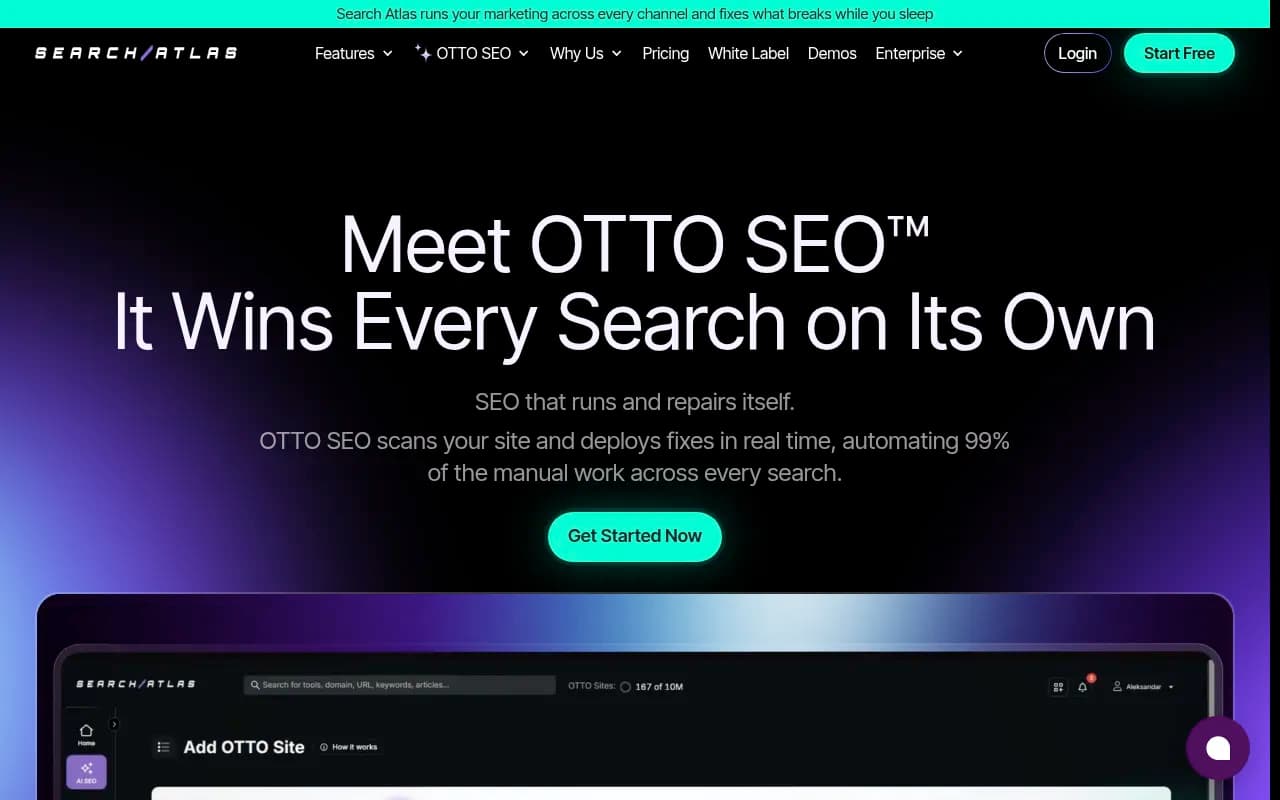
OTTO SEO is the execution agent inside Search Atlas, the SEO platform from the company of the same name. The pitch is blunt: most SEO tools hand you a to-do list, OTTO makes the change. It crawls your site, grades it, and pushes fixes to the live page, then pings Google Search Console Instant Indexing and IndexNow for Bing so the change gets seen quickly.
The audience is agencies, in-house marketers, founders and SEO teams who manage one or many websites and would rather not file a dev ticket for every missing alt tag. Search Atlas says more than 614K websites have been optimized with OTTO. That number comes from the vendor, and so do the eye-catching efficiency percentages on the product page, which I would not treat as benchmarks. The more useful question is how well it works in practice and where it can bite you.
Key features
Real-time deployment through multiple routes. This is the core idea. You install the OTTO Pixel in your site header, or connect through Cloudflare DNS for a no-code setup. There is also edge deployment with a Cloudflare Worker, native CMS connectors for WordPress, HubSpot, Webflow, Shopify, Contentful and Duda, and code-pipeline connectors for GitHub, Vercel and Netlify. The vendor says new connectors ship monthly. The edge route is the most interesting for agencies because you change what the page serves without touching the client's CMS.
Technical SEO automation. OTTO handles titles, canonical URLs, broken and redirect links, Open Graph and Twitter cards, missing alt text and schema markup. Each fix type can be enabled by category, so you can switch on alt text and leave redirects manual. Semrush and Ahrefs audits tell you what is wrong. OTTO is closer to Alli AI or ContentKing-style monitoring with a write layer added.
On-page optimization. Headings, meta tags, internal links and image alt text are refined per page, with an alt text configuration screen where you can steer the output. Keyword insertion is automatic, which one vendor testimonial praises ("adds missing keywords to the site automatically"). Automatic keyword insertion is also the kind of behavior you want to audit before you trust it.
Dynamic Indexing Engine. After a change, OTTO submits the URL through Google Search Console Instant Indexing and IndexNow. It also targets low-traffic or newly optimized pages that crawlers visit rarely. Whether this speeds up ranking depends on Google, but cutting the wait between a fix and a recrawl is a real convenience.
Content creation and the Domain Knowledge Network. OTTO builds AI-generated topical maps, turns them into publish-ready articles, optimizes existing pages, builds landing pages and keeps a Knowledge Base for brand voice. Articles consume credits: the pricing page equates 50,000 credits (Starter) to roughly 50 premium articles. Quality will vary by niche, so plan on an editor.
Off-page and local automation. WILDFIRE handles automated link building through what the vendor calls trusted networks, alongside press release distribution, digital PR and cloud stacks. On the local side, OTTO manages Google Business Profile optimization, GBP posts, Ask Maps (GBP Q&As) and review replies. Automated link building without outreach is a category where I would read the fine print and check the link quality yourself. The local tooling is more clearly useful for multi-location businesses.
OTTO Grade and Crawl Monitoring. The dashboard scores Content, Authority, Technical and UX, and reports perfect pages, issues fixed, time saved and ROI. Crawl Monitoring shows how search engines (Google, Bing, DuckDuckGo, Baidu, Yandex) and LLM crawlers engage with your site, with crawl rates, response times and indexation results. That LLM crawl view is the closest OTTO gets to AI visibility diagnostics.
Control and Deep Freeze. Approval mode lets you review each change. You can approve or edit individually, run bulk actions, add custom instructions and roll back. OTTO Deep Freeze is the retention feature: optimizations stay live after cancellation or a project pause. Deep Freeze is a selling point, though a Trustpilot reviewer says work and data are not easily portable on exit, so test what actually persists before you rely on it.
Who is it for
The best fit is an agency running 10 to 50 small-business sites, such as dentists, home services and ecommerce shops, where the same technical fixes repeat on every project. Search Atlas publishes case studies in those verticals. A solo marketer with one Shopify store also fits: install the pixel, enable alt text and schema, and stop thinking about them. In-house teams without developer capacity get the most obvious win because a Cloudflare Worker or CMS connector bypasses the engineering queue.
It suits less well for large enterprises with strict change-control processes, or for sites where a bad metadata rewrite costs real money. Any tool that rewrites live pages can get it wrong, and Trustpilot reviewers describe unwanted changes, inconsistent metadata and sites that broke after following recommendations. These are undated snippets, and Search Atlas also has many positive reviews, but the pattern is why approval mode matters.
It is also not the right pick if your main problem is understanding AI search performance specifically. OTTO fixes pages. It does not tell you which prompts you lose, which sources ChatGPT cites, or what traffic AI sends you.
Integrations and ecosystem
OTTO sits inside the wider Search Atlas platform. It connects to Google Analytics, Google Search Console and Google Business Profile for performance data. Deployment connectors cover Cloudflare (edge), WordPress, HubSpot, Webflow, Shopify, Contentful, Duda, GitHub, Vercel and Netlify. Indexing goes through Search Console Instant Indexing and IndexNow. The wider Search Atlas product also lists Looker Studio, an API and MCP support among its keywords, though I could not verify their depth from the OTTO page, so check before you build a workflow around them. I found no official browser extension for OTTO on the page itself, and I could not confirm official X, GitHub or Discord links.
Pricing and value
OTTO is bundled with Search Atlas, not sold alone. The pricing page now shows monthly billing, and an earlier third-party review lists annual-billing figures. Both sets are below. Confirm at searchatlas.com/pricing before buying.
- Starter: $99/mo monthly ($79 annual). 50,000 Universal Credits, 1 site powered by OTTO, 1 project and seat, 2,000 tracked keywords, 50,000 audit pages, 3 GBP profiles, no LLM visibility projects.
- Growth: $199/mo monthly ($159 annual). 120,000 credits, 2 OTTO sites, 2 projects, 3 seats, 3,500 keywords, 100,000 audit pages, 2 LLM visibility projects with 100 queries, AI visibility tracking for ChatGPT, Gemini and Google AI Mode, Meta and Google Ad Studio. Includes free 30-minute onboarding.
- Pro: $399/mo monthly ($319 annual). 400,000 credits, 4 OTTO sites, 4 projects, 5 seats, 6,000 keywords, 10M audit pages, adds Copilot, Perplexity and Claude (6 AI platforms), white-label dashboards and reporting.
- Agency: from $999/mo. 1,000,000+ credits, 10 OTTO sites, 10 projects and seats, client portals, branded dashboards, priority support eligibility. The plan list says unlimited keyword tracking while the limits table shows 50,000, so ask which is true.
There is a 7-day trial. The gotcha is the per-site cap: every plan includes OTTO, but only 1, 2, 4 or 10 sites can be powered by it. An agency with 25 clients hits the Agency ceiling fast, which is where pricing gets complicated. Credits also deplete: the page equates 50,000 credits to about 50 premium articles, 100 AI edits or 1,500 rank checks, so heavy content use burns through a plan.
For a single site, $99 to $199 is cheap compared with paying a freelancer for recurring technical fixes, and cheaper than stacking Semrush, a crawler and an indexing tool. For multi-client agencies the value depends on the per-site cap. Some Trustpilot reviewers also describe trouble with refunds and cancellations, so read the terms.
Strengths and limitations
What it does well
- Closes the gap between audit and fix, which is the real bottleneck in most SEO programs.
- Several deployment paths (pixel, Cloudflare Worker, eight-plus CMS and code connectors) mean it works on most stacks.
- Approval mode, bulk actions and rollback give a sensible safety net.
- Instant indexing submission shortens the wait after changes.
- Pricing is lower than most incumbent suites, a point a Digital Information World review also made.
Where it falls short
- Reliability concerns. Trustpilot reviewers report unwanted live changes, recurring bugs that take weeks to fix and slow escalation. Vendor testimonials are selective, so weigh both.
- Per-site OTTO caps and credit budgets make costs less predictable at agency scale.
- Support and data handling complaints include one agency whose automated reports kept going to its clients after cancelling.
- Consistency is a recurring theme in user reports, with a Reddit reviewer calling it the main disadvantage.
Compared with Promptwatch
OTTO also claims AI search and GEO optimization, so it is fair to compare it with a dedicated platform. Promptwatch is built around AI visibility and has no equivalent in OTTO for much of it. What OTTO lacks:
- IP-verified AI crawler logs (GPTBot, ClaudeBot, PerplexityBot and others) with crawl-to-citation tracking per page. OTTO's Crawl Monitoring shows crawl rates, but not spoofed-bot filtering or citation rates.
- Prompt volumes, difficulty scores and query fan-outs, plus content gap analysis against real prompts.
- Citation analytics, including Reddit, YouTube and LinkedIn tracking and offsite mentions.
- AI Shopping tracking (ChatGPT, Amazon Alexa) and Ads Radar.
- AI traffic attribution, with visitor analytics and Search Console and Bing data next to AI data.
- Agent Chat, a prioritized Action Board and a Content Agent that plans, writes and publishes to Webflow, Framer or WordPress against visibility gaps.
- Real-UI tracking across 15+ AI engines, including coding agents like Codex and Claude Code. OTTO's tracked models are tiered by plan, and Growth covers only three.
If you want data on how AI crawlers behave, Promptwatch's AI crawler traffic report covers weekly IP-verified requests from June to September 2026. For more tools in the category, the GEO software directory at bestgeosoftware.com is a good starting point.
Bottom line
OTTO SEO is a solid pick if your pain is the grind of technical and on-page fixes across one to ten sites, and you are willing to run it in approval mode for the first few weeks. The deployment options are broad, the price is reasonable, and the ability to ship changes to the edge without a developer is the real draw. Treat the vendor's efficiency figures as marketing and watch the per-site caps.
If your goal is growing visibility and revenue from AI answers, not just fixing pages, Promptwatch is the stronger choice because it measures why you are or aren't cited and then helps you fix it, where OTTO mostly applies classic SEO automation.

Best use case: an agency or small in-house team that wants repeat technical SEO fixes deployed to live sites automatically, with a human approving the output.
Frequently asked questions
What is OTTO SEO?
How much does OTTO SEO cost?
How does OTTO deploy changes to my site?
What happens to OTTO changes if I cancel?
Is OTTO SEO a good tool for AI search or GEO?
Is there a limit on how many sites OTTO can manage?
Similar and alternative tools to OTTO SEO