Averi AI Review 2026
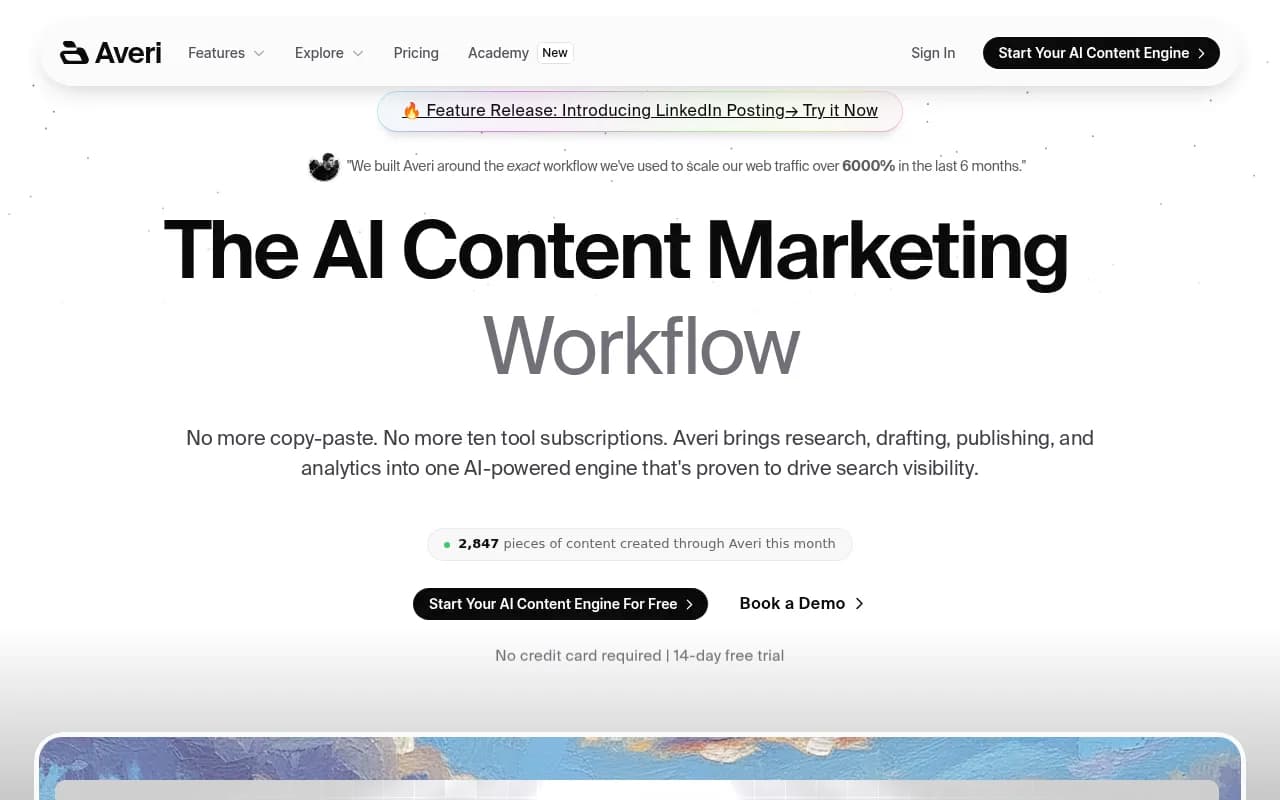
End-to-end content marketing platform that automates strategy, creation, and distribution. Designed to remove SEO bottlenecks and scale content output for growing teams.
Key takeaways
- Averi is a full-cycle content marketing platform built specifically for startups and lean teams -- it handles strategy, research, drafting, publishing, and analytics in one workflow rather than stitching together five separate tools.
- Competes partially with Promptwatch on GEO/AI citation optimization, but lacks dedicated AI visibility monitoring, AI crawler logs, prompt volume data, citation tracking across LLMs, and traffic attribution from AI search -- capabilities Promptwatch is built around.
- Strong fit for early-stage and growth-stage startups that need to build a content engine from scratch without hiring a full marketing team.
- Pricing appears to start around $45/month, making it accessible for bootstrapped founders and small teams.
- The "approve, don't create" model is genuinely useful -- you stay in control without doing the heavy lifting of research and first drafts.
Averi is an AI-powered content marketing platform built for startups that want to run a serious content engine without a serious headcount. The product covers the full workflow: brand onboarding, content strategy generation, keyword and competitor research, AI-drafted articles optimized for both Google and LLMs, team collaboration, CMS publishing, and performance tracking. The pitch is that you spend two hours a week approving content instead of twenty hours creating it.
The company points to its own growth as proof of concept -- the team claims to have scaled Averi's own organic search impressions from a few thousand per month to 1.68 million monthly impressions over roughly nine months. That's a bold claim, and the chart they show on the homepage does show a steep compounding curve. Whether that's replicable for every customer depends heavily on niche, domain authority, and content quality, but it's at least a concrete data point rather than vague promises.
The target audience is clearly defined: startup founders, heads of marketing at Series A/B companies, solo content marketers, and growth-focused SEO managers who are resource-constrained. Averi positions itself as "the output of a content team without the overhead, the hiring, or the burnout." That framing resonates with anyone who's tried to run content marketing while also shipping product.
Key features
Brand and ICP onboarding When you first set up Averi, you train it on your business: your brand voice, target customer profiles (ICPs), competitors, and goals. This context gets baked into every piece of content the platform generates going forward. In practice, this means drafts should reflect your positioning rather than generic industry filler. The quality of this step matters a lot -- the more specific you are during onboarding, the more useful the outputs.
Automated content strategy generation Rather than starting with a blank content calendar, Averi builds your content plan automatically based on your brand context, keyword opportunities, and competitor analysis. It identifies what topics your audience is searching for, what competitors are ranking for, and where gaps exist. You get a structured plan without the hours of manual research that typically precede it.
Keyword and trend research Averi continuously monitors trending keywords and competitor content, then queues up new topic ideas. The workflow shows you what's gaining traction in your space and surfaces content opportunities on an ongoing basis. You review and approve what gets created -- the platform doesn't publish autonomously without your sign-off.
SEO and GEO-optimized drafting This is the core of the product. Averi writes first drafts structured to rank on Google and get cited by AI models like ChatGPT and Perplexity. The platform explicitly calls out "GEO optimization" (Generative Engine Optimization) as a feature, meaning content is written with the structural and semantic patterns that LLMs tend to cite. In practice, this means clear headings, direct answers to questions, and factual density -- the kinds of signals that AI search engines pull from when generating responses.
Team collaboration The editing environment supports comments, teammate tagging, and real-time collaborative editing. For small teams where a founder, a content marketer, and maybe a subject matter expert all need to touch a piece before it goes live, this removes the back-and-forth of Google Docs and email threads. Everything stays in one place.
CMS publishing integrations Averi connects directly to Webflow, Framer, WordPress, and other CMS platforms. When a piece is approved, you publish it directly from Averi without copy-pasting into another tool. Content is also stored in Averi's library, where it serves as future context for the AI -- so the platform learns from what you've already published.
Built-in analytics and performance tracking Rankings, impressions, and clicks are tracked inside the platform. Averi analyzes which pieces are performing, identifies what's working, and uses that data to recommend what to create next. The loop is: publish, track, learn, repeat. Google Analytics is listed as an integration, which suggests the analytics layer pulls from external data sources rather than relying solely on proprietary tracking.
Smart content recommendations Based on performance data, competitor monitoring, and trend analysis, Averi surfaces recommendations for what to create next. This is the "engine gets smarter every week" claim -- the idea being that the platform compounds its usefulness over time as it accumulates data about your content and your market.
Content library and brand memory Every piece you publish gets stored in Averi's library. This serves a dual purpose: it's a content archive for your team, and it's training data for the AI so future drafts stay consistent with your established voice and don't repeat topics you've already covered.
Who is it for
Averi is most clearly built for early-stage startup founders and small marketing teams (one to three people) who need to produce consistent, quality content but can't justify hiring a content agency or a full content team. Think a Series A SaaS company with a head of marketing who's also running paid, email, and product marketing simultaneously -- content keeps falling to the bottom of the list because there's no bandwidth. Averi is designed to solve that specific problem.
It also fits solopreneurs and bootstrapped founders who understand that content compounds over time but have no realistic way to produce it consistently on their own. The "2 hours approving, not 20 hours creating" framing is aimed squarely at this person. If you're a technical founder who knows content matters but dreads writing, Averi gives you a workflow that keeps the human judgment in the loop without requiring you to be the one staring at a blank page.
Growth marketers and SEO managers at slightly larger companies (20-100 employees) are another natural fit, particularly those who want to scale content output without proportionally scaling headcount. Averi also explicitly targets agency owners and what it calls "agency refugees" -- people who've been paying content agencies $5,000-$15,000/month and want to bring that capability in-house at a fraction of the cost.
Who should probably look elsewhere: large enterprise marketing teams with complex approval workflows, compliance requirements, or highly technical content needs (medical, legal, financial) where AI drafts require heavy expert review. Also, companies that already have a full content team and established toolchain may find Averi redundant rather than additive.
Integrations and ecosystem
Averi's integration list covers the essentials for a startup content workflow:
- CMS publishing: Webflow, Framer, WordPress -- direct publish connections so you're not copy-pasting
- Analytics: Google Analytics integration for performance data
- Visual library: Some form of image/visual asset integration is referenced, though specifics aren't fully detailed on the public site
The platform also has a resources subdomain (resources.averi.ai) with downloadable playbooks and guides, suggesting some investment in content assets beyond the main product. There's a demo booking flow via Cal.com, which is a lightweight but functional approach for a startup-stage product.
What's notably absent from the public documentation: a developer API, Zapier/Make integration, or any mention of webhook support. For teams that want to build custom workflows or connect Averi to their broader marketing stack, this could be a limitation. There's no mention of a browser extension or mobile app either -- this appears to be a web-only platform.
Pricing and value
Based on available information, Averi's pricing starts around $45/month, which positions it as one of the more accessible AI content platforms in this space. Full pricing tier details aren't publicly listed in a structured way, which is a minor friction point for buyers doing due diligence.
At $45/month entry-level, Averi is significantly cheaper than hiring even a part-time content writer, and it's priced well below enterprise content platforms like Contently or ClearScope. For a bootstrapped founder or a small startup, the math is straightforward if the platform delivers consistent, publishable drafts.
For comparison: tools like Jasper start around $49/month but focus on writing assistance rather than full workflow automation. Clearscope (SEO optimization only) runs $170+/month. A content agency engagement typically starts at $2,000-$5,000/month. Averi's pitch is that it replaces the agency, not just one tool in the stack.
The lack of transparent pricing tiers makes it hard to assess what you get at different spend levels -- specifically around content volume limits, number of users, and CMS connections. This is worth clarifying before committing.
Strengths and limitations
What Averi does well:
- The end-to-end workflow is genuinely differentiated. Most AI writing tools give you a text editor with AI assistance. Averi gives you a content engine -- strategy, research, drafting, publishing, and tracking in one loop. That's a meaningful difference for resource-constrained teams.
- The GEO optimization angle is timely and relevant. Explicitly structuring content to get cited by ChatGPT and Perplexity is a real need in 2026, and Averi is one of the few content creation tools that bakes this into the drafting process rather than treating it as an afterthought.
- The "approve, don't create" model respects the reality of how founders and small teams actually work. You're not handing over the keys entirely -- you stay in the editorial loop without being the bottleneck.
- The self-referential proof point (1.68M monthly impressions from near-zero in nine months) is more credible than most SaaS testimonials because it's the company's own data, not a cherry-picked customer case study.
- Pricing accessibility. At ~$45/month, it's within reach for bootstrapped founders who can't justify agency spend.
Honest limitations:
- The GEO/AI citation optimization in Averi is about writing content that tends to get cited -- it doesn't include actual monitoring of whether your content is being cited by AI models, which LLMs are citing you, how your visibility compares to competitors in AI search, or what prompts are driving AI traffic. For that level of insight, you'd need a dedicated AI visibility platform. Promptwatch covers this gap specifically -- it tracks citations across 10+ AI models, shows you which pages are being cited and how often, and includes AI crawler logs and traffic attribution that Averi doesn't offer.

- No visible API or Zapier integration limits how well Averi fits into more complex marketing stacks. Teams that rely on automation workflows will hit a wall.
- Pricing transparency is poor. The lack of a clear pricing page with tier breakdowns makes it harder to evaluate before signing up, which is a friction point that most mature SaaS products have solved.
- The platform is clearly optimized for blog/article content. Social media content, email marketing, video scripts, and other content formats don't appear to be primary use cases, which limits its utility as a true all-in-one content platform.
Bottom line
Averi is a well-conceived product for the specific problem it's solving: helping startups and lean marketing teams build a consistent content engine without the overhead of a full team or agency. The end-to-end workflow -- from strategy generation through CMS publishing and performance tracking -- is genuinely more complete than most AI writing tools, and the GEO optimization angle makes it relevant for the current search landscape.
That said, if you want to actually measure your AI search visibility -- see which AI models are citing you, track citation share against competitors, understand which prompts drive AI traffic, and get crawler-level data on how AI engines read your site -- Averi's content creation workflow won't give you that. It creates content optimized to be cited; it doesn't tell you whether it's working in AI search. For the monitoring and optimization side of GEO, Promptwatch is the more complete answer.
Best use case in one sentence: Averi is the right tool for a startup founder or small marketing team that needs to go from zero to a functioning content engine -- publishing SEO and GEO-optimized articles consistently -- without hiring writers or an agency.
Frequently asked questions
What is Averi AI?
How much does Averi AI cost?
How is Averi different from ChatGPT or Jasper?
Does Averi optimize content for AI search (GEO)?
What CMS platforms does Averi integrate with?
Who is Averi best suited for?
Similar and alternative tools to Averi AI