ContentMonk Review 2026
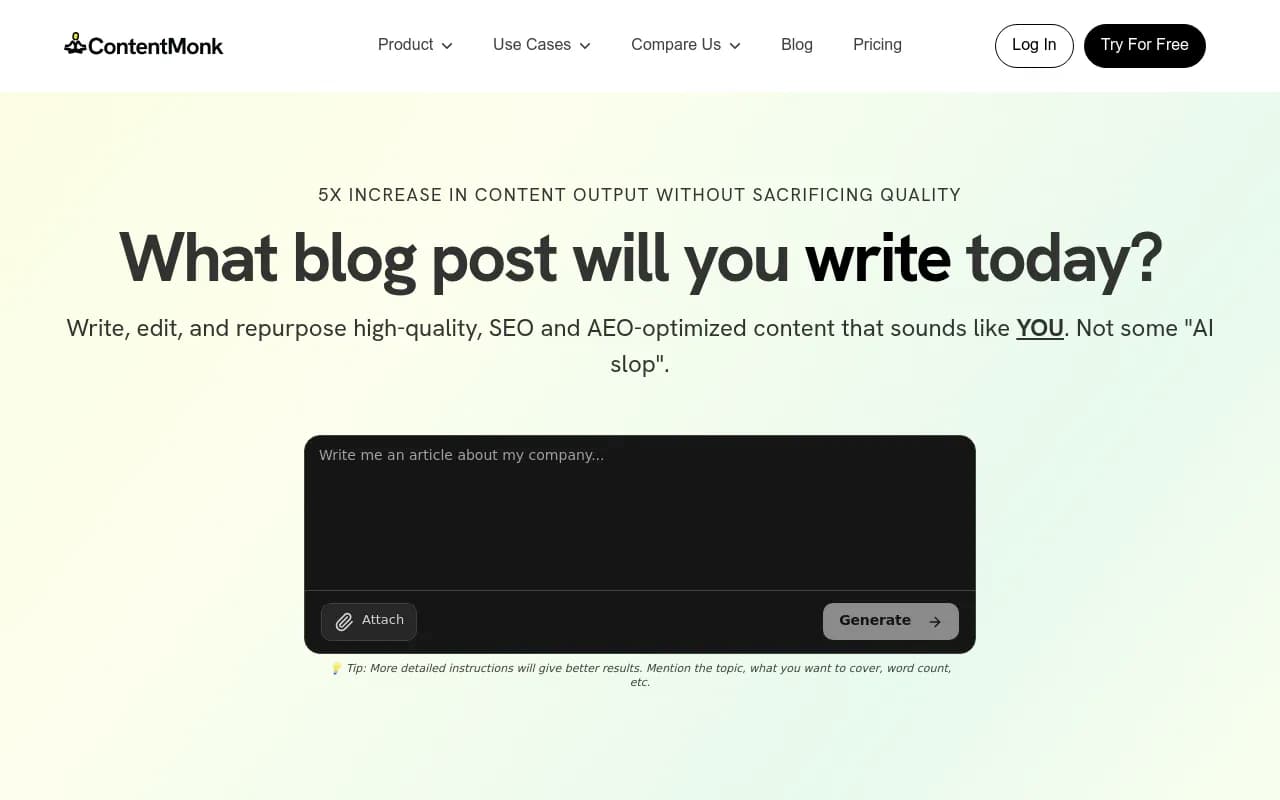
ContentMonk is an AI-powered content creation and operations platform designed for marketing teams, agencies, and freelancers. It combines automated SERP research, knowledge base management, AI writing that preserves your brand voice, and content repurposing capabilities to help teams publish 5x mor
Summary
- Best for: Marketing teams and agencies drowning in content production bottlenecks who need to scale output without hiring more writers or sacrificing quality
- Core strength: Eliminates "AI slop" by grounding content in your team's actual insights, company knowledge, and brand voice -- not generic templates
- Speed: Creates publication-ready articles in under 2 minutes, with editing down to 15-30 minutes vs 2+ hours with other AI tools
- Operations hub: Replaces scattered Google Sheets and Notion boards with unified content planning, knowledge base, and collaboration workspace
- Pricing: Custom pricing based on article volume and team size; starts around $59-69/month per seat with 14-day free trial
ContentMonk positions itself as the anti-generic-AI-content platform. While most AI writing tools churn out bland, SEO-stuffed articles that sound like every other site, ContentMonk focuses on capturing what makes your content unique -- your team's expertise, customer insights, and brand personality. The platform is built around a specific workflow: collect insights, create briefs, write articles that sound like you, and repurpose everything across formats.
The insight collection problem
Most content teams sit on goldmines of unique knowledge -- customer call transcripts, internal Slack discussions, product docs, competitive research -- but it's scattered across tools and never makes it into published content. ContentMonk's knowledge base is designed to capture up to 95% of these insights automatically. You upload transcripts, documents, and notes; the platform indexes everything and surfaces relevant insights when you're creating briefs or writing articles. This is the foundation that separates ContentMonk content from generic AI output.
Brief creation with automatic SERP research
ContentMonk generates detailed content briefs in under a minute by combining your internal knowledge with automated SERP competitor analysis. The platform crawls top-ranking articles for your target keyword, identifies content gaps (topics competitors missed that users and search engines want), and builds a brief that positions your article to fill those gaps. You're not just matching what's already ranking -- you're finding angles competitors overlooked. Briefs include suggested structure, key points to cover, and relevant insights from your knowledge base.
AI writing that preserves your voice
The core writing engine is where ContentMonk differentiates itself. Instead of generic templates, the platform learns your specific writing style and brand voice with each article you create. You feed it briefs, past articles, and style guidelines; it generates drafts that match your tone, sentence structure, and terminology. Users consistently mention this in testimonials -- the output doesn't read like AI-generated filler. It sounds like something your team actually wrote.
The platform claims to produce near-perfect first drafts in under 2 minutes. "Near-perfect" here means structurally complete, on-brand, and covering all brief points -- not that you publish without editing. The editing time is where ContentMonk shines compared to competitors: 15-30 minutes to add images and fine-tune sentences, vs 2+ hours of heavy rewriting with other AI tools.
AI-powered editing assistant
The built-in editor includes AI power-ups for fast revisions. You can rewrite paragraphs, expand sections, or resolve team comments with AI suggestions -- all without leaving the editor. This is particularly useful when multiple stakeholders leave feedback. Instead of manually addressing each comment, you can batch-resolve them with AI-generated fixes that maintain your voice.
Content repurposing in 2 clicks
ContentMonk handles repurposing across formats: turn customer call transcripts into case studies, long-form articles into LinkedIn posts, ebooks into lead magnets, or any other transformation you need. The platform understands the structural and tonal differences between formats. A 3,000-word guide becomes a punchy LinkedIn post, not just a truncated version. Agencies and in-house teams use this heavily -- one client (Hunch) repurposed 50+ customer calls into success stories for GTM campaigns.
Content operations management
Beyond writing, ContentMonk replaces the typical mess of spreadsheets and Notion docs that content teams use for planning. You build content calendars, assign tasks, track progress, and collaborate -- all in one workspace. The platform includes custom dashboards for monitoring output, performance, and team workload. For agencies managing multiple clients, ContentMonk supports multiple workspaces with separate knowledge bases and content calendars per client.
SEO and AEO optimization
ContentMonk explicitly optimizes for both traditional SEO and AEO (Answer Engine Optimization -- ranking in AI-generated answers from ChatGPT, Perplexity, etc.). The platform's SERP research identifies what Google wants, while the insight-driven approach ensures your content has the depth and specificity that AI models cite. This dual focus is increasingly important as more search traffic shifts to AI-powered answer engines.
Who is it for
ContentMonk is built for three main personas:
Marketing teams at SaaS companies and B2B brands (50-500 employees) who need to publish 20-50+ articles per month but don't have the budget to hire a full content team. These teams typically have 1-3 content people drowning in requests from product, sales, and leadership. ContentMonk lets them scale output without burning out. Clients include Pixis, GetResponse, Userpilot, Avoma, and GoBolt.
Content agencies managing 5-20 clients simultaneously. Agencies face the double challenge of maintaining quality across different brand voices while hitting aggressive publishing schedules. ContentMonk's multi-workspace setup and voice customization per client make it possible to deliver client-specific content at scale. The platform's knowledge base per workspace means each client's insights stay separate.
Freelance content strategists and writers who want to take on more clients without working 80-hour weeks. Freelancers use ContentMonk to handle the heavy lifting (research, first drafts, repurposing) so they can focus on strategy and high-value editing. The platform's speed means a freelancer can realistically manage 3-5 clients instead of 1-2.
ContentMonk is NOT for: Bloggers or small businesses publishing 2-5 articles per month (overkill and too expensive), enterprise teams with complex compliance/legal review workflows (the platform is built for speed, not multi-stage approvals), or anyone looking for a simple AI writing assistant without the operations/knowledge base features.
Integrations and ecosystem
ContentMonk's integration story is limited compared to established players. The platform doesn't currently list native integrations with major tools like Google Search Console, Ahrefs, Semrush, WordPress, or HubSpot. This is a notable gap -- most content teams want to push finished articles directly to their CMS or pull keyword data from their SEO tool. The workaround is manual export/import, which adds friction.
The platform does support workflow automation through tools like Zapier (based on user mentions), but this requires technical setup. There's no mention of a public API, browser extensions, or mobile apps. For a platform positioning itself as an all-in-one content operations hub, the lack of ecosystem integrations is a weakness.
Pricing and value
ContentMonk uses custom pricing based on three factors: how many articles you plan to create per month, how many users need access, and how many workspaces (for agencies). Based on comparison pages and user mentions, the Pro plan starts around $59/month per seat with annual billing or $69/month with monthly billing. There's a 14-day free trial with full access -- no credit card required.
The pricing model makes sense for the target audience (teams and agencies, not individuals), but the lack of transparent public pricing is frustrating. You have to book a demo or contact sales to get exact numbers. For comparison, Jasper starts at $49/month for individuals, Outrank at $79/month, and AirOps at custom pricing. ContentMonk sits in the mid-range but bundles more features (operations management, knowledge base, repurposing) than pure writing tools.
Value depends on your volume. If you're publishing 20+ articles per month, the time savings (5+ hours per article down to 30 minutes) justify the cost quickly. At 20 articles/month, you're saving 90+ hours -- easily worth a few hundred dollars. For lower volumes, the ROI is harder to justify.
Strengths
Voice and quality: The platform's focus on learning your specific writing style is real. Multiple testimonials mention that ContentMonk output doesn't sound like generic AI content. This is the core differentiator.
Speed without sacrificing depth: Creating a full article in under 2 minutes, then editing in 15-30 minutes, is legitimately fast. Other AI tools either produce garbage first drafts that take hours to fix, or require extensive prompt engineering to get decent output.
Knowledge base as a competitive moat: Capturing team insights and surfacing them during content creation is a feature most competitors lack. It's the reason ContentMonk content feels unique instead of regurgitated.
Repurposing capabilities: Turning one piece of content into multiple formats (articles, case studies, LinkedIn posts, ebooks) in 2 clicks is powerful for teams trying to maximize content ROI.
Operations management: Replacing 10+ spreadsheets and Notion docs with a unified workspace is a real pain point solver for content teams.
Limitations
Weak integration ecosystem: No native CMS integrations, no SEO tool connections, no public API. This forces manual workflows that slow down publishing.
Opaque pricing: Custom pricing based on usage is fine, but forcing users to book a demo just to see ballpark numbers is friction. Competitors with transparent pricing have an advantage here.
Limited automation: While the platform automates brief creation and writing, it doesn't support advanced workflow automation (e.g. auto-publish to WordPress on approval, auto-refresh old articles, scheduled repurposing). These features are "coming soon" but not available yet.
No content performance tracking: The platform helps you create and manage content but doesn't track how it performs (traffic, rankings, conversions). You still need Google Analytics, Search Console, and an SEO tool for the full picture.
Bottom line
ContentMonk is the right choice for marketing teams, agencies, and freelancers who need to publish 20+ high-quality articles per month without hiring more writers. The platform's strength is eliminating the "AI slop" problem by grounding content in your team's actual expertise and brand voice. If you're drowning in content requests and your current process involves 5+ hours per article, ContentMonk's speed and quality will feel like a superpower. The operations management and repurposing features are bonuses that make it a true content hub, not just a writing assistant.
Skip it if you're publishing fewer than 10 articles per month (overkill), need deep CMS/SEO tool integrations (not there yet), or want transparent pricing without a sales call. For high-volume content teams, though, ContentMonk is one of the few AI platforms that actually delivers on the promise of scaling quality.
Tags:
Frequently asked questions
What is ContentMonk and what does it do?
How much does ContentMonk cost?
Is ContentMonk free to use?
Who is ContentMonk best for?
How is ContentMonk different from other AI writing tools?
How fast can ContentMonk create content?
What features does ContentMonk include?
Does ContentMonk help with SEO optimization?
Can ContentMonk maintain my brand voice?
What is the ContentMonk knowledge base feature?
Similar and alternative tools to ContentMonk